Southern Africa · Volume 21, The Most Layered Plate
Liphalishi lemabele, with umbidvo wetintsanga
Eswatini
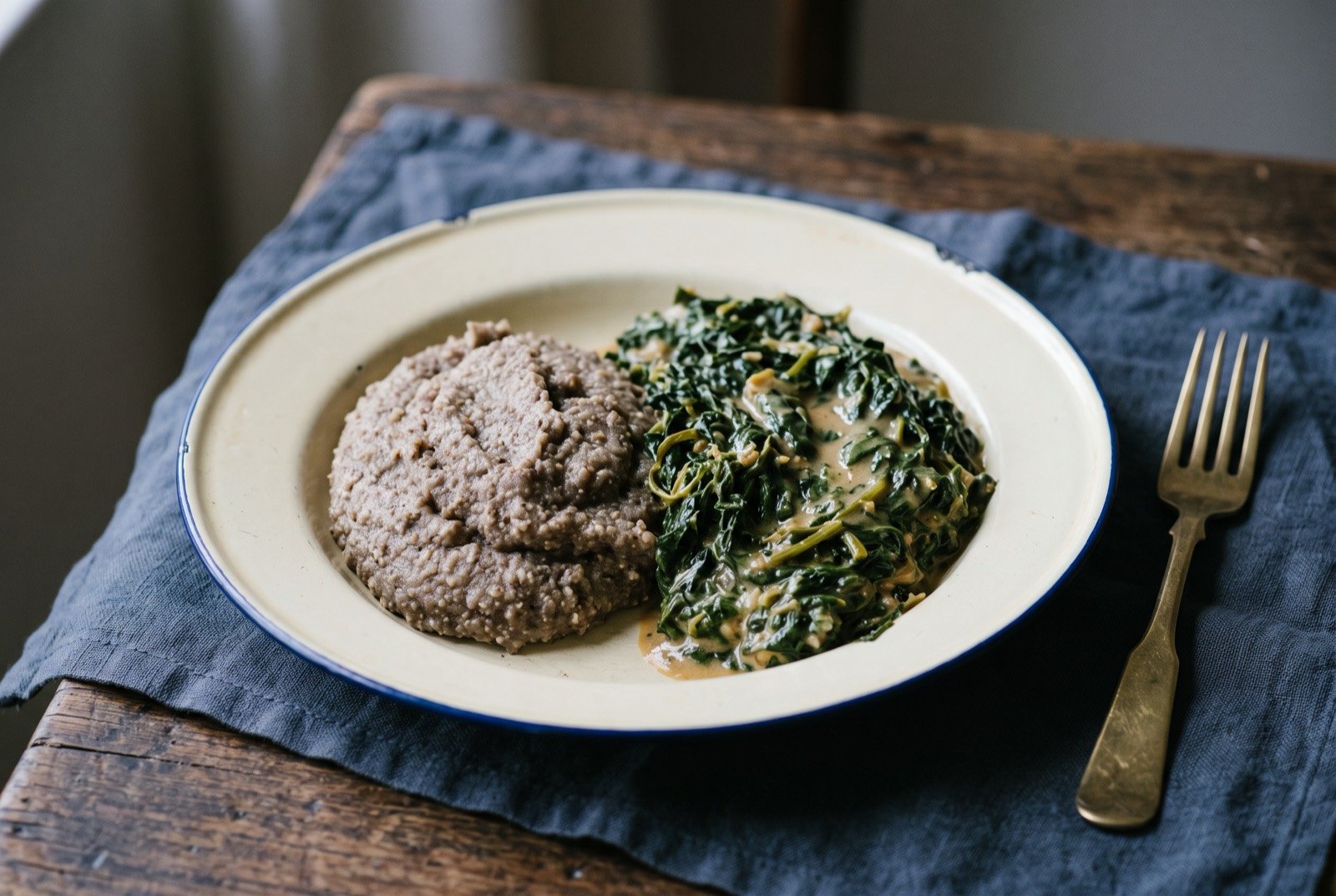
An illustration of the dish, not a photograph of it cooked.
- Time
- 45 minutes
- Reviewed
- Not yet reviewed from inside the tradition
- Cooked
- Not yet cooked and reported
Vumile Mavimbela, writing in the Times of Eswatini, calls emabele a forgotten staple and gives the method with real timings, which makes it the only in-country recipe from either kingdom this chapter could stand behind. The partner dish, umbidvo wetintsanga, is pumpkin leaves cooked with ground groundnut: the same solution to the same problem the whole West African leaf sauce belt reaches, found at the far southeastern corner of the continent.
As tradition built it
Serves 4. 45 minutes.
Ingredients
- 250 g sorghum meal (mabele)
- 1.2 L water
- 1 tsp salt
- 400 g pumpkin leaves, stringy ribs stripped
- 100 g raw groundnuts, ground coarse
- 1 onion, chopped
Method
- Mix the sorghum meal with cold water to a smooth paste. This is the slake, and it is the same principle as tô, funge and placali elsewhere in this series.
- Bring the remaining salted water to the boil and stir the paste in gradually.
- Cook gently 30 to 45 minutes, stirring occasionally, to a thick, firm consistency.
- Strip the ribs from the pumpkin leaves, shred, and cook with the onion in a very little salted water until collapsed, about 10 minutes.
- Stir in the ground groundnut and cook a further 5 to 10 minutes, until it thickens and loses its raw taste.
- Serve with emasi if you have it.
Notes
An honesty note. The porridge timings are from the Eswatini national press. The groundnut greens quantities are not from a weighed siSwati source, because no weighed siSwati recipe reached this chapter. They are a reconstruction from a described method, and they are flagged as such in the final section.
What a modern chef changes
The nut roasted, the groundnut emulsified, and the porridge given a crust
Rungs 5, 1 and 4
Method
- Toast the groundnuts before grinding. Ten minutes in a dry pan until they smell of roasting rather than of raw legume. Rung 5's logic applied to a nut: you are generating pyrazines raw groundnut does not have, and it changes the dish more than any other single move.
- Build the greens as an emulsion, not a mixture. Work the ground groundnut smooth into a little hot liquid before the leaves go back in. Dropped dry into a wet pan it sits as grit; worked into liquid first it emulsifies and coats.
- Give the porridge a crust. Press the cooked sorghum into a hot, oiled cast iron pan and leave it alone for six minutes. Rung 1: the same Maillard and dextrinisation that gives the breyani crust, on a grain most British cooks have never eaten.
- Strain emasi to cream cheese and quenelle it on top. Sive Bhembe's technique used in its home cuisine rather than in a dessert, and strained kefir does the job in Britain.