Africa · Volume 20
Angola, Namibia & Botswana
Desert, Coast and Funge
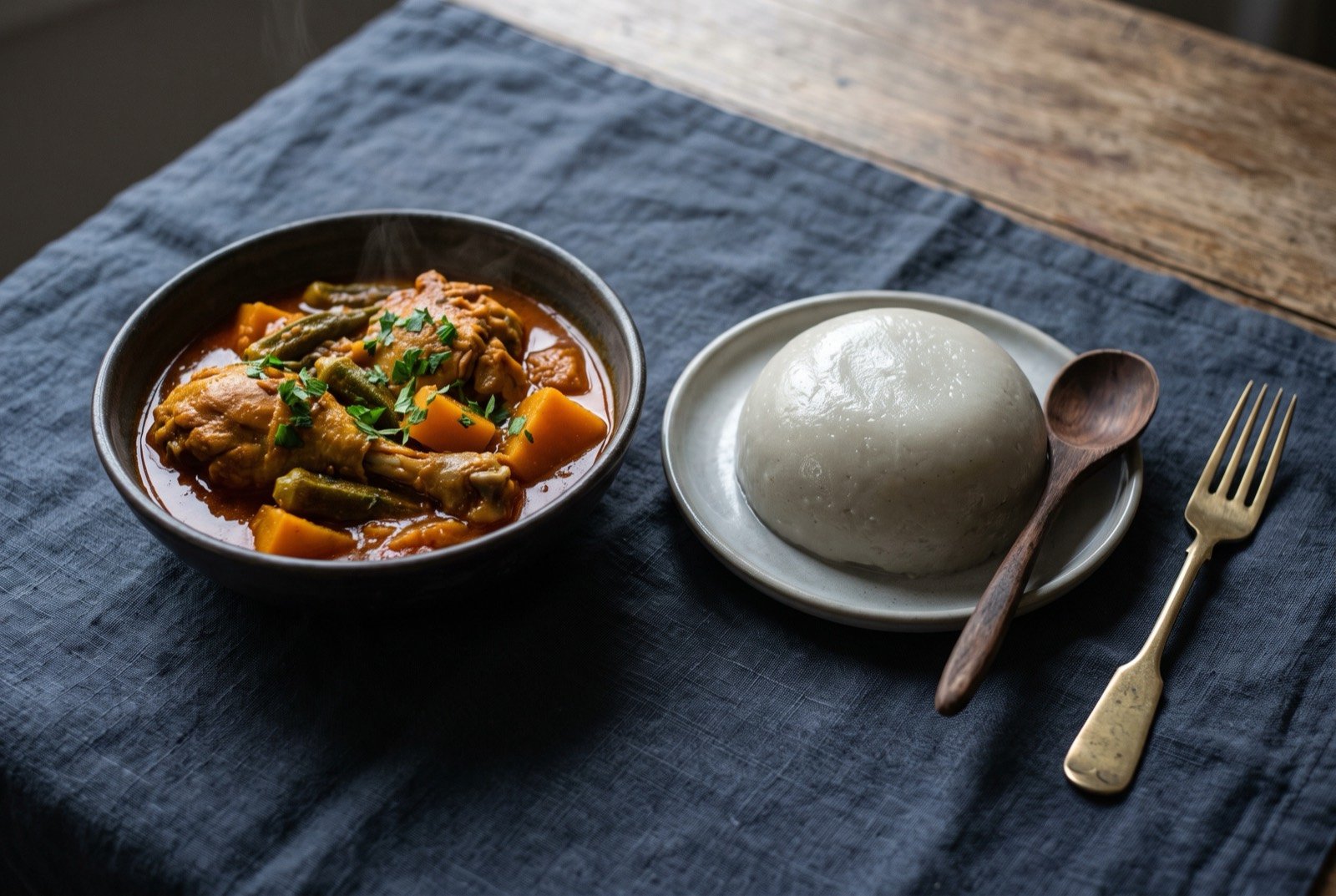
Three countries joined by the desert rather than divided by it. A palm oil and cassava cuisine on the Atlantic, a cattle and grain cuisine in the sand, and the line where one becomes the other. Every dish as tradition built it, then what a modern chef would change.
Sources and review · What this chapter does not assert · How we research · Spotted something wrong?
A Sense of Place
The organising fact of this volume is not a border. It is water, and where there is not enough of it.
Angola's north is wet, forested, Atlantic and Central African, and cooks with palm oil and cassava. Angola's south is arid and continuous with Namibia. Namibia's north is, ecologically and ethnically, Angola's south. Namibia's eastern sandveld is Botswana, and Botswana is roughly seventy per cent Kalahari. The subject of this volume is what a cuisine does when water is the limiting nutrient, and what happens where that country meets a rain-fed palm and cassava culture around the Cuanza. That gives four culinary worlds rather than three national cuisines, best defined by fat, thickener, aromatic and starch.
Atlantic and northern Angola
Luanda, Bengo, Cuanza Norte and Sul, Uíge, Zaire and Malanje. The Ambundu who speak Kimbundu, the Bakongo in the north, and the Luanda creole society that four centuries of Portuguese trade produced.
Fat: red palm oil, óleo de dendê, and beside it muamba de dendem, the pressed pulp of the same fruit, which is a different ingredient and not a fat at all. Thickener: okra, plus the starch of the funge that comes with it. Aromatic: gindungo, chilli crushed with garlic and onion, plus tomato, lemon, vinegar and salted dried fish. Starch: funge de bombó, the grey elastic paste of retted cassava flour, with rice at table.
The planalto and the Angolan south
Ovimbundu on the central highlands, then Nyaneka-Nkhumbi, Ovambo and Herero groups including the Ovahimba and Ovamucubal, then true desert at Namibe.
Fat: butterfat and animal fat, not palm oil. Thickener: essentially none; the porridge carries the meal. Aromatic: salt, soured milk, a little chilli. Starch: maize, as pirão and as funge de milho, with sorghum and pearl millet further south.
This is the line where Angola stops being West-Central African and starts being southern African, and one dish marks it: leite azedo com pirão de milho, soured milk with maize porridge, a Huíla dish functionally identical to Ovambo practice two hundred miles south and to Tswana practice a thousand kilometres away. If you want one plate that explains why these three countries share a chapter, it is that one.
The Cuvelai floodplain
The Aawambo of northern Namibia are eight communities, Oukwanyama, Ondonga, Uukwambi, Ongandjera, Ombalantu, Uukolonkadhi, Uukwaluudhi and Ombadja, and the land is a seasonal flood system of shallow channels called oshanas, filled by rain that falls in Angola.
Fat: minimal, and latterly sunflower. Thickener: none; sauces are thin and greens are cooked down. Aromatic: salt, soured milk, dried oshana fish, wild greens, mopane worms. Starch: mahangu, pearl millet, cooked as oshifima and fermented into oshikundu.
Mahangu is here because nothing else will grow: Pennisetum glaucum tolerates low fertility, heat, salinity and low pH better than any other cereal grown in Namibia, and has been farmed in Africa for roughly four thousand years.
The pastoral centre and the Namib coast
Ovaherero and Ovahimba with cattle, Nama and Damara who call themselves ǂNūkhoen, San communities including Haiǁom, Juǀ'hoansi, ǃXun and Khwe, the Topnaar or ǂAonin on the Kuiseb, Basters, Afrikaners and the descendants of German settlers.
Fat: milk fat, rendered meat fat, and in the Namib the ǃnara seed. Thickener: none. Aromatic: salt, coriander, black pepper and vinegar in the settler line; almost nothing at all in the Herero line, where Ovaherero accounts state that the traditional diet was meat, omaere and veldkos. Starch: traditionally almost none. Maize meal now, and the reason is in the history section and it is not a happy one.
The ǃnara, Acanthosicyos horridus, is a leafless, spiny desert vine whose roots reach the water table, endemic to the Namib and the staple of the Topnaar. Evidence of ǃnara seed eating goes back at least eight thousand years there, and each Topnaar family owns specific bushes as private property, though not the ground they stand on.
Botswana, the cattle republic and the Kalahari
Batswana groups including Bakwena, Bangwato, Bangwaketse, Batawana, Bakgatla, Balete, Barolong and Batlokwa; Bakalanga in the east; Bayeyi and Hambukushu in the delta; and San peoples across the Kalahari including Naro, Gǀui, Gǁana, Juǀ'hoansi and ǂKhomani.
Fat: beef fat. Botswana is a cattle economy the way Mali is a grain economy. Thickener: none. Aromatic: salt, and very little else. Starch: sorghum, mabele, and maize, as stiff bogobe or thin motogo, plain or fermented as ting.
The unseasoned quality of Botswanan cooking is the thing outsiders most often try to correct, and they are wrong to. Seswaa is meat, water and salt. It is a position about beef, held by people who have more and better beef than the person correcting them, and this chapter is not going to add a bay leaf to it.
Two cities and one fence
Luanda produced mufete, the weekend platter of grilled fish, palm oil beans, cassava, sweet potato and plantain. Katutura, Windhoek's township, produced kapana, thin strips of beef grilled on a welded steel plate over wood, chopped to order and seasoned by the eater. And between them runs a fence: the veterinary cordon of 1896, the Red Line, drawn to restrict the movement of livestock and of people, which worked as a political boundary and still shapes what Namibians can farm, sell and export. Present tense, too: Angola's Huíla province currently looks to Namibia for beef and breeding cattle.
The History in Layers
San and Khoe foodways, as knowledge, and what this chapter will not print
San and Khoe material is the most romanticised body of writing about food anywhere in Africa, much of it second-hand, undated and unattributed. Almost every English-language source says "the San", as though Juǀ'hoansi, Naro, Gǀui, Gǁana, ǂKhomani, Khwe, ǃXun and Haiǁom were one people with one language and one cuisine. They are not. The Kxʼa, Tuu and Khoe-Kwadi language families are as different from each other as Indo-European is from Uralic.
So here is the rule this chapter follows. I could not find a single source produced by, or with, a named San or Khoe community that gives preparation detail, times, quantities or methods, for mongongo, tsamma, morama, the Kalahari truffle or wild tubers. Everything at that level came from outside the community. This chapter therefore prints no San or Khoe preparation parameters at all. The ingredients are named, the community organisations are cited for the present, and the method is left blank rather than filled in from a safari blog. That blank is the honest state of the record.
What can be said. The knowledge system is large: several hundred plant species and their uses, with where they grow and what they yield in drought. Tsammalex, the ethnobiological database of plant, animal and fungus names across African languages including the Khoe-Kwadi, Kxʼa and Tuu families, is the right place to check a name before printing it. Richard Lee's work among the Dobe Juǀ'hoansi established the mongongo nut as roughly half the plant-food diet by weight, and the most useful thing in that literature is a later correction: once processing time is counted in, the caloric return per forager hour falls sharply, which reframes gathering as skilled labour rather than as picking.
And the community organisations say something different from the safari literature. The Nyae Nyae Development Foundation of Namibia, working with the Juǀ'hoansi of the Nyae Nyae Conservancy around Tsumkwe, describes the community's own food-security programme in terms of permaculture gardens, tools and seed, sweet potatoes, and water as the limiting factor, with self-sufficiency as the stated goal, and its devil's claw harvesting programme is a community commercialising its own plant knowledge on its own terms. That is the correct register: the Juǀ'hoansi are not a foraging tableau, they are a community running conservancy institutions and negotiating water, and the wild-food knowledge sits inside that rather than instead of it. The counter-example is Hoodia gordonii, patented by a pharmaceutical company, litigated as biopiracy and settled with royalties payable to San organisations. Those two cases are the question of who owns this knowledge, and it belongs in a cookbook because the answer decides who gets to write the recipe.
In Botswana the question is legal and recent. The Central Kalahari Game Reserve evictions began in 1997 and were effectively complete by 2002. Water tanks were confiscated and hunting inside the reserve was banned; one judge described those measures as tantamount to condemning the remaining residents to death by starvation. On 13 December 2006 a three-judge panel of the Botswana High Court ruled two to one that the evictions were unconstitutional and that the San were entitled to return. Implementation has been contested ever since. Any chapter that writes lyrically about Kalahari foraging without that paragraph is dishonest.
Portugal in Angola, and what the trade did to the plate
Cattle reached southern Africa roughly two thousand years ago with Khoekhoe herders, and Bantu-speaking farmers brought sorghum, pearl millet, cowpea and iron. For the Tswana that sorghum and cattle economy is the deep structure of everything: ting is a grain tradition roughly four thousand years old. Angola's story is different, and it is a story about the Atlantic.
Luanda was founded in 1575 by Paulo Dias de Novais. Between 1580 and the 1820s well over a million people from present-day Angola were exported as slaves, overwhelmingly to Brazil, and for two centuries the colony developed essentially as a slave-trading enterprise. The trade was abolished in 1836; a native tax was introduced in 1908 to force Africans into wage labour; over 300,000 Angolans were still working under compulsion as late as 1954; forced labour was formally abolished only in 1962. The uprising of 15 March 1961 began the Colonial War, and independence came on 11 November 1975.
Cassava and maize came in through the trade, and the variety that spread is the one that needs detoxifying. Both plants are American. Cassava was adopted because it stores in the ground, resists locusts and raiding, and yields on poor soil, exactly the qualities a population under slave-raiding pressure needs. The bitter cassava is the one that spread, because it yields more and nobody steals it, and bitter cassava must be retted before it is safe. It is not an exaggeration to say that funge de bombó exists in its present form because of the slave trade, and the sourness of that grey paste is the audible signature of a safety step that a demographic catastrophe made necessary.
The trade carried Angolan cooking to Brazil as well as Angolan people. Muamba de galinha in Angola, frango com quiabo in Brazil, and Brazilian writers name the Angolan dish as the ancestor; caruru is listed in Angolan sources as Brazilian, so it has been round the loop twice. The Portuguese layer at the table is real and thin: vinegar, garlic, bay, cabidela, salt cod, wine and the café culture of Luanda, sitting on an intact Kimbundu and Kikongo base rather than replacing it.
And there is a book. Óscar Bento Ribas, Luanda 1909 to Cascais 2004, blind from thirty-six, dictated his work to his brother and became the great documenter of Kimbundu oral tradition. His Alimentação Regional Angolana (Luanda, 1965, thirty-seven pages) is, as far as I can establish, unread by anybody writing about Angolan food in English.
Germany in Namibia, and the Herero and Nama genocide
This has to be named as genocide, and it has to be named in the same section as the beer.
German colonisation formally began on 7 August 1884. Land and cattle were expropriated systematically under European legal forms, and the 1896 veterinary cordon sorted the territory politically as well as epidemiologically. The Herero rose in 1904. After the Battle of Waterberg, General Lothar von Trotha issued an extermination order: within the German borders, every Herero, with or without a gun, with or without cattle, would be shot. German forces guarded every water source and drove survivors into the Omaheke desert to die of thirst, and a German military report described the desert as completing what the German army had begun. Concentration camps followed, Shark Island the most notorious, with forced labour and medical experimentation. Bans on mixed marriages came in 1905, and the system anticipated apartheid. German rule ended at Khorab on 9 July 1915, after which South Africa administered the territory and later imposed apartheid outright.
The death toll is a range and must be printed as one. Sources give between 25,000 and 100,000 Herero and more than 10,000 Nama, the most commonly repeated figures being around 65,000 and 10,000, often with the statement that roughly eighty per cent of the Herero population died. These are estimates from a colonial administration that did not count, and historians disagree. Germany formally recognised the genocide and apologised in May 2021 with a development package of about 1.1 to 1.3 billion US dollars over thirty years. Herero and Nama leaders rejected it, on the grounds that it excludes direct reparations and that their representatives were excluded from the negotiations. Namibia held its first Genocide Remembrance Day on 28 May 2025.
Now the food consequence, stated plainly. A cattle culture that loses its cattle and its land does not simply carry on cooking. Ovaherero accounts state that until the nineteenth century the diet was meat, omaere and veldkos. What replaced it, after the herds were seized and the survivors pushed onto reserves and into wage labour, was maize meal. The maize-meal diet of southern Africa is not a preference, it is a consequence. A cattle culture eats maize meal because it was made to, not because it chose to, and any account of southern African staples that omits that has told you what people eat and hidden why.
In the same territory, in 1920, Carl List and Hermann Ohlthaver merged four failing breweries into South West Breweries, brewing to the 1516 Reinheitsgebot. Renamed Namibia Breweries at independence in March 1990, acquired by Heineken in April 2023. Windhoek Lager, Tafel, Hansa and Urbock are genuinely good beers and they are also the surviving commercial infrastructure of the colony that did the above. Both sentences are true and they belong next to each other. The Damara, ǂNūkhoen, meanwhile describe their own culture, at their community-run museum near Twyfelfontein, as something that had to be reconstructed after colonisation, and the museum exists because the knowledge was nearly lost.
The modern moment in all three
Botswana came out of colonisation differently: a British protectorate rather than a settler colony, independent in 1966, then diamonds. The Botswana Meat Commission was established by Act of Parliament on 24 December 1965, months before independence, runs plants at Lobatse, Francistown and Maun with a combined capacity of 252,000 head a year, and exports to the United Kingdom, so Botswanan beef legitimately enters the British supply chain and nobody here sells it as such. Meanwhile the mopane worm is being pushed from subsistence food to export commodity with most of the margin sitting with traders rather than the rural women who harvest it, and ting sits on the Slow Food Ark of Taste precisely because it is receding.
Angola. The civil war of 1975 to 2002 destroyed the agricultural economy. Angola has depended on commercial food imports since 1977 and oil overtook coffee as the largest export in 1973. And yet Angola produced 8.6 million tonnes of cassava in 2018, ninth in the world, plus 280,000 tonnes of palm oil. The staples survived the war. The cash crops did not.
Namibia. The Namibian Chefs Association, founded at the Rössing Country Club near Swakopmund in 1985 as the Verein der Köche Südwest Afrika, made a standalone Namibian body at independence in 1990 and a World Association of Chefs Societies member since 1995, now shares a calendar with a national kapana championship, which is the best single sentence available about Namibian food politics. Xwama Traditional Restaurant in Katutura serves Ovambo food and traditional drinks sitting down, and omagongo's UNESCO inscription in 2015 turned the marula festival into a state occasion.
The thread through all three. In every one of these countries a traditional technique is being asked to justify itself commercially. Oshikundu has a six-hour shelf life. Ting takes three days. Phane pays the harvester least of anyone in its chain. Morama, one of the most nutritionally valuable wild legumes on earth, has never been domesticated. The argument of this series, that restaurant technique has an indigenous ancestor, has a sharper political edge here than anywhere else in the book, because the ancestors are still alive and are being undercut.
The Flavour Arsenal
If you buy three things, buy unrefined red palm oil, palm nut concentrate and whole dried smoked fish. If you buy four, add bone-in beef shin with its marrow bones.
The fats
| Ingredient | Names | Source | Character and use |
|---|---|---|---|
| Red palm oil | óleo de dendê, óleo de palma | Elaeis guineensis mesocarp | Orange, grassy, faintly violet and savage. Roughly 43.5 per cent palmitic, 36.6 oleic, 9.1 linoleic, so semi-solid at British room temperature. About one cup per chicken in muamba |
| Muamba de dendem | palm nut concentrate, sauce graine | The pulped mesocarp, boiled and pounded | Rounder and less aggressive than the oil. A paste, not a fat. Body as well as flavour. Sold tinned |
| Marula kernel oil | ondjove, odjove | Sclerocarya birrea kernel | Nutty, stable, high oleic. A finishing oil in the Ovambo north. Not sold to food standards in Britain |
| ǃNara seed | butter-nuts | Acanthosicyos horridus | About 57 per cent fat and 31 per cent protein. Eaten whole or ground, not pressed. The Namib's fat |
| Beef fat and marrow | Marbling is the point of kapana. Marrow is the point of seswaa | ||
| Soured butterfat | omaere, omashikwa, madila, leite azedo | Cow, goat | Soured, never sweet. The acid of the pastoral kitchen |
The heat, which is only in Angola
Gindungo, also spelled jindungo, is chilli crushed with garlic and onion, sometimes let down with brandy, sometimes with palm oil, sometimes with lemon. It is a paste in the pot and a paste on the table, and it is the only real heat in the Angolan kitchen. A documented cooked version soaks dried chillies thirty minutes, blends them with garlic, vinegar, salt and sugar, then cooks the purée in oil for ten minutes and jars it, where it keeps a month refrigerated.
Kapana spice is Namibian: chilli flakes, peri-peri, salt, usually paprika, garlic and pepper, applied by the eater and not by the cook, which is a technical decision as well as a commercial one. Botswana uses salt, and that is not a gap in the arsenal, it is the arsenal.
The umami spine
| Ingredient | Names | Source | Use |
|---|---|---|---|
| Dried and salted fish | peixe seco | Atlantic and river species | The glutamate engine of calulu. Soaked, but deliberately not desalted completely. Used at parity with fresh fish, a kilo to a kilo |
| Mopane worms | Setswana phane, Oshiwambo omagungu, Zimbabwean madora | Gonimbrasia belina | 49.4 per cent protein and 20.2 per cent fat by dry weight, iron 19.0 mg and zinc 17.9 mg per 100 g when correctly processed. Like dried mushroom and dried shrimp at once |
| Omajowa | Otjiherero omajova | Termitomyces schimperi | The giant termite-mound mushroom, up to a kilo apiece, erupting after the heavy rains of late January to March. Dense, meaty, mild |
| Kalahari truffle | Kalaharituber pfeilii | Up to 12 cm and around 200 g, more in a wet year. Mild and nutty. Not a Tuber and not a substitute for one | |
| Catatos | Palm-weevil larvae, Uíge | Fried with garlic. The Angolan member of the same protein family as phane |
The greens and the one thickener
| Ingredient | Names | Source | Character |
|---|---|---|---|
| Okra | quiabo | Abelmoschus esculentus | Angola only, essentially. Late into muamba, layered into calulu. Slice for more draw, leave whole for less. That is your viscosity dial |
| Cassava leaf | kizaka, quizaca | Manihot esculenta leaf | Must be pounded and then boiled. Deep, mineral, faintly bitter, slightly sulphurous |
| Sweet potato leaf | gimboa | Ipomoea batatas leaf | The classic calulu green, milder than cassava leaf |
| Ombidi | Oshiwambo | Wild oshana greens | Cooked down long, often finished with marula kernel oil |
| Morogo | Setswana | Amaranth, cowpea leaf, pumpkin leaf, spider plant | Boiled plain beside seswaa. A category, not a species, and not to be translated as spinach |
The starches, the wild cabinet and the drinks
Fuba de bombó, retted, dried and pounded cassava, grey and sour. Fuba de milho, maize flour. Mahangu, pearl millet. Mabele, sorghum, plain or as ting. Samp, cracked dehulled maize. And rice, imported, urban and everywhere in Luanda.
The Kalahari cabinet is named here and not instructed, for the reason given above. Morama, Tylosema esculentum, a wild perennial legume carrying 29 to 39 per cent protein and 24 to 48 per cent oil, soybean's protein and groundnut's oil in a plant that fixes nitrogen and needs no irrigation; it carries trypsin inhibitor activity that must be destroyed before eating, and roasting is the traditional route. Tsamma, Citrullus lanatus, the wild melon, about ninety per cent water, with a protein-rich seed that roasts, grinds and presses. Mongongo, Schinziophyton rautanenii. Marula, Sclerocarya birrea, fruit for omagongo and kernel for oil. And devil's claw and hoodia, which are medicine rather than food.
To drink: omagongo, the UNESCO-listed marula ferment; oshikundu, the daily sour mahangu and malted sorghum drink; quissângua, fermented maize from southern Angola, used in healing rituals as well as drunk; mongozo, palm-nut beer brewed by the Chokwe before Europeans arrived; maluva, palm wine; chibuku, Botswana's opaque sorghum beer; and the German brewing line above.
Part Two
The Technique Ladder
First, an honest problem
There is no Michelin star anywhere in this volume, and no prospect of one, because Michelin does not publish a guide covering Angola, Namibia or Botswana at all. I could not find a starred chef of Angolan, Namibian or Botswanan heritage anywhere in the world and I do not believe one exists. That is a negative finding rather than a verified fact, which is the honest status of any claim of that shape.
Volume 03 could hang its elevations off Ikoyi and Akoko. This volume cannot. It has four other things instead.
One: a technically credentialed Angolan chef building infrastructure rather than a dining room. Helt Araújo, born in Benguela, trained in Lisbon, with the one-starred Fortaleza do Guincho on his CV and a stage at Hacienda Benazuza El Bulli. He grew a catering company into Grupo CHA, now eight brands and 150 staff from four employees in five years. Its flagship, Flor do Duke on the Ilha do Cabo, honours the Namibe and the Welwitschia mirabilis, the two-leaved desert plant that lives a thousand years, and its own site lists kibeba de choco, the Angolan squash with cuttlefish, and a chocolate foam with quitaba, the groundnut and palm oil paste.
His intellectual project matters more. Ovina Yetu is a foundation documenting Angola's gastronomic heritage whose stated method is to rescue little-known Angolan cooking by reinvention rather than reproduction. He has inventoried over a thousand native products, among them the catatos of Uíge, which he calls a possible protein of the future. And the most quotable fact about Angolan gastronomy is his own: the constraint is not ingredients or interest but a shortage of trained cooks.
Two: a national competitive street-grill circuit in Namibia. The Nedbank Kapana Cook-off runs regional heats and a national final, framed by its organisers around entrepreneurship rather than gastronomy. New Era's archive returns 477 articles containing the word kapana and The Namibian's returns 411, and no British publication has written about any of them. Ester Silas won the 2023 competition at Ongwediva after competing repeatedly. Petrus Iyambo trades as Rasta Kapana there, has been grilling since 2007 when he was eighteen, and starts at six in the morning. Hileni Hashipala, Johannes Haulondjamba and Petrus Nambili reached the 2024 final. That is what a star would have given this chapter: a competitive standard, named practitioners, a judged notion of what good looks like, and a decade of local documentation.
Three: camp kitchens in the Namib and the Okavango. Chef Simeon Nghipandwa at Wilderness Little Kulala works from omajova, aloe flowers, ombidi, marula-nut oil and mopane worms, and his named dish is a chicken potjie with oshigali, a cowpea purée, and marula-nut oil. In the Okavango, Wilderness Vumbura Plains serves tswii pasta, waterlily stalks pounded into a sauce with house-made rigatoni, which is the best single dish idea in the volume: keep the ingredient, change the vessel.
Four, for Botswana, a government magazine. I could find no named Botswanan chef at restaurant-craft level, and Mmegi and the Botswana Daily News carried no food or restaurant headline on the day the research was done. Kutlwano, the Government of Botswana's magazine, publishes recipes with real quantities and timings, and it supplies the bone marrow fry that every Western seswaa recipe drops. That one line is the difference between a moist dish and a dry one.
And one honest problem about the chapter rather than the region. The Angolan half is the weaker half: no weighed funge ratio from any credible Angolan source, no measured account of palm pulp extraction, no food science on gindungo in any language. Where a number is missing below, this chapter says the source does not supply it rather than inventing one, and the six rungs are built from mechanism.
Rung 1. Cold-slake the flour, then work it by shear, in two stages
Funge comes in three forms: funge de bombó from fermented cassava flour, grey and elastic; funge de milho from yellow maize, elsewhere pirão; and funge misto.
The method Angolan cooks describe is a gruel-and-flour method, not a stir-in. Boil the water. Separately slake a portion of the flour in cold water to a smooth slurry. Pour that into the boiling water, stirring continuously, and cook the thin gruel until the raw flour smell goes and the surface gains a gloss. Then add the remaining dry flour a little at a time, beating hard with a wooden paddle until the mass is stiff and pulls from the pot wall.
Why the cold slake is not optional, in numbers. Cassava starch granules are heterogeneous, measured at 1.17 to 22.22 micrometres, with onset gelatinisation at 56.33 to 63.00°C, peak at 62.00 to 71.29°C and conclusion at 69.10 to 77.12°C. The small granules gelatinise while the large ones have not started, so dry flour dropped into boiling water forms a lump whose outside gels into a waterproof skin at around 60°C while the inside stays raw powder forever. A funge lump is not a stirring failure. It is a gelatinised shell.
Why the second stage is beating and not stirring. Cassava amylose runs 15.9 to 22.4 per cent, low for a food starch, with peak viscosity high at 782.3 to 983.5 cP and a breakdown of 383.8 to 506.8 cP, so the paste is shear-thinning and cohesive rather than firm and setting. Continued beating after gelatinisation ruptures the swollen granules and releases amylose and amylopectin into a continuous network, which is why funge turns stretchy and glossy at around the ten-minute mark. Low amylose is also why it does not retrograde into a sliceable block the way maize pap does: funge stays soft and sticky, which is what a palm oil sauce needs to cling to. The posture is engineering rather than folklore: Angolan cooks put the pot on the floor and grip it between the knees to get the whole upper body behind the paddle.
And here is the through line that makes this rung the spine of the book. Funge in Angola, tô in Burkina Faso, oshifima in northern Namibia and ugali in East Africa all cold-slake or pre-hydrate the flour before the bulk of it goes in. Four cuisines, four grains, four languages, one solution to the same physical problem, and no evidence that any learned it from the others. Volume 05 made the argument for tô, Volume 16 for ugali, and Volume 19 met it again in nshima and sadza. This is not borrowing. It is the same discovery made independently, wherever a starch is cooked to a stiff paste.
What the sources do not give. No credible Angolan source publishes a weighed ratio for funge. The nearest weighed figures here are the Jornal de Angola quissângua formula and the Namibian oshifima ratio of about 4.7 parts water to one part flour, and funge is stiffer than either. I will not interpolate a number and call it Angolan, and the traditional method does not need one, because the second charge of flour is added to a texture rather than to a weight.
Rung 2. Choose the palm oil's temperature state on purpose. There are three of them.
State one, raw or barely warmed, below roughly 60°C. Full carotene load, full free-fatty-acid bite, violent orange and floral. The state for finishing a calulu or dressing beans.
State two, the working fry, roughly 140 to 180°C. Where muamba is built, and the losses are manageable. 150°C loses only about 15 per cent of the beta-carotene, while 200°C loses 59 per cent over two hours. Even three hours at 170°C leaves 46 per cent of the alpha-carotene and 40 per cent of the beta. Short cooking of around thirty minutes retains carotene well across all methods.
State three, the deliberate bleach. Over 98 per cent of total carotenoid content is destroyed after twenty minutes at 240°C. Industrially that is deodorisation; domestically it is a real West African technique, and the British market sells the product as bleached ofada oil: pale, nutty, smoky and a different ingredient. Do not confuse it with industrially refined RBD palm oil, which has had the free fatty acids stripped as well and is simply neutral.
Why the fat behaves as it does. At roughly 43.5 per cent palmitic and 36.6 oleic, that near-even split of a long saturated and a monounsaturated is why palm oil is semi-solid at British room temperature, why it coats the tongue like a sauce, and why a muamba sets as it cools. Smoke point around 230 to 235°C. Palm kernel oil is a different fat entirely at 81 per cent saturated and must never be substituted. And muamba de dendem is not palm oil at all: it is the pulped mesocarp, sold here as palm nut cream, carrying fibre, protein and the fruit's own flavour. Muamba de galinha is chicken with palm paste and palm oil. Substituting more oil for the missing pulp gives colour and fat with no body, which is why bad muamba is greasy and thin at the same time.
Rung 3. The seswaa pound, and the marrow that makes it work
Seswaa looks like the simplest dish in Africa. It is a precise piece of protein engineering, and almost every published Western version gets it wrong.
The method, from Botswana's own government magazine. Two to three kilos of lean beef on the bone, covered with water, with one and a half teaspoons of salt. Boil four hours until tender. Drain. Fry with the bone marrow. Then pound until the meat flakes into fine fibres. Kutlwano's rabbit version is boiled about thirty minutes before pounding, which tells you the four hours is about the collagen load of beef shin rather than about seswaa as such.
The four hours. A sub-boil hold converts collagen in the perimysium and endomysium to gelatin, and working muscle carries far more of it than a prime cut. The gelatin does not leave with the water, because you drain but do not discard the fibre network holding it.
The pound, not the shred. Pounding drives fibres apart along the connective planes rather than cutting across them, giving high surface area of intact fibre bundles rather than mush. A blade cuts the fibre and releases the interior as paste.
The marrow. The step every Western recipe drops and the one that matters. Bone marrow is a soft, largely monounsaturated fat carrying phospholipids, and frying the drained meat in it re-fats the surface area the pound just created, with the gelatin already in the meat acting as the emulsifier. That is why properly made seswaa is moist without sauce. Without it the dish tastes dry and salty, and more salt does not help, because nothing is carrying the flavour.
The salt discipline. One and a half teaspoons in two to three kilos is deliberately light, and there are no aromatics at all. Stock, garlic or a bay leaf turns seswaa into a pot roast.
Rung 4. Dry curing with no heat, and water activity as the instrument
Biltong looks like jerky and is not, and the misunderstanding is dangerous rather than disappointing. There is no kill step.
The cure. Vinegar first, traditionally grape, then a spice mix of equal weights of rock salt, lightly roasted whole coriander, coarsely ground black pepper and brown sugar. Strips around 25 mm wide, with the grain for chew or across it for tenderness. Cure 12 to 24 hours, then air dry with no applied heat.
The validated parameters, worth printing because British cooks get them wrong. A standard process, marinating thirty minutes in vinegar, salt, coriander and pepper then drying at 23.9°C at 55 per cent relative humidity, achieved greater than a 5 log reduction of E. coli O157:H7, Listeria monocytogenes and Staphylococcus aureus in 6 to 8 days. A second study achieved 5.0 log reductions of Salmonella and E. coli O157:H7 drying at 25.5°C and 80 per cent relative humidity, taking water activity below 0.85. Pathogen reduction increases as water activity falls, so it matters that water activity drops quickly, not just that it eventually gets there.
Why it works. Multi-hurdle preservation with no thermal step whatsoever. Acetic acid drops surface pH and is directly bactericidal; salt lowers water activity osmotically; coriander contributes linalool and other terpenes with real antimicrobial activity as well as flavour; and moving air at moderate temperature and humidity takes water activity below 0.85, at which point neither Salmonella nor E. coli O157:H7 nor Listeria can grow. The contrast with jerky is the teaching point: jerky is heated to at least 71°C, so its proteins coagulate and it tastes cooked, while biltong never exceeds ambient and stays raw, dense and close to cured ham inside. The Botswanan cousin, segwapa, is the same process under a Setswana name.
The safety line, printed rather than implied. Biltong made in a warm humid British kitchen with no airflow is genuinely dangerous. A dehydrator on its lowest setting with the door propped is the right kit, and here it is a safety instrument rather than a convenience.
Rung 5. Kapana is cooked on a plate, not a grate, and the fuel underneath it is a different fuel
The plate. A steel plate is welded into a grill stand with a flat top and the wood burns underneath it. Because the surface is solid, rendered fat stays under the meat and the meat effectively fries in its own fat while it sears. On a grate that fat falls through and is lost.
The fuel. Camelthorn, Vachellia erioloba, kameeldoring, has a density of 936 kg per cubic metre, which is ironwood territory, and Namibian desert-dried stock arrives at 1 to 2 per cent moisture content. Mopane is described by the trade as the longest-burning of the lot, with coals that hold heat long after the flame has gone. British kiln-dried oak or beech sits at 15 to 20 per cent moisture.
The physics is simple. Very high density plus one to two per cent moisture means almost none of the fire's energy is spent boiling water out of the wood, so nearly all of it forms coals of very high heat capacity delivering a stable radiant flux for a long time. A one-centimetre strip of ribeye over that reaches searing temperature almost immediately and holds it, giving full Maillard development on both faces before the interior overcooks. British kiln-dried wood gives a hotter flame, a shorter and cooler coal bed, and a steamed surface for the first minute.
The domestic translation, with an honest caveat. The Namibian cook Ester Laub gives usable home figures: well-marbled entrecôte or ribeye, sliced about 1 cm thick then into strips, grilled at about 175°C, three minutes a side then two minutes a side until the sear marks set, roughly ten minutes total. That 175°C is a tested domestic equivalent and it is certainly not the temperature of an Oshetu Market drum grill, which is far hotter and far less even. The correct British rig is a cast-iron plancha on the Big Green Egg, not the standard grate. And one ethical line: camelthorn is protected, and only dead trees and fallen branches may legally be harvested.
Rung 6. The acid in this cuisine is fermented, not squeezed. Build the sour layer on purpose.
There is almost no citrus tradition in the interior of any of these three countries and very little vinegar outside biltong. The acid comes from lactic fermentation, and there is one in every kitchen.
Bombó, the retted cassava behind northern Angolan funge. The fermentation is lactic and follows a clear succession, Lactococcus lactis, then Leuconostoc mesenteroides, then Lactobacillus plantarum predominant, with lactic acid bacteria over 99 per cent of the flora after 48 hours. Softening comes from pectin methylesterase and pectate lyase lysing the cell walls, and the linamarase that destroys the cyanogenic glycosides is mainly endogenous to the root rather than microbial, which is why the soak must be long enough for the tissue to break down and let the plant's own enzyme meet its own substrate. Cyanogenic potential falls by 85 to 99 per cent. Sweet cassava carries roughly 20 mg cyanide per kilo fresh, bitter cultivars can reach 1,000 mg per kilo, the WHO safe limit is 10 mg per kilo, and inadequate processing causes konzo, an irreversible spastic paraparesis. Retting is not only detoxification: it is where funge de bombó gets its sour, faintly cheesy character. Funge from sweet cassava flour is chemically safe and gastronomically neutered.
Ting, Botswana's soured sorghum meal. Mixed with warm water, sealed, left 2 to 3 days, judged ready by smell when the aroma turns sharp. Fermentation is by lactic acid bacteria and yeasts to a final pH of 3.5 to 4.0, and response-surface optimisation gives 28°C for 72 hours as the numerical optimum. Sorghum is high in condensed tannins and phytate, both of which bind minerals and dull flavour, and lactic fermentation partially degrades both. Ting is southern African sourdough and it predates the word.
Oshikundu, northern Namibia's daily drink and the best-measured ferment here, thanks to the University of Namibia. Substrate is malted sorghum, pearl millet flour, pearl millet bran and water, the bran carrying the inoculum rather than acting as filler, fermented spontaneously at around 30°C. It runs pH 3.33 to 3.60 with titratable acidity of 1.20 to 1.68 per cent as lactic acid, low to non-alcoholic, and shelf life is about six hours at ambient, limited by coliforms and psychrotrophic spoilage organisms. A portion of the previous batch seeds the next, which is what makes a six-hour ferment possible at all. A pH of 3.3 to 3.6 reached in hours is a food-safety technology, not a flavour preference: with no refrigeration, a rapidly acidified cereal drink is safer than the water it was made from.
Madila and omaere, soured milk left in a gourd or a hide bag that carries the flora of every previous batch. The unwashed vessel is a continuous culture, the technology of a sourdough starter and of the Fulani calabash in Volume 05.
Why this matters to the plate. Mildly acidic cereal slurries paste to a higher peak viscosity, so a soured bogobe is firmer and holds a quenelle better, and fermentation and malting raise protein digestibility. Above all the acid balances a fat-heavy plate: a muamba built on palm oil, served with funge, has no acid in it at all unless the funge is sour. This is the single biggest gap between this food cooked at home in Luanda, Windhoek or Gaborone and the same food cooked in Britain. Diaspora cooking reproduces the starch and the stew and quietly drops every ferment, because ferments are perishable, unbrandable and not sold in shops.
Part Three
The Ferment and Preserve Bench
Four things worth making. The first three are the acid axis this cuisine is built on and cannot be bought in Britain in any form.
1. A sour cassava slurry, which is an approximation of bombó and not bombó
Do not ret cassava roots at home. Bitter cultivars can carry up to 1,000 mg cyanide per kilo, the WHO limit is 10 mg per kilo, and konzo is irreversible. Every cassava flour on sale in Britain is sweet-cassava flour: safe, and flavourless. What you can honestly do is put the lactic acidity back.
Whisk 100 g cassava flour into 200 ml water in a clean jar, cover loosely, and leave at 25 to 30°C for 2 to 4 days, until distinctly sour and gently active. Stir daily. Backslop a tablespoon into the next batch. Use the strained liquor to replace part of the cooking water in funge, and the slurry as part of the slake.
This is not bombó and I am not going to pretend it is. Bombó's character comes from a long retting of the whole root, with the plant's own linamarase working on its own substrate as the tissue breaks down. What you are making is lactic acid on cassava starch. It restores the axis and it does not restore the depth.
2. Ting ya mabele
Slurry finely milled white sorghum meal with warm water at roughly one part meal to two parts water by weight. Cover and leave 2 to 3 days, ideally at 28°C, the published optimum at 72 hours. It is ready when the smell turns sharp and the pH sits at 3.5 to 4.0. Backslop a spoonful from the last batch to start the next.
Cook it into bogobe, use the liquor to sour a funge, spoon it under grilled meat, or reduce it to a syrup as a finishing acid. It keeps a week refrigerated and gets sourer.
3. Oshikundu
The recorded formula is mahangu flour, pearl millet bran and malted sorghum flour with tepid water, fermented spontaneously at around 30°C for a few hours. The bran is not a filler: it carries the inoculum. British homebrew shops sell malted sorghum flour for gluten-free brewing, which is the practical route to the malt; generic millet flour stands in for the mahangu and the bran, imperfectly.
The finished drink runs pH 3.33 to 3.60 with titratable acidity of 1.20 to 1.68 per cent as lactic acid, low to non-alcoholic. Shelf life is about six hours at ambient. Make it in the morning and drink it that day, and backslop a cup into the next batch, which is what makes a six-hour ferment possible at all. Offering it to a visitor is the standard token of welcome in the Namibian north.
4. Madila and omaere, and the vessel that is never washed
Milk goes into a gourd, or into a hide bag which in Setswana is a lekuka, carrying the flora of every previous batch, and is left to sour at ambient temperature. Butterfat is separated by rocking or churning. Madila is thick enough to eat with a spoon. In Herero practice women milk and make omaere; men herd and trade cattle, and girls are taught both young.
In a British kitchen: a thick live kefir, or natural yoghurt drained through muslin, let down with a little of its own whey and soured a further 24 hours at room temperature. Keep a jar going and always leave a spoonful in it. That is the whole technology, and it is the same technology as a sourdough starter and as the Fulani calabash in Volume 05.
A closing note on omagongo, which is not on this bench and should not be. The marula ferment of the Aawambo north was inscribed on the UNESCO Representative List of the Intangible Cultural Heritage of Humanity in 2015. Women gather the fruit and make the baskets and clay pots; men carve the wooden goblets and the cattle-horn tool that pierces the fruit and presses out the juice. It ferments in clay for two to seven days, and when it clears it is ready. The festival runs two to three days between March and April, hosted in rotation by one of the eight Aawambo traditional authorities.
Piercing rather than crushing keeps the bitter kernel and the tannic skin out of the juice; the clay pot is porous, evaporatively cooled and carries resident flora from the previous year; the clearing is the yeast dropping out. All of that is technically interesting and none of it is a recipe you can lift, because it is an annual calendar belonging to eight named authorities and requiring a fruit you cannot buy. It is here because it should be known, and it is not on the bench because it is not yours to make.
Sourcing in Britain
Verified August 2026. This volume needs two different shopping trips, and that is the useful structural point.
Trip one: the African grocer
For palm oil, palm nut concentrate, cassava flour, dried and smoked fish, okra, scotch bonnet, and frozen cassava and sweet potato leaves.
- Niyis (niyis.co.uk, Unit 8 Sentinel End, Reading RG2 0BF, 0118 975 7751). Strongest verification and the default. Free shipping over £120, click and collect at Reading. Verified: Olu Olu Gourmet palm oil £5.69 and Banga red palm oil from £8.99; Nkulenu Palm Soup Base from £2.99 and Trofai Sauce Graine from £4.29; cassava flour 2 kg from £3.99; whole smoked dried catfish 500 g £10.99; stockfish fillet 500 g £20.99; fresh scotch bonnet £17.99 per kg.
- Ogbongeh (ogbongeh.com, Belvedere DA17 6BP, 020 3375 6130). The best palm oil range in Britain for this volume, because it carries the third state. OMOLUABI palm oil 1 L £4.99 up to 18 L £47.99; Ofada Ayamase Oil (Bleached) 1 L £7.99; Trofai palm nut concentrate £2.69 and £4.10.
- Physical geography, carried over: Peckham, Dalston, Brixton and Tottenham in London; Moston Lane in Manchester; Handsworth in Birmingham; Chapeltown and Harehills in Leeds; Stapleton Road in Bristol; Solly's African Village in Glasgow, established 1992; Havens Foods in Cardiff; Alaoma Food Hub in Sheffield's Moor Market; Lodge Lane in Liverpool.
Trip two: the Portuguese grocer
New for this volume, and where the specifically Angolan half of the shopping happens: bacalhau, malagueta and piri-piri in oil and in vinegar, fubá de milho for pirão, chouriço, and sometimes farinha de mandioca for farofa. Britain's Portuguese-speaking population concentrates on South Lambeth Road and Stockwell, Golborne Road and Vauxhall in London, and outside London in Thetford, Boston and Wisbech, Great Yarmouth, Reading and Croydon. I could not verify a single individual Portuguese grocer's address for this chapter, because every domain tried either failed DNS or refused a connection. The corridors are well documented; the shops are not, so ring before you drive.
Optional trip three: the South African shop
Biltong St Marcus (stmarcus.co.uk), founded 1983 by the butcher Emory St. Marcus to serve London's South African community, now using British grass-fed beef and game. The default if you are buying biltong rather than making it. Southern Braai Wood advertise kameeldoring: trading but not fully verified, since two of their pages refused my fetcher, so pack size, price and delivery are unconfirmed. This is the most important non-food purchase in the volume and it needs a phone call. For comparison, Sous Chef returned 97 results for palm oil and not one red palm oil, palm nut product or African chilli, and Brindisa is excellent and Spanish only.
The things you simply cannot buy in Britain
Bombó, retted cassava flour: not available, approximate by souring, do not ret at home. Mahangu flour as distinct from generic millet flour: not available in any form I could verify. Omajova: not available and not substitutable. Kalahari truffle: not available, populations believed to be declining, and Terfezia is the honest analogue. Food-grade marula kernel oil: cosmetic marula oil is everywhere and is not sold to food standards. Tswii, waterlily stalk: not available. Mopane worms: I could not verify a single UK retailer, so a Zimbabwean, Zambian or Botswanan grocer is the route if you have one. Fresh gindungo: scotch bonnet and habanero are close enough that this is a soft gap.
The ranked list, and the quality markers
- Red palm oil, fresh, unrefined, used at a chosen temperature. The most commonly mishandled ingredient here.
- Palm nut pulp, not more palm oil. The difference between body and grease. Under £5.
- Cassava flour that is actually cassava, worked with real shear. Funge is the plate.
- Whole dried and smoked fish, rehydrated in stages, with the soaking water used.
- Bone-in beef with its marrow, for seswaa.
- A deliberate sour element: ting, madila or a sour cassava slurry.
- Fresh scotch bonnet or true piri-piri, made into gindungo yourself.
- Dense, very dry hardwood for kapana, and whole coriander, lightly roasted and coarsely cracked, for biltong.
- Finely milled sorghum or millet meal, because coarse flour gives gritty bogobe and oshifima, and those are the plate.
- Okra sized and cut for the viscosity you want, green leaf rather than khaki, dark-roast unstabilised groundnut paste, and salt applied in layers and in seswaa applied barely at all.
Red palm oil should be violent orange-red and semi-solid to soft-solid at British room temperature, because palmitic acid is 43.5 per cent of the fat; a clear pourable liquid has been refined and the carotene is gone. It should smell floral, faintly violet and slightly savage, and flat, waxy or crayon means oxidised. Palm nut concentrate should be a thick, dull orange-brown paste that separates in the tin, and separation is good. Cassava flour should be talc-fine and smell of almost nothing. Dried fish should snap rather than bend, with no white bloom and no ammonia note. Beef for seswaa should be dark red, firm rather than weeping, and on the bone.
Voices and Sources
From inside the tradition
- Helt Araújo, Grupo CHA and Flor do Duke, Luanda. The Ovina Yetu method, rescue by reinvention rather than reproduction, is the most useful single idea in this volume. He has inventoried over a thousand Angolan native products and argues publicly for the catatos of Uíge as a protein of the future, and his stated constraint on Angolan gastronomy is a shortage of trained cooks.
- Renato de Menezes, Rita Neo Bistro, Lisbon, opened October 2023 and named for his grandmother: moamba, calulu de peixe, mufete, funje de bagre fumado, pirão with cabbage sauce. He calls it a cuisine of memory, including for Portuguese diners who lived in Angola, which is a materially different diaspora dynamic from the West African one, where the colonial population did not stay long enough for the food to become nostalgic for the coloniser. O Petisqueiro, also in Lisbon, is self-described luso-Angolan, and its calulu de carne seca, the dried-meat version, is the harder and more interesting one.
- Ester Silas, winner of the 2023 Nedbank Kapana Cook-off at Ongwediva, and Petrus Iyambo, trading as Rasta Kapana, grilling since 2007 and at work by six. Hileni Hashipala, Johannes Haulondjamba and Petrus Nambili reached the 2024 final. If you want to know how kapana is actually cooked, read these people rather than a travel round-up.
- Simeon Nghipandwa, resident chef, Wilderness Little Kulala, working from omajova, aloe flowers, ombidi, marula-nut oil and mopane worms, with a chicken potjie, oshigali and marula-nut oil as his named dish. On why: guests want to experience the country through its food and not only its landscapes, and that strengthens local economies and preserves culinary heritage.
- Ester Laub, who writes as Ester Kocht, Namibian, the most reliable published Namibian voice on domestic method in a European kitchen, and the source for the oshifima ratio and the kapana grill figures used here.
- Werner Embashu and colleagues, University of Namibia, whose work on oshikundu is the most rigorous food science in the volume and the reason this chapter can print a pH and a shelf life rather than an impression.
- Kutlwano, Government of Botswana, the single most valuable in-tradition written source here, and the one that supplies the bone marrow fry every Western seswaa recipe drops.
- Ednah Rosen, Taste of Botswana, who frames her project as preservation of culinary heritage rather than as recipes; Kenneth Tebogo Middleton, Paradise: For Those Who Live to Eat, whose luxury seswaa is an elevation of this food made by a Motswana; and Lindsay Thebe, whose survey supplies the vernacular the tourist sources miss: segwapa, mogatla, leleme, ditlhako, serobe, motogo, phaletshe, diphaphatha, matemekwane, magwenya.
- The Nyae Nyae Development Foundation of Namibia, for what the Juǀ'hoansi of the Nyae Nyae Conservancy say about their own food security: gardens, tools and seed, water as the limiting factor, self-sufficiency as the goal, and devil's claw harvested and sold on the community's own terms.
- The Ovaherero Genocide Foundation, for the statement that the traditional diet was meat, omaere and veldkos, which is the sentence that makes the maize-meal argument possible, and the Damara Living Museum, community-run, describing a culture that had to be reconstructed.
- Óscar Bento Ribas, Alimentação Regional Angolana, Luanda, 1965. Not read for this chapter, and it should have been. Xwama Traditional Restaurant, Katutura, which put Ovambo food and traditional drinks in a sit-down room and made a business of it.
The gaps, named
There is no Angolan, Namibian or Botswanan restaurant of any standing in London. The place most often described online as the best Angolan food in London is a Portuguese restaurant, and the confusion is the story. I could not find a single named Botswanan chef operating at restaurant-craft level, having checked Mmegi and the Botswana Daily News directly and found no food or restaurant headline at all, and in Windhoek the city's upper tier is German-colonial and continental, with the country's best-known chef cooking local ingredients in the German tradition. Both are real findings about the countries rather than gaps in the research.
South Africa is the nearest star system and it is not this volume's food. Mmabatho Molefe at Emazulwini in Cape Town, on the World's 50 Best 50 Next list in 2022, cooks Nguni and Zulu food as fine dining; her ulimi noshatini, sliced ox tongue with tomato, and uphuthu namasi, crumbed maize and sour milk served as dessert, map straight onto this volume, since tongue is leleme and uphuthu namasi is bogobe plus madila. Wandile Mabaso at Les Créatifs in Johannesburg cooks biltong and baobab inside a classical French framework. Both do exactly what this series argues for, and this chapter is not going to borrow them as though they were cooking its food.
Things this chapter has deliberately not asserted
The section that makes the rest of it trustworthy, and it is long because the sourcing environment for this volume is the hardest in the series.
- A flour-to-water ratio for funge. No credible Angolan source publishes one. The nearest weighed figures are the Jornal de Angola quissângua formula and the Namibian oshifima ratio of about 4.7 to 1, and funge is stiffer than either. The chapter fixes the water and works the flour to a texture rather than inventing a number.
- The Kimbundu name for the funge gruel stage. One term is used confidently, with a technically coherent description of the method, but only in a comment by an Angolan speaker on a video platform. A separate site gives a word that looks like a transcription error and means nothing plausible in Portuguese. Neither survives checking, so the stage is described and not named.
- How long the bombó soak takes. Traditional Angolan accounts give 7 to 12 days; the Central African retting literature reports equilibrium at about 24 hours; a third figure of 48 to 72 hours circulates for the fermentation specifically. These may be describing different processes. I cannot reconcile them, so the chapter gives the chemistry and no single duration.
- Whether seswaa is exclusively cooked by men. A strong norm at communal occasions, stated by several sources, but I found no Motswana ethnographic source giving it as a rule or explaining the exceptions. The chapter uses the defensible form: at weddings, funerals and kgotla gatherings it is the men who cook seswaa.
- That seswaa takes four hours over wood. Four hours is consistent across sources, but every one is a domestic-hob recipe rather than documentation of a three-legged pot over an open fire, which will not behave the same way.
- That kapana is grilled at 175°C. That comes from one Namibian home cook adapting the dish to a domestic grill, and it is certainly not the temperature of an Oshetu Market drum grill, which is far hotter and far less even. Nor does this chapter say that kapana vendors burn camelthorn: every account says wood and charcoal and none names a species under a kapana plate. The camelthorn and mopane density figures are braai-wood trade data, which is sound, and the inference from them is not.
- The etymology of the word kapana. Widely said to be Oshiwambo for meat, but Oshiwambo dictionaries give ombelela for meat, and the word may come from another language entirely, plausibly with migrant workers from Zambia or Angola. Unresolved, so unstated.
- Any San or Khoe preparation parameter, for anything. No source produced by or with a named San or Khoe community gives times, quantities or methods for mongongo, tsamma, morama, the Kalahari truffle or wild tubers, so this chapter prints none. That specifically excludes morama roasting parameters, on which the literature is unanimous that the trypsin inhibitor must be destroyed and entirely silent on how long and how hot; the claim that a person can survive six weeks on nothing but tsamma, for which I found no primary source, no observation and no physiological basis, and which has the exact shape of a claim hardened by repetition; the "400 to 500 plants known" figure and the San mortality figures beside it, both of which reach me through a compiled tourist guide derived from a self-published, out-of-print book; and the caloric-return-per-forager-hour correction to Richard Lee's mongongo data, which is real and important but which I have only through secondary summaries.
- Which San or Khoe community any given Kalahari practice belongs to. Where this chapter names a practice it names a community, and where the source did not, it says so. The click orthography should also be checked by a Khoekhoegowab or Juǀ'hoan speaker before print. Standard characters are used where I am confident, and getting them wrong is exactly the failure this series exists to avoid.
- A single figure for the Herero and Nama death toll. Sources give 25,000 to 100,000 Herero and more than 10,000 Nama, most commonly 65,000 and 10,000. These are estimates from an administration that did not count, and historians disagree, so the chapter prints the range and says it is a range. The extermination order, the guarded water sources, the camps, the recognition of May 2021 and its rejection by Herero and Nama leaders are all asserted.
- That biltong descends from a specific documented Khoikhoi practice. The most likely account, but I found no primary documentation of a pre-colonial practice with named parameters, so it is labelled inference. The biltong safety parameters come from two studies whose primary methods sections I could not open; the figures are mutually consistent, which is why they are printed, and they should be checked before anyone relies on them commercially.
- That mopane worms are 40 per cent protein. That figure circulates in travel writing with no food-composition source behind it. The 49.4 per cent printed here is of dry weight, from a specific optimisation study with a stated processing route, and the two are not interchangeable.
- The year of Helt Araújo's Académie Internationale de la Gastronomie recognition, and the exact size of the Ovina Yetu inventory. Two Portuguese-language sources report the award and I reached neither the Academy nor a dated primary account, and the "over one thousand products" figure comes from a search summary rather than an article body. Both are treated as real and undated.
- That Botswanan or Namibian beef is slaughtered older or fed differently than British beef. The mechanism, that a leaner, older, free-range animal carries the collagen a four-hour seswaa exists to convert, is sound food science. Neither Meatco nor the Botswana Meat Commission publishes comparative slaughter-age data, so the comparison is inference and is not printed as fact.
- Whether "gindungo" and "jindungo" are one word or a regional split. Both spellings are in Angolan use and the difference is probably orthographic. Unsettled, so the chapter uses one and notes the other.
- That there is a Michelin-starred restaurant cooking this food anywhere. There is not. Michelin does not publish a guide covering Angola, Namibia or Botswana at all, and I found no starred chef of Angolan, Namibian or Botswanan heritage anywhere in the world. That is a negative finding rather than a verified fact. What replaces it here is the Nedbank Kapana Cook-off, with named winners and a decade of Namibian newspaper coverage, and Kutlwano, which publishes better seswaa than any restaurant guide. That constraint made this a better chapter, not a thinner one, because it forced every elevation to justify itself mechanically.
- That the Angolan half of this chapter is as well documented as the other two. It is not, and pretending otherwise would be the dishonesty this section exists to prevent. There is no serious food-science literature on funge, on Angolan palm pulp extraction or on gindungo in any language, comparable to what exists for oshikundu, ting or mopane worms. Three acts would fix most of it: buy and read Ribas, read Indigenous Plant Products in Namibia in full, and transcribe four Angolan cookery channels with an Angolan cook standing over the pot. Until somebody does, the Angolan half rests on home cooks, one national newspaper and a handful of blogs, and this chapter says so on the page rather than in a footnote.
Volume Twenty of Not Just Stew. Research briefs: vol20-tradition.md and vol20-modernist-sourcing.md. Sourcing verified August 2026.
Cold-slake the flour, then work it by shear, in two stages
Funge comes in three forms: funge de bombó from fermented cassava flour, grey and elastic; funge de milho from yellow maize, elsewhere pirão; and funge misto.
Choose the palm oil's temperature state on purpose. There are three of them.
State one, raw or barely warmed, below roughly 60°C.
The seswaa pound, and the marrow that makes it work
Seswaa looks like the simplest dish in Africa.
Dry curing with no heat, and water activity as the instrument
Biltong looks like jerky and is not, and the misunderstanding is dangerous rather than disappointing.
Kapana is cooked on a plate, not a grate, and the fuel underneath it is a different fuel
The plate. A steel plate is welded into a grill stand with a flat top and the wood burns underneath it. Because the surface is solid, rendered fat stays under...
The acid in this cuisine is fermented, not squeezed. Build the sour layer on purpose.
There is almost no citrus tradition in the interior of any of these three countries and very little vinegar outside biltong.
The dishes
- Funge de bombó Angola, the Kimbundu and Bakongo north
- Muamba de galinha Angola
- Calulu de peixe Angola and São Tomé
- Kizaka com ginguba Angola
- Mufete Luanda
- Oshifima with ombidi Ovamboland, northern Namibia
- Kapana Katutura, Windhoek
- Biltong and segwapa Namibia, Botswana and the whole southern African interior
- Seswaa Botswana
- Bogobe jwa ting Botswana
- Phane Botswana, and the Oshiwambo north where it is omagungu
Sources and review
- Reviewed
- Not yet reviewed from inside the tradition
- Cooked
- Not yet cooked and reported
Where this volume comes from
3 research briefs on file for this volume, researched to the rules on How we research. Published 26 August 2026. Last changed 8 September 2026.
The brief's own account of its sources
An honest accounting of where this brief's authority comes from. Roughly the split. Of about 100 cited sources, I count 31 as local or in-tradition, 19 as scientific literature (nationality irrelevant, judged on peer review), 28 as UK retailer or trade primary sources (the shops' own sites, which is what "local" means for the sourcing half), and 22 as Western secondary, of which about 9 are the low-grade travel and aggregator class this project deprioritises.