Southern Africa · Volume 20, Desert, Coast and Funge
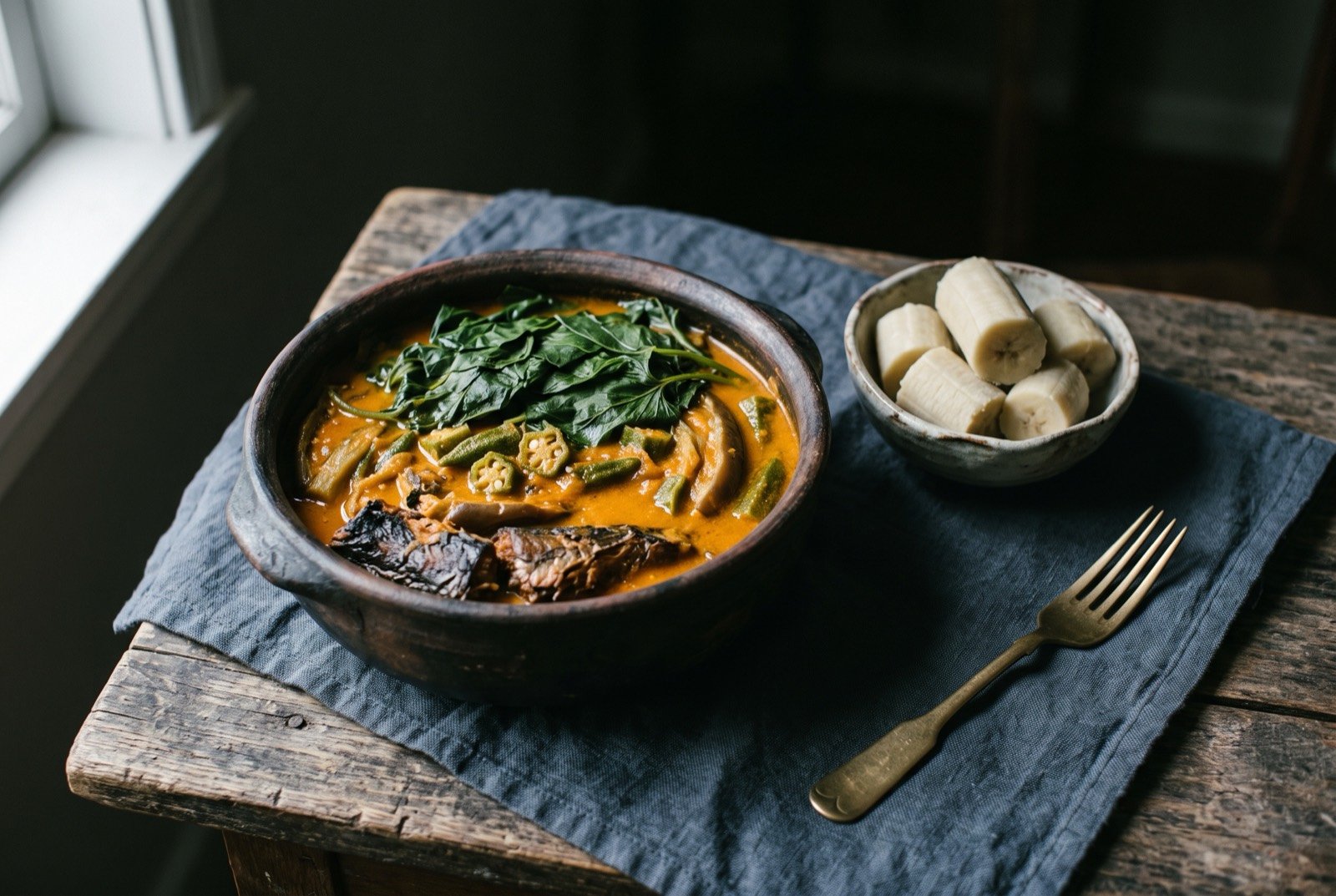
Calulu de peixe
Angola and São Tomé
Illustration
- Time
- 1 hour 15
- Researched
- Researched from 209 sources in the brief
Calulu is a dried-fish dish before it is anything else. Substituting fresh fish gives you something with no depth that also falls apart, which is the commonest diaspora failure. Worth noticing too that Namibian and Afrikaans potjiekos, layered in a three-legged pot and never stirred over slow coals, arrives at the same no-stir logic from a completely different tradition, and Volume 04's kedjenou reached it from a third direction.
As tradition built it
Serves 8 to 10. About 1 hour 15, plus soaking.
Ingredients
- 1 kg dried fish
- 1 kg fresh fish
- 3 onions, sliced
- 3 large tomatoes, chopped
- 500 g okra
- 1 kg sweet potato leaves (gimboa)
- 3 garlic cloves
- 2 cups red palm oil
- 2 gindungo
- to taste salt
Method
- Soak the dried fish, but not so long that all the salt comes out. Fast route: cover with boiling water, stand 20 minutes, drain, cover again and stand 1 hour, then skin and bone. Slow route: cold water, 3 to 4 hours. Either way, keep the second soaking water.
- Season the fresh fish with salt, garlic and vinegar or lemon.
- Sweat the garlic in a little of the palm oil in the bottom of a heavy pot.
- Now layer, in this order: dried fish, fresh fish, sliced onion, chopped tomato, okra, sweet potato leaves, gindungo, and the rest of the palm oil poured over the top.
- Check the salt, cover, and cook over low heat for about 30 minutes, adding a little water only if it threatens to catch. Do not stir.
Notes
The weighed formula is from Angola24Horas, the only fully weighed Angolan formula in this chapter, printed as given, which is why it feeds a crowd.
What a modern chef changes
The stack read as heat management, the soaking liquor used as the stock, and the oil kept in state one
Rungs 2, 6 and 3
Method
- Understand what the layering is doing. Salt and moisture migrate downward from the fish and the leaves; the palm oil melts down through the stack and bastes it. The dried fish sits at the bottom in the hottest zone, which is where it should be because it takes longest to give up its glutamate, and the fresh fish, insulated by everything above, effectively steams. Treat it as a sealed pot: lid on, and never a spoon.
- Use the second soaking water as the only added liquid. It carries concentrated inosinate and smoke, and pouring it away is the commonest way to throw out depth you have already paid for.
- Keep the top oil in state one and the acid off the plate. Because the oil goes on last and the pot never exceeds a low simmer, it barely rises above 100°C and keeps most of its carotene, so do not fry it first. And citrus into a calulu flattens it: a sour funge under it lifts the whole thing instead.