Southern Africa · Volume 20, Desert, Coast and Funge
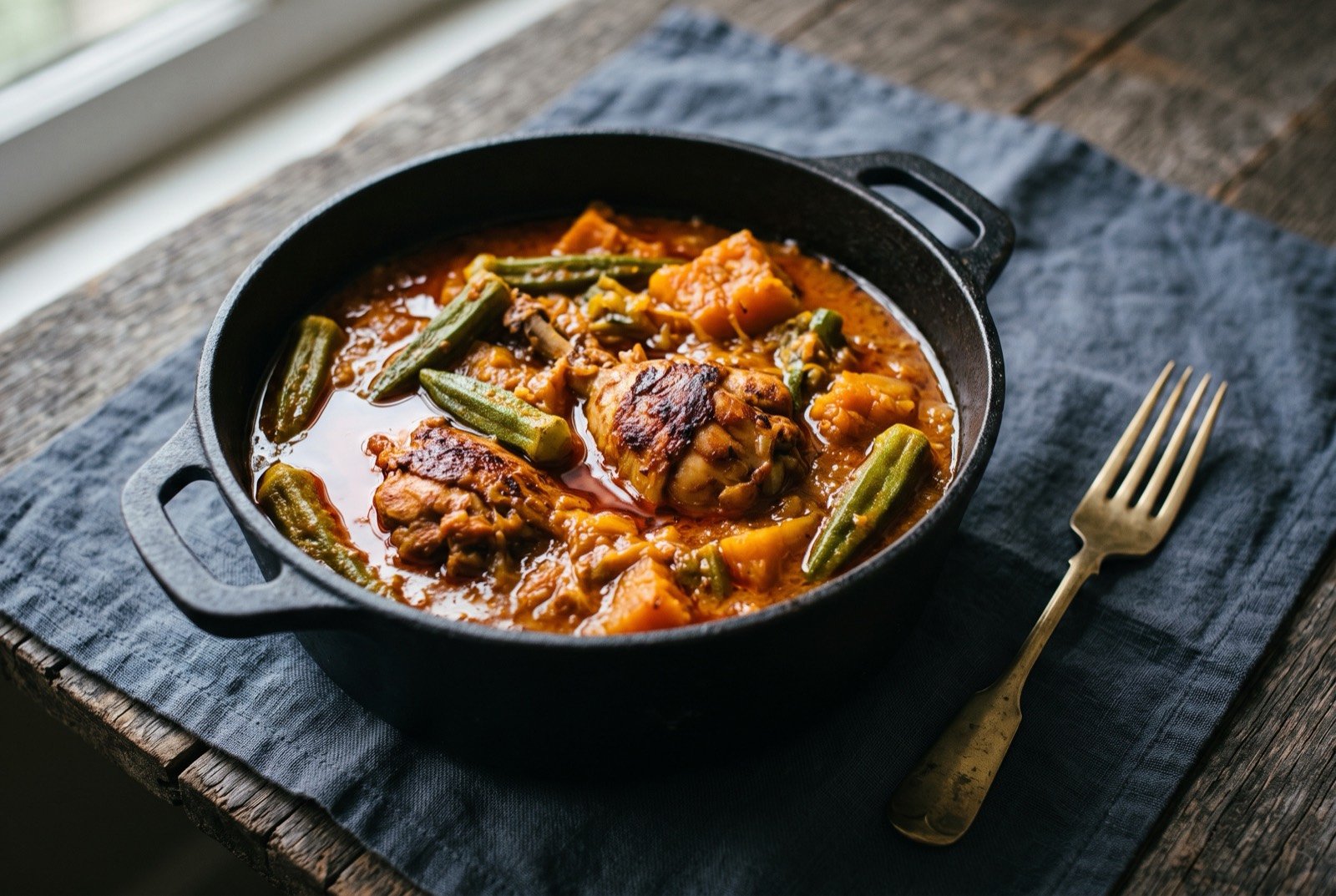
Muamba de galinha
Angola
Illustration
- Time
- Hands on 1 hour 30 · Waiting 1 hour
- Researched
- Researched from 209 sources in the brief
It is also the ancestor of Brazilian frango com quiabo, carried across the Atlantic by enslaved Angolans, and Brazilian writers say so explicitly. A provenance note. The architecture below is agreed across every source I have. The specific quantities come from sources of mixed provenance rather than from Angolan writing, and the definitive account, Ribas, is the one nobody has read. Treat them as good working figures, not canon.
As tradition built it
Serves 6. About 1 hour 30, plus 1 hour marinating.
Ingredients
- 1.5 kg chicken, jointed into 8
- 4 garlic cloves, crushed
- 2 tbsp gindungo
- 1 lemon, juiced
- 1 tsp salt
- 240 ml unrefined red palm oil
- 2 onions, chopped
- 3 tomatoes, chopped
- 390 g palm nut concentrate (1 tin)
- 600 g pumpkin or squash, in 3 cm chunks
- 250 g okra, halved lengthways
Method
- Marinate the chicken with the garlic, gindungo, lemon and salt for 1 hour.
- Heat the palm oil and brown the chicken hard. Browning in palm oil rather than adding it later is what fixes the colour and the roasted note into the sauce.
- Add the onion, remaining garlic, chilli and tomato and cook down about 30 minutes, until the chicken is nearly done.
- Add the pumpkin and cook 10 to 15 minutes. It partly breaks down, and that starchy backbone stops the sauce reading as pure fat.
- Stir in the palm nut concentrate.
- Add the okra and simmer a few minutes only. Long okra gives slime. Fast okra gives gloss.
- Correct the salt. Serve with funge and with feijão de óleo de palma, beans stewed in palm oil.
What a modern chef changes
Palm oil in two states, palm pulp treated as body rather than colour, and okra used as a dial
Rungs 2, 6 and 1
Method
- Brown at a measured temperature and then never boil again. Take the oil to 170 to 180°C for the sear, then hold at a bare simmer. At 150°C you lose about 15 per cent of the beta-carotene; at 200°C you lose 59 per cent over two hours. The colour of a muamba is a record of how it was cooked.
- Hold back a third of the palm oil and stir it in off the heat. State one, below 60°C, full carotene, full aroma. Depth from the cooked oil, colour and fruit from the raw. The most visible improvement available to the dish, and it costs nothing.
- Use the pulp and add it late. The concentrate is the body of the sauce, not its colour, and boiling it hard for thirty minutes turns it grey. Adding more oil in its place is the standard British error. Then split the okra, half sliced and half whole, both in at the end, so viscosity is set deliberately rather than hoped for.