Southern Africa · Volume 20, Desert, Coast and Funge
Biltong and segwapa
Namibia, Botswana and the whole southern African interior
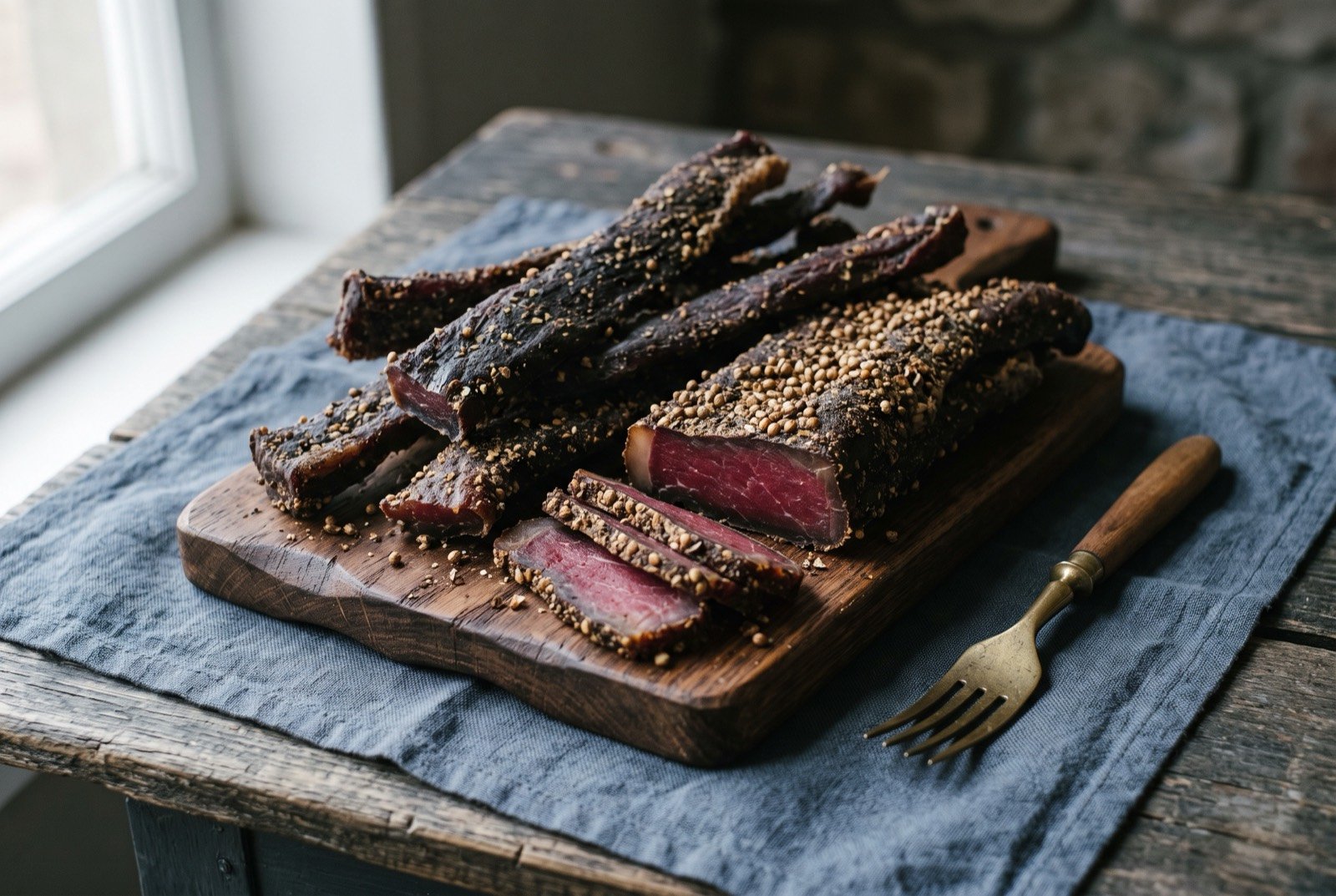
An illustration of the dish, not a photograph of it cooked.
- Time
- 24 hours
- Reviewed
- Not yet reviewed from inside the tradition
- Cooked
- Not yet cooked and reported
There is no kill step. Preservation is entirely acid, salt, spice and moving air taking water activity below the threshold at which pathogens can grow. Get it wrong in a warm damp British kitchen and you have a hazard rather than a disappointment. The origin story needs care too. The tale of Dutch riders curing meat under the saddle is almost certainly false. The sober account is that Dutch settlers adapted an existing Khoikhoi meat-drying practice and layered vinegar and spice onto it, and that account is inference rather than documentation.
As tradition built it
Makes about 600 g. 12 to 24 hours curing, then 6 to 8 days drying.
Ingredients
- 1.5 kg beef silverside or topside, in one piece
- 200 ml red wine vinegar
- 25 g coarse rock salt
- 25 g whole coriander seed, lightly roasted and coarsely cracked
- 25 g black peppercorns, coarsely ground
- 25 g dark brown sugar
Method
- Cut the beef into strips about 25 mm wide. With the grain for chew, across it for tenderness. Thicker strips give a wetter centre.
- Marinate in the vinegar 12 to 24 hours, turning once.
- Roast the coriander lightly, then crack it coarsely. Do not powder it. Roasting develops the pyrazines and drives off some of the soapy aldehyde note; powdering makes biltong taste dusty. Mix with the salt, pepper and sugar in equal weights.
- Drain the strips, do not rinse, and coat all over with the spice.
- Hang with real air movement, cool, and apply no heat. Traditionally this was done in the winter cold, when bacterial and mould risk is lowest.
- Historically a fortnight. To the parameters below, 6 to 8 days.
What a modern chef changes
Water activity treated as the instrument it is
Rung 4
Method
- Work to numbers, not to a feeling. The validated process is 23.9 to 25.5°C at 55 to 80 per cent relative humidity with real airflow, for 6 to 8 days, to a water activity below 0.85. At those parameters the literature records greater than 5 log reductions of E. coli O157:H7, Listeria monocytogenes, Staphylococcus aureus and Salmonella. The dehydrator on its lowest setting with the door propped is the right kit, and a hygrometer inside the chamber is not optional. If a chapter publishes a no-heat cured meat, it should publish the instrument that makes it safe.
- Get water activity down fast, not just eventually. Pathogen reduction increases as it falls, so the early hours matter most: good airflow from the start, strips hung with space between them, no crowding.
- The vinegar is a hurdle, not a flavouring. Grape is traditional and balsamic or cider both work. Malt vinegar does not. Do not reduce the quantity to make it milder.
- Buy the spice as four whole ingredients. Pre-mixed biltong spice is mostly salt, MSG and anti-caking agent, and it is the usual culprit behind dusty, one-note biltong.