Africa · Volume 19
Zambia, Zimbabwe, Malawi & Mozambique
Nshima and the Relish
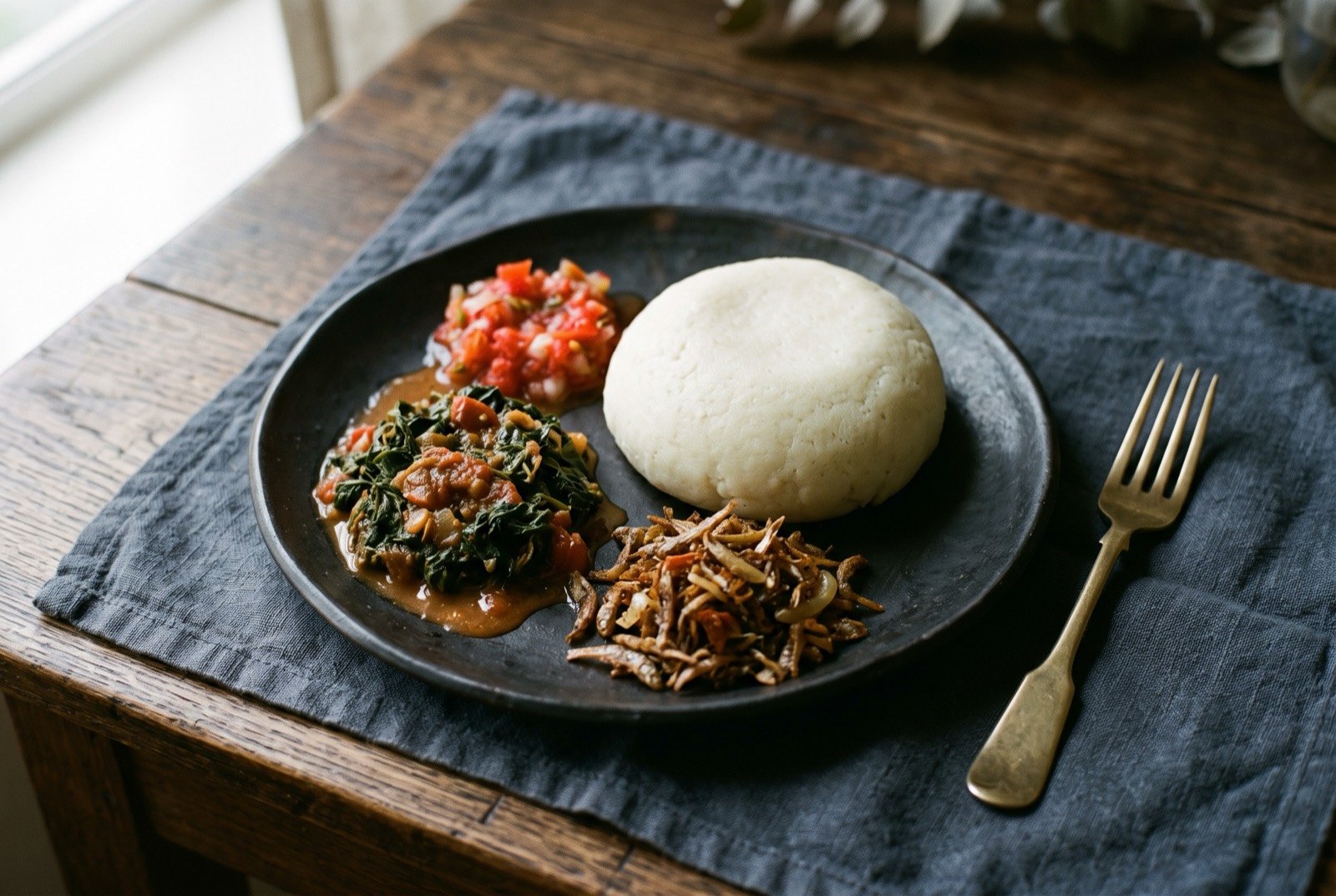
Four countries organised around one relationship: a bland, clean, elastic starch and a small, intense, fat rich relish. The starch is eaten in quantity, the relish in spoonfuls, and all the technique lives in the relish. The canon as it is actually cooked, a ladder built from the inside, and every dish as tradition built it, then what a modern chef would change.
Sources and review · What this chapter does not assert · How we research · Spotted something wrong?
A Sense of Place
Three countries share one culinary grammar almost completely. The fourth belongs to the Indian Ocean, and what separates it is a fat.
Zambia, Zimbabwe and Malawi thicken the relish with groundnut. Mozambique thickens it with groundnut and coconut together. The starch, the eating gesture, the leaf vocabulary and the alkali are shared across all four. West to east, the sauce fat changes and very little else does.
There is no single word for the starch, and that is a fact about the region rather than a gap in the sources. It is nshima, ubwali, insima or buhobe in Zambia, nsima in Malawi, sadza or isitshwala in Zimbabwe, xima in Mozambique. The relish is ndiwo, umunani, usavi, muriwo, caril. Where this chapter needs a neutral pair it says the starch and the relish, because the grammar is the point and the grammar is shared.
The Bemba north and the Copperbelt
Northern, Luapula, Muchinga and Copperbelt provinces: Bemba, Bisa, Lunda, Lala and Kaonde, plus the mixed mining population of the line of rail. Miombo woodland on poor acid soils, worked historically by chitemene ash cultivation, and therefore fungus country, caterpillar country and wild leaf country.
The fat is groundnut in the specific form of raw pounded groundnut powder, not oil and not roasted paste. The alkali is chidulo, wood ash lye. The starch was finger millet and is now maize: the Bemba word ubwali originally described a millet paste, which is the most economical way to say what happened to this region's diet in the twentieth century. Signature: ubwali with umunani, ifisashi, chikanda, ifishimu (caterpillars), munkoyo.
The Zambian centre, south and west
Lusaka, Central, Southern and Western: Tonga, Ila, Lenje, Soli, and Lozi on the Barotse floodplain. Cattle country in the south, an annually flooded plain in the west, and the only substantial dairy zone in the volume. Groundnut again, plus butterfat from soured milk. The Tonga call the paste insima, the Lozi buhobe. Signature: insima, mabisi, chibwantu, fish from the Kafue and the Zambezi.
The Chewa, Tumbuka and Ngoni belt
Eastern Zambia and all of Malawi: Lake Malawi, the Shire valley, the Nyika and Viphya highlands. Fish is not an occasional protein here, it is the default relish. Malawi is a groundnut country in the way Mali is, and it has a real chilli culture that has been commercialised. The starch is maize nsima, and in the north also kondowole, a fermented cassava paste that is a separate dish by a separate technique. Signature: nsima with ndiwo, chambo, usipa, kondowole, thobwa.
The Shona and Ndebele plateau
A high, dry granite plateau falling to the hot Zambezi and Limpopo valleys, with mopane woodland in the west and south, which is where the caterpillars are.
This is the one zone where the groundnut is roasted. Dovi, peanut butter proper, is the standard sauce fat where Zambia and Malawi use raw pounded powder. That divergence is the most consequential technical difference inside the western three quarters of the volume, and it is Rung 3. Sadza came historically from mapfunde (sorghum), rukweza (finger millet) and mhunga (bulrush millet), and now from magwere, maize. Signature: sadza with muriwo une dovi, nhopi, madora, nyimo.
Mozambique, north and south
Maputo, Gaza and Inhambane hold the Ronga, Changana, Chopi and Tsonga on a sandy coast that is coconut country from Inhambane south. Coconut milk and groundnut together is the defining fat. The aromatics are gindungo or piri-piri, garlic, lemon, onion, tomato, dried and fresh prawn; the starches are xima, upswa (a cassava flour paste) and white rice.
North of that, Zambézia, Sofala, Tete, Nampula and Cabo Delgado hold the Sena, Ndau, Lomwe, Makhuwa, Makonde, Mwani and the Swahili and Arab population of the Quirimbas. This is the Zambezi delta and the largest coconut belt in the country: Zambézia and Inhambane supply the rest of Mozambique. Here the Portuguese refogado sits under the indigenous leaf without argument, and curry spice, lime, cashew and dried prawn come in off the Indian Ocean. Signature across both: matapa, xiguinha de cacana, galinha à Zambeziana, caril de camarão, badjias, achar.
The History in Layers
The pre maize base, which is the intellectual heart of the volume
Every technique in this chapter predates maize, and the evidence is in the language and in the pots.
In Zimbabwe the vocabulary does the arguing. The Manyika word sadza denotes a thick porridge made from mapfunde, rukweza, mhunga or maize: the grain is a variable in the definition, not part of it. The same vessel, the mukate, serves all four, and the ethnographic record from the Nyanga highlands is explicit that the pot has no neck specifically so that it can be stirred. Its secondary uses are nhopi, samp, cowpeas, nyimo, yams, cassava and Livingstone potato. The Manyika are the modern population of the Nyanga agricultural complex, terraced and worked by agropastoral societies between roughly CE 1300 and 1900.
The same happens in Bemba. Ubwali, now the word for maize nshima, described a thick millet porridge eaten with umunani at nearly every meal; the classic account is Audrey Richards's 1939 study of Bemba land, labour and diet. The type vocabulary preserves the alternatives: sima ya mapila from sorghum, sima ya kambala from finger millet, sima ya chikhau from cassava. In Mozambique, millet and sorghum were the primary grains and xima replaced them.
So write the sentence plainly. The two stage paste, the relish, the alkali, the leaf vocabulary, the pounded groundnut, the calabash ferment and the drying rack are all older than the grain that now goes into them. Maize did not create this cuisine. It was fitted into one that already existed, and the fit was not perfect: maize needs more water than sorghum, cooks faster, tastes blander and stores worse.
The Columbian Exchange, handled honestly
The popular story is that the Portuguese brought maize from the New World to south east Africa and it swept the region. Marvin Miracle's 1965 survey in the Journal of African History, still the foundational study, says that linguistic evidence strongly suggests maize penetrated the interior from the coastal regions, that the timing and mode of its introduction cannot be established, and that the commonly repeated assertion that the Portuguese brought maize to tropical Africa from the New World cannot be documented, though they certainly had economic motives for doing so. It was probably introduced at more than one point and time, and is referenced in Zanzibar and around the mouth of the Ruvuma in the seventeenth century.
Then the sentence that should head every account of this food: until well within the twentieth century, maize was neither a major export nor a mainstay of the diet in most of eastern and central tropical Africa, which is the bulk of the area where it is now of major importance. James McCann's Maize and Grace dates arrival to around 1500 and traces five centuries of consequence.
The honest chronology is a long fuse and a short explosion. Present on the east African coast in the sixteenth and seventeenth centuries, marginal in the interior for roughly three hundred years, and the staple of Zambia, Zimbabwe and Malawi only within the twentieth century, much of that inside living memory.
The other Columbian arrivals are less contested and no less important. Chilli, in the Capsicum frutescens cultivar that became piri-piri, naturalised so thoroughly in southern Mozambique that its name is Ronga. Tomato. Groundnut, which displaced the indigenous Bambara groundnut from exactly the job it had held, as it did in the Sahel. Cassava. Pumpkin and its leaves, American, now the most important cultivated green in all four countries. Amaranth, also American, now one of the most characteristic Mozambican greens.
The Portuguese and Indian Ocean layer
Mozambique is a separate case with three overlays.
The prazo system. Semi feudal Portuguese land grants on the Zambezi, emerging in the sixteenth century: a lease held against a fixed annual fee, which the holder was meant to live on and forbidden to sell or rent, and frequently did both. A reform of 1677 granted vacant estates to orphan girls and the daughters of crown servants, who passed them down the female line for three generations provided they married Portuguese men. In nineteenth century Tete province 32 prazeiros held 57 estates. The culinary consequence is a genuinely creolised Afro-Portuguese household culture on the Zambezi with no counterpart in the British territories.
The Indian Ocean layer. Chamuças and rissóis are now characteristic of Mozambican street eating; achar, the piri-piri, mango and lemon pickle, is an Indian pickle domesticated; caril is simply the standard word for a sauce. The Slow Food and Maputo city agriculture booklet, the best single document on this cuisine, says Mozambican cooking tells a little of the country's history, in particular of the encounter with Arab and Indian culture, with particular force on the coast.
The Portuguese layer proper. The refogado of onion, garlic, tomato and piri-piri sweated in oil; bread; the coconut sweets; the grilled prawn culture; and piri-piri as a table condiment rather than something pounded into the sauce.
One caution, because it is usually got wrong. The Portuguese did not bring the chilli and then invent piri-piri. They brought an American plant, an African population selected and named the cultivar, and the sauce was assembled with condiments the Portuguese were trading out of Asia. Piri-piri is a three way object and deserves describing as one.
How maize became compulsory
In Northern Rhodesia, along the line of rail, maize was by far the most important crop for both African and European producers. The Depression era market crisis plus direct competition between them produced the Maize Control Ordinance of 1935 and the Maize Control Board, the direct ancestor of Zambia's NAMBOARD. Kenneth Vickery's judgement, in the Journal of Southern African Studies in 1985, is unambiguous: Maize Control represented a state commitment to the survival of white settler farms.
In Southern Rhodesia the machinery was financial as much as regulatory: the Land and Agricultural Bank, from 1924 to the end of Federation in 1963, financed settler agriculture ahead of African farmers. After independence the apparatus was kept and expanded, and Melinda Smale and Thomas Jayne's synthesis across Kenya, Zimbabwe, Zambia and Malawi is deliberately sceptical about the phrase "maize success story": the booms were episodic, the public investment in controlled markets was not fiscally sustainable, and policies that produced success in one period caused decline in the next. Maize area in sub-Saharan Africa expanded by almost 60 per cent between 2007 and 2017, at the expense of crop diversity.
Two things are genuinely contested among serious historians, and this chapter prints both rather than choosing. Whether African farmers were pushed or jumped: Miracle's evidence shows maize spreading along African trade and settlement routes long before any colonial state existed, which is hard to square with a purely imposed crop, while Elijah Doro and Sandra Swart, working from the National Archives of Zimbabwe, warn against reading adoption as free agency when the structural constraints were as sharp as they were. And whether the maize success was a success at all, which Smale and Jayne call equivocal.
What this chapter will not say is that maize was forced on the region by decree, because the documented mechanism is subtler. A market was rigged, a seed system was funded, a milling industry was built, a meal subsidy was maintained for decades, and a whole population's palate followed the incentives. Nobody had to be ordered to eat nshima.
Milling, and why the grade is a political fact
The Copperbelt mines were the market that made commercial maize worth growing. The composition of the mine compound ration itself is not documented in anything this chapter could obtain, and is therefore not asserted.
The milling is documented, and it is still a live argument. Zambian consumers buy either breakfast meal, highly refined, or roller meal, less refined and cheaper, and the gap between the two prices is a political fact: between 1994 and 2010 the real retail prices of both fell by 34 to 51 per cent in Zambia's major urban markets, driven by new investment in commercial milling and by the informal hammer millers. After the surplus harvest of 2012 the country still managed widespread meal shortages by November, and government price controls did not stop a 25 kg bag reaching 100 kwacha in some markets by February 2013.
The modern moment
Zimbabwe. A survey of 440 adults aged 18 to 69, approved by the Medical Research Council of Zimbabwe, found that only 9.3 per cent consume traditional foods daily. The strongest individual barrier was the inconvenience of accessing and preparing traditional foods, at 33.2 per cent; the strongest national barrier was the aggressive marketing of processed foods, at 47.8 per cent.
Zambia. The nutrition transition is documented from the Indaba Agricultural Policy Research Institute in Lusaka: supermarket penetration rising, calories available per capita falling over several decades, nutrient rich foods becoming dearer relative to staples, and expenditure shifting from staples to fats, sugars and processed foods, faster now in rural areas than urban ones because urban areas are already further along.
Mozambique. The Slow Food and Maputo city agriculture booklet records the same shift from the other side. In the Zonas Verdes of Maputo about 14,000 producers farm roughly 1,300 hectares at an average holding of half a hectare, and traditional leaves are grown there far more marginally than the introduced vegetables. In urban areas most of these greens are being forgotten or marginalised, considered a symbol of poverty and typical only of the countryside, and have been replaced by cabbage, lettuce and meat.
That is a document co-produced with a municipal agriculture directorate saying that its own country's greens are going out of fashion for being poor people's food. It is worth sitting with before cooking anything in this chapter.
The Flavour Arsenal
If you buy three things, buy a proper white maize meal, whole dried kapenta, and good unadulterated groundnut.
The fats and the thickeners
| Ingredient | Names | Character and use |
|---|---|---|
| Raw groundnut powder | mbalala; kutendela is the act of adding it | Raw nuts pounded and sieved fine. Sweet, milky, faintly green. Sets a sauce over 20 to 30 minutes. Not interchangeable with peanut butter. Dosed at roughly 40 per cent of the weight of the greens |
| Dovi | Shona | Roasted, ground paste. Glossy, nutty, dark. The Zimbabwean sauce fat, used as the fat rather than as a garnish |
| Coconut milk | leite de coco | Grated flesh worked with warm water, first press. Zambézia and Inhambane supply the country. The defining Mozambican fat |
| Nyimo | Vigna subterranea, Bambara groundnut | The African domesticate the American groundnut displaced. Now boiled as a pulse, not used as a sauce base |
The umami spine
| Ingredient | What it is | Use |
|---|---|---|
| Kapenta, matemba | Limnothrissa miodon, Stolothrissa tanganicae | Salted on landing, sun dried 8 to 12 hours. Salt, mineral, faintly bitter. Soaked, then fried with onion, tomato and groundnut |
| Usipa | Engraulicypris sardella, Lake Malawi | The Malawian equivalent. Chambo is the prestige fresh tilapia |
| Dried prawn | camarão seco | The Mozambican coastal savoury note, into matapa and caril |
| Madora, amacimbi | Gonimbrasia belina | Boiled in salt, dried, fried. Savoury, mushroomy, high in iron and zinc |
| Hohwa, termites, mice | miombo mushrooms, insects | Fire drying is a distinct relish technique in the Zambian classification, not a curiosity |
The alkalis, which are a technique and not a seasoning
Chidulo is water filtered through the ashes of burnt banana leaves, groundnut haulms or maize stalks. Zambian cooks describe it as tasting like vinegar and use it to soften tough wild greens. Bicarbonate of soda is the modern substitute, and the exchange rate given in tradition is the most useful single line in the research: one cup of chidulo stands in for half a teaspoon of bicarbonate, for 450 g of greens.
Three uses run through the region: alkali in a groundnut relish, to soften the leaf fast and hold it green; alkali in delele, to build the slippery body that is the point of the dish; and alkali in chikanda, where it is not seasoning at all but the setting agent.
And then the inversion, which is one of the genuinely surprising facts in the volume. In Shurugwi district, Alfred Maroyi's ethnobotanical survey of 147 participants records that Corchorus tridens, the jute mallow the Shona call derere, is cooked with bicarbonate or ash to lessen the mucilaginous state of the dish. In West Africa the same alkali goes into the same plant to increase the draw. Same chemistry, opposite aesthetic, on one continent. Volumes Three and Four spent pages on making a sauce draw more; here are cooks doing the arithmetic in the other direction on purpose.
The greens
| Name | Species | Character |
|---|---|---|
| chibwabwa, muboora | Cucurbita spp. leaf | The great cultivated green. Fibrous stems and ribs must be stripped. An hour dried, 15 to 20 minutes fresh |
| delele, derere | Corchorus spp., okra | The mucilaginous family. Zambia counts 20 to 30 named types |
| nyevhe, lumanda | Cleome gynandra | Peppery, mustardy, bitter. Cited by 93.9 per cent of Maroyi's Shurugwi respondents. Sun dried for the dry season |
| muchacha, mugaka | Cucumis anguria, C. metuliferus | 87.8 and 90.5 per cent citation. The horned cucumber's fruit keeps in shade 1 to 3 months |
| cacana | Momordica balsamina | 17 amino acids, rich in calcium, iron, zinc. Strongly bitter: blanched and strained, which is bitterness management, not a rinse |
| matapa | Manihot esculenta, cassava leaf | Over 20 per cent protein depending on ecotype. Must be pounded |
| nhangana, madledlele | cowpea leaf, sweet potato leaf | High in vitamin A, calcium, iron |
| tseke, xikhepu | Amaranthus spinosus, Dioscorea leaf | Amaranth is Central American and now naturalised; yam leaf must be boiled then squeezed dry |
Roughly 800 to 1,000 species of traditional leaf grow in sub-Saharan Africa and most are barely recorded. The Slow Food and Maputo list is the authoritative one for the Mozambican coast.
The chillies, acids and aromatics
Piri-piri, gindungo in Mozambique, is a cultivar of Capsicum frutescens descended from the malagueta, running 50,000 to 175,000 Scoville units, with fruit 2 to 3 cm long. The name is Bantu: pilipili is Swahili for pepper, and the Oxford tracing of the word goes back to Ronga, the language of southern Mozambique.
Lemon and lime finish matapa, marinate the chicken for galinha à Zambeziana and go into achar, and they are what keeps a coconut and groundnut sauce from cloying. Baobab, mauyu, is the region's own souring agent and its answer to tamarind, and one of very few cases where the British health food aisle stocks the right product.
Tomato and onion are universal now, and they are modern. Every in-tradition recipe treats them as improvers rather than as the foundation, and reading them as the base of the sauce is a European habit imported into a cuisine that does not need it. Salt is the older seasoning, and in the Zimbabwean pot vocabulary the boiled relish is salted after it is soft, not before.
The starches, and a naming trap that decides whether your recipe works
White maize meal comes in three broad grades: super refined or breakfast, roller, and whole grain hammer milled (mgaiwa, mugaiwa). Then finger millet, sorghum, bulrush millet, cassava flour, rice, and in Mozambique upswa and Portuguese bread.
From the published grade table of Roff, a South African milling equipment manufacturer selling into all four countries. Extraction rate is the percentage of the whole grain that ends up in the bag, so lower extraction means more germ and bran removed, and a whiter, finer, lower oil, longer keeping meal.
| Country | Grade | Extraction |
|---|---|---|
| South Africa | Super Maize Meal | 69 to 74 per cent |
| South Africa | Special Maize Meal | 80 to 85 per cent |
| Zimbabwe | Super Refined Meal | 70 to 75 per cent |
| Zimbabwe | Special Roller Meal | 80 to 85 per cent |
| Zambia | Breakfast Meal | 72 to 78 per cent |
| Zambia | Super Roller Meal | 79 to 85 per cent |
Read the Zambian rows twice. In Zambia, "breakfast meal" is the refined grade and "roller meal" is the coarse cheap one. That is the exact opposite of the South African intuition, in which breakfast meal suggests a coarse porridge grade, and the opposite of what general web summaries repeatedly say. Trust the miller's own country table, and understand that these names do not travel between countries. Note also that "super" means refined, not coarse or fine: Iwisa's Coarse Braai Pap declares its ingredient as coarse super maize meal.
The Zambian vocabulary for the finished paste is a diagnostic tool, not folklore. It names your failures for you.
| Term | Meaning |
|---|---|
| nshima ya mugayiwa | from whole grain hammer milled meal, darker and rougher |
| sima ya mapila, ya kambala, ya chikhau | from sorghum, finger millet, cassava |
| sima ya mambontho | lumpy, from hasty cooking |
| nshima yibisi | undercooked |
| nshima yopola | gone lukewarm, hard and crumbly |
| nshima yosoza | eaten with no relish at all, a sign of hardship |
In Malawi the parallel distinction is in the flour rather than the paste: ufa woyera, refined, against ufa wa mgaiwa, whole grain.
Part Two
The Technique Ladder
First, an honest problem
There is no Michelin starred restaurant cooking Zambian, Zimbabwean, Malawian or Mozambican food anywhere in the world. Michelin's own London Africa selection is Ikoyi, Chishuru and Akoko, all West African in reference. Britain has no restaurant from any of these four countries that this chapter could verify as trading at any standing. That is the position in 2026 and it is the world, not a research gap.
One internationally legible fine dining restaurant exists, and it opened in April 2025 in a private house. Sungani Phiri cooks for 22 seats at Sungani Restaurant in Livingstone. He is Zambian, with roughly twenty years in five star kitchens across South Africa, Tanzania, the DRC and Zambia, trained in South Africa with a two starred chef, and was head chef at Royal Chundu and at Botanica in Lusaka before opening his own room. The menu, The Rebirth, runs 14 to 16 courses by season, costs 215 US dollars paid in advance, and sources every ingredient within a 100 kilometre radius. It doubles as a training kitchen. His origin story is this chapter in miniature: after culinary school he intended to cook the European fine dining he had been taught, and his sister told him it would be pretentious unless it was grounded in Zambia. His diagnosis of the problem is one sentence long. Chefs come to learn at his restaurant, the first thing they focus on is indigenous ingredients, and most young Zambian chefs have never cooked with them seriously.
Harare had a real traditional restaurant sector, documented in 2017 and not since. Gava's, opened late 2013 by Allen Gava with head chef Brian Machipisa, cooked its whole menu outdoors over open fire: white sadza and sadza re zviyo from finger millet, peanut butter rice, muboora, matemba, trotters and tripe, with produce bought direct from farmers. Gava's own line is the thesis stated by a man who does not need it explained: traditional food is not inferior, and he wanted a restaurant that could compete at the international level. Neither Gava's nor PanAfrika could be confirmed as still trading, and this chapter does not say they are.
Malawi has a competition circuit rather than a restaurant scene, and that is worth saying plainly. The Battle of Chefs Africa drew around 400 applications for roughly 35 places, with a brief to incorporate culinary heritage and collaborate with local producers. Chef Ipyana Mwagomba is the one named Malawian chef with real coverage, and his pitch is exactly on theme: he sells goat soup as a high end dish, and says he is happy goat soup is now five star.
Mozambique's strongest voice is not in a fine dining restaurant either. Celestino Santos, born in Beira in 1960, forty five years in kitchens, now cooking in Maputo, gives the diagnosis in both languages: "Moçambique tem tudo, em termos de produtos alimentares. O que acontece é que as receitas de culinária, geralmente nos restaurantes, são importadas." Mozambique has everything in the way of raw materials; what happens is that the recipes, in restaurants generally, are imported.
Where Mozambican cooking is actually a restaurant cuisine is Lisbon, and it is invisible if you search only in English: Cantinho do Aziz in Mouraria, Oliveira's with its Quelimane repertoire, and Zambeze above the Mercado Chão do Loureiro, whose published carta is the most useful document in the research because it is priced and public. Matapa com mexilhão e caju at 22.50 euros, caril de caranguejo with crisp cassava and coconut rice at 36.00, beef fillet with peanut sauce at 24.50. Note what that says technically: coconut rice is the default starch, not xima, caril is the dominant sauce format, and peanut sauce lands on a fillet rather than in a stew. That is the Lisbon dialect, and it should be distinguished from the Maputo and Zambézia ones rather than blended with them.
So the elevations below copy no starred kitchen. They are built from mechanism, and from what in-tradition cooks and regional food scientists have already measured. Two of the region's most experienced professionals, in two countries, independently identified the same gap: Santos says the recipes in restaurants are imported, Phiri says young chefs have never cooked seriously with indigenous ingredients. The method, not the recipe, is the part that was never written down.
Rung 1. The two stage starch, and the reserve that is dry flour
This is the central technique of the volume and almost every English description of it is wrong. It is not "stir maize meal into water". It is a two stage build, and in the Shona kitchen the stages have names.
The shape of it, in all four countries. Slake a portion of the meal in cold water to a smooth slurry. Bring the rest of the water to the boil, pour the slurry in, and cook it to a thin porridge, which is itself a dish: bota in Shona, phala in Chichewa. Cover and simmer that porridge, nearly undisturbed, for a long stretch. Then beat in the remaining dry meal in small additions, stirring hard as it stiffens. Then steam it covered off the heat and work it once more against the pot wall.
Use the Shona vocabulary, because it turns four vague minutes into four named events. Kukwata is uncovering and raising the heat until it boils properly. Kushinyira is the volcanic bubbling as the dry addition rains in. Kumona is pounding the paste against the sides of the pot until it is stretchy and lump free. Zambia has a partial equivalent, kutyakula or ukunaya. Malawian stage vocabulary beyond phala and mthiko, the stick, could not be found, and is not invented here.
Why the cold slurry. Maize starch gelatinises over roughly 62 to 72°C and the granules swell enormously as it does. Tip dry meal into boiling water and the outer particles of every clump gelatinise instantly, forming a waterproof skin around dry flour. That is a lump, and it is permanent: no amount of beating rehydrates the interior. Disperse the meal in cold water first and every granule is hydrated before any of it can swell, so the whole population crosses the gelatinisation window together. It is the identical logic to a beurre manié or a yudane.
Why two stages. The first fully hydrates and gelatinises the starch and drives off the raw cereal aroma. The second introduces a population of only partly hydrated granules into an already gelatinised, viscous matrix, and the covered rest steams them through. The last dry addition is not about hydration at all. It raises the solids fraction inside a matrix that is already fully gelatinised, and that is what gives nshima its clean, elastic, non pasty bite. Skip the second stage and you have polenta. Skip the rest and you have nshima yibisi, raw specks. Rush the second and you have sima ya mambontho, lumpy nshima, the mark of an inexperienced cook.
And here is the comparison this chapter most wants to make. In the Sahelian tô of Volume Five the cook removes a portion of the cooked gruel and beats it back in later as a viscosity brake, letting a seized paste down again in stages. Here the reserve is dry flour, held back and beaten in at the end, stiffening a stable porridge in stages. Same problem, opposite solution. And the hydration ratios are almost identical: Tembo's Zambian 2 cups of meal to 4 cups of water is about 260 g to 950 g, near 1 to 3.6, against the weighed West African tô figure of 1000 g flour to 3981 g water, or 1 to 4. Printed as a comparison and not as a genealogy: there is no evidence of a historical connection and this chapter asserts none.
The pot is part of the technique. The Manyika mukate has no neck specifically so that it can be stirred. A wide, heavy, straight sided pan you can beat paste against matters as much as the ratio, and non-stick is a liability here.
Rung 2. The relish is the dish and the starch is the plate
In Bemba the relish is umunani, in Nyanja ndiwo, in Shona usavi. The vocabulary does work English loses. The starch is not a main course with sauce on it and the relish is not a side; the starch is the vehicle and the relish is the composition. The proof is on the only fine dining menu in the region: the two most technical courses on The Rebirth are built on bondwe, an ordinary relish green, and on delele, okra, not on a protein.
The restaurant translation is to stop building one pot. A Zambian ifisashi cooked properly at home is three preparations happening at once in one vessel: leaf, tomato and groundnut. At restaurant level they separate. Blanch the leaf hard and refresh it to fix the colour. Bring the groundnut to a sauce on its own with stock. Reduce the tomato to a concentrate. Assemble to order.
Why it works. Every element has a different optimum, so cooking them together guarantees at least two are wrong. Pumpkin leaf loses its green in roughly 5 to 7 minutes of boiling, as magnesium is displaced from the centre of the chlorophyll molecule by hydrogen ions released from the plant's own acids. Groundnut needs twenty minutes and more to lose its raw note and set. Tomato needs a long reduction to concentrate its glutamate. And each component salted at its own stage tastes seasoned, where one salting at the end tastes salty. That is precisely the failure mode of a relish finished with a stock cube.
Rung 3. Raw pounded groundnut is not peanut butter, and the region divides on exactly this
The most useful technical correction in the volume, and invisible in Western writing about this food.
Zambian and Malawian cooks pound raw groundnuts and sieve them to a fine powder. That is what "pounded groundnuts, sieved" means, and it is the kutendela of the traditional relish grammar. Zimbabwean cooks use dovi, a genuinely roasted, ground paste. Both are correct in their own kitchens and they are not interchangeable.
Why they behave differently. Raw groundnut powder disperses into water as discrete particles carrying intact protein bodies and oleosomes. It hydrates; then over 20 to 30 minutes the protein denatures, the oil bodies coalesce, and the sauce sets to a thick, slightly grainy, sweet, milky suspension. Roasted peanut butter is already a coalesced, fat continuous paste: it will thin the sauce rather than set it, gloss it rather than body it, and taste roasted rather than green and milky. Substitute peanut butter into an ifisashi and you have not made a slightly different ifisashi. You have made a Zimbabwean sauce.
The stirring rule is not optional in either style. Groundnut protein flocculates and scorches on the base of the pot, and a burnt relish of this kind is unrecoverable.
The restaurant translation, for the roasted style. Roast your own nuts, grind them, and split the addition: two thirds in early with the aromatics and a little fat, cooked out over low heat until the oil visibly separates and the paste darkens, then stock added in stages and reduced so the oil re-emulsifies; the final third stirred in off the heat. Cooking the paste out drives Maillard reactions on the residual protein and sugars, generating the pyrazines that make a groundnut sauce smell roasted rather than green; it volatilises the raw aldehydes, chiefly hexanal, which is also the marker compound of peanut rancidity, and which is why an undercooked paste and a rancid one taste confusingly alike; and it liberates free oil that can be redispersed as fine droplets stabilised by the peanut's own protein and by gelatin from the stock. The same two stage logic as the sadza, applied to fat instead of starch.
And the failure mode to name in print: never boil a groundnut sauce hard. Peanut protein is a poor emulsifier above roughly 85°C, and a rolling boil breaks the sauce into an oil slick over a gritty solid.
Rung 4. Kapenta, matemba and usipa are a base, not a garnish
Kapenta is Limnothrissa miodon and Stolothrissa tanganicae, two Lake Tanganyika clupeids introduced into Lake Kariba and Cahora Bassa and now the cheapest animal protein in the region. They are eaten whole, which is the technically important part.
The processing is a two stage dry and it is deliberate. From FAO's survey of the Kariba industry: salt or ice immediately on landing, because ambient temperature averages 27°C and reaches 40°C; dry salting used by 10 of 13 companies and brining by 2; sun drying for 8 to 12 hours depending on weather, giving a shelf life of up to six months and the most consumer acceptable product; mechanical drying at about 58°C for a minimum of two hours after an initial sun dry. The sun exposure forms a dried surface skin fast enough to arrest spoilage and stop the fish sticking together; the slow finish drives interior water off without case hardening. That is the identical logic to the first sun dry in kilishi in Volume Five, arrived at independently for a completely different raw material.
The numbers that justify the rung. Dried kapenta runs about 72.9 per cent protein, essentially identical to a Norwegian fish protein concentrate at 72.8 per cent. Drying concentrates hard: about 63 g protein and 209 kcal per 100 g dried against 16 g and 85 kcal fresh. Because the whole fish is eaten it delivers calcium, iron, zinc, vitamin B12, taurine and nucleic acids.
The restaurant translation, which nobody in Britain does. Split the bag. Take half, dry toast it until it smells nutty rather than fishy, then steep it in hot but not boiling water for 15 to 20 minutes and use the liquor as the stock for the relish, exactly as a Japanese cook makes niboshi dashi. Boiling extracts bitterness and the amines that read as "fishy"; a sub-boil steep extracts nucleotides and glutamate. Fry the other half hard at the end for texture and put it on top. The same ingredient now does two jobs and the dish has a base instead of a topping.
One honesty note. Dried sardine generally carries roughly 40 to 50 mg per 100 g glutamate and 350 to 800 mg per 100 g inosinate against katsuobushi's 30 to 40 and 470 to 700. Those figures are for dried sardine in general. No assay specific to kapenta could be found, and this chapter does not pretend otherwise.
Rung 5. Alkalinity is a lever here, and it has to be pulled on purpose
What raising the pH of a cooking liquid does. It saponifies pectin in cell walls, so fibrous savanna and woodland leaves collapse in twenty minutes rather than an hour. It stabilises chlorophyll, because the magnesium at the centre of the molecule is not displaced by hydrogen ions, so the green survives instead of going olive. It increases the solubility and hydration of mucilage polysaccharides, which is the whole purpose of delele. And it accelerates Maillard browning at lower temperatures, which is why alkaline cooked relishes read darker and smell more roasted.
What it costs. Thiamine is destroyed rapidly at alkaline pH and vitamin C goes with it. Over-dosed bicarbonate gives a soapy, slippery, faintly metallic mouthfeel and turns a green vegetable to mush. Zambian cooks state both halves themselves, and the folk formulation is exactly right: a little soda makes the dish taste great but can take away some nutrients. So the dose is the technique. A quarter teaspoon in a family pot, added late. Ash lye, being potassium rich rather than sodium rich, does the same job with a different mineral load, which is why cooks who use it describe a rounder result.
And then the reversal, which is the fact worth carrying out of this chapter. In West Africa, potash goes into okra and jute mallow to increase the draw, and Volumes Three and Four treat the slippery network as the object of the exercise. In Shurugwi, respondents cook derere with bicarbonate or ash to lessen the mucilaginous state. The chemistry is the same in both places; the aesthetic is opposite. This region does not want a sauce that ropes. It wants a relish soft, savoury and dense enough to cling to a ball of paste.
A fourth use, structural rather than culinary. In chikanda the bicarbonate is not seasoning and not a leavener but the setting agent, cross linking the orchid tuber's polysaccharide into a firm, sliceable, thermally irreversible gel. That is dish five.
Rung 6. Coconut and piri-piri: an emulsion problem and a solubility problem
The base of Mozambican coastal cooking is coconut milk plus piri-piri plus lime plus garlic, and two pieces of physics govern all of it.
Why the fat is not optional. Capsaicin is strongly lipophilic and effectively insoluble in water. In a watery sauce it stays as undissolved particulate, reading as harsh, spiky, front of mouth heat that arrives all at once and leaves. Dissolved into the fat phase of coconut milk it distributes evenly through the emulsion, so the heat becomes broad, slow and long. The carotenoid colour is fat soluble too: a coconut base goes orange and glossy where a water base goes pink and dull. Bloom the chilli in the fat, not in the liquid.
Why the emulsion breaks. Coconut milk is an oil-in-water emulsion stabilised by coconut proteins and phospholipids. Those proteins denature and lose emulsifying capacity between roughly 80 and 90°C, and acid, which is to say the lime that belongs in the dish, pushes them further toward their isoelectric point. Boil a coconut and lime sauce and it curdles into oil and grainy solids. Hold the sauce below a simmer once the coconut is in. Add the acid at the very end, off the heat. Use full fat tinned coconut milk with a short ingredient list, or better, the first press from a fresh nut, worked with warm water rather than hot, because hot water extracts more oil but also more starch and protein and gives a milk that splits more readily over a long simmer.
And the cyanide question, which is a safety parameter dressed as a texture step. Cassava leaves contain the cyanogenic glucosides linamarin and lotaustralin. Traditional Mozambican processing is heavy pounding in a pilão followed by hours of slow cooking, and the pounding is not decoration: rupturing the cells releases the plant's own linamarase, which begins breaking the glucosides down, and the long cook volatilises the liberated hydrogen cyanide. A blender pulse is not equivalent to twenty minutes in a mortar, and the traditional total of 90 minutes to two and a half hours from pounding to service is not a texture preference. Frozen cassava leaf sold as pondu arrives already ground, which does the mechanical half. It still needs the long cook.
Part Three
The Ferment and Preserve Bench
Four things worth making, all of them methods this region already runs on, and one honest account of something you cannot make here.
1. Mufushwa: drying your own greens
The dry season technique that keeps the relish going, and the most rewarding project in this volume for a British cook with a dehydrator.
In Shurugwi, Cleome gynandra and Cucumis anguria leaves are sun dried for later use, and Maroyi's respondents describe these preserved plants as a critical food resource in the dry season and in drought. The same logic runs through Zambia, where dried chibwabwa and dried delele are market staples handled quite differently from fresh: a thirty minute warm soak, then an hour of cooking.
What to do in Britain. In late August and September, when the squash plants are finishing anyway, strip young squash and courgette leaves of their fibrous ribs, wash them, blanch 60 seconds, refresh, dry on a cloth, and dehydrate at 45 to 50°C until brittle, roughly 6 to 8 hours. Kale, mustard greens and amaranth all work. Store airtight in the dark. The flavour is deeper, more savoury and faintly hay-like, closer to a dried mushroom than to a green vegetable. It is an ingredient, not a fallback.
2. Thobwa, and the enzyme problem it solves
Malawi and eastern Zambia. Boil water with ufa wa m'gaiwa, whole grain white maize flour, to a porridge. Add more water and bring to a rolling boil for about 15 minutes. Cool it to warm. Stir in a handful of maŵele, millet flour. Rest it in an mbiya, a clay pot, in a cool place for two days. Left five days it becomes mowa, beer.
The millet is not a flavouring. It is the enzyme source. It goes in below gelatinisation temperature specifically so its amylases survive to saccharify the starch the boil has just gelatinised. Cool the porridge properly before the millet goes in, or you have destroyed the only active ingredient.
The same idea done with a wild root is the most distinctive indigenous technology in the volume. Zambian munkoyo and chibwantu use the roots of Eminia, Rhynchosia and Vigna species, dug from miombo understorey shrubs, beaten into fibrous strands and dried, as the saccharifying agent in place of malt. They break gelatinised starch down to maltose 80 per cent, maltotriose 17 per cent, glucose 3 per cent. A survey of 172 Zambian producers gives the sequence: cook the porridge, most commonly for an hour; cool; add the beaten roots overnight, with about 45°C optimal for hydrolysis; then spontaneous fermentation, most commonly one day, to a finished pH of 3 to 4. Calabashes are still preferred by producers selling commercially, because a used calabash ferments faster, its walls carrying the bacteria.
And the honest limit. Munkoyo and chibwantu roots are not obtainable in Britain in any form. Both spellings were searched. There is no substitute and none is offered.
3. Mabisi, approximated
The Zambian soured milk, and the method is four words long: raw milk into an uncleaned calabash, two days at ambient temperature, no starter beyond what the vessel carries. The biofilm on the wall is the culture, exactly as in munkoyo.
In Britain you cannot do that and should not pretend to. Raw milk sale is restricted, the spontaneous flora of a British kitchen is not the flora of a Zambian calabash, and an uncontrolled raw milk ferment at ambient temperature is a genuinely bad idea.
What you can do. Warm 1 litre of whole pasteurised milk to 40°C, stir in 2 tablespoons of live plain yoghurt or, better, the last two tablespoons of your previous batch, and hold at 30 to 32°C for 18 to 24 hours until thickly set and pleasantly sharp. Back-slop from batch to batch and the culture settles into its own character within a month. Use it beside a groundnut relish, where its acidity does the job lime does in Mozambique. It is not mabisi. It is a back-slopped soured milk that behaves similarly, and saying otherwise would be easier and wrong.
4. Achar
The Mozambican pickle, and the Indian layer of this cuisine sitting in a jar. Traditional achares are built on piri-piri, called malagueta or sakana in this context, with mango and lemon. The source names the components and gives no proportions, so what follows is a working formulation and is labelled as one.
Cut 2 hard unripe mangoes into batons, salt them with 30 g of salt, and leave 4 hours until they have wept. Drain but do not rinse. Pack into a sterilised jar with 6 piri-piri chillies split lengthwise, 4 cloves of garlic sliced, the peel and juice of 2 lemons and a teaspoon of salt. Cover with 150 ml of groundnut oil warmed to 60°C with a teaspoon of mustard seed and a teaspoon of ground turmeric, poured over hot. Seal and leave a week in a cool dark place before opening.
Why it belongs on the bench. Rung 6 says the lime goes into matapa off the heat; the achar says the rest of the acid lives beside the food, under the eater's control. That is why this cuisine can build fat rich, unacidified sauces without them cloying.
Sourcing in Britain
Verified August 2026. Where a supplier could not be fully confirmed, that is said rather than smoothed over.
The decision that decides everything
The grade of maize meal. Nothing else matters as much, because the meal is the plate.
Buy Iwisa No.1 white maize meal, a South African super grade: degerminated, roller milled, white. From The South African Shop (southafricanshop.co.uk), 1 kg to 10 kg, £3.69 to £19.99, £7.99 shipping up to 15 kg. Or from Niyis (niyis.co.uk), 2 kg at £4.99, 5 kg at £12.49, 10 kg at £21.99. It is a South African product and not a Zimbabwean or Zambian one, and this chapter says so: it is the closest correct thing reliably in stock in Britain, and it makes a sadza and an nsima a Zimbabwean or Malawian cook would recognise. Buy the coarse bag too: Iwisa Coarse Braai Pap, 2.5 kg, £9.80, is the same super grade at a larger particle size. Blend roughly 3 parts fine to 1 part coarse.
The grind you want is fine and free flowing, like semolina rather than flour: very slightly gritty rubbed between finger and thumb, leaving no dusty film, and bone white. A yellow tint means yellow maize, stigmatised in this region as relief food. A grey or cream tint means the germ is still in there.
What does not work, and why. Polenta and Italian or American cornmeal: wrong variety, wrong grind distribution, usually not degerminated, and it will never hold a pinched ball. Masa harina: nixtamalised, alkali cooked, its starch already modified. Cornflour: pure starch, no protein, glue. Wholegrain maize flour from a health food shop: the germ is 30 to 40 per cent oil, so it goes rancid within months and gives a grey paste, and rancid maize meal is the sour cardboard note people cannot name. Instant or pre-cooked meal: already gelatinised, so the two stage method has nothing to do. Kenyan Grade 1 sifted ugali flour is the closest legitimate alternative at 80 to 85 per cent extraction, but expect a darker, softer result.
Storage. Airtight, cool, dark. A degerminated super meal holds six to twelve months, a wholegrain meal three at most. A 10 kg bag opened in a British kitchen in July is an insect problem waiting to happen.
The retailers
ZimFoods UK (zimfoods.co.uk) is the strongest verification in this volume and the default recommendation. A Zimbabwean run online grocer with 411 live product pages on its own sitemap, last modified 25 August 2026, and the only British retailer found carrying these ingredients under their Shona and Ndebele names: matemba / kapenta, 100 g, £4.99; dried Kariba fish, £12.99; macimbi / madora mopane worms, 100 g, £6.99; mufushwa weMunyevhe, 100 g, £3.99, plus mufushwa wetsunga and mixed dried vegetables; upfu weZviyo, finger millet flour, 300 g, £6.50, plus unmilled zviyo; nyimo, nyemba and a mutakura mixture; mauyu (baobab), masau, nyii; Family Peanut Butter (dovi), Willards and Black Cat; Dairibord Pfuko maheu. One flag: the site footer reads 2020 while the product sitemap updates weekly, so the copyright line is stale rather than the business.
Niyis (niyis.co.uk, Reading warehouse) is verified trading with a 2026 copyright, click and collect, free shipping over £120. It carries Iwisa maize meal, frozen pondu cassava leaves at 500 g for £2.99, fresh ugu and 100 per cent peanut pastes. Verified negative: a search for kapenta on Niyis returns nothing. It is a West African shop and its inventory reflects that.
ZimGroceries (zimgroceries.co.uk) is not a UK grocer. It is a diaspora remittance service: you pay from abroad, they buy in Harare, they deliver to your family inside Zimbabwe with photo proof. That tells you something true about this diaspora's food economy and is of no use to a cook in Britain.
Physical shops
Built by querying OpenStreetMap through the Overpass API on 26 August 2026 for UK retail food premises whose names contain African, Afro, Zimbab, Zambia, Malawi, Mozambi, Mzansi, Biltong or Portugue. 232 records returned, every one a real premises mapped on the ground, and the query is re-runnable. Coverage is uneven: Sheffield, Luton, Coventry and Reading returned nothing, which is a mapping gap rather than an absence of shops. Treat this as a floor.
London. African Food Centre, 18 Cricklewood Lane NW2 1EX; Butcher & African Food Centre, 53 to 55 Deptford High Street SE8 4AD; and, for the South African and Zimbabwean crossover, Tara's Biltong, 547 Garratt Lane SW18 4SR. For the Mozambican strand the corridor to know is South Lambeth Road, Stockwell, London's Little Portugal, and outside London a Portuguese delicatessen is where the good piri-piri and malagueta are.
The Zimbabwean diaspora centres. Milton Keynes: The African Cash & Carry, 696 North Row MK9 3AP; Afromart, 208 Whaddon Way MK3 7DG. Northampton: Afro Choice, 36 Abington Square NN1 4AA. Swindon: Afro Caribbean Store, 61 Commercial Road SN1 5NX, and The South African Spaza Shop, SN3 4WA.
Elsewhere. Leeds: Afrogrocers Cash and Carry, 4 Berking Avenue LS9 9LF. Derby: Baasko Afro Continental Stores, 6 Osnabrück Square DE1 2DS. Manchester: Global African Ltd, 78 Hulme High Street M15 5JP. Birmingham: Blessing Market, 10 King Edwards Road B1 2PZ. Glasgow: Main African Store, 486 Duke Street G31 1QF. And Bexhill-on-Sea, of all places: Marula African Foods & Meats, 216 London Road TN39 4AH.
The ranked list: what decides great from grim
- The right grade of white maize meal. Nothing else is close. Polenta will ruin every plate in the volume.
- Kapenta, matemba or usipa, bought whole and kept frozen. The inosinate and glutamate base of the whole cuisine, and the ingredient British cooks most consistently demote to a garnish.
- Fresh, unadulterated groundnut, sieved. Rancid or sugared peanut butter ruins ifisashi, dovi and matapa more completely than any other single failure.
- Real stock instead of a Royco or Knorrox cube. Gelatin, free amino acids and nucleotides; a cube supplies none of the three.
- The leaf, and its preparation. Stripping the fibre from every stalk and rib is the difference between a relish and a mouthful of string.
- Full fat coconut milk, held below a simmer. For the entire Mozambican half, a broken coconut sauce is unrecoverable.
- Piri-piri bloomed in fat. Broad and long instead of spiky and short.
- Bicarbonate used deliberately: a quarter teaspoon, late.
- Finger millet flour for sadza re zviyo. The premium sadza, not the poor one.
- Baobab, for acid. The region's own souring agent, sold in Britain, and almost never used by the people who own a bag of it for smoothies.
Quality markers, and the kit
Kapenta should be silvery rather than yellow-brown, brittle and snapping rather than leathery, and smell cleanly marine with no ammonia note. Yellowing is oxidised fish oil and will not improve. It belongs in the freezer, sealed, always. If you cannot get it, Japanese niboshi is the closest thing on a British shelf and behaves almost identically in a steep; fish sauce does not, bringing water and the wrong salt curve.
Peanut butter for dovi should have oil separated on top, which is good and not bad, a mid brown colour rather than pale beige, and smell of roasted nut rather than cardboard. Avoid anything labelled no-stir, because the emulsion has been stabilised and breaking it is the first step of the sauce. Groundnut carries a real aflatoxin risk at source: a knowledge and practice study across three Malawian districts, 900 farmers at baseline, was set up specifically to test whether handling training reduced aflatoxin in groundnut, maize and sorghum. Buy from a retailer subject to UK food law and not from an informal import.
Dried piri-piri pods should still be pliable and smell fruity and sharp rather than dusty. At 50,000 to 175,000 SHU the difference between two pods and four is enormous. Thai bird's eye is a reasonable substitute; scotch bonnet is not, its fruity apricot aroma being West African and audibly wrong here.
Kit. A heavy flat bladed wooden spoon or a proper mugoti, because a silicone spatula will fold under stiff sadza. A deep, heavy, straight sided pot you can beat paste against, not a non-stick one. A granite mortar and pestle of at least 20 cm, because in matapa the pounding is part of the detoxification. A fine drum sieve for the pounded groundnut, a spice grinder for the caterpillar rub, a probe thermometer, a dehydrator for the mufushwa, and a freezer bin for dried fish, worms and leaf, all three of which will perfume anything they touch.
Voices and Sources
From inside the tradition
- Sungani Phiri, Sungani Restaurant, Livingstone, opened April 2025, 22 seats, 14 to 16 courses, everything sourced within 100 km. The one internationally legible fine dining kitchen in the region. On why it is in his house: when you want to honour someone here, you do not take them to a restaurant, you bring them to your table. On his ingredient theatre: placing a chibwantu root in someone's hands is not showing them an ingredient, it is taking them to the river, to the bush, to a Zambian childhood. And the diagnosis this chapter builds on: most young Zambian chefs have never cooked with indigenous ingredients seriously. Alibesi Mwale Phiri is co-founder and director of operations, and Mazuba Kapambwe, the Zambian writer, produced the only published course by course account of the menu.
- Celestino Santos, Beira 1960, forty five years in kitchens, now cooking in Maputo. The strongest local voice in Mozambique: the country has everything in the way of raw materials, and what restaurants actually serve are imported recipes.
- Jeny Sulemange, Cantinho do Aziz, Lisbon, who took over from her mother-in-law Mãe Farida, the pioneer of Mozambican cooking in that city, and who with Khalid Aziz wrote Cozinha Moçambicana, the only proper in-tradition cookbook identified for any of these four countries. Alfredo Lacerda reviewed the restaurant for Time Out Lisboa in July 2022 and gave three stars out of five, writing that the small Mozambican tasca grew, went slack, and lay down in the shade of its own fame and of tourism: a local critic making this book's argument about what success does to a kitchen.
- Allen Gava and head chef Brian Machipisa, Gava's, Harare, cooking outdoors over open fire and putting offal on the menu as menu items rather than as poverty food. Gava's line: traditional food is not inferior. Ibbo Mandaza, PanAfrika. Both documented in 2017 and in nothing later that could be reached.
- Zweli Williams, born in Zimbabwe, of Zwelis Kitchen and Ekhaya in Durham, North Carolina, described as the first known Zimbabwean restaurant in the United States: dovi rice bombs with pepper sauce, and a kitchen that runs without freezers or microwaves, a small operational rule with a large flavour consequence that costs a home cook nothing to copy. Munopa, born in Harare and raised in the UK, competed in MasterChef 2025; Bernadette Mutangara presents My Zim Plate.
- Ipyana Mwagomba, Malawi, selling goat soup as a five star dish; Daud Aly, who organises the Battle of Chefs Africa, and Fiona Saka of Zomba, a previous winner; Emmanuel Nkhata of Vwaza Marsh, whose nsima method is the clearest Malawian one available.
- Mwizenge S. Tembo, Zambian sociologist, whose pages on nshima and ndiwo supply the weighed method, the relish grammar, the chidulo and bicarbonate exchange rate, the type vocabulary and the etiquette. The most load bearing single source in this chapter. Alfred Maroyi, whose Shurugwi ethnobotany of 147 participants supplies the wild green citations, the muriwo une dovi description and the alkali inversion. Nyamushosho, Chirikure and colleagues, whose Heliyon paper on Manyika pottery and foodways supplies the pot vocabulary and the grain-as-variable definition of sadza. Anjimile Mtila Oponyo, whose Malawian method gives the third of the three flour splits printed here.
- Elias Mandala, The End of Chidyerano: A History of Food and Everyday Life in Malawi, 1860 to 2004, the most important in-tradition work on this subject, which this chapter has only at second hand through two published reviews. Named as a debt and not as a source. Chef Bruno of Maputo, who launched Do Mar para a Cozinha on 12 February 2026, is named as the report names him: this chapter does not print a surname it would be guessing.
The gap, named
No Zambian, Zimbabwean, Malawian or Mozambican restaurant of any standing could be verified as trading in Britain. What Britain has instead is a serious diaspora grocery trade, supper clubs, and a business model aimed at nostalgia and remittance rather than cooking. The clearest evidence is what the shops stock: ZimFoods' largest categories are biscuits, sweets, snacks and soft drinks, and ZimGroceries is not a British grocer at all. Nobody is building a supply chain aimed at a British cook who wants to make a good relish.
No Maputo restaurant could be verified from a Mozambican source. Several names appear in travel aggregators and none appears in anything retrievable from O País, Jornal Notícias, Savana, Carta de Moçambique or Diário Económico, so this chapter names none of them. Two whole national press groups are also missing: Zimpapers titles sit behind Cloudflare and refused every retrieval route, and Nation Publications of Malawi was unreachable, which removes half of Malawi's national press.
Things this chapter has deliberately not asserted
The section that makes the rest of it trustworthy.
- That there is any canonical split of flour between the two nshima stages. Three in-tradition cooks give three answers and all three recipes are internally consistent: Tembo's is roughly 37.5 per cent first and 62.5 per cent second, the Great Zimbabwe Guide's is 57 and 43, Oponyo's is 50 and 50. The range is real, not an error, so this chapter prints a principle and a range. It would be settled by weighing rather than measuring by volume in three household kitchens, one per country.
- That the West African tô method and the southern African nshima method are historically related. They are structurally cousins and structurally opposite, and the parallel is the best single idea in this volume. There is no evidence at all of a historical connection. Printed as a comparison, not as a genealogy.
- That the Portuguese brought maize to this region. Miracle's 1965 survey states that the commonly repeated assertion cannot be documented and that the timing and mode of introduction cannot be established. The related claim that maize arrived in Zimbabwe around 1890 comes from a general encyclopaedia entry and conflicts with the coastal evidence for the sixteenth and seventeenth centuries; it is probably a compressed statement about the settler commercial maize economy rather than about the plant.
- That maize is nutritionally inferior to the sorghum and millet it displaced. Maize is lower in iron and in some limiting amino acids and its niacin is bound, and pellagra has a real history in maize dependent populations. But sorghum carries condensed tannins that depress protein digestibility, and the honest comparison depends heavily on milling extraction, fermentation and what else is on the plate. No source from inside the region settles it. This chapter describes the trade-offs and does not rank the grains.
- The composition of mine compound rations on the Copperbelt, and the claim that they made maize meal the standard African urban food. Repeated everywhere, entirely plausible, and strongly implied by Vickery's account of the line of rail maize market. No source documenting the ration itself could be obtained, so none is printed. It would be settled by the Rhodesian Anglo American and Roan Selection Trust records, the Rhodes-Livingstone Institute nutrition surveys, or Audrey Richards's own work on Bemba diet.
- The kapenta salting ratio of 2.5 kg of salt per 30 kg of fish. This figure circulates widely and is not in the FAO technical report, which describes dry salting and brining without giving a proportion. The safe form, used above, is that the fish is salted immediately on landing, either dry salted or brined, then sun dried for 8 to 12 hours.
- Glutamate and inosinate figures specific to kapenta. The protein and amino acid data are solid. No free amino acid or nucleotide assay for Limnothrissa miodon could be found, so the umami argument at Rung 4 rests on published figures for dried sardine in general. The mechanism is standard; the species specific numbers are not in hand.
- The glucomannan mechanism in chikanda. Plausible, widely repeated in popular writing, and consistent with what cooks describe. No primary chemistry confirming it could be found, so it is treated as plausible and unconfirmed, and the konjac version is labelled a facsimile.
- That ifisashi means "groundnut sauce". Widely repeated. Tembo, the authority to trust here, does not gloss it that way, and the Bemba class prefix ifi- suggests something else. It would be settled by a Bemba speaker or a Bemba dictionary.
- Malawian stage vocabulary for the nsima method. The Shona terms are fully documented (bota, kukwata, kushinyira, kumona) and the Zambian partially (kutyakula, ukunaya). The Chichewa equivalents could not be found beyond phala and mthiko, and the UNESCO inscription does not supply them despite describing the process at length. No Chichewa terms are invented here to balance the paragraph.
- That Gava's and PanAfrika in Harare are still trading, or that a British cook can make munkoyo or chibwantu. The Harare restaurants are documented in 2017 reporting and in nothing later, so they are described in that past tense. The amylase bearing roots are not obtainable in Britain in any form, under either spelling, and no substitute is offered because there is not one.
- That the general online description of maize meal grades is correct. Web summaries repeatedly describe breakfast meal as a lower grade, often from yellow maize and coarser in texture. The published country table of a regional milling equipment manufacturer says the opposite for Zambia: breakfast meal at 72 to 78 per cent extraction is more refined than super roller meal at 79 to 85 per cent. This chapter trusts the miller and says plainly that these names do not travel between countries.
- That any name given here amounts to a British restaurant scene for this food. There is none that could be verified. That constraint made this a better chapter rather than a thinner one, because it forced every elevation to justify itself mechanically instead of by pointing at somebody's tasting menu.
Volume Nineteen of Not Just Stew. Research briefs: vol19-tradition.md and vol19-modernist-sourcing.md. Sourcing verified August 2026.
The two stage starch, and the reserve that is dry flour
This is the central technique of the volume and almost every English description of it is wrong.
The relish is the dish and the starch is the plate
In Bemba the relish is umunani, in Nyanja ndiwo, in Shona usavi.
Raw pounded groundnut is not peanut butter, and the region divides on exactly this
The most useful technical correction in the volume, and invisible in Western writing about this food.
Kapenta, matemba and usipa are a base, not a garnish
Kapenta is Limnothrissa miodon and Stolothrissa tanganicae, two Lake Tanganyika clupeids introduced into Lake Kariba and Cahora Bassa and now the cheapest...
Alkalinity is a lever here, and it has to be pulled on purpose
What raising the pH of a cooking liquid does.
Coconut and piri-piri: an emulsion problem and a solubility problem
The base of Mozambican coastal cooking is coconut milk plus piri-piri plus lime plus garlic, and two pieces of physics govern all of it.
The dishes
- Nshima, sadza, nsima and xima All four countries
- Ifisashi Bemba Zambia, visashi in Nyanja
- Chibwabwa Zambia, and mkhwani in Malawi
- Kapenta with tomato and groundnut Zambia and Zimbabwe, where it is matemba
- Chikanda Bemba, north eastern Zambia
- Muriwo une dovi Shona Zimbabwe
- Nhopi Shona Zimbabwe
- Madora and amacimbi Shona and Ndebele Zimbabwe, ifishimu in Bemba Zambia
- Kondowole Northern Malawi
- Matapa Mozambique
- Galinha à Zambeziana Zambézia, Mozambique
Sources and review
- Reviewed
- Not yet reviewed from inside the tradition
- Cooked
- Not yet cooked and reported
Where this volume comes from
3 research briefs on file for this volume, researched to the rules on How we research. Published 26 August 2026. Last changed 8 September 2026.
1 dish here carries a time estimated from comparable dishes in this atlas, because no source states one.