Southern Africa · Volume 19, Nshima and the Relish
Nshima, sadza, nsima and xima
All four countries
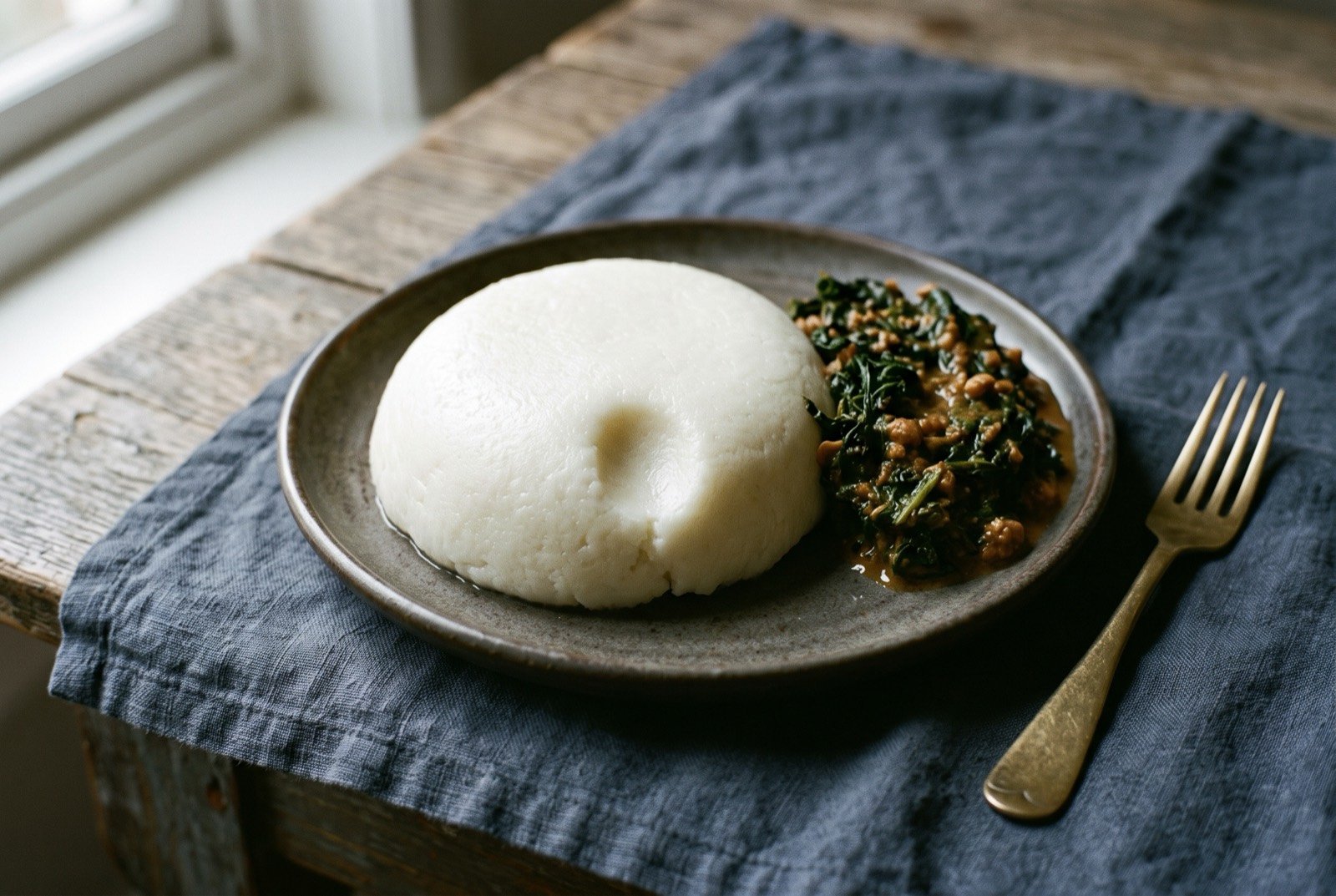
An illustration of the dish, not a photograph of it cooked.
- Time
- 30 minutes
- Reviewed
- Not yet reviewed from inside the tradition
- Cooked
- Not yet cooked and reported
The whole meal, and at lunch and dinner very often the only one. It is eaten with one hand, rolled into a ball in the palm, dented with the thumb and used to scoop. The etiquette is part of the dish: elders wash their hands first and the youngest last, the oldest person uncovers the dishes first and stops eating first, leftover nshima is never served to an adult, and a cook's skill is judged partly on the stick and partly on the ability to find a different relish every day, avoiding kutinkha, the boredom of the same relish too long. In Malawi it is the tradition rather than the dish that UNESCO inscribed in 2017: flour to table, not pot to plate.
As tradition built it
Serves 4. About 30 minutes.
Ingredients
- 260 g white maize meal, refined, fine
- 950 ml water
Method
- Warm the water in a wide, heavy, straight sided pan for 3 to 4 minutes, until lukewarm.
- Sprinkle in 100 g of the meal, stirring constantly with a flat wooden stick, until it thickens and boils. This intermediate is a dish in itself: bota or phala, and it is what breakfast is made of.
- Cover and simmer 3 to 5 minutes on medium. Lay the stick between lid and pot to stop it boiling over.
- Uncover and raise the heat until it boils properly: kukwata.
- Pour in the remaining 160 g in small additions, stirring hard. It will bubble volcanically as it stiffens: kushinyira. Then work it repeatedly against the sides of the pot until smooth and stretchy: kumona.
- Cover, turn off the heat, stand 2 to 3 minutes.
- Tembo's doneness test is better than a timer: push a finger deep into the cooked nshima, and if it resists penetration because of the heat, it is done.
- Turn out onto a wetted plate and shape with wet hands.
Notes
After Mwizenge S. Tembo, the Zambian sociologist writing for a Zambian readership. His volumes are 4 cups of water to 2 cups of meal, converted here at roughly 130 g per cup.
The split between stages is not canonical. Tembo's Zambian version is roughly 37.5 per cent first and 62.5 per cent second; the Great Zimbabwe Guide's is 57 and 43; Anjimile Mtila Oponyo's Malawian version is 50 and 50. Learn the principle and the range, not a rule.
What a modern chef changes
A cold slurry, a longer first stage, a blended grind
Rungs 1 and 2
Method
- Slake the first addition in cold water instead of sprinkling it into warm. Work the 100 g into 200 ml of cold water to a smooth slurry, then pour that into the remaining 750 ml at a rolling boil, stirring. You have eliminated the only step where a lump can form, using a technique in-tradition Zimbabwean and Malawian cooks already use.
- Lengthen the first stage to 15 minutes, covered, on low. Longer completes gelatinisation and drives the raw cereal aroma off, so the second addition thickens violently, which is what you want.
- Blend the grind, 3 parts fine to 1 part coarse. Iwisa Coarse Braai Pap is the same refined grade at a larger particle size, and the blend is the closest a British kitchen gets to a hand pounded meal.
- Rest longer and serve warm rather than scalding. Sadza retrogrades as it sits, going firm then crumbly as amylose recrystallises, so make it last and serve it first. A tray of sadza held hot for three hours is the commonest reason this food disappoints in Britain.