Southern Africa · Volume 19, Nshima and the Relish
Madora and amacimbi
Shona and Ndebele Zimbabwe, ifishimu in Bemba Zambia
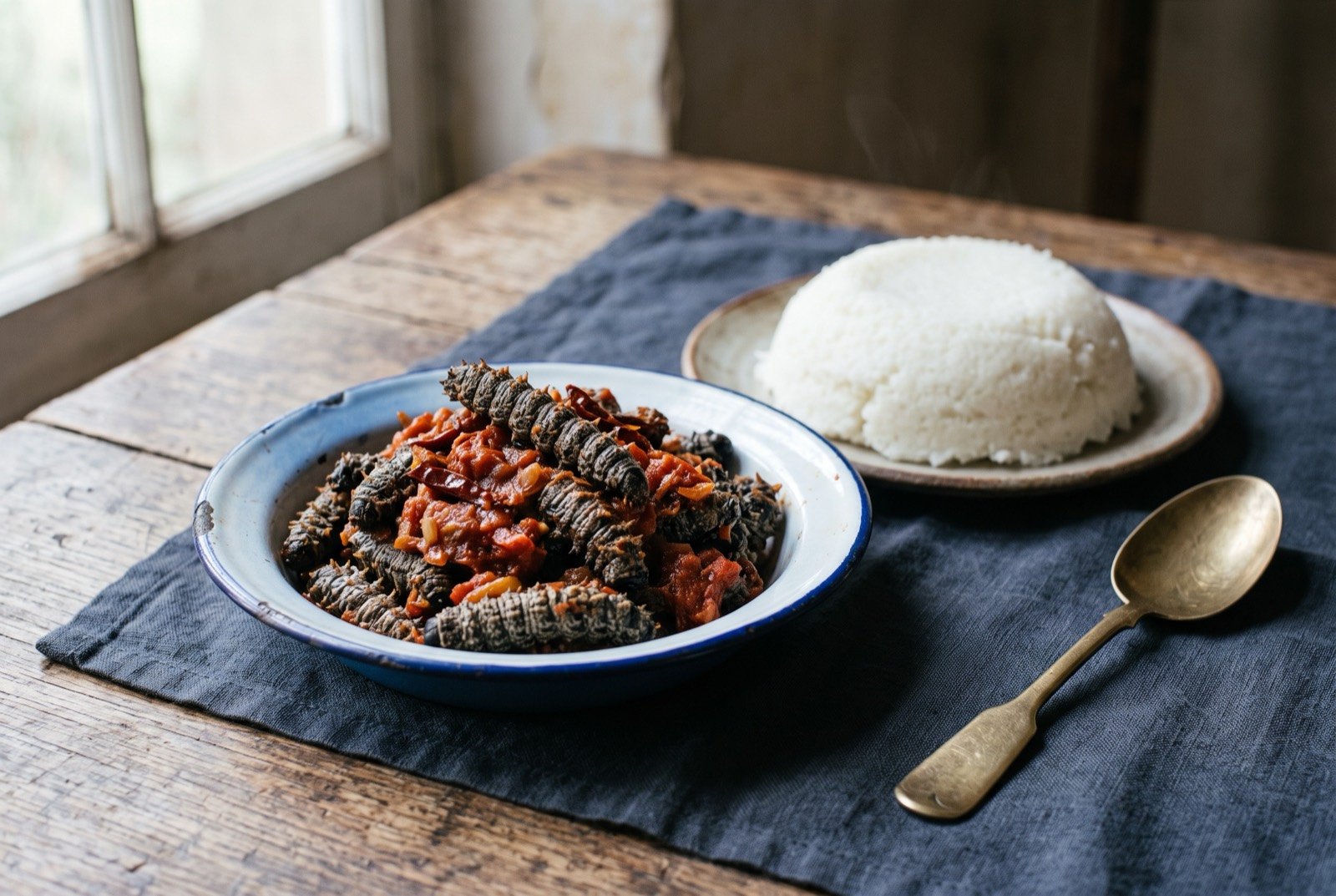
Illustration
- Time
- 45 minutes
- Researched
- Researched from 146 sources in the brief
Gonimbrasia belina, the emperor moth caterpillar, is one of the most efficiently produced foods anywhere: roughly 3 kg of mopane leaves per 1 kg of worms, against something like 10 to 1 for cattle. Traditional processing is a summer harvest, November to December, then degutting by pinching the tail to rupture the organs, squeezing the body lengthwise like a tube of toothpaste and whipping it to throw out the green contents, then boiling in salted water and sun drying or smoking. And it has been measured. Chinhoyi University of Technology, working on worms harvested in Gwanda district between March and May 2021, found the optimum to be boil 20 minutes, then dry at 40°C, giving the highest protein with minimal coliform counts, at 2.78 per cent ash, 20.16 per cent crude fat and 13.60 per cent crude fibre on a dry weight basis. Reported composition generally runs 52 to 61 per cent protein, 10.8 to 13.3 mg zinc and 9.7 to 29 mg iron per 100 g. Earlier work found boiling in salt water followed by open pan roasting the most effective traditional route, eliminating coliforms, Staphylococcus aureus, Salmonella and E. coli. Longer boiling is worse, not better: sixty minutes significantly reduced protein.
As tradition built it
Serves 4 as relish. About 45 minutes.
Ingredients
- 100 g dried mopane worms
- 2 tbsp oil
- 1 onion, sliced
- 2 tomatoes, chopped
- 1 fresh chilli
- to taste salt
Method
- Rinse thoroughly in several changes of water, then soak in warm water 20 to 30 minutes until pliable. Drain.
- Dry fry in a hot pan until they crisp and smell nutty, then set aside. This is the open pan roast the traditional route uses after boiling, and it is where the flavour is.
- Cook the onion, tomato and chilli down to a thick base in the oil.
- Return the worms with a splash of water and simmer 10 minutes so they take up the sauce without going soft. Salt at the end.
Notes
In Britain you start from the dried product. The sources describe the cooking without weights; the quantities below are working ones.
What a modern chef changes
Ground to a rub, which is the single best idea in the volume
Rungs 4, 2 and 3
Method
- Grind them and use the powder as a rub, in Sungani Phiri's manner. On The Rebirth, dried caterpillars that would ordinarily be deep fried are ground to a powder and used as a steak rub. Phiri's explanation is the most transferable sentence in the research: the ingredient is fully present, but the technique creates a bridge. For a reader squeamish about eating a whole caterpillar this is the entire on-ramp, and it is not a trick: the powder is intensely savoury, mushroomy and mineral, and it crusts on meat exactly as a dried mushroom powder does.
- Make the rub properly. Dry toast 30 g until brittle, grind fine in a dedicated spice grinder, sieve, and cut with an equal weight of salt and a quarter of its weight in piri-piri. A month in an airtight jar in the dark, then the freezer: these are fatty and they oxidise.
- Use the rest as a stock ingredient. Rung 4 applied to an insect rather than a fish. Steep 20 g in 400 ml of water at 70°C for 20 minutes and strain, and you have a dark savoury liquor that is the correct base for the tomato relish the worms are usually cooked in.
- Keep the fried texture separate to the last second. Rung 2. Anything crisp that meets a wet sauce more than a minute before service is no longer crisp.