Southern Africa · Volume 19, Nshima and the Relish
Matapa
Mozambique
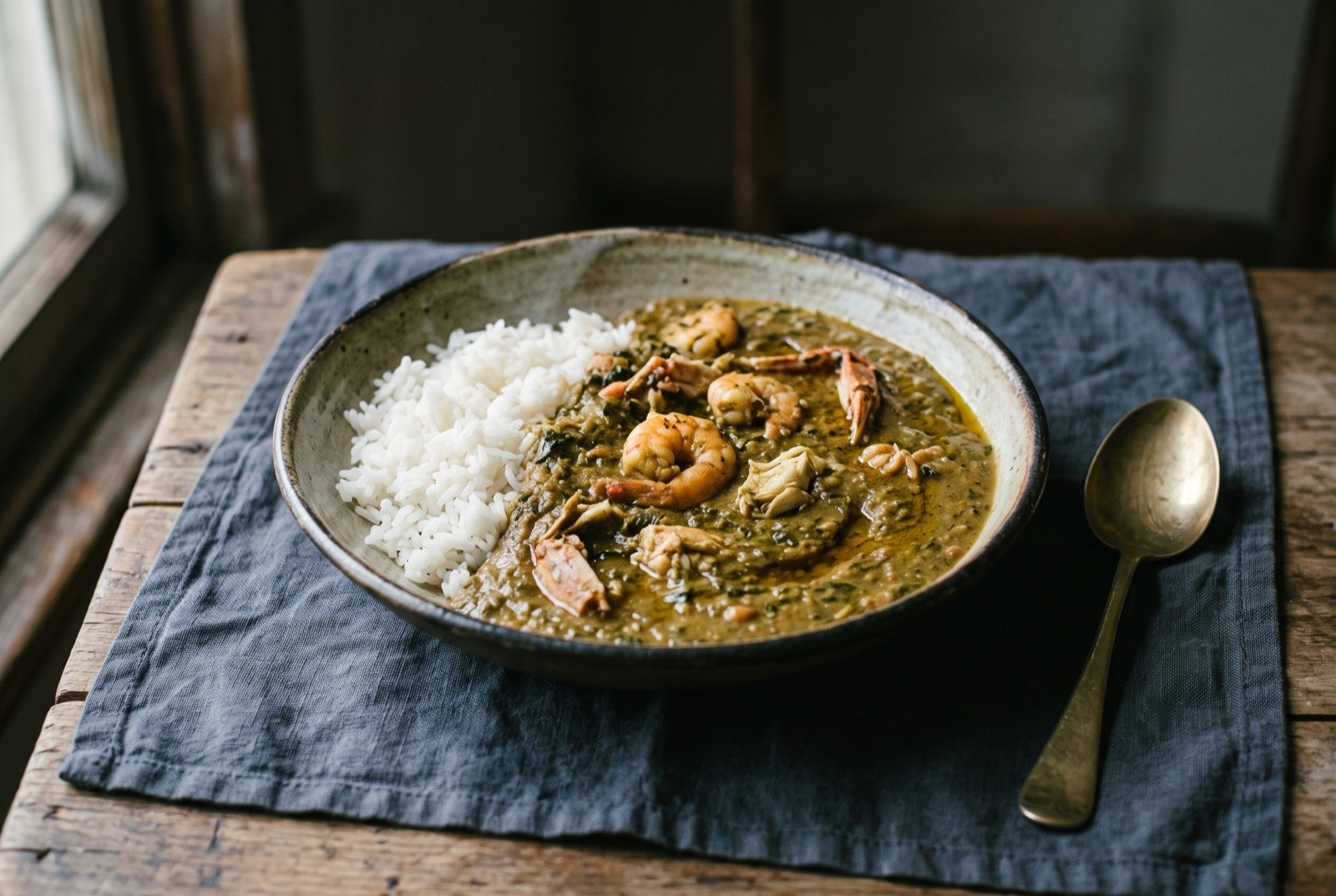
An illustration of the dish, not a photograph of it cooked.
- Time
- 1 hour 50
- Reviewed
- Not yet reviewed from inside the tradition
- Cooked
- Not yet cooked and reported
Genuinely different from anything to the west, because the leaf is pounded raw with the aromatics before it is cooked. Mozambican food writing calls it um elo de união nacional, a link of national union, with the recipe varying from north to south. Read the ratio below: two parts groundnut to one part leaf, by weight. That is far more groundnut than a Zambian ifisashi, and it is why matapa eats like a thick nut porridge carrying a green flavour rather than like greens in a sauce.
As tradition built it
Serves 6 to 7. About 1 hour 15 cooking, plus 35 minutes of preparation.
Ingredients
- 250 g young cassava leaves
- 500 g groundnuts, pounded and sieved
- 5 cloves garlic
- 1 whole fresh coconut, grated
- 1 small onion, chopped
- 1 tsp salt
- to taste piri-piri, to taste
- as available prawns or crab, cleaned, optional but usual
- 1 juice of 1 lemon
Method
- Wash the cassava leaves and let them dry.
- Add the garlic, piri-piri and salt and pound very thoroughly in a pilão to a compact paste. This is not a texture step: rupturing the cells releases the plant's linamarase, and it is the enzymatic half of the detoxification.
- Put the paste in the pot with a little water and boil 30 minutes.
- Meanwhile grate the coconut and work it with warm water for the milk; sieve the pounded groundnut; clean the prawns or crab; chop the onion.
- Pour the coconut liquid in, add groundnut, onion and prawns or crab, and simmer 1 to 2 hours. The long cook completes both the detoxification and the emulsion and cannot be shortened.
- Finish with lemon juice, off the heat.
- Serve with white rice, xima or upswa.
Notes
Weighed version after MMO in Maputo, with the pounding and the finish from the Slow Food and Maputo city agriculture booklet.
An alternative Mozambican account gives the first stage as an evaporation stage: cook the pounded paste in water and salt uncovered until the water has gone, then add the coconut milk, groundnut, onion and shellfish and simmer gently for an hour. Both are recorded and this chapter does not rank them.
What a modern chef changes
Temperature control, acid held to the end, prawn out of the long cook
Rungs 6, 2 and 3
Method
- Hold everything below a simmer from the moment the coconut goes in. A probe in the pot, 80 to 85°C, never a bubble. Coconut proteins denature between roughly 80 and 90°C; boil it and you get oil over grainy solids, and a broken matapa is unrecoverable. Rung 6.
- Bloom the piri-piri in fat rather than pounding it into water. Warm two tablespoons of the thick top layer of the coconut milk with the chilli and garlic at low heat for five minutes before it joins the pot. In fat the capsaicin distributes through the emulsion and the heat arrives broad and long; in water it stays particulate and hits spiky and front of mouth.
- Take the shellfish out of the long cook. Cook the leaf, groundnut and coconut for the full time, because that time is doing detoxification work, then poach the prawns separately for three minutes at the end and fold them through. The long simmer is right for cassava leaf and catastrophic for prawn. Rung 2.
- The lemon goes in off the heat, and more at the table. Acid pushes coconut protein toward its isoelectric point and will break a sauce that survived the heat.
- If you are using frozen pondu, still cook it long. It arrives already ground, which does the mechanical half. It does not do the chemical half.