Southern Africa · Volume 19, Nshima and the Relish
Kondowole
Northern Malawi
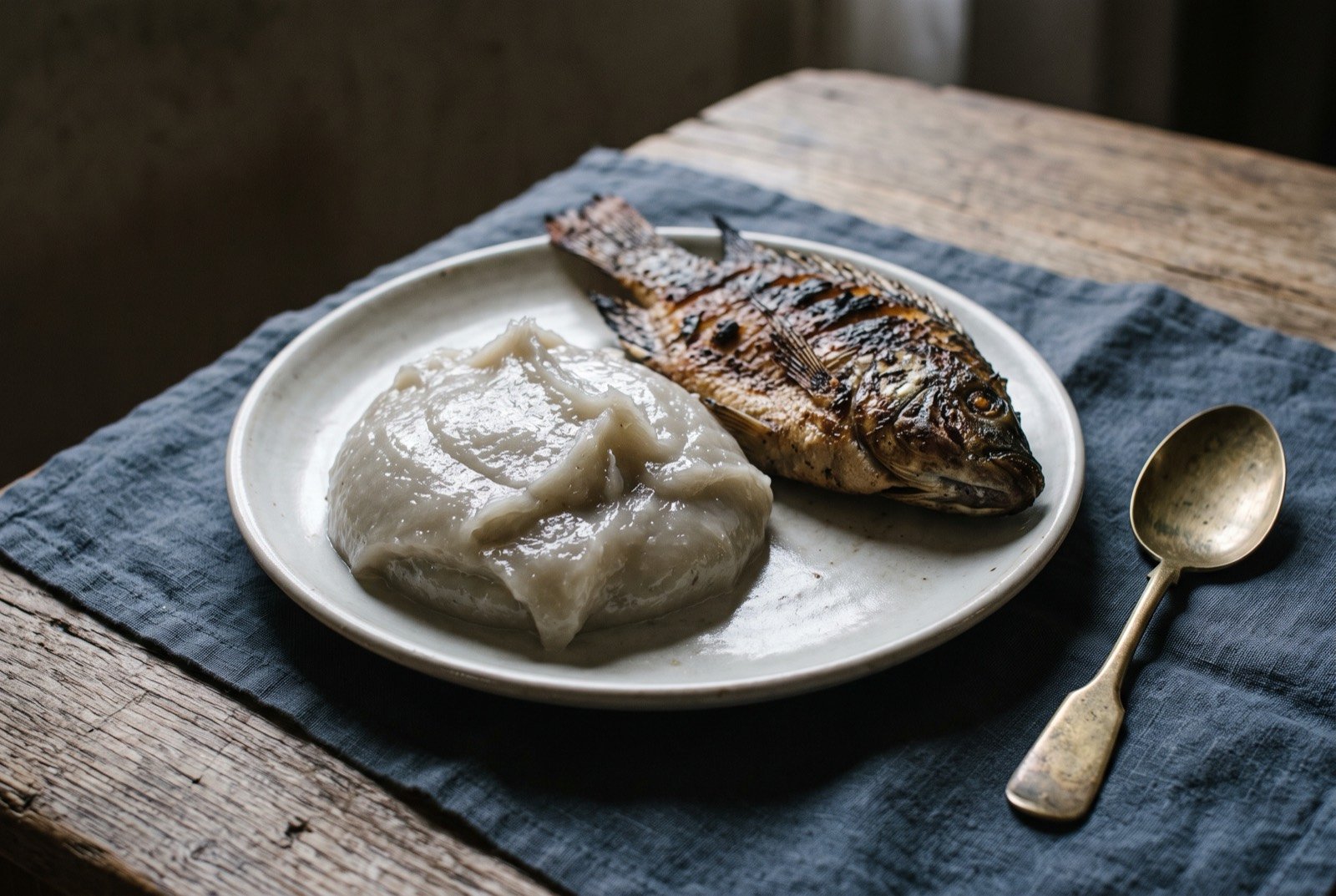
An illustration of the dish, not a photograph of it cooked.
- Time
- 15 minutes
- Reviewed
- Not yet reviewed from inside the tradition
- Cooked
- Not yet cooked and reported
Not a variant of nsima but a separate dish by a separate route. The flour is the dish. Peel the cassava; soak it 2 to 4 days to ferment; remove the central fibrous core; pound to a paste in a mortar, the mtondo, with a pestle, the musi; sun dry in small separated portions; grind; then sieve, or take it to the maize mill. Why the soak. Fermenting the peeled roots does for the tuber what pounding does for the cassava leaf in matapa: it lets linamarase act on the cyanogenic glucosides, and it acidifies and softens the tissue. It also produces the sour note that distinguishes kondowole from a plain cassava paste, which is the flavour the dish exists for. It is so stiff that it is cooked on the floor, because you cannot get enough leverage on the stick at hob height, and it cannot be made in bulk. It is eaten with lake fish, especially utaka and chambo.
As tradition built it
Serves 2. About 15 minutes from flour.
Ingredients
- 250 g fermented cassava flour (four handfuls)
- 400 ml water
- to taste salt
Method
- Boil the water and salt in a small pot, filled no more than halfway.
- Add the flour.
- Stir briefly over the heat until it goes pasty. This happens fast.
- Take it off the heat and keep mixing until the flour is fully incorporated and the paste is smooth, translucent and extremely stiff. Put the pot on the floor and hold it with your feet if you need to. That is not folklore; the leverage is the technique.
Notes
The source gives the sequence in handfuls rather than grams; the conversion is mine.
What a modern chef changes
Cold slake, sourness as a dial, small batches
Rungs 1 and 2
Method
- Slake it cold. Work the 250 g into 150 ml of cold water to a smooth slurry, then rain that into the remaining 250 ml at a simmer. No lumps, and half the work. Rung 1, and the same principle that funge, tô, placali and nshima all arrived at independently, which is a striking piece of convergent engineering across a continent.
- Taste the slurry for acid and treat it as a dial. Fermented cassava flour varies enormously in sourness between brands. If it is flat, add a tablespoon of strained lacto-ferment brine; if it is aggressive, let the fish carry the plate.
- Do not try to make it in bulk. The tradition is right, and the reason is mechanical: a large mass of very stiff paste cannot be worked evenly by one pair of arms and the centre stays raw.
- Portion into quenelles rather than a communal dome, with a whole grilled lake fish, or in Britain a whole grilled bream. Rung 2 applied at the plate.