Melanesia, Micronesia and Polynesia · Volume 05, The Highlands, the Sepik and the Reef
Saksak
The Sepik
Illustration
- Time
- 30 minutes
- Researched
- 1 source cited
Saksak is both the starch and the dish, and it anchors the diet of a river system with genuinely poor soil for almost anything else. No source this chapter could reach gives an exact ratio of sago starch to banana or coconut, or a precise cooking time for the finished parcel; the technique itself, mixing the starch with banana or coconut and cooking the result on or near hot stones or charcoal until set, is well corroborated, and the quantities below are this chapter's own workable scaling of that technique rather than a transcribed traditional recipe.
As tradition built it
Serves 4. About 30 minutes, once the starch itself is prepared.
Ingredients
- 300 g sago starch or sago flour (see Sourcing in Britain: not sago pearls, which are the wrong product)
- 2 ripe bananas, mashed
- 200 ml coconut cream
- as available banana leaf, for wrapping
Method
- Mix the sago starch with the mashed banana and coconut cream to a thick, cohesive paste.
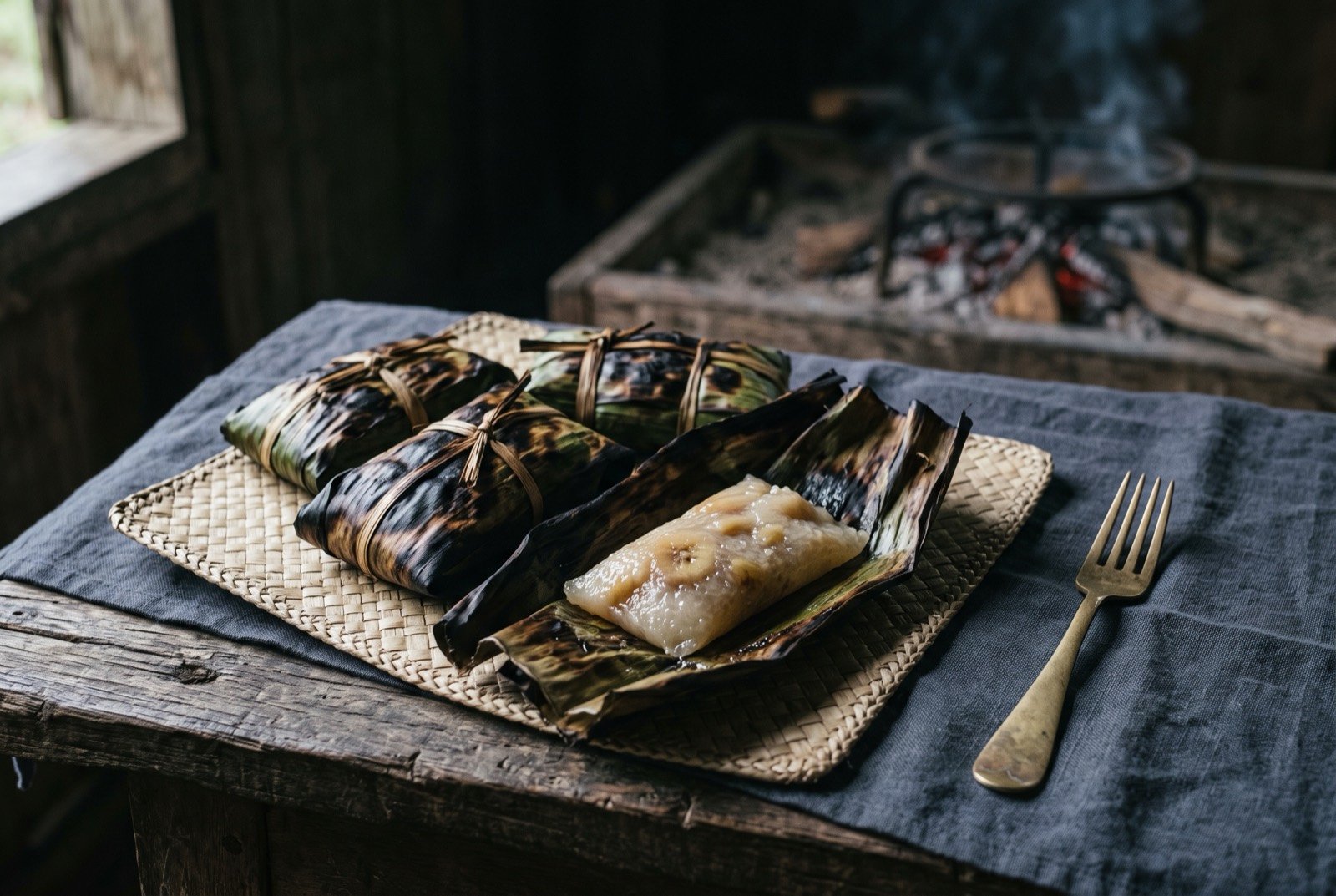
- Divide into portions and wrap each in a piece of banana leaf, folded into a parcel.
- Cook the parcels on a rack over hot coals, or on a griddle over a low flame, turning occasionally, until the starch inside has set translucent and firm, roughly 15 to 20 minutes.
- Unwrap and serve warm, traditionally alongside smoked fish or wild greens.
What a modern chef changes
The starch extraction itself treated with real precision, since that separation, not the final cooking, is the whole technique
Rung 2
Method
- If working from raw sago pith rather than bought starch, pulse it briefly in a high-power blender rather than pounding it by hand, then wash the pulp through a fine chinois set over a bowl, pressing to force the starch-laden water through while the spent fibre stays behind: this is a direct mechanical translation of the traditional pound-and-strain sequence, not a different technique, only a faster one.
- Let the strained liquid settle undisturbed for at least 2 hours, then pour off the clear water and use the wet starch sediment directly, which is closer to how the starch is traditionally used fresh than drying it fully first.
- Steam the wrapped parcels in a covered steamer rather than over open coals, which gives an evenly cooked, fully translucent set without the risk of scorching the leaf before the starch inside has actually finished setting.