Oceania and the Pacific · Volume 05
Papua New Guinea
The Highlands, the Sepik and the Reef
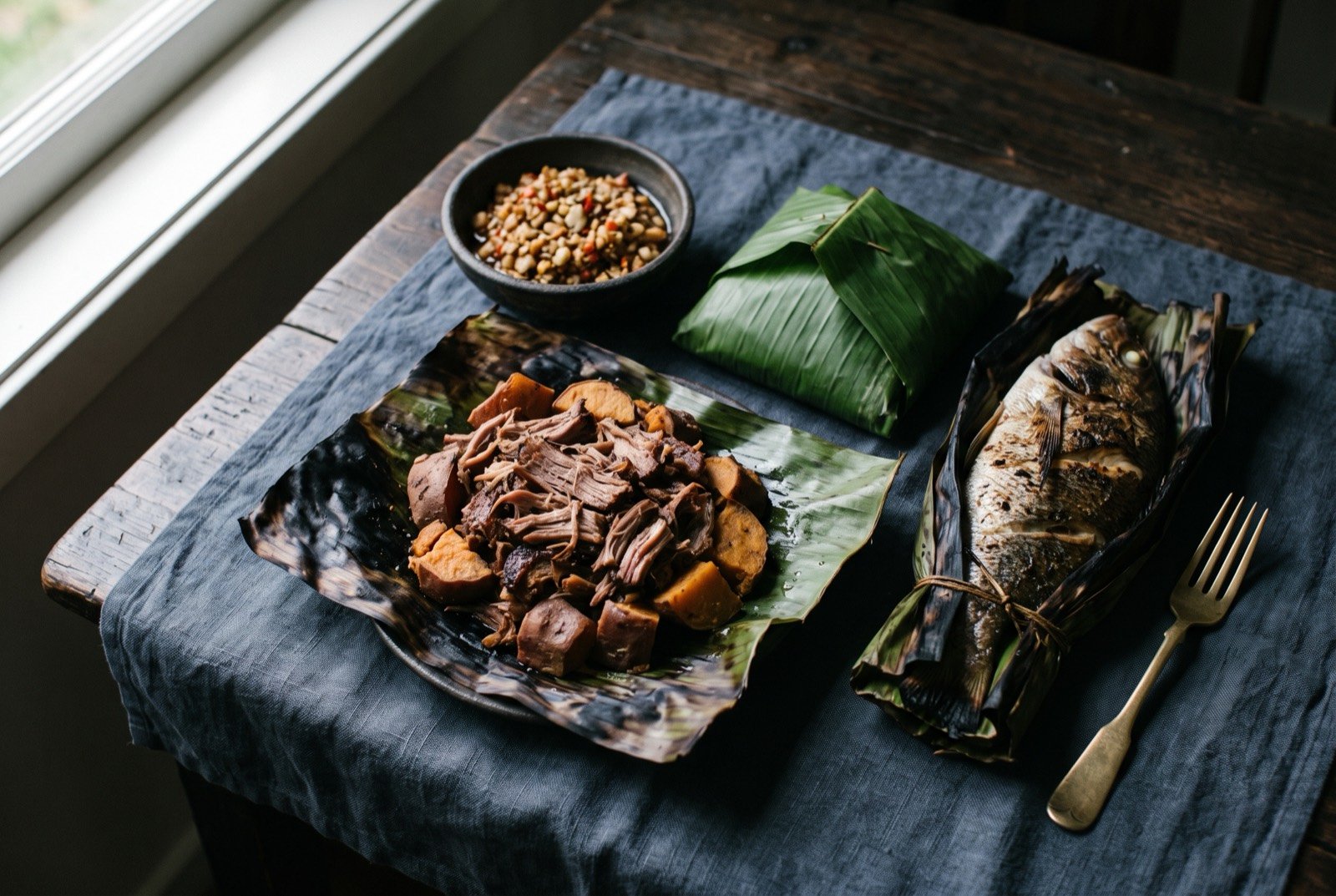
Papua New Guinea holds more than eight hundred distinct language groups, and there is no single Papua New Guinean cuisine. There are at least three food worlds sharing one flag: a highland interior built on sweet potato and the pig, the Sepik built on wild sago and fish, and a coast and islands built on coconut and the reef, and every dish as tradition built it, then what a modern chef would change.
Sources and review · What this chapter does not assert · How we research · Spotted something wrong?
A Sense of Place
Three ecologies, not one country's worth of cooking
The densely populated highland provinces, Western Highlands, Eastern Highlands, Chimbu, Enga, Southern Highlands, Hela and Jiwaka, sit in intermontane valleys mostly between 1,500 and 2,400 metres, with gardens pushed above 2,700 metres in places like Ialibu and Tambul, where frost rather than rainfall is what limits a harvest. This is genuinely unusual: a tropical mountain interior supporting population densities that in parts of the Wahgi Valley reach around 150 people per square kilometre, dense enough that food security here is a matter of real, recurring risk rather than abstract concern. The staple is kaukau, sweet potato, and the currency is the pig. Fat, where there is one, is pork fat or the juices an earth oven renders down through its own layers; the thickener does not really exist as a category, since highland cooking is built on steaming and boiling rather than sauce-making; the aromatic is ginger where it is anything at all.
The Sepik river basin, in the country's north, is a different world entirely: a vast, low, swampy floodplain of some 78,000 square kilometres and over 400,000 people, where the wild sago palm needs no cultivation at all and grows in genuine abundance. Sago, saksak in Tok Pisin, and fish are the whole of the diet for many Sepik villages, and the two are traded between specialist communities, river people who fish and forest people who process sago, rather than produced identically everywhere along the river. One Eastern Iatmul villager, interviewed by the American anthropologist Eric Silverman, put the region's relative poverty in resources bluntly against provinces sitting on mineral and petroleum wealth: "we only have water and fish." Fat here is coconut where the lowland forest allows it and otherwise none at all; the aromatic, where used, tends to be smoke, from fish and meat preserved over the fire rather than a spice cupboard.
The coast, and beyond it the New Guinea Islands, New Britain, New Ireland, Bougainville and Manus, run on a third logic again: coconut as the dominant fat, reef and pelagic fish as the dominant protein, and, on the islands specifically, the galip nut, an indigenous forest tree nut with a documented history stretching back some seventeen thousand years in parts of the Sepik and over eleven thousand on Bougainville, making it one of the oldest continuously used foods anywhere in this atlas. Betel nut, buai, chewed rather than eaten, threads through all three zones and deserves treating honestly rather than as a curiosity, which the Flavour Arsenal below does.
| Highlands | The Sepik | Coast and Islands | |
|---|---|---|---|
| Staple starch | Kaukau (sweet potato) | Saksak (sago) | Coconut-cooked root crops, banana |
| Fat | Pork fat, mumu juices | Coconut where available, otherwise none | Coconut cream and oil |
| Protein | Pig, the highland store of wealth | River fish, sago grubs | Reef and pelagic fish, galip nut |
| Cooking logic | Steaming, boiling, the earth oven | Pounding, washing, steaming | Coconut-milk stewing, leaf-wrapped grilling |
| The exchange economy | Moka and tee: pigs given in escalating cycles for status | Fish traded for processed sago between specialist villages | Galip nut as an island trade good since deep prehistory |
This table names four peoples and regions this chapter can actually document with real sources: the Melpa of Mount Hagen and the Enga of the western highlands, whose exchange systems anthropologists have studied for decades; the Iatmul and Sawos of the middle Sepik; and the New Guinea Islands broadly, where the galip nut trade is the best-evidenced coastal thread. It does not claim to represent the other several hundred language groups this atlas simply could not reach in one research pass, and it says so again at the end.
The History in Layers
Ten thousand years before anyone else had it
In the Wahgi Valley of Western Highlands Province, about twelve kilometres northeast of Mount Hagen, sits Kuk Swamp, a UNESCO World Heritage site inscribed in 2008 as one of the small handful of places on earth where agriculture was independently invented rather than learned from somewhere else. Excavation led by Jack Golson from the 1960s onward, reinterpreted with modern archaeobotany by Tim Denham and colleagues from the late 1990s, shows drainage ditches and mounded cultivation from as early as ten thousand to seven thousand years ago, taro exploitation from around seven thousand years ago, and deliberate cultivation of bananas and sugar cane on drained ground from roughly 6,900 to 6,400 years ago. This predates or matches the earliest agriculture in the Fertile Crescent, China and Mesoamerica, and it happened in continuous, identifiable phases across thousands of years rather than in one inventive moment. The crop at the bottom of all of this is taro, not sweet potato. Kaukau, the staple this whole chapter is otherwise built around, is a much later arrival, and how much later is genuinely disputed.
The kaukau question, held honestly open
The mainstream archaeological reading, based on Golson and Denham's own Kuk Swamp chronology, is that sweet potato reached the Trans-Fly coast of New Guinea via island Southeast Asia sometime between 1645 and 1790, most likely following Iberian contact with the Moluccas and the Philippines in the sixteenth century, and that the highland garden system had reorganised itself fully around the crop by around 1700. Direct radiocarbon dating of charred sweet potato fragments from Nombe rockshelter in the highlands, published in 2022 using microCT scanning to confirm the material before dating, returned dates broadly consistent with that window, three hundred to a hundred and fifty years before present. On the strength of dated physical evidence, this chapter treats kaukau's arrival as recent, on the order of three to four hundred years, with its full social transformation of highland life unfolding across the eighteenth and nineteenth centuries.
That is not the only position in circulation, and it deserves a fair hearing rather than silence. Sceptics of the tight window point to a real puzzle: Papua New Guinea has no loanwords for sweet potato derived from Spanish or Portuguese, camote or batata, which is genuinely odd if an Iberian-mediated route were solely responsible, and the depth of the crop's integration into ritual, myth and named local variety looks to some readers like the product of a longer relationship than four centuries allows. This argument has been made most vocally in PNG-focused amateur commentary rather than in a peer-reviewed paper with its own radiocarbon dates, and this chapter does not treat it as equally weighted against Golson and Denham's dated stratigraphy. But the underlying puzzle it raises, rapid diversification with no trace of the words that ought to have arrived with the plant, is a real one, independently noted in peer-reviewed genetic diversity literature on New Guinea as a secondary centre of sweet potato variation, and it is fairer to the reader to say the dating is contested than to present the mainstream figure as beyond question.
Whichever the true timeline, sweet potato's advantage over the taro and banana it displaced was practical and decisive: it tolerates poor, cool, high-altitude soil, grows on a short cycle, and yields far more food per unit of labour than taro ever did at altitude, which let cultivation climb higher up the mountainsides than the older staples could follow. That single agronomic fact is the most defensible explanation on offer for why the highlands can support the population densities they do.
Pigs, not cash, as the highland store of wealth
Pig husbandry developed as part of the same agricultural package as sweet potato, and the two remain inseparable: culled small tubers unfit for human eating, roughly a quarter to a third of a highland household's total sweet potato harvest by the National Agricultural Research Institute's own figures, are the standard pig feed. Smallholder pig farming produces an estimated 27,000 tonnes of pork a year nationally, against around 1,000 tonnes from commercial production, which tells its own story about where PNG's meat actually comes from.
Pigs, not land or cash, are the literal basis of the highlands' two most studied exchange systems. Moka, centred on the Melpa-speaking people of Mount Hagen and studied for decades by the anthropologists Andrew Strathern and Pamela Stewart, is a competitive gift-giving system in which pigs, and historically pearlshells, are given in escalating cycles between exchange partners: the term moka specifically names the increment by which a gift exceeds what was received, and giving more brings greater status, underwriting a highland "big man" political system with no hereditary chief at its centre. Tee, the parallel system further west among the Enga, documented in detail by the anthropologist Darryl Feil among the Tombema Enga, runs on the same pig logic, with a detail popular accounts often flatten out: women are recorded as essential political actors in tee, allotting pigs and deciding which exchange partnerships actually proceed, not bystanders to an all-male system. Pigs are also the currency of bride price and of compensation payments that settle disputes across the highlands generally, with reported cases running from single figures up to twenty-six pigs alongside cash, and large-scale pig-kill festivals, sometimes exceeding a hundred pigs in a single event, are staged as part of these exchange and compensation cycles, frequently combined with singsing, competitive massed song and dance in full ceremonial dress. The two flagship contemporary showcases of this culture, the Goroka Show and the Mount Hagen Cultural Show, both descend from this ceremonial complex, though both are now also public tourism events and should be read as such rather than as unmediated tradition.
Sago, fish, and a river that trades in itself
The Sepik's food geography is not one undifferentiated sago economy but a network of villages specialising and trading with each other. Silverman's fieldwork among the Eastern Iatmul at Tambunum records that river villages traditionally exchanged fish for processed sago starch with their inland neighbours, the Sawos, who have the forest and the sago stands but not the river. This division of labour, river people fish, bush people process starch, and the two trade, is a structuring fact of Sepik life, not a colourful detail. It is worth adding, because it complicates any romantic picture of the river as endlessly abundant, that Silverman also documents the Sepik as a comparatively unproductive fishery by world standards, and that species introduced from the 1950s onward, tilapia, common carp and later the Amazonian Prochilodus, known locally as raba maus, "rubber mouth", have displaced native fish that were staples within living memory. Villagers he interviewed in 2014 told him plainly: "we only have new fish, rubbish fish... we want the fish we grew up on." The Sepik cooking this chapter describes is built on a somewhat different river than the one an older generation grew up fishing.
Crocodile, once food, now mostly a spirit
Crocodile deserves a specific correction, because a chapter written carelessly could present it as a current everyday Sepik dish, which it is not. Silverman's fieldwork is unambiguous that by the 2010s, crocodile as food among the Eastern Iatmul had become marginal: decades of hunting for skins, combined with wetland degradation, have made Sepik crocodiles the beneficiaries of active conservation projects, and "most of the crocodiles seen today are decorative images", on souvenirs, the provincial flag, the one-kina coin. Crocodile spirits continue to preside over ceremonial and cosmological life along the river even as the animal itself is rarely eaten or seen, which is a genuinely interesting fact about how a food culture's symbolism can outlive the food, but it is not the same as crocodile being a dish this chapter can responsibly give a recipe for.
Coconut, copra, and the colonial economy of the coast
The coast and islands' relationship with coconut is not purely culinary. Coconut has been the dominant cash crop of coastal and island Papua New Guinea since the German and then Australian colonial administrations built a copra export economy around it, and it remains one of the country's most significant agricultural exports, engaging a very large share of the population in either income or subsistence food from the same tree. Germany annexed the northeastern mainland and the islands as German New Guinea from 1884; Australia took administrative control during the First World War and held it, first as a League of Nations mandate and later as a United Nations trust territory, until independence on 16 September 1975. This chapter does not have the sourcing to trace a detailed culinary line from that administrative history into any specific dish here, the way an earlier volume in this atlas can trace nutmeg directly to the Dutch East India Company's Banda monopoly, and it would be dishonest to invent one. What can be said plainly is that the coconut palm's economic centrality on the coast is a colonial-era fact as much as an ecological one, and naming that is part of telling this region's history in full.
The Flavour Arsenal
Kaukau, the highland staple and its real diversity
Kaukau, sweet potato, supplies somewhere between half and ninety per cent of the calories eaten in the central highlands, depending on the specific study consulted, and the National Agricultural Research Institute holds one of the largest sweet potato germplasm collections in the world, 865 distinct accessions, making Papua New Guinea a recognised secondary centre of the crop's genetic diversity. This is worth being precise about, because vague claims of "hundreds" or even "thousands" of named highland varieties circulate widely online without a traceable source. What can actually be cited is more interesting and more specific: NARI's own genebank of 865 accessions, nine improved highland lines released under the name NARI Hailans Kaukau, and a farmer-participatory project at Teptep village in the Madang highlands that documented fifteen named local varieties still grown by a single community, several with names visibly tied to place, Kerot Simbu, Kerot Kainantu, Minj Purple. In the highest gardens, above roughly 2,100 metres, growers build large circular soil mounds packed with a composting core of decaying vine and weed matter, which generates internal heat to protect tubers from night frost while improving drainage, a real and specific piece of highland agricultural technology worth knowing before assuming kaukau simply grows itself.
Saksak, the sago that needs no planting
Sago, saksak, is extracted from the pith of the sago palm through a sequence consistent across every account this chapter checked: the palm is felled; the bark is split away to expose the starchy white pith; the pith is pounded or rasped, traditionally with a purpose-built tool sometimes called a "seven"; the pulp is washed with water and strained through a leaf-fibre sieve to separate starch from waste fibre; and the starch-laden water is left to settle before the sediment is dried for storage. The palm grows wild across the Sepik floodplain and needs no cultivation at all, which is precisely why it, rather than a planted grain, anchors the diet of a region with comparatively poor soil for other staples.
Kumu, and a coconut caveat worth taking seriously
Kumu is the Tok Pisin umbrella term for cooked leafy greens, as distinct from abus, meat, and the starches above. It covers aibika, also called Pacific cabbage or bele, a hibiscus-family green with a faintly mucilaginous texture when cooked, alongside amaranth, kangkong and other local greens. Cooking kumu in coconut cream is repeatedly described as one of the most recognisable signatures of Papua New Guinean food generally, and it is a genuinely coastal signature. It is very likely not a highland one: the highlands sit well above coconut palm range, so any coconut reaching a highland kitchen has always been an imported good carried up from the coast, and highland kumu is at least as likely, probably historically more likely, to be cooked plain, with rendered pork fat or mumu juices, or with ginger, as with coconut cream. This chapter treats the "coconut and greens" image of Papua New Guinean food as a coastal truth wrongly generalised to the whole country in a great deal of secondary writing, and keeps its two kumu dishes below deliberately distinct on that basis.
Galip, an ancient nut with a live second act
Galip, Canarium indicum, is a large forest tree bearing a nut with a milky, buttery flavour, closer to a rich almond crossed with a pine nut than to anything commonly sold in Britain. It is one of the oldest continuously used foods in this entire atlas: archaeobotanical seed remains have been dated to roughly seventeen thousand years ago in the middle Sepik, fifteen and a half thousand years ago on Manus, eleven and a half thousand years ago on Bougainville, and nine thousand years ago on New Ireland. Traditional processing places harvested nuts in water-filled pools to let the surrounding husk decompose over several days, after which they are sun-dried and smoke-cured over cooking fires for storage lasting a year or more, work that has traditionally fallen principally to women across the whole supply chain, from harvest to processing to sale. Galip is also, right now, the subject of the single most genuine "living tradition" story this chapter could find: more than thirty years of agricultural research support from ACIAR, Australia's international agricultural research body, working in direct partnership with PNG's National Agricultural Research Institute, has built a real if still small commercial industry, more than eighty per cent of it smallholder-supplied, women prominent throughout. A private Rabaul-based processor, Frangipani Foods, founded by the former NARI scientist Dr John Moxon, has since won Great Taste Awards from Britain's own Guild of Fine Food and stated an ambition to reach the UK market, though as the sourcing section below makes clear, that ambition is not yet a working supply chain.
Betel nut, held honestly
Buai, the areca nut chewed with lime and a mustard catkin, is not a food in the sense this chapter otherwise means the word, but no honest account of Papua New Guinean daily life can leave it out. A widely cited World Health Organization estimate puts daily chewing at around eighty per cent of PNG's adult population, and the practice functions socially as a greeting, a shared snack at meetings, and a genuine informal-economy livelihood in every PNG town, starting, by some accounts, as young as eight years old. It carries a real and serious cost that this chapter will not soften: the World Health Organization has identified Papua New Guinea as having the highest incidence of oral cancer in the world. Nerida Bun, a lecturer in dentistry at the University of Papua New Guinea, wrote in August 2026 that the country now has the highest oral cancer incidence rate among a hundred and eighty five countries measured, ahead of India, Bangladesh and Pakistan, and that the practice has spread from its traditional rural base into urban Port Moresby with no meaningful age restriction, against a health system with no national cancer registry to even measure the true scale of the problem precisely. Both things are true at once, buai's deep social embeddedness and its documented cancer burden, and this chapter holds both without resolving the tension for the reader, which is the house style's instruction for exactly this kind of contested, serious subject.
Sago grubs, a real protein and a genuine one this chapter cannot cook
The larva of the sago weevil, Rhynchophorus ferrugineus, grows in the decaying pith of a felled sago palm left deliberately for several months, a managed harvest rather than opportunistic foraging. A Japanese-authored entomological field study in East Sepik villages recorded the larva's composition, roughly seven per cent protein and eleven per cent fat, and a common preparation, stewed with coconut milk, salt, onion, aibika and mushroom, alongside a habit of children eating the grubs raw and live straight from the palm. This is a genuine, ordinary food, not an exoticism performed for outsiders, and it belongs in this chapter's honest account of Sepik protein for exactly that reason. It does not appear in the Dishes, Twice below, because there is no way to source the animal in Britain and no responsible way to write a "modernist elevation" of a dish this chapter's reader cannot actually cook; naming it properly here, rather than either omitting it or forcing it into an unusable recipe, is this chapter's best answer to that specific problem.
The Technique Ladder
The argument, from inside
Every technique below either traps heat and steam somewhere it would otherwise escape, or slowly separates one thing from another, starch from fibre, cream from grated flesh, flavour from a raw nut. None of it depends on imported equipment. All of it rewards patience with time rather than intensity of heat, which is the same discipline this atlas keeps finding wherever a cuisine has had to feed people well without a hearth full of French sauce pans.
Rung 1. Seal the heat in, and let steam do the cooking
Mumu works because a pit sealed under banana leaf and earth traps the steam and residual heat of white-hot river stones long enough to cook meat and root vegetables slowly and evenly from every side at once, without the surface-scorching risk of direct fire. This is a member of the same earth-oven family found right across the Pacific, the Māori hāngī, the Fijian lovo, the Hawaiian imu, the umu of Samoa and Tonga, and this chapter treats mumu as this atlas's home account of that shared technique for Papua New Guinea specifically, cross-referencing the sibling volumes elsewhere in Oceania rather than re-explaining the same physics from scratch each time.
Rung 2. Pound, then wash, then let gravity finish the job
Extracting sago starch works by mechanically breaking down fibrous pith so that water can carry the starch granules away from the fibre that has no culinary use, then simply waiting for gravity to settle the heavier starch out of suspension. No heat is involved until the starch is actually cooked; the entire extraction is a patient physical separation, not a chemical one.
Rung 3. Wrap in a living leaf before you touch fire
A banana leaf wrapped around fish or a starch parcel before it meets heat does two jobs at once: it holds in moisture so the food steams gently inside its own wrapper rather than drying out over direct heat, and it imparts a faint grassy, tannic flavour of its own as it lightly chars. This is a genuinely different mechanism from the sealed pit above, working over minutes on an open fire rather than hours underground, and it is worth keeping the two techniques distinct rather than treating "wrap it in a leaf" as one undifferentiated Pacific gesture.
Rung 4. Squeeze the cream, then keep it below a simmer
Coconut cream is extracted by grating the flesh and squeezing it, by hand or through cloth, to release the fat-rich liquid, and a coconut-based stew depends on keeping that liquid below a hard boil once it goes into the pot: coconut cream's fat and protein will split and turn grainy under sustained high heat in exactly the way a French beurre blanc will, and a gentle, patient simmer is what keeps a fish-and-coconut stew silky rather than curdled.
Rung 5. Roast before you grind, never after
A galip nut's flavour depends on roasting before grinding, since roasting develops the deep, buttery aromatic compounds that a blender or pestle can only distribute evenly through a paste once they already exist, never create afterward. This is the same principle this atlas has already stated for hazelnuts in a Belgian praline, applied here to a nut with no European counterpart.
The Ferment and Preserve Bench
This chapter cannot offer a highland fermentation bench, because no documented highland fermentation tradition was found in the research behind it: the honest position is that this may reflect a genuine absence, or it may simply reflect the limits of what has been written up in English or Tok Pisin from any of the highlands' hundreds of language groups, and this chapter cannot tell the two apart. What is documented is lowland: spontaneous fermentation of stored sago starch, the same lactic-acid and wild-yeast process that sours a Belgian lambic or a Sepik-adjacent fermented breadfruit pit elsewhere in this atlas's future Melanesian volumes, occurs naturally in sago starch left wet in storage rather than dried promptly, souring it over days. This chapter treats it as worth knowing about rather than as a dish to reproduce at home, since no source gives a usable method or timing for doing so deliberately.
Sourcing in Britain
Verified August 2026. Where a gap is real, it is stated as a gap rather than papered over with a substitute presented as equivalent.
The two honest headline gaps. Galip nut is not currently buyable in Britain at any scale. The PNG producer Frangipani Foods has won Great Taste Awards from the Guild of Fine Food and has stated an ambition since at least 2022 to reach the UK market, but no working UK retail or wholesale channel for their products, or anyone else's galip nut, could be found. Separately, no dedicated UK importer of Pacific Islands food exists at all, for Papua New Guinea or anywhere else in the region, which is a genuinely different situation from West African or South Asian ingredients, where at least a specialist trade channel exists even where individual products are hard to find.
The ranked list: what decides workable from wrong
- Sago starch or flour, specifically, not sago pearls. The small dried balls sold in the UK as "sago" or "tapioca sago pearls" (widely available through South and Southeast Asian grocers, for example East End Sago Seeds via Bazaar Foods) are a pudding ingredient, not the fine starch PNG cooking actually uses. What you want is sago starch or sago flour, sold through the same category of importer under names like organic sago starch or sabudana flour; check the product description for "starch" or "flour" rather than "pearls" or "seeds" before buying.
- Aibika, honestly acknowledged as unavailable, and callaloo as the closest working substitute. No UK retailer sells aibika under this or an equivalent name. Callaloo, an amaranth-family green widely stocked fresh and frozen at Afro-Caribbean grocers across Britain's larger cities, is the closest match on cooking behaviour and mild mucilaginous texture once wilted; Swiss chard or spinach are the fallback where even callaloo is not available, and neither is claimed here as a flavour match, only as a workable stand-in.
- Banana leaves, increasingly stocked frozen at larger Afro-Caribbean and Southeast Asian grocers and through specialist online importers, are genuinely obtainable and worth seeking out specifically for the leaf-wrapped dishes above rather than substituting baking paper, which does none of the same flavour work.
- Galip nut, named honestly as currently unobtainable, with macadamia as a pragmatic, non-equivalent substitute. Macadamia's oil content and roasting behaviour are the closest reasonable match in a British kitchen, but galip's own flavour, closer to a rich, buttery almond crossed with a pine nut, has no real UK stand-in, and a finished dish made with macadamia should be understood and described as a substitution, not a recreation.
- Kaukau, taro, yam and coconut cream need no special sourcing advice at all: sweet potato is in every supermarket, taro and yam are reliably stocked at Afro-Caribbean and South and Southeast Asian grocers in any sizeable British city, and coconut cream is universal.
Kit notes for this volume
A Big Green Egg, run at a low, steady indirect heat with a water pan, is the single most useful piece of kit in this chapter, standing in for the earth oven's sealed, humid heat far more reliably than an open fire and buried stones. Sous vide earns its place for the coconut-milk fish dish specifically, where the traditional instruction to keep the liquid "below a boil" becomes a guaranteed temperature rather than a matter of watching the pan. A high-power blender and a chinois together do the modernist version of what a traditional cook does by hand pounding and straining sago pith or squeezing grated coconut, faster but not differently.
Voices and Sources
From inside the tradition, and from serious fieldwork
- Lohia Vagi, Tura Restaurant, Port Moresby. PNG-born, of Motuan heritage, European-trained, the clearest example this chapter found of a PNG-national chef doing deliberate modernist work on native ingredients in the country itself; his own words on the project, "we're not just preserving our food culture, we're elevating it," are the closest thing this volume has to a mission statement from inside the tradition.
- Neil Abrahams, executive chef, Mumu Restaurant, Hilton Port Moresby, working with PNG apprentice chefs Richard Rupa and Yohun Magni. Abrahams himself is expatriate, not PNG-born, which this chapter states plainly rather than obscuring, but the kitchen's stated project, elevating pitpit, kaukau and mumu technique to a full restaurant standard, and the PNG nationals training under him, are real.
- David Soroda, writing in Paradise, Air Niugini's in-flight magazine, republished by Business Advantage PNG, is the single most useful PNG-published source behind this chapter's account of both traditional and contemporary PNG cooking; his personal background could not be independently confirmed beyond his publication.
- Anno Darkop, a lead farmer at Teptep village in the Madang highlands, quoted directly by the Food and Agriculture Organization on sweet potato variety conservation and household food security, one of the few directly quoted PNG voices behind this chapter's agricultural material.
- National Agricultural Research Institute (NARI), Papua New Guinea's own agricultural science body, the source behind this chapter's citable sweet potato genebank and galip nut development figures.
- Dr John Moxon CBE, founder of Frangipani Foods, a former NARI scientist and the strongest named voice behind the galip nut commercialisation story.
- Eric Silverman, anthropologist, long-term fieldworker among the Eastern Iatmul of the Sepik. A Western academic rather than a PNG voice, but decades-embedded primary ethnography rather than desk research, and the single strongest source behind this chapter's honest account of crocodile's shift from food to symbol and of the Sepik's changing fish stocks.
- Andrew Strathern and Pamela Stewart, and separately Darryl Feil, the anthropologists behind this chapter's account of moka and tee, again Western academic voices, embedded in decades of highland fieldwork rather than passing observation.
- Nerida Bun, Lecturer in Dentistry, University of Papua New Guinea, writing in The Conversation, the strongest and most current source behind this chapter's honest treatment of betel nut and oral cancer.
The UK, honestly named as absent
No PNG restaurant, PNG-led chef, or PNG diaspora supper club or pop-up could be found operating anywhere in Britain. This is not a gap in this chapter's research; it is stated in the modernist-sourcing brief behind this chapter as a genuine negative finding, and it is worth Stewart knowing plainly rather than left implicit: there is currently no PNG dining presence in the UK to visit, correspond with, or learn from directly.
Things this chapter has deliberately not asserted
- A settled date for kaukau's arrival in the highlands. The mainstream archaeological reading, three to four hundred years ago, rests on dated stratigraphy and radiocarbon evidence and is what this chapter uses, but a real counter-argument, pointing to the absence of Iberian loanwords for the crop, exists and is not dismissed outright, only weighted as less strongly evidenced.
- Any specific mumu stone temperature or cooking time as researched fact. Figures such as "400 to 500 degrees Celsius" or "six to ten hours" circulating online trace only to uncredited food blogs with no PNG sourcing and are not repeated here; this chapter's own timing is stated plainly as its own calibration, not a transcription of a verified traditional figure.
- Hundreds or thousands of named highland sweet potato varieties. The citable figures are NARI's 865-accession genebank and Teptep village's documented 15 named local varieties; broader claims found only on food-blog aggregators are not repeated.
- Coconut cream as typical of highland greens cookery. This chapter judges this a coastal generalisation very likely bled into national-cuisine writing about the highlands specifically, given that coconut does not grow at highland altitude at all.
- Crocodile as a current, everyday Sepik dish. Fieldwork evidence points to the animal's near-total shift from food to cultural and cosmological symbol; this chapter does not give it a recipe on that basis.
- Cassowary or tree kangaroo as coastal, Sepik or New Guinea Islands foods. The sourcing found for both animals skews heavily toward highland bride price and compensation practice; neither is asserted here as a coastal or island tradition, and neither appears in this chapter's Dishes, Twice.
- Sago grubs as a recipe this book can responsibly give. The food itself is real and documented; the ingredient cannot be sourced in Britain, and this chapter names it honestly in the Flavour Arsenal rather than forcing an unusable recipe.
- Any Michelin-recognised or internationally prominent chef doing a genuine modernist treatment of Papua New Guinean cuisine specifically, as opposed to a chef with partial PNG heritage using generically Pacific or Australian native ingredients.
- An organised PNG diaspora restaurant or supper-club movement in Australia or Britain. None was found in either country; the negative finding is stated as such rather than smoothed over.
- A "ceviche-style" citrus-cured raw fish dish as well corroborated PNG tradition. It is mentioned in one PNG tourism-industry source only and is not given a full recipe here on that basis.
- A current UK retail or wholesale channel for galip nut. Real UK award recognition and a stated export ambition exist; a working supply chain does not, and this chapter says so rather than implying a home cook could order galip nuts to Britain today.
- David Soroda's personal identity and background as a "PNG food writer." His publication venue, Air Niugini's own in-flight magazine, is genuinely PNG-national, but his own biography could not be independently confirmed.
- Completeness. Papua New Guinea holds more than eight hundred distinct language groups. This chapter draws on real, checkable sources for the specific peoples and regions it names, the Melpa and Enga highlands, the Iatmul and Sawos of the Sepik, the galip-producing New Guinea Islands, and it does not claim, and could not honestly claim, to represent the food of the several hundred language groups it could not reach. That is a structural limit of what any single chapter, or any single research pass, can responsibly cover for a country this linguistically fragmented, not a shortfall specific to this attempt.
Seal the heat in, and let steam do the cooking
Mumu works because a pit sealed under banana leaf and earth traps the steam and residual heat of white-hot river stones long enough to cook meat and root...
Pound, then wash, then let gravity finish the job
Extracting sago starch works by mechanically breaking down fibrous pith so that water can carry the starch granules away from the fibre that has no culinary...
Wrap in a living leaf before you touch fire
A banana leaf wrapped around fish or a starch parcel before it meets heat does two jobs at once: it holds in moisture so the food steams gently inside its own...
Squeeze the cream, then keep it below a simmer
Coconut cream is extracted by grating the flesh and squeezing it, by hand or through cloth, to release the fat-rich liquid, and a coconut-based stew depends on...
Roast before you grind, never after
A galip nut's flavour depends on roasting before grinding, since roasting develops the deep, buttery aromatic compounds that a blender or pestle can only...
The dishes
- Mumu The Highlands
- Kaukau na kumu The Highlands
- Saksak The Sepik
- Fish wrapped in banana leaf, grilled The coast
- Fish in coconut milk The coast
- Coconut kumu The coast
- Galip nut relish New Guinea Islands
Sources and review
- Researched
- 1 source cited
- Reviewed
- Not yet reviewed from inside the tradition
- Cooked
- Not yet cooked and reported
Where this volume comes from
4 research briefs on file for this volume, researched to the rules on How we research. Published 28 August 2026. Last changed 8 September 2026.
The brief's own account of its sources
Rough split. Of roughly 20 sources actually read or substantively drawn on in this section: approximately 6 to 7 are genuinely local/regional or Pacific-academic in character (the PNG-published *Paradise*/Business Advantage PNG piece; ACIAR's own project pages and blogs, which are Australian government research-cooperation material co-produced with PNG's NARI and reporting directly on PNG smallholders; NARI's own galip page, though only reachable second-hand; *The National*, a PNG daily newspaper, for bride-price reporting; Nerida Bun's University of Papua New Guinea-affiliated piece in *The