Oceania and the Pacific · Volume 12
Samoa, Tonga & Niue
The Umu, the Mission and the Sunday Table
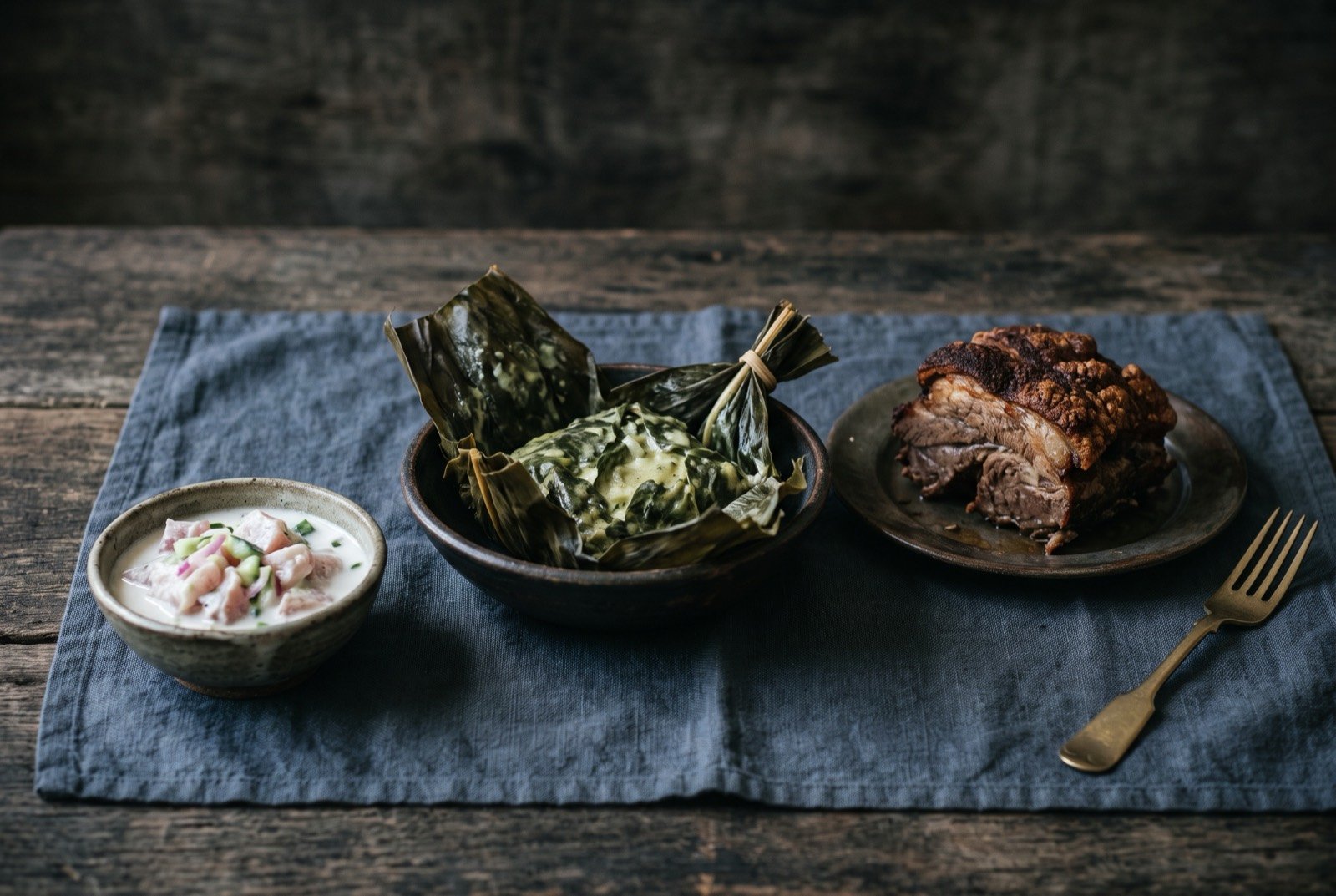
Three nations bound not by a shared colonial history, because they genuinely do not have one, but by ecology and by faith. Taro, breadfruit and coconut carry the starch and the fat everywhere in this chapter; the above-ground umu carries the heat; and the Sunday walk to church and back, more than any empire, is what still organises the week. Every dish as tradition built it, then what a modern chef would change.
Sources and review · What this chapter does not assert · How we research · Spotted something wrong?
A Sense of Place
Say the honest thing about this volume before anything else, because the planning checklist that scoped it got one thing wrong and this chapter does not want to repeat the error. Tonga was never colonised, and that fact does real work here: it is the reason a Tuʻi Tonga monarchy still exists in unbroken form, and it is the reason this chapter treats Tonga's food world as continuous with its own past in a way few Pacific nations can claim. But Samoa was colonised, twice, first by Germany and then by New Zealand, and its food culture survived not because empire skipped it but because its system of customary land tenure did not collapse the way it did elsewhere in the colonised Pacific. Niue was folded into New Zealand's own colonial administration from 1901 and has been self-governing in free association with New Zealand since 1974, a status distinct from both Samoa's and Tonga's. Tuvalu was part of the British Gilbert and Ellice Islands Protectorate until a 1975 referendum split the Polynesian-speaking Ellice Islands from the Micronesian-speaking Gilbert Islands, Tuvalu becoming independent in 1978.
So what actually binds these four places into one chapter is not a shared colonial ledger. It is ecology, taro, breadfruit, coconut, the volcanic or coral soil each depends on, and it is the London Missionary Society and Wesleyan Methodist missions that arrived within a few decades of each other and reorganised the week around Sunday, church, and the feast that follows it. That is a real argument and this chapter makes it directly rather than smoothing four different colonial and constitutional histories into one false story of shared subjugation or shared freedom.
Samoa carries the largest population in this volume by a wide margin, and its food world is correspondingly the best documented of the four. Lapita pottery dates the earliest Polynesian settlement of the Samoan islands to roughly 1000 to 900 BCE, though the literature genuinely disputes the precise bracket, and Samoa is regularly called the cradle of Polynesia because later voyages east to the Society Islands, the Marquesas, Hawaii and Aotearoa are thought to have staged from there. Britannica, "Lapita culture" Christianity arrived on 24 August 1830, when John Williams of the London Missionary Society landed at Sapapaliʻi on Savaiʻi and secured the conversion of Malietoa Vaiʻinupo, the paramount chief who had just unified much of Samoa militarily; the wider population's conversion followed the chief's lead rapidly, which is the reason Sunday churchgoing organises Samoan food life at the household level rather than a colonial administration ever having done so. Samoa Observer, "John Williams remembered"
Tonga is the volume's constitutional outlier and its ceremonial deep end. It was never formally colonised by any foreign power, the Tuʻi Tonga line runs in unbroken form to the present monarchy, and the country's most elaborate surviving feast ceremony, the Taumafa Kava, was performed in full at both the 2008 and 2015 coronations. Wesleyan Methodist mission arrived and took hold distinctly from Samoa's Congregationalist LMS: King George Tupou I was baptised in 1831 and the Free Wesleyan Church of Tonga was formally founded in 1885, a genuinely different missionary lineage from Samoa's even though both nations now organise their week around church in a broadly similar way.
Niue is the volume's population outlier in the opposite direction: a resident population under 2,000 against a New Zealand diaspora of roughly 35,000, an extraordinary ratio driven by post-cyclone emigration from the late 1950s onward and the 1971 opening of Niue's airport. Te Ara Encyclopedia of New Zealand, "Niueans" Niue's food culture is correspondingly thin in what this chapter could document on the island itself, and correspondingly hard to find represented by its own diaspora abroad, a genuine finding rather than a research failure, treated honestly below rather than padded.
Tuvalu sits geographically and politically inside Micronesia in most reference works, and this chapter includes it here anyway, on the atlas's own culinary and ethnolinguistic judgement rather than on any single source that makes this argument for us: Tuvaluan is a Polynesian language, and pulaka, the giant swamp taro grown in painstakingly dug coral pits, sits inside the same taro-and-coconut grammar as the rest of this volume rather than the atoll-and-pandanus grammar that defines Kiribati, the Marshall Islands and Nauru immediately to its north. This is this chapter's own synthesis, stated as such, not a claim lifted from a cited authority.
| Nation | What fills the structural role | What actually organises the food |
|---|---|---|
| Samoa | Taro, breadfruit, coconut cream for the umu table; koko Samoa for drink and ceremony; corned beef and tinned fish as the colonial-trade layer | Tautua, service to family and matai, and the Sunday toʻonaʻi that follows church |
| Tonga | Taro, ʻufi (yam), coconut cream; kava for formal ceremony rather than everyday drink | The never-broken monarchy and its feast ceremony, and the Sunday ʻumu that follows Wesleyan church |
| Niue | Taro, papaya, coconut, uga (coconut crab) as prestige protein | A tiny resident population sustaining what documentation exists almost entirely through a handful of named growers, cooks and cafés |
| Tuvalu | Pulaka, grown in dug coral pits, standing in for the high-island taro this volume otherwise depends on | Atoll ecology forcing an intensively worked staple crop where Samoa, Tonga and Niue can simply plant taro in open ground |
A word on language and searching, stated honestly. Real queries were run in Samoan and in Tongan, not English queries with a single local word dropped in. The Samoan searches found almost nothing of substance beyond dictionary entries and general cultural essays, with one real exception: a site-restricted search of samoaobserver.ws surfaced a genuine Samoan-language feature on the origin of the ʻava ceremony, used below. The Tongan searches, including site-restricted queries against Matangi Tonga and Kaniva Tonga, surfaced almost entirely English-language results even when run in Tongan, and this chapter treats that as a real, stated gap rather than evidence that no Tongan-language food writing exists. No Niuean-language or Tuvaluan-language source was found at all. This chapter's modernist research, separately, was conducted in English only, weighted toward Pacific-region and diaspora outlets rather than generalist Western food media, a deliberate choice explained further below.
The History in Layers
Voyaging and the missions
All four nations descend from the same Lapita voyaging tradition that carried taro, breadfruit, coconut and the earth-oven technique itself east across the Pacific from roughly 1000 to 900 BCE, Samoa staging much of the onward voyaging east and south. Christianity reorganised each nation's week within a few decades of the others but through genuinely different missionary lineages, worth keeping distinct rather than flattened into one generic "the missionaries came" sentence: London Missionary Society Congregationalism in Samoa from 1830, Wesleyan Methodism in Tonga from the 1820s and 1830s, taking formal institutional shape with the Free Wesleyan Church in 1885. Niue's own mission history ran through Samoan LMS teachers rather than a direct European mission, a further distinct thread this chapter did not find independently documented in enough depth to give a date and name with confidence, and says so rather than inventing one.
Samoa's actual colonial history, corrected
The task brief that scoped this chapter originally described Samoa as having a near-total absence of full colonisation. That does not survive research and this chapter corrects it rather than repeating it. Samoa was formally colonised twice: German Samoa from 1900 to 1914, then New Zealand administration from 1914 to 1962, first as a military occupation and then under a League of Nations mandate. German governor Wilhelm Solf abolished the traditional office of Tupu Sili, paramount king; New Zealand's administration mishandled the 1918 influenza pandemic so badly that it killed over a fifth of the population; and on 28 December 1929, New Zealand military police shot dead a peaceful pro-independence Mau demonstration, killing eight Samoans including the high chief Tupua Tamasese Lealofi III. Samoa became independent in 1962, the first Pacific nation to do so after the Second World War, precisely because of decades of sustained, organised resistance, the Mau movement, not because colonisation was ever light-touch. NZ History, "New Zealand's administration of Samoa, 1920 to 35"; Archives New Zealand, "The rise of the Mau and the fall of colonial rule in Sāmoa"
What is genuinely distinctive about Samoa, and what this chapter offers instead of the "light colonisation" myth, is a fact about land and labour, not about the absence of colonial rule. Unlike Fiji, where the British imported Indian indentured labourers who came to form nearly half the population and permanently reshaped land use around sugar, Samoa's plantation economy, German-era cocoa, later copra, never produced a demographically dominant settler or indentured population that displaced Samoans from the land at scale. At independence, 80.5 per cent of Samoa's land was still customary land, administered under matai authority; only 3.7 per cent was freehold. Commonwealth of Nations, "Samoa agriculture sector" That is the real reason the umu, the household plantation and matai-controlled food distribution survived intact enough to still be the daily food system today. Chinese indentured labourers were brought in for the German cocoa plantations from 1903, roughly 3,868 recruited by 1914, conditions harsh enough that a 1908 Chinese government investigation documented serious abuses; recruitment was banned outright in 1934. Wikipedia, "Cocoa production in Samoa" This labour history left a real, visible mark on Samoan food, sapasui above all, covered below, just not on Samoan land tenure.
Tonga's unbroken line
Tonga's never-colonised status is not a footnote, it is the single fact that most distinguishes this volume's constitutional shape from the rest of the atlas. The Tuʻi Tonga line runs continuously to the present monarchy, and Tongan feast ceremony survives with a completeness this chapter did not find matched anywhere else in Oceania: the Taumafa Kava, the full royal kava ceremony, was performed at both the 2008 coronation of King George Tupou V and the 2015 coronation of King Tupou VI. Wesleyan Methodist mission took hold distinctly from Samoa's Congregationalism, King George Tupou I baptised in 1831, the Free Wesleyan Church of Tonga formally founded in 1885, a genuinely separate missionary lineage worth keeping distinct from Samoa's LMS rather than treating "the Pacific missions" as one undifferentiated wave.
Niue and the emptying island
Niue came under New Zealand administration in 1901 and has been self-governing in free association with New Zealand since 1974, a constitutional status distinct from both Samoa's full independence and Tonga's unbroken sovereignty. The defining fact for this chapter's purposes is demographic rather than constitutional: a resident population under 2,000 against a New Zealand diaspora of roughly 35,000, a ratio driven by post-cyclone emigration from the late 1950s onward and the 1971 opening of Niue's airport, which made leaving straightforward in a way it had not been before. Te Ara Encyclopedia of New Zealand, "Niueans" A population this small, this widely dispersed, cannot sustain the kind of documented food-writing tradition Samoa's larger population has, and this chapter's Niue section is honestly shorter than its Samoa section for exactly that reason, not because Niuean food is less real or less interesting.
Tuvalu, and the Micronesia question
Tuvalu was administered as the Ellice Islands, part of the British Gilbert and Ellice Islands Protectorate, until a 1975 referendum split the Polynesian-speaking Ellice Islands from the Micronesian-speaking, ethnically distinct Gilbert Islands, now Kiribati; Tuvalu became independent in 1978. This chapter places Tuvalu inside its Polynesia volume rather than the atlas's Micronesia volumes on ethnolinguistic and culinary grounds, pulaka cultivation and coconut-based cooking sitting inside the same taro-and-coconut grammar the rest of this chapter documents, rather than the pandanus-and-breadfruit atoll grammar that unites Kiribati, the Marshall Islands and Nauru. This is stated here as this chapter's own reasoned judgement, not as a claim any single source makes for us.
The present day, honestly
Rice and tinned protein have entered every household economy in this volume without displacing the umu the way rice has displaced root crop staples in parts of Melanesia and Micronesia; the Sunday feast remains, on the evidence gathered here, genuinely central rather than a heritage performance. Pisupo, tinned corned beef, and povi masima, fresh-salted brisket, both function as customary ceremonial gifts standing alongside fine mats as markers of respect, not as evidence of a food culture in decline, a point this chapter returns to below rather than treating tinned meat as something to apologise for.
The Flavour Arsenal
Starches
Taro (Colocasia esculenta). The core staple across Samoa, Tonga and Niue, called talo in Samoan and Tongan; grown in open ground on all three high islands, distinct from the pit-cultivated pulaka this chapter documents for Tuvalu below.
Pulaka (giant swamp taro, Cyrtosperma merkusii). Tuvalu's defining staple, grown for years, not months, in dug coral pits deep enough to reach the freshwater lens beneath an atoll's thin soil, a genuinely labour-intensive crop that stands in for the taro this volume's other three nations can simply plant in open ground.
Breadfruit (ʻulu, mei). The second staple starch across all four nations, roasted whole, its flesh pounded or grated depending on the dish.
Cassava. A post-contact introduction now fully naturalised into several dishes named below, including one of the two accounts of faʻausi.
Fats
Coconut cream. The universal binding liquid across this entire volume, extracted by grating and squeezing fresh coconut flesh, the base for palusami, lu pulu, koko alaisa and nearly everything else in the dish list below.
Aromatics and drink crops
Koko Samoa. The Samoan Trinitario cacao variety and the drink made from it, grown, fermented, sun-dried, stone-roasted and ground almost entirely for domestic and diaspora consumption rather than for a commodity export market. Covered in full below, both in the Ferment Bench and in the modernist section, since it is the single ingredient in this volume with the most active contemporary specialty-producer scene behind it.
Kava (ʻava in Samoan, kava in Tongan). A ceremonial pepper-root drink, its Samoan and Tongan ceremonial protocols genuinely distinct from each other and from the Fijian yaqona ceremony documented in this atlas's OC-07 volume; this chapter treats Samoan ʻava and Tongan kava as two related but separately protocolled ceremonies rather than one Pacific kava tradition, covered in the Technique Ladder below.
Corned beef (pisupo) and salted beef (povi masima). Nineteenth and twentieth century colonial-trade imports now genuinely embedded as ceremonial gifts across the whole volume, not a modern degradation of an older diet; treated with real weight in the dishes below rather than as an embarrassment to be minimised.
Leaves and greens
Taro leaf (lau talo). The wrapping and cooking medium for palusami and lu pulu, requiring the double-cooking or soak-and-boil treatment covered in the Technique Ladder to break down the calcium oxalate crystals raw leaves carry.
Protein
Reef fish and tuna, the everyday and ceremonial protein base for ʻota ʻika and oka across the whole volume. Octopus, feke in Tongan and Niuean, more thinly attested for Niue specifically than for Tonga, flagged honestly below. Uga, coconut crab, Niue's genuine prestige protein, now conservation-constrained in several parts of the Pacific and worth naming as such wherever it appears on a menu. Ifi, the Polynesian or Tahitian chestnut, a tree nut used across Samoa, Tonga, Fiji and Niue and documented on Michael Meredith's Metita menu paired with seared tuna, worth flagging here as one of this volume's few genuinely shared, cross-national tree-nut ingredients.
The Technique Ladder
Five rungs, each a real, sourced mechanism from this volume's own kitchens.
Rung 1. The above-ground umu, not a pit
The Samoan and Tongan umu is built above ground from volcanic stones, distinct in construction from the below-ground Māori hāngī, the Fijian lovo, or the Melanesian earth ovens this atlas's OC-05 and OC-06 volumes document: food sits on top of the heated stones rather than inside a covered pit. The fire is built from palm logs and hardwood laid in a square with stones on top, judged ready once the burning wood and coconut husk have reduced to coal, at which point the fire is raked away and food, wrapped in banana leaf, coconut frond or placed in half coconut shells, is laid directly onto the hot stones and covered with more leaves. Samoa Tourism, "Umu Cooking Guide"
What a cook does with this rung. A Big Green Egg run indirect, deflector plate removed rather than in, more closely reproduces the umu's above-stone, radiant-and-convective heat than the deflector-in, buried-parcel setup this atlas recommended for the Melanesian pit ovens in OC-05 and OC-06; the distinction matters because an umu-style cook wants more direct radiant contact with the stone bed than a true earth oven does.
Rung 2. Citrus first, coconut last
The single clearest technical lesson to come out of this chapter's modernist research: in a properly made oka or ʻota ʻika, the citrus does its acid-cure work on the raw fish before the coconut cream is folded in, not the other way round. Michael Meredith's geoduck version at Metita keeps this sequence exact even as he changes the protein, timing the citrus stage separately from the coconut stage so the dairy-fat richness of the cream does not mute the citrus cure. The Denizen, "Michael Meredith shares insight into the inspiration behind Metita's new & most-loved dishes"
What a cook does with this rung. Sashimi-grade fish, fresh lime rather than bottled juice, and fresh, not tinned, coconut cream folded in only once the acid cure has finished doing its work, is the whole discipline, and it is exactly the discipline a fine-dining kitchen is applying when it plates the dish for a single diner rather than a communal bowl.
Rung 3. The taro leaf's oxalate problem, solved by soak and double-wrap
Raw taro leaves contain calcium oxalate crystals that irritate the mouth, throat and gut if undercooked, and in documented cases have caused poisoning requiring medical attention. Canadian Institute of Public Health Inspectors, "Two cases of poisoning by raw taro leaf" Soaking taro leaves for around 18 hours followed by boiling reduces soluble oxalate content by roughly 60 per cent, about 26 per cent from the soak and a further 36 per cent from the boil; blanching for 30 to 60 seconds followed by an ice-water shock is cited elsewhere as sufficient to make leaves pliable and non-irritating. PubMed, "The effect of soaking and cooking on the oxalate content of taro leaves" Palusami's traditional double-cooking answers this directly: young, tender leaves hold the coconut cream filling and are themselves parcelled inside a second, tougher outer layer, the whole parcel then cooked through for roughly an hour, long enough to finish breaking down the oxalates in both layers rather than relying on a single quick steam.
What a cook does with this rung. A dedicated blanch-and-shock stage before the leaves ever meet the coconut cream, timed properly rather than eyeballed, is the single most important food-safety step in this whole chapter's recipe list, more important than any modernist flourish that follows it.
Rung 4. Coconut cream as the whole sauce system
As in this atlas's Melanesian volumes, nearly every dish in this chapter is built, poured or finished with coconut cream rather than a built spice sauce; the sourced Samoan and Tongan methods pour it raw into the parcel before wrapping, letting the umu's heat cook milk and filling together.
What a cook does with this rung. A chinois produces a genuinely smooth, grit-free coconut cream from fresh grated coconut, and a controlled stovetop reduction lets a home cook decide deliberately between a thin, first-pour cream and a thickened, reduced one, a choice the umu's ambient heat does not really allow.
Rung 5. Fermentation and stone-roasting, koko Samoa's own technique
Koko Samoa is fermented and sun-dried before it is ever roasted, the single documented fermentation step in this entire volume outside the ferment bench below: ripe pods are harvested, the beans separated from the pulp, fermented and sun-dried, then roasted over a hot metal plate heated by open fire, the husks removed, and the roasted beans ground into a coarse paste in a wooden mortar, traditionally by women. Wikipedia, "Koko Samoa"
What a cook does with this rung. A spice grinder reproduces the wooden mortar's grind far more consistently, and a controlled low oven or dehydrator can hold roasted beans at a steady temperature a wood fire never could, letting a UK kitchen rebuild koko Samoa from raw or lightly processed cacao using the traditional stone-grind logic rather than substituting Dutch-processed cocoa powder, which behaves nothing like it.
The Ferment and Preserve Bench
Koko Samoa's fermentation and sun-drying, covered in full as Rung 5 above, is this volume's clearest documented ferment step. Povi masima, fresh-salted beef brisket, sold in large buckets and boiled with onion and cabbage, and pisupo, tinned corned beef, both function as preserved, shelf-stable proteins that entered Samoan and Tongan ceremonial food distribution well over a century ago and never left; a 1980s to 1990s photograph from Satupaʻitea, Savaiʻi shows povi, tinned fish and povi masima being divided after an ʻava ceremony, useful primary evidence that these imported preserved meats were already integrated into ceremonial distribution by the time the photograph was taken. Pacific Manuscripts Bureau, Australian National University
Sourcing in Britain
The honest headline, stated once rather than repeated ingredient by ingredient: the UK's Samoan, Tongan and Niuean population is small enough that no census breaks it out individually, folded instead into a wider "Pacific" ethnic grouping recorded at 12,395 people across the whole of England and Wales in the 2021 census, under 0.1 per cent of the population. Birmingham City Council, community health profile citing the 2021 census No currently-trading Samoan, Tongan or Niuean restaurant of any register was found operating anywhere in the UK as of this research. Monica Galetti's Mere, in Fitzrovia, did exactly this for seven years before closing in April 2024, reportedly for post-Brexit hospitality-cost reasons rather than any failure of the food itself, and this chapter names that closure plainly as the reason Britain currently has no restaurant of this kind, rather than implying no appetite for the cuisine ever existed. Time Out London, 4 November 2024
What is genuinely sourceable
Fresh taro root, fresh breadfruit and fresh whole coconuts are all well stocked via named UK exotic and Afro-Caribbean grocers and wholesalers, including AfroBox, London Grocery, Sunland Caribbean, Fruit + Veg and En Route Fruit, a real botanical overlap rather than a stretch, since the same or closely related species are eaten across West Africa, the Caribbean and this volume's own three nations. Fresh taro leaf specifically, as opposed to dried, is a genuine quality risk worth naming: only two UK retailers, AfroBox and Alli Bhavan, were found stocking it fresh at all, and a reader should check freshness carefully given the raw-leaf toxicity documented in the Technique Ladder above rather than assume any listing is reliable stock. Corned beef, for lu pulu, is trivially available in any UK supermarket, though the culturally specific reference brand favoured in Pacific diaspora cooking, New Zealand's Hellaby's, colloquially "helapi," is not confirmed stocked in Britain.
Kava, stated plainly
Kava remains illegal to sell as a food or drink product in England. The Medicines for Human Use (Kava-kava) (Prohibition) Order 2002, together with a parallel food-law prohibition, remains in force, confirmed directly against primary legislation on legislation.gov.uk, only amended since for terminology, not repealed. A claim circulating online that the Food Standards Agency authorised kava extracts in 2024 could not be corroborated against either the actual 2024 statutory instrument or the FSA's own novel foods register, and this chapter explicitly rejects it rather than repeating it. A reader wanting a genuine kava ceremony at home should know plainly: it cannot currently be bought legally in Britain.
What is genuinely thin
Koko Samoa, the ingredient this chapter's modernist section treats with real seriousness, has no confirmed UK stockist at all; the only lead found is a possible Australia-based mail-order route, Fale Koko, unverified for UK delivery. No UK Samoan, Tongan or Niuean community organisation or church network, the kind of informal ingredient and knowledge-sharing channel that supports Pacific diaspora cooking elsewhere in the world, was found. One genuine exception to the general pattern is worth naming: Fiji Store UK, trading as Kaiviti and based in Goole, is a real UK Pacific Islands grocery business, though its stock specific to Samoa, Tonga or Niue could not be confirmed, and a Fijian-focused wholesaler existing in Britain is not evidence of dedicated sourcing for this volume's own three nations, which have a genuinely thinner UK trade and diaspora history than Fiji's.
Voices and Sources
From inside the tradition
- Henry Onesemo, chef-owner of Tala, Parnell, Auckland, alongside his wife Debby. The first restaurant in the world to receive a Michelin star for contemporary Samoan food. His own words, rejecting "Pacific" as an undifferentiated catch-all category, are close to a direct match for this atlas's own thesis that a culinary region is not a border, and are quoted at length above.
- Michael Meredith, chef-owner of Metita, SkyCity Auckland, named for his late mother Metita Saleilua, who ran a pancake stall at the Apia market where he spent his childhood. One of New Zealand's most internationally regarded chefs, treating both raw-fish-and-coconut tradition and corned-beef-and-chop-suey colonial-trade dishes as equally part of "their food story."
- Monica Galetti, born in Pago Pago, American Samoa, senior sous chef at Michel Roux Jr's Le Gavroche before running Mere in Fitzrovia with her husband David from 2017 to 2024, the UK's one significant documented instance of Samoan food taken seriously at a professional level.
- Fipe Preuss, Samoan, founder of Living Koko in Melbourne, whose grandfather Laulu Sesole John Stanley was high chief of the Vaiusu and Vailima district his cacao is grown in; she has spoken publicly about food sovereignty and the lunar-cycle timing of cacao harvest as inherited knowledge, not marketing language.
- Bautista Sione Atu Latu and Lorrita Achica, of Simiz Kai Lelei in East Palo Alto, alternating weekly menus between Samoan and Tongan tradition, a household, not chef-driven, restaurant that treats both cuisines with real seriousness rather than blending them into one undifferentiated "Pacific" menu.
The researchers and institutions
- Garrett Hillyer, whose 2023 doctoral thesis at the University of Hawaiʻi at Mānoa, E Tuai Tuai, Ta Te Māʻona Ai: A Food History of Sāmoa, integrates archaeology, ethnobotany, linguistics and oral tradition into dedicated case studies on corned beef, alcohol and Samoan-style chop suey; only its abstract was accessible in this research pass, and it is worth a full reading before any future edition of this chapter. ScholarSpace, University of Hawaiʻi at Mānoa
- The National University of Samoa, whose institutional thesis glossary supplied this chapter's clearest sourced picture of the matai system's food vocabulary, sua, momoli, faʻalolo, ʻaiavā, piasua, vaisalo and tolo among the terms. nus.edu.ws
- Michel Tuffery, the New Zealand-born Samoan artist whose 1994 sculpture Pisupo Lua Afe (Corned Beef 2000), a bull built entirely from flattened corned beef tins, held at Te Papa, remains the strongest single source anywhere in this research for the cultural meaning of pisupo, asking directly whether foreign intervention encourages independence or dependence.
The gap, named plainly
No source written in Tongan by a Tongan food writer, and no named Tongan chef running a fine-dining or chef-led restaurant anywhere in the world, on Tongatapu or in any diaspora, was found despite real search effort. No named Niuean chef running a restaurant of any register beyond the small on-island café cluster documented above was found either. This chapter states this as a genuine, confirmed finding rather than a search failure, and it is the reason Samoa's section of this chapter runs considerably longer and deeper than Tonga's, Niue's or Tuvalu's.
Things this chapter has deliberately not asserted
- That Samoa had a near-total absence of full colonisation. It was colonised twice, by Germany from 1900 to 1914 and by New Zealand from 1914 to 1962, including the mishandled 1918 influenza pandemic and the 1929 Black Saturday shooting of Mau demonstrators. What is genuinely distinctive is that customary land tenure survived at roughly 80 per cent, not that colonial rule was ever light.
- That koko Samoa's arrival in Samoa dates to around 700 CE via Peruvian contact. This claim exists only in Western tourism and lifestyle copy with no primary or archaeological source behind it, against a documented 1883 German introduction with named individuals, dates and shipment records.
- A single, resolved account of the taupou's role in preparing versus serving ʻava at ceremonial gatherings. The sources found conflict on this point and it needs a stronger, ideally Pacific-authored ethnographic source before any future edition states it flatly either way.
- Precise ratios, leaf counts or a single "correct" traditional recipe for palusami, lu pulu or takihi. The underlying chemistry and mechanism are well sourced; specific household quantities are not, and this chapter reports documented method rather than inventing false precision.
- That non-matai food-tribute obligations and a strict matai-eats-first serving order are settled ethnographic fact in Samoa, rather than a plausible but weakly sourced claim repeated across secondary sites.
- That feke, octopus in coconut cream, is a well-documented Niuean dish in its own right. The sourcing found for Niue specifically is thin and largely borrowed from Tongan lo'i feke material; this chapter names that borrowing rather than presenting it as independently confirmed.
- That the UK kava market is legal, or became legal again in 2024 via an FSA authorisation. It is not, and this chapter explicitly checked and rejected the competing claim rather than repeating it.
- That "Tongan and a Tipi," a small social-media-only pop-up found during UK sourcing research, is an established or currently operating UK Tongan food venture. It could not be corroborated beyond its own low-follower Facebook page and is not treated as real evidence of UK Tongan food culture.
- That Whittaker's Cocoa Samoa, a mainstream New Zealand confectionery flavour, is equivalent to or made from artisan koko Samoa. It is named only as evidence the flavour has entered the mainstream New Zealand palate, sourced to a single diaspora food blog's taste comparison, a weak source that should not carry more weight than that.
- That sous vide, dehydration or any other named modernist-kitchen equipment has been documented in professional use on any dish in this volume. No such example was found in this research; every equipment-based technique offered in this chapter's own modernist recipes, takihi, ʻotai and tulolo above especially, is this chapter's own extension of a documented traditional method, not attributed reportage, and is written that way throughout.
- That Tuvalu's inclusion in this volume, rather than in the atlas's Micronesia volumes, rests on any single cited source. It is this chapter's own reasoned synthesis from Tuvaluan's status as a Polynesian language and pulaka's place inside this volume's taro-and-coconut grammar, stated plainly as that rather than as an externally sourced claim.
The above-ground umu, not a pit
The Samoan and Tongan umu is built above ground from volcanic stones, distinct in construction from the below-ground Māori hāngī, the Fijian lovo, or the...
Citrus first, coconut last
The single clearest technical lesson to come out of this chapter's modernist research: in a properly made oka or ʻota ʻika, the citrus does its acid-cure work...
The taro leaf's oxalate problem, solved by soak and double-wrap
Raw taro leaves contain calcium oxalate crystals that irritate the mouth, throat and gut if undercooked, and in documented cases have caused poisoning...
Coconut cream as the whole sauce system
As in this atlas's Melanesian volumes, nearly every dish in this chapter is built, poured or finished with coconut cream rather than a built spice sauce; the...
Fermentation and stone-roasting, koko Samoa's own technique
Koko Samoa is fermented and sun-dried before it is ever roasted, the single documented fermentation step in this entire volume outside the ferment bench below...
The dishes
- Palusami Samoa
- ʻOta ʻika Samoa
- Lū pulu Tonga, also made in Samoa as lu pulu
- Sapasui Samoa
- Koko alaisa Samoa
- Panipopo Samoa
- Takihi Niue
- ʻOtai Tonga
- Tulolo Tuvalu
Sources and review
- Researched
- 29 sources cited
- Reviewed
- Not yet reviewed from inside the tradition
- Cooked
- Not yet cooked and reported
Where this volume comes from
3 research briefs on file for this volume, researched to the rules on How we research. Published 28 August 2026. Last changed 8 September 2026.
The brief's own account of its sources
Roughly one third of the sources used in this section are meaningfully local or in-tradition: the National University of Samoa glossary (a genuine institutional academic source), the Samoa Observer's Samoan language "Samoa neʻi Galo" heritage feature on ʻava, the Pacific Manuscripts Bureau archival photograph caption from Satupaʻitea, Savaiʻi, Te Papa's account of the Tuffery corned beef sculpture, Garrett Hillyer's University of Hawaiʻi doctoral dissertation (Pacific food history, though only its abstract could be reviewed here), Wikipedia's cocoa production and Pisupo Lua Afe articles (both