Oceania and the Pacific · Volume 06
Solomon Islands, Vanuatu & New Caledonia
The Root, the Reef and the Earth Oven
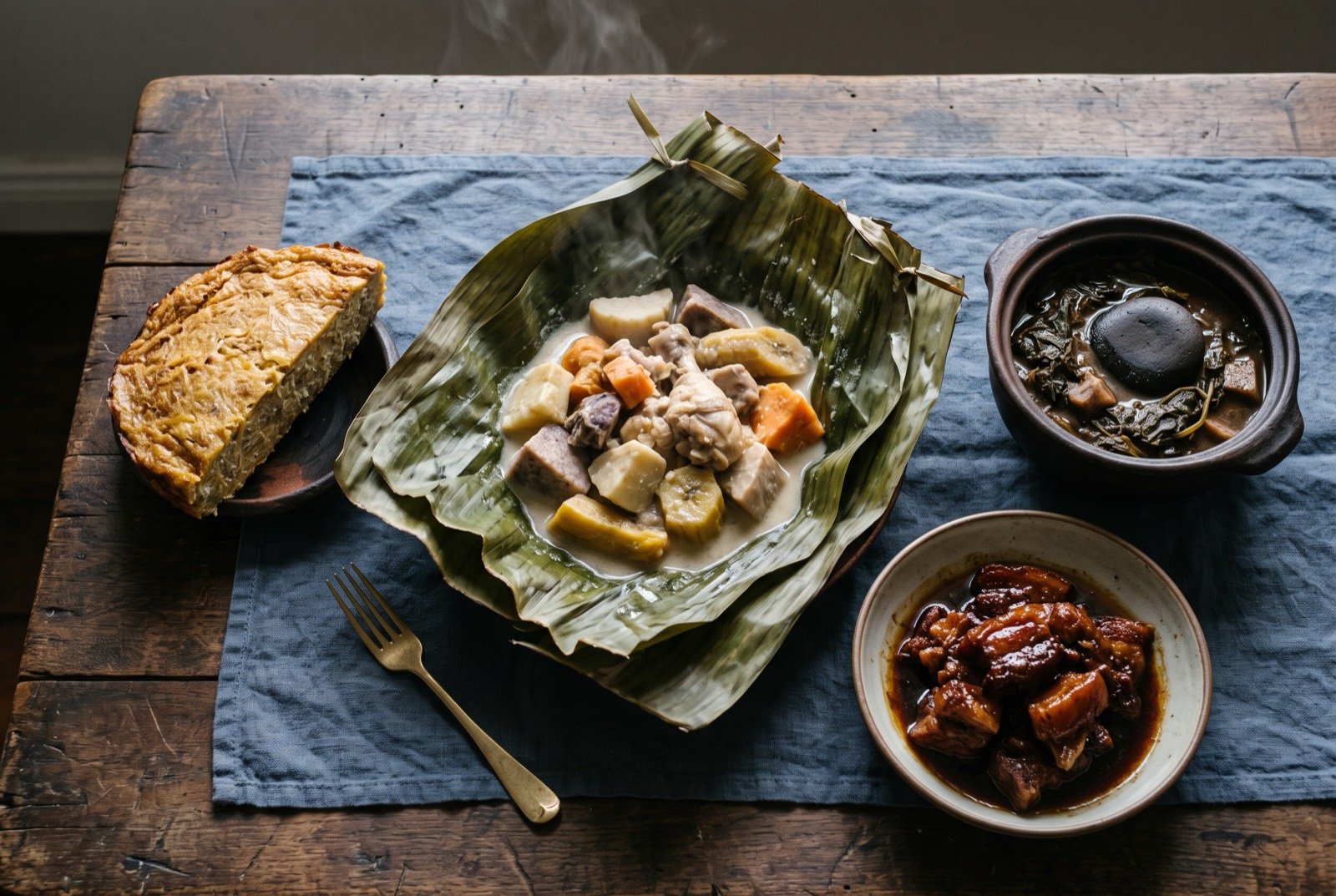
Three small nations, taken together for a reason this chapter states plainly rather than smooths over: not a shared culinary history, but a shared ecology, root crop and coconut, and a shared cooking technology, the heated stone earth oven, worked out independently under two different colonial administrations, one Anglophone, one French. Every dish as tradition built it, then what a modern chef would change.
Sources and review · What this chapter does not assert · How we research · Spotted something wrong?
A Sense of Place
Say this at the start, because the rest of the chapter depends on it being said honestly rather than discovered halfway through: this is the thinnest volume in the atlas so far, and its case for standing together as one chapter is ecological, not historical. Solomon Islands and Vanuatu share the earth oven, the root crop, the coconut palm and a colonial-era Anglophone thread, though even that thread ran through two genuinely different administrations. New Caledonia shares the ecology and the earth oven technique itself but sits inside a wholly separate political and linguistic world, a French special collectivity with its own press, its own institutions and its own layered migration history. There is no single trade route, faith or empire binding all three the way there is, for instance, across the Mediterranean or the Swahili coast. What binds them is what grows on volcanic and coral soil in the Coral Sea, and what a Melanesian household has always done with hot stones and a banana leaf. That is a real argument, not a weak one, but it is a different kind of argument from most of this atlas's other volumes, and the chapter says so rather than dressing three thinly documented food cultures up as one richer one.
Solomon Islands sits on a harder ecological base than either of its two neighbours here. Some of its nearly one thousand islands are rugged and volcanic, others low coral atolls with poor soil and little fresh water, and only around 1 per cent of national land is classed as arable. Reef fish supplies roughly three quarters of the protein in the rural diet, and the country's Western Seascape holds the second highest reef fish diversity on earth after Raja Ampat in Indonesia, part of why the Coral Triangle's own boundary was extended to take it in. Four root crops, taro, yam, sweet potato and cassava, carry the starch load nationally, with inland communities leaning on them more heavily than coastal ones, who lean harder on the reef instead.
Vanuatu, by contrast, is genuinely a centre of agricultural diversity. Its 82 mostly volcanic islands weather into mineral rich soil that supports one of the deepest tuber and tree crop cultures anywhere in the Pacific: a single ethnobotanical survey conducted between 2004 and 2009 recorded 539 separate named breadfruit cultivars alone, and yam and taro are, in Vanuatu specifically, not just staples but the prestige currency of custom itself. Jean-Pierre Labouisse, "Ethnobotany of Breadfruit in Vanuatu," Ethnobiology Letters 7(1), 2016 No source found in researching this chapter states the Solomons-versus-Vanuatu ecological comparison in so many words. It is this chapter's own synthesis of the two countries' separately documented geography and agriculture, offered as a reasonable inference rather than a cited claim.
New Caledonia is the odd one out politically and the richest one culturally, on the evidence this chapter could gather. It is a French special collectivity, not an independent nation, carrying a French colonial and penal history, a genuinely distinct Kanak agricultural and ceremonial tradition built around the yam, and two unusual twentieth century labour migrations, Javanese and Vietnamese, whose food has become thoroughly naturalised rather than staying a diaspora curiosity. Its food writing is also, simply, better resourced: a real French language press, a cultural agency dedicated to Kanak heritage, and an agronomic research institute that has done serious work on its own yam varieties. That imbalance in how well documented each of the three nations is shows up throughout this chapter, and it is named here rather than papered over with false parity.
| Nation | What fills the structural role | What actually organises the food |
|---|---|---|
| Solomon Islands | Taro, yam, sweet potato, cassava for starch; reef fish for protein; coconut for fat | The reef, more than the garden, in most coastal communities; a real recent shift toward imported rice in Honiara |
| Vanuatu | Yam and taro as the two "chief crops," prestigious in both diet and custom; breadfruit near universal; coconut for fat | The volcanic garden and the kastom (custom) economy that yam and taro both feed into |
| New Caledonia | Igname (yam) and taro, paired as masculine and feminine staples; poingo banana; coconut for fat | Kanak custom, specifically the yam's role in ceremonial exchange, sitting inside a French administrative and culinary overlay |
A word on language and searching, stated honestly rather than glossed over: this chapter's Solomon Islands and Vanuatu research was conducted in English, with real attempts to search in Bislama and Solomon Islands Pijin ("kakae blong Vanuatu," "kaikai Solomon Islands") that returned essentially no independent-language web content. Both are overwhelmingly spoken rather than written languages, and what web presence exists (Vanuatu Daily Post, Solomon Star) mostly publishes in English. This is a real, stated limitation, not the same as having searched a body of local language sources the way this atlas's other volumes have managed for Amharic, Swahili or Arabic. New Caledonia's research was conducted properly in French, against a genuine French language press and institutional record, and it shows in how much deeper that section runs.
The History in Layers
Pre-contact and the Lapita voyagers
Both archipelagos were settled by Lapita seafarers moving east through Near and Remote Oceania roughly 3,000 to 3,400 years ago, carrying breadfruit, taro, yam and other staple crops with them. Vanuatu shows archaeological evidence of settlement from around 3,000 years before present, and later Polynesian contact after roughly AD 1000 reached a handful of outlying islands, Futuna, Aniwa, Mele and Ifira, which is why Polynesian derived food words and practices survive on a small number of islands inside an otherwise Melanesian archipelago. [Labouisse 2016, as above]
Missionaries as the earliest written record
The London Missionary Society established Vanuatu's first mission in the southern islands in 1839, and missionary observers are, awkwardly, the earliest written sources on food practice in the whole volume: Inglis's 1890 account of breadfruit cultivation and preservation on Aneityum, and Codrington's 1891 count of 60 named breadfruit varieties on Mota in the Banks Group, are among the oldest ethnobotanical records for the region. [Labouisse 2016] New Caledonia's Marist mission, arriving from 1843, left an even more specific trace: the word "bougna" itself, as this chapter explains below, is not Kanak at all.
Two colonial administrations, genuinely different in kind
The Solomon Islands were a single power British Solomon Islands Protectorate from 1893 to independence in 1978, its capital at Tulagi until the Second World War destroyed it, after which Honiara, built on the site of a former American military base at Point Cruz, Guadalcanal, became the new capital. [Christine Jourdan, "The Cultural Localization of Rice in the Solomon Islands," Ethnology 49(4), 2010, pp. 263 to 282] Vanuatu, then the New Hebrides, was jointly administered from 1906 by Britain and France as the Anglo-French Condominium, an arrangement genuinely strange enough to earn its own nickname: each power kept its own resident commissioner, police force, prison and hospital, translating documents between English and French while everyday life ran in Bislama and dozens of local languages. Visitors, especially Australian journalists, called it "the Pandemonium," a play on "Condominium" that stuck well enough to be recorded in the country's own political memoirs and later used by Walter Lini, Vanuatu's first prime minister. Woodward, A Political Memoir of the Anglo-French Condominium of the New Hebrides, ANU Press Under the Condominium, ni-Vanuatu were legally stateless, neither British subjects nor French citizens, banned from buying alcohol while Europeans were not, and Port Vila's shops were segregated in practice, one reason Chinese run stores gained ni-Vanuatu custom. This administrative oddity did not, on the evidence this chapter could find, reshape food practice the way missionisation or the labour trade did; its relevance here is mainly why Vanuatu's food vocabulary carries French as well as British loanwords, Vietnamese style spring rolls, French bread, doughnuts called "gateau."
New Caledonia's own colonial history ran differently again. It became a French penal colony from 1864: the first 250 convicts landed at Port-de-France that May aboard the Iphigénie, and across 75 convoys roughly 21,630 registered convicts were transported there by 1897. Convict labour, nicknamed "chapeaux de paille," straw hats, built much of colonial Nouméa between 1866 and 1877, including its bandstand and cathedral. Wikipédia, "Bagne de Nouvelle-Calédonie" What convicts actually ate could not be established from any source consulted for this chapter, and that gap is named plainly in "deliberately not asserted" below rather than filled with a guess drawn from penal colony history elsewhere in the French empire.
Blackbirding, and how it put rice on a Solomon Islands plate
From 1863 the Queensland sugar labour trade recruited, very often through trickery, coercion or outright kidnapping, an estimated 62,000 people from more than 80 Pacific islands, heavily including Vanuatu and the Solomon Islands, to work Australian cane fields in conditions that in many documented cases amounted to slavery, until the trade ended in 1901. At its height, more than half the adult male population of some islands was working abroad. ABC Pacific, "It's 160 years since the blackbirding era began" This connects directly and traceably to food history in the Solomon Islands case. An estimated 17,756 Solomon Islanders were recruited to Queensland's cane fields in the second half of the nineteenth century, issued rations of mostly potatoes with up to six ounces of rice, plus meat, bread, sugar and tea. Returning labourers brought a taste for rice home, and sold surplus rice for the shell money needed in bridewealth and other exchange ceremonies. By the 1920s rice was standard in the rations issued to plantation workers and to villagers at government and mission stations alike, alongside sugar, tinned beef, soap, salt, tea and tobacco. [Jourdan 2010, citing Price and Baker 1976, Akin 1999, Bennett 1987] This is one of the more precisely documented instances anywhere in this whole volume of a colonial labour system directly reshaping a Melanesian diet, and it carries directly into the present day, below.
New Caledonia's nickel, and two unusual twentieth century migrations
New Caledonia's nickel deposits, among the largest on earth, drove a colonial demand for indentured and contract labour that pulled in two groups worth treating as their own strand rather than a footnote, because both left a lasting, still visible trace on the plate. The Javanese migration began on 16 February 1896, when a ship from Java landed 163 people, including 23 women, fleeing a famine and unemployment crisis that followed Dutch colonial planters replacing rice paddies with coffee, indigo and tobacco. They worked first on plantations, then in the nickel mines, and Javanese recruitment continued into coffee, sugar cane and copra cultivation. Le Petit Journal Jakarta, "Histoire méconnue de l'immigration Javanaise en Nouvelle-Calédonie"
The Vietnamese migration, known by the term chân dang, "pieds engagés," roughly "indentured feet," began with the first convoy in 1891 aboard the Chéribon: sources differ slightly on numbers, one giving 768 people including 479 prisoners transferred from the Poulo Condor penal colony, another around 790, including 50 women, recruited chiefly from a famine hit Tonkin, especially Ninh Bình and Nam Định provinces, and from 1895 direct from Haiphong. Conditions were harsh: labourers were assigned numbers rather than called by name, worked from 5am past sunset with no guaranteed breaks, received only half the promised daily rice ration, were subject to corporal punishment, and could not leave designated zones without authorisation. The recruitment promise had been five years' wages plus 700 grams of rice a day, with the stated hope of returning home able to buy rice paddies of their own. Wikipédia, "Chân Dăng"; diacritics.org, "Autrefois une île de résidence: la diaspora Vietnamienne en Nouvelle-Calédonie"
By the 1960s many chân dang descendants had integrated through marriage and small business, notably grocery retail, and their food genuinely took root rather than staying a diaspora curiosity: nems, said locally to run noticeably longer than the mainland French version, and porc au sucre, a Caledonian adaptation of Vietnamese caramelised pork, described in the same source as now "as common as steak frites on the island." [diacritics.org, as above] The Javanese trace is distinct: New Caledonia's own "bami" diverged from Indonesian bami goreng by using transparent glass vermicelli instead of egg noodles, described in one French language source as being "to Nouméa's Javanese community what camembert is to Normans."
Independence, and a divergence that still defines the volume today
The Solomon Islands became independent in 1978, Vanuatu in 1980. Vanuatu's independence movement under the Vanua'aku Party built its new national identity on kastom, customary tradition, and shared Christianity rather than any single pre-colonial identity, coining the name "Vanuatu" itself from "vanua," land, present across many of the country's roughly 105 languages, to replace the colonial "New Hebrides." New Caledonia took no such path: it remains a French special collectivity today, and its own defining modern political rupture, the unrest of the 1980s known locally as les Événements, was substantially a land conflict. Kanak activists' central demand from the 1970s was the restitution of ancestral land that colonial era Europeans had confiscated for settler farming, since most pre-contact Melanesian villages on the Grande Terre had sat on land later taken for exactly that. Land reform accelerating from the mid-1980s saw the state buy back settler land, one documented case being the Waka clan grouping of six tribes recovering roughly 900 hectares. The land reclaimed under that reform is, in a direct and continuing sense, the same land the yam and taro custom economy still depends on today.
The present day, honestly
Rice, imported from Australia and increasingly China, is now the dominant staple in urban Honiara, displacing sweet potato, yam and taro in the city diet even as they remain the norm, or a prestige item, in remote rural areas: Jourdan's fieldwork found 90 per cent of surveyed Honiara households ate rice daily against 76 per cent eating sweet potato daily. Government campaigns since the 1990s and NGOs including the Kastom Gaden Association have pushed to revive local vegetable and root crop consumption specifically because of this shift and its association with rising non-communicable disease. Vanuatu offers a genuinely striking present day counter-example: after Tropical Cyclone Harold struck in April 2020, the Port Vila food company Fine Foods produced and distributed more than 800 heat-and-eat pouches of laplap, made with island cabbage, cassava, pork, herbs, spices and coconut cream, to cyclone-hit communities on Santo's west coast, specifically as an alternative to the standard post-disaster ration of tinned fish, rice and noodles. ABC Pacific/RNZ Pacific, "Vanuatu: Cyclone victims sent traditional meals instead of tinned fish and rice" Laplap being chosen over imported rations by disaster relief planners is a strong marker of the dish's real, present-tense status, not a museum piece. New Caledonia's own version of this same tension is the Slow Food Foundation's Presidio for the taro and yam of Lifou, which names imported rice, potatoes, bread and even pasta as actively displacing the tuber staples, correlating with rising obesity and diabetes, and describes school canteens now serving what one source calls an "alimentazione alla francese" rather than local food. Fondazione Slow Food, "Taro e igname dell'isola di Lifou" All three nations, in other words, are living through the same real, ongoing displacement of root crop by imported starch, for different colonial and economic reasons, and this chapter treats that as the present day chapter of the same history rather than a separate modern footnote.
The Flavour Arsenal
Starches
Taro (Colocasia esculenta). The core staple across all three nations. In Vanuatu it is, with yam, one of the two "chief crops," essential to both diet and custom. In New Caledonia it is explicitly paired with yam as the feminine staple against the yam's masculine symbolism, both subject to the same Lifou Slow Food Presidio described above. A related but distinct crop, giant swamp taro, locally kakake in parts of the Solomon Islands, is grown in wetter, more labour intensive conditions and reserved for prestige dishes.
Yam (Dioscorea alata and other Dioscorea species). Vanuatu's other chief crop, prestigious and ceremonially essential. In the Solomon Islands, one of the four national root crops. In New Caledonia, the single most culturally loaded ingredient in this entire volume: Kanak growers still cultivate six species and around 120 varieties, ranked by custom into "vraies ignames," true yams, that form the basis of ceremonial exchange, "ignames ordinaires," ordinary yams eaten day to day, and "ignames semi-sauvages," semi-wild yams used as a supplementary harvest. [Fondazione Slow Food, as above] A variety's rank depends on how long it has been established in the local terroir, how early it fruits, and its physical straightness, length and regularity. The Agence de développement de la culture kanak states plainly that the yam "symbolise la fidélité aux ancêtres, l'attachement à la terre, l'humilité et le respect des règles coutumières," symbolises fidelity to the ancestors, attachment to the land, humility and respect for customary rule, and each tribe maintains its own yam house, both storage and gathering place, whose quality is read as a sign of the tribe's own standing. ADCK, "Journée de l'Igname" Named varieties recorded include warèïs or walèïs (Dioscorea esculenta), kokoetha and wadrawa, though this is very likely a small fraction of the true 120 variety count and should be read as illustrative, not exhaustive.
Breadfruit (Artocarpus altilis). Extraordinarily diverse in Vanuatu specifically, with 539 distinct named cultivars recorded in the 2004 to 2009 survey cited above, most important on the smaller, land constrained islands of the Banks and Shepherd Groups, Futuna and Malo. Traditionally preserved by pit fermentation, a practice now largely vanished, see the Ferment Bench below.
Cassava (manioc). An introduced crop, now a major everyday staple across the whole volume, its Solomon Islands introduction part of the same nineteenth and twentieth century crop exchange pattern that also brought sweet potato and, as above, rice.
Poingo banana. New Caledonia's Kanak cooking banana, described as a cross between African and Asian varieties, smaller and fleshier than a dessert banana, also called banane farine, banane jaune or banane cochon depending on region. Certain varieties carry their own socio-cultural role inside Kanak culture as clan identity markers, transmitted as prestigious offerings across generations. This is genuinely a New Caledonian term: neither Vanuatu nor the Solomon Islands, on the evidence gathered for this chapter, has an equivalent named cooking banana tradition, only generic references to "banana" as a laplap or nalot ingredient.
Fats and nuts
Coconut. The universal fat, cream and milk base across all three nations, and, as copra, the historic cash crop around which every colonial economy here was substantially built.
Ngali nut (Canarium indicum). A native Solomon Islands nut, its annual harvest traditionally marking the start of the Solomon Islands calendar year, the tree itself described as sacred, its kernel roughly 72 per cent oil. This chapter states plainly, against the planning checklist's original assumption, that ngali nut is not confirmed as a genuinely New Caledonian or Kanak ingredient with its own local name and tradition: the evidence gathered points to it as a Solomon Islands ingredient specifically, only loosely noted by one general source as "also eaten in certain parts of New Caledonia." Solomon Islands' own ngali nut export trade, run by the social enterprise SolAgro, sells almost exclusively to a health food retailer in Nouméa, New Caledonia, which is itself a real, if commercial rather than culinary, link between two of this volume's three nations.
Leaves
Island cabbage, slippery cabbage, aibika, boneo (Abelmoschus manihot). The single most consumed leafy green across this volume, described by the Vanuatu politician and cultural figure Ralph Regenvanu as Vanuatu's most consumed vegetable, with over 140 named varieties grown there under the name aelan kabij or bele. The same species is called bele or pele in Fiji and Polynesia, chou kanak in New Caledonia, and gedi in the Philippines, a genuinely useful piece of botanical continuity for the UK sourcing section below. High in protein, vitamins A and C, riboflavin, thiamine, niacin, potassium, magnesium, calcium and iron. In the Solomon Islands it is called boneo in at least some communities and forms the base of the single best documented dish family in this entire chapter, below.
Protein, and an honest present-tense note
Reef fish, grilled or baked whole or simmered gently in coconut cream, is the everyday protein base across all three nations, though this chapter could not find a single named, technique detailed reef fish recipe with real quantities comparable to the slippery cabbage material below, a genuine gap rather than an oversight. Coconut crab is a shared delicacy, now conservation restricted in more than one of these nations. Roussette, flying fox, Pteropus ornatus and Pteropus vetulus, both endemic to New Caledonia, is a traditional bougna protein and a genuinely live conservation issue rather than historical colour: hunting is legally permitted only on weekends in April, capped at five animals per hunter per day, sale in any form is prohibited outright, and colony destruction carries penalties up to 3,500,000 CFP and two years' imprisonment. Any chapter naming roussette as an ingredient should say so alongside the recipe, not after it. Tinned corned beef and tinned fish deserve real weight here rather than a passing mention: they are genuinely central to everyday Solomon Islands and Vanuatu diets today, a legacy of colonial era and wartime supply that never went away.
Aromatics, and a negative finding worth stating plainly
No source consulted for this chapter supports a strong built-in aromatic or spice tradition anywhere in this volume comparable to, say, West Africa's seed and pod pantry or the Horn's berbere. Salt, citrus, ginger, chilli, tomato, spring onion and, in New Caledonia specifically, turmeric or basil appear as seasonings for bougna, but coconut milk itself, not a spice base, is what carries flavour through nearly every dish in this chapter. This is worth stating as a real finding rather than a gap: it is not that this research failed to find an aromatic tradition, it is that reef fish, root starch, leaf greens and coconut milk are the actual grammar of this cooking, and a reader should not go looking for a hidden spice complex that was never there.
The Technique Ladder
Five rungs, each a real, sourced mechanism from this volume's own three kitchens.
Rung 1. The earth oven as engineered thermal mass, not a hole in the ground
The Solomon Islands' motu, also written mumu, Vanuatu's earth oven, and New Caledonia's four kanak are, on the evidence gathered here, one continuous Pacific cooking technology under three names, not three separate inventions: stones heated in an open fire, then arranged in a pit, food, often leaf wrapped, layered over them, covered with more hot stones and banana leaves laid in alternating directions to seal in heat and moisture, and left to steam roast for one to several hours, sometimes overnight for a large feast. New Caledonia's own documented sequence matches this closely: a pit dug, pre-heated stones laid at the bottom, several leaf wrapped parcels placed on top and covered with more hot stones, then freshly cut leafy branches, then earth, cooking for roughly two hours. What a cook does with this rung. A Big Green Egg run in indirect mode, deflector plate in, is functionally the same idea as an earth oven's stone and earth mass: thick thermal mass that stores heat and releases it evenly over hours rather than spiking. Load only once the ceramic has fully stabilised at temperature, the single most common earth oven failure mode reported across sources being food placed on stones or a mass that has not yet evened out.
Rung 2. Internal radiant heat, a hot stone inside the parcel itself
The single most distinctive and least documented professionally, but best ethnographically observed, technique this whole research pass turned up. In Malekula's laplap sosor, a single glowing hot volcanic stone is placed in the centre of the unbaked pudding, with chicken, onion and tomato laid directly on top of the stone, coconut milk poured over the whole assembly, then wrapped and baked, so that the food on the stone cooks specifically from the steam given off where hot stone meets coconut milk, not from ambient earth oven heat. Rolf Potts, "Malekula's laplap sosor" The Solomon Islands' Kastom Gaden cookbook documents an independent parallel: chiliri ngache, where roughly four hot stones from a mumu are dropped directly into a covered pot of coconut milk, ginger, salt and slippery cabbage, the lid closed for fifteen minutes, the vegetables cooking from the stones' direct contact inside a sealed vessel rather than from the pot sitting over a flame. What a cook does with this rung. Heat a large, clean stone (or, more practically and more safely in a British kitchen, a cast iron sear stone or a heavy stainless steel disc) to searing temperature in a Big Green Egg, then drop it directly into a covered pan of coconut milk and vegetables, exactly reproducing the mechanism, steam generated at a single hot point inside a sealed vessel, without needing an actual earth oven. No professional restaurant anywhere was found doing this; it exists only as observed traditional technique, which makes it exactly the kind of thing this chapter's own modernist half exists to elevate.
Rung 3. Grate for a paste, pound for a mash, and know which dish wants which
Laplap, nalot and tuluk all start from a root vegetable reduced to a working paste, but the sourced methods diverge in a way worth treating as a real technical choice rather than interchangeable prep. Raw yam, taro, cassava or banana is grated by hand into laplap and tuluk's base paste. Roasted breadfruit for nalot is instead pounded with a pestle on a wooden plate after its rind, core and seeds are removed, a method that works on already softened, cooked flesh rather than a raw root, and produces a smoother, more homogeneous mass than grating a raw root ever can. What a cook does with this rung. A high power blender lets a cook reproduce pestle pounding's smoothness on breadfruit or cooked taro far faster and more consistently than hand pounding, while raw grating for laplap and tuluk is better left as grating, coarse and hand done, since a blender purées a raw starchy root into something closer to a batter than a workable dough.
Rung 4. Coconut milk as the whole sauce system, not a finishing touch
Nearly every dish in this chapter is built, poured or finished with coconut milk rather than a built spice sauce, and the sourced methods show real variation in how it is used across the technique ladder. Nalot's documented method pours a second, separately heated batch of coconut milk, heated by dropping stones directly into it with a wooden spoon, over the already pounded and mixed breadfruit, a layered rather than single addition. Bougna's method doused raw coconut milk directly onto the assembled parcel before wrapping, letting the earth oven's heat do the cooking of both food and sauce together. What a cook does with this rung. A chinois lets a cook produce a genuinely smooth, grit free coconut milk from fresh grated coconut, and a controlled stovetop reduction, rather than the earth oven's ambient heat, lets a home cook decide deliberately whether a dish wants a thin, first-pour milk or a thickened, reduced one, a choice the earth oven itself does not really allow.
Rung 5. Nut fat worked into starch, not sprinkled on top
Ngali nut, roasted and crushed in a wooden bowl with a stick, then mixed with salted water until fluffy, is layered directly into masimasi's slippery cabbage and root vegetable parcel before it goes into the motu, not added afterward as a garnish; Makira's six-month pudding goes further, working hot coconut oil gradually into pounded taro until the taro is fully saturated with it. What a cook does with this rung. Candlenut, this volume's honest UK substitute for ngali nut, see Sourcing below, can be emulsified with warmed coconut oil in a high power blender into a genuinely smooth, saturating paste before it meets the starch, reproducing the gradual saturation the Makira method describes by hand, rather than folding chopped nuts through a finished dish where they read as texture rather than as the dish's actual fat.
The Ferment and Preserve Bench
New Caledonia and the Solomon Islands offer little here; Vanuatu offers the single best documented fermentation practice in the whole volume, and it is worth treating with real care because it has almost entirely disappeared.
Pit-fermented breadfruit
A once widespread Vanuatu preservation technique, now surviving in only a few places: breadfruit fermented for months in a leaf lined earth pit under near anaerobic conditions, its starch converting to lactic acid, keeping the resulting paste edible for a year or more. It carries different names and slightly different local practice island to island: namaraï-ma on Aneityum, namandaï on Erromango, mara, both the paste and the pit itself, on Futuna, mele on Epi, navinang on Tongoa. On Futuna specifically, preparation could include soaking the cut fruit in the sea between coral reef stones before pounding, mixing with coconut milk and cooking inside small bamboo sticks. A related but distinct method, dried whole fruit rather than fermented paste, survives with particular pride on Mota Lava under the name nekey, and on Mota as kor: peeled fruit dried whole on wooden sticks over hot stones inside a purpose built oven, then tied with pandanus leaf ribbons for storage. [Labouisse 2016, drawing on Inglis 1890 and Shulter and Shulter's 1966 archaeological survey of pre-European earth pits on Aneityum] What a cook does with this. A dehydrator run at a low, controlled temperature reproduces nekey's dried whole fruit method far more evenly than an open air dry ever manages in a British kitchen, and a small, deliberately built lactic ferment, roasted breadfruit flesh packed under weight with a modest salt brine rather than buried in a real earth pit, offers a home approximation of namaraï's souring without pretending to replicate a technique this research found no living practitioner of outside Vanuatu itself.
Sourcing in Britain
The honest headline, stated once rather than repeated ingredient by ingredient: most of what is sourceable here is sourceable only because it happens to overlap with West African, Caribbean or Southeast Asian grocery, not because anyone in the UK trades in Solomons, Vanuatu or New Caledonia food specifically. The 2021 England and Wales census recorded 12,395 people in the entire "Pacific Islander" grouping, all of Melanesia, Micronesia and Polynesia combined, out of a population of roughly 60 million, under 0.1 per cent, with no breakdown by individual nation, so Solomon Islands, Vanuatu and New Caledonia cannot even be isolated within that figure. No dedicated shop, importer or community organisation for any of the three was found anywhere in the UK, and none should be assumed to exist.
Kava: a correction worth stating plainly before it enters any reader's shopping list
This chapter's own early research briefly assumed kava had become legal to sell in the UK again from 2022. That assumption was wrong, and two independent research passes corrected it. The Medicines for Human Use (Kava-kava) (Prohibition) Order 2002 came into force on 9 January 2003, banning kava as an unlicensed medicinal product, and a parallel food-law prohibition sits alongside it. It was reviewed in 2006 by an Expert Working Group, which found the ban "justified and proportionate," and remains in force as of the most recent review found, dated 2025. There is no legitimate UK kava bar or dedicated retailer. State this plainly to any reader tempted to source kava for a genuine tereré-style or ceremonial preparation at home: it cannot currently be bought legally in the UK, and this chapter does not pretend otherwise.
What is genuinely sourceable
Taro, yam and cassava are all well stocked via West African and Caribbean grocers, Niyis African Supermarket, Cafro Foods, Home From Home Foods and Afro-Caribbean Foods among them, a real botanical overlap rather than a stretch, since the same species are eaten across West Africa, the Caribbean and this volume's three nations. Breadfruit is available almost exclusively tinned, under Jamaican branding, Tropical Sun the dominant name; fresh breadfruit exists only through exotic-produce specialists at high cost and inconsistent stock, and this chapter says plainly that tinned, pre-cooked, sliced Jamaican breadfruit is a genuinely different product from a whole breadfruit roasted in embers or a motu oven, not an equivalent. Fresh coconut and coconut cream are fully mainstream UK supermarket stock, no sourcing issue at all, though this is a generic tropical-agriculture supply chain, mostly Thai, Sri Lankan, Indonesian or Filipino sourced, with no genuine link to this volume's own nations. Tinned corned beef and tinned fish, given real weight above as genuinely everyday Solomon Islands and Vanuatu ingredients, are equally mainstream UK stock, though the specific Fray Bentos brand is not carried by the big four supermarkets and needs Amazon or a specialist.
What needs a substitute, named honestly
Ngali nut is effectively unobtainable in the UK. The one listing found, an extracted oil rather than the nut itself, is out of stock with no restock date, and the Solomon Islands' own ngali export trade runs to a health food retailer in Nouméa, not to Britain. The closest available substitute is candlenut, sold under its Indonesian name kemiri via Indonesian and Malaysian grocers, the closer botanical and culinary relative, both oil rich tropical nuts used ground as a thickener and both faintly toxic raw, requiring cooking. Macadamia, mainstream at every large UK supermarket, is a more available but less exact fallback, with a similar buttery richness but a sweeter, less resinous flavour than ngali. State plainly to a reader: neither is ngali nut, and ngali nut itself cannot currently be bought in the UK.
Island cabbage, slippery cabbage, genuinely shares its botanical identity, Abelmoschus manihot, with the Philippine "gedi," sold in some UK Filipino grocers, though this chapter could not confirm a live, in-stock listing under that name on research day, only the general existence of frozen Filipino leaf-vegetable retail via a different plant's listing. This is worth a direct phone or message check to a Filipino grocer before a reader is told flatly that it is available. Do not reach for bitterleaf as a substitute: it is a different, genuinely bitter West African plant with no real resemblance.
What exists and is not this
A Fiji-branded wholesaler, Fiji Store UK, trades in the UK but names no product specific to Solomon Islands, Vanuatu or New Caledonia; a Fijian import business existing here is not evidence of sourcing for this volume's three nations, which have a genuinely different, and genuinely thinner, trade and diaspora history than Fiji's own. This chapter names that distinction plainly rather than letting a reader assume one Pacific shop covers the whole ocean.
Voices and Sources
From inside the tradition
- Alphonse Ishice Kocé, Kanak, born on Maré, trained under Joël Robuchon and Yannick Alléno in Paris, London and Dubai before returning home during the pandemic to open a Nouméa restaurant built on Kanak ingredients, Celeneraw, now trading as Pacific Good Food. The clearest, best documented embodiment anywhere in this volume of the atlas's own thesis that every restaurant technique has an indigenous ancestor, worth naming with real weight.
- Lucy Siale, Olga Tutua Koito, Rachael Mae, Annie Lute, Nancy Malu and Mary Timothy, named contributors to the Solomon Islands Ministry of Health and Ministry of Agriculture's 2009 "Kaikai" cookbook, alongside the Kastom Gaden Association, the Zai Na Tina Organic Research and Demonstration Farm, the West Are'are-Rokotanikeni Association of Malaita, Don Bosco Rural Training Center and Betikama Adventist College. This is the strongest, most genuinely in-tradition source in the whole volume, real named cooks, real villages, real quantities.
- Floriane Kombouare and the association Drai ne Xen, twelve producers behind the Slow Food Foundation's Presidio for the taro and yam of Lifou, working to refine agronomic technique across the island's three growing environments and to push back against imported rice, potatoes, bread and pasta displacing the traditional tubers.
- Ralph Regenvanu, Vanuatu politician and cultural figure, cited for his own public writing naming island cabbage as Vanuatu's most consumed vegetable.
The researchers and institutions
- Jean-Pierre Labouisse, CIRAD, whose 2016 peer-reviewed ethnobotany of Vanuatu breadfruit, drawing on fieldwork and archival sources back to Inglis 1890, is the single strongest and most detailed source in this entire chapter.
- Christine Jourdan, Concordia University, whose 2010 ethnography of rice's arrival in the Solomon Islands via the Queensland labour trade is the best documented single causal chain anywhere in this volume between colonial history and a present-day plate.
- The Agence de développement de la culture kanak and the Institut Agronomique néo-Calédonien, both institutional New Caledonian sources behind the yam and custom material above.
The gap, named plainly
No source written by a Solomon Islander or ni-Vanuatu person specifically about their own food, beyond the named contributors to the 2009 Kaikai cookbook, was located in the course of this research. No named Solomon Islander or ni-Vanuatu chef, at home or in any diaspora anywhere in the world, working professionally with the technique this chapter documents, was found despite real searching in English across the obvious cities. This is stated as a genuine, confirmed finding rather than a search failure: Alphonse Kocé stands essentially alone in this volume as a named professional voice from inside any of these three traditions, and that imbalance is worth a reader knowing rather than smoothing into false parity with, say, this atlas's better resourced African or European volumes.
Things this chapter has deliberately not asserted
- That the UK kava market became legal again from 2022. It did not: the 2003 prohibition remains in force as of the most recent review found, dated 2025, and this chapter's own early research briefly assumed otherwise before being corrected.
- That poi is the Solomon Islands' national dish, despite this claim appearing in several English language secondary sources. No local or government source corroborates it, and the most authoritative in-tradition source found, the 2009 Kaikai cookbook, does not mention it at all.
- That masimasi or ngali nut pudding are Vanuatuan dishes, as the original planning checklist's grouping implied. The evidence found places both firmly in the Solomon Islands.
- That tuluk is eaten or claimed anywhere in Vanuatu beyond Efate, or that a version of it exists in the Solomon Islands. Sourcing consistently locates it on Efate specifically.
- Named yam varieties "Diwa" and "Doï," suggested by the original planning checklist for New Caledonia. Neither could be corroborated by any source found in this research and neither appears in this chapter.
- That ngali nut is a genuinely New Caledonian or Kanak ingredient with its own local name and tradition. The evidence found points to it as a Solomon Islands ingredient specifically.
- The Lifou "bougna de rat" marriage custom preparation as settled fact. It rests on a single source not independently corroborated elsewhere in this research.
- Any account of convict diet in New Caledonia's penal colony period. No source describing it was found despite a dedicated search, and this chapter does not infer one from penal colony history elsewhere in the French empire.
- A precise stone temperature, pit dimension or more granular timing for bougna's earth oven cook beyond the recurring "roughly two hours" figure documented across sources.
- That the "poisson et crevettes bougna" dish attributed to Alphonse Kocé's restaurant is confirmed against a primary source. It is reported here via a secondary review citation, the primary source page having returned a server error on the day of research, and is presented with that caveat rather than as settled fact.
- Full gram quantities or a precisely timed recipe for porc au sucre. No source consulted gave one; the method above reports documented technique honestly rather than inventing figures no source provided.
- A single, precisely sourced comparative claim that Vanuatu's food world is ecologically richer than the Solomon Islands'. The geography and agriculture found supports it as a reasonable inference, stated as this chapter's own synthesis, not as a claim any cited source makes directly.
Volume OC-06 of Melanesia, Not Just Stew. Research briefs: OC-06-tradition.md and OC-06-modernist-sourcing.md. Sourcing verified August 2026.
The earth oven as engineered thermal mass, not a hole in the ground
The Solomon Islands' motu, also written mumu, Vanuatu's earth oven, and New Caledonia's four kanak are, on the evidence gathered here, one continuous Pacific...
Internal radiant heat, a hot stone inside the parcel itself
The single most distinctive and least documented professionally, but best ethnographically observed, technique this whole research pass turned up.
Grate for a paste, pound for a mash, and know which dish wants which
Laplap, nalot and tuluk all start from a root vegetable reduced to a working paste, but the sourced methods diverge in a way worth treating as a real technical...
Coconut milk as the whole sauce system, not a finishing touch
Nearly every dish in this chapter is built, poured or finished with coconut milk rather than a built spice sauce, and the sourced methods show real variation...
Nut fat worked into starch, not sprinkled on top
Ngali nut, roasted and crushed in a wooden bowl with a stick, then mixed with salted water until fluffy, is layered directly into masimasi's slippery cabbage...
The dishes
- Laplap Vanuatu's national dish
- Laplap sosor Malekula, Vanuatu
- Nalot Vanuatu
- Tuluk Efate, Vanuatu
- Masimasi Solomon Islands
- Chiliri ngache Solomon Islands
- Bougna New Caledonia
- Porc au sucre New Caledonia, Vietnamese-derived
Sources and review
- Researched
- 16 sources cited
- Reviewed
- Not yet reviewed from inside the tradition
- Cooked
- Not yet cooked and reported
Where this volume comes from
3 research briefs on file for this volume, researched to the rules on How we research. Published 28 August 2026. Last changed 8 September 2026.
The brief's own account of its sources
This brief was researched in two threads, run concurrently: Solomon Islands and Vanuatu in English (with attempted, largely unsuccessful, Bislama and Solomon Islands Pijin queries), and New Caledonia in French. Local and in-tradition sources, versus Western secondary sources. The balance differs sharply between the two threads and is worth stating separately rather than averaged into one figure.
5 dishes here carry a time estimated from comparable dishes in this atlas, because no source states one.