Oceania and the Pacific · Volume 11
Hawaii
The Imu, the Camp and the Plate Lunch
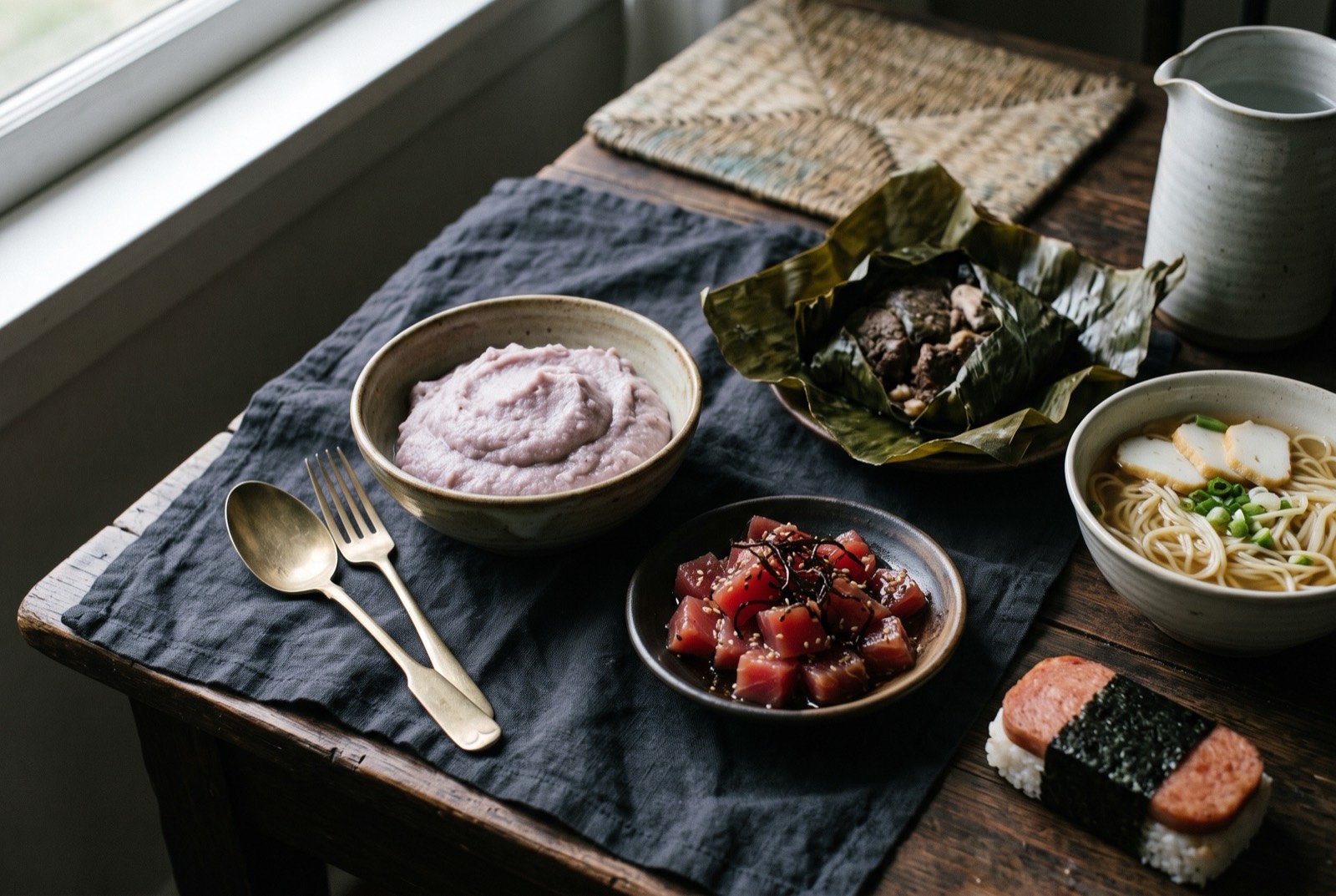
Hawaii carries two food worlds under one flag: Native Hawaiian cooking built on kalo, the imu earth oven and the papa kuʻi ʻai pounding board, and the plantation-built world of six migrant kitchens, Chinese, Japanese, Portuguese, Puerto Rican, Korean and Filipino, forced to share one lunch break, plus the 1991 chef-led movement that read both seriously. Every dish as tradition built it, then what a modern chef would change.
Sources and review · What this chapter does not assert · How we research · Spotted something wrong?
A Sense of Place
Hawaii carries two food worlds under one flag, and the second is unlike anything else in this atlas. The first is Native Hawaiian, a Polynesian voyaging tradition built on kalo, the taro plant Hawaiians trace their own ancestry to, worked through the imu earth oven and the papa kuʻi ʻai pounding board into poi, laulau and kalua pig. The second did not arrive as one migration but as six, layered on top of the first in barely seventy years: Chinese from 1852, Japanese from 1868 and 1885, Portuguese from 1878, Puerto Rican from 1900, Korean from 1903, Filipino from 1906, all recruited to work the same sugar and pineapple plantations, housed in ethnically segregated camps by an ownership class that wanted them divided, and mixing anyway, at lunch, in the one place segregation could not reach. What that produced, plate lunch, saimin, manapua, malasada, Spam musubi, does not belong to any one of those six communities and has no equivalent anywhere else Polynesia's staple crops and earth-oven technique reach. This is why Hawaii gets its own volume rather than folding into a wider Polynesian chapter the way Samoa, Tonga and Niue share one: nowhere else in the triangle did a single plantation economy layer this many distinct immigrant kitchens onto one indigenous base this fast, and nowhere else did the result read, a century later, as a genuinely new cuisine rather than a set of transplants sitting side by side.
A third layer sits on top of both: Hawaiian Regional Cuisine, the 1991 chef-led movement that took the plantation-era mixing seriously as raw material for real technique rather than tourist kitsch, and the next generation of Hawaii chefs now pushing past it toward something less mediated by French method and closer to what an aunty actually cooks. All three layers get real space here, and none of them stands in for the others.
Native Hawaiian Hawaii: the ahupuaʻa, the elder sibling, and a system engineered for a whole watershed
The Hawaiian archipelago was settled by Polynesian voyagers arriving between roughly 300 and 600 CE, carrying the canoe crops that still structure the indigenous kitchen: kalo (taro), ʻulu (breadfruit), niu (coconut), ʻuala (sweet potato), plus pig, dog and fowl. Land was divided into ahupuaʻa, wedges running from mountain summit to reef, each a working watershed rather than an administrative boundary: wao akua, the high cloud forest, home to the gods; wao lāʻau, the forest zone supplying timber and firewood; wao kanaka, the cultivated zone where loʻi kalo, the terraced, water-fed pond fields, did the heavy lifting; kula, open grassland; kahakai, the coastal strand and fishpond; and the stream itself, the ʻauwai system that carried cool, moving water from field to field and finally back to the sea. A konohiki, a resource manager answering to the district chief, oversaw the whole wedge, with a luna wai specifically responsible for the irrigation. Water belonged to no one, not even the highest chief, who held it in trust for the ahupuaʻa as a whole, a concept that resurfaced with real legal force in the twentieth century (see The History in Layers).
The fat of this kitchen barely exists in the European sense: there is no dominant cooking oil or rendered fat carrying flavour the way palm oil or ghee do elsewhere in this atlas. Instead the defining fat-adjacent ingredient is niu, coconut, used across a genuine ripeness ladder from the jelly-soft flesh of a green nut eaten straight, through a firmer half-ripe stage eaten with salt and poi, to mature meat pressed for cream. The starch, unambiguously, is kalo. A single acre of well-managed loʻi produces three to five tons of corms a year and, because the huli, the cut top of the plant, is simply replanted, a loʻi never needs to fallow the way a dryland field does. The protein is reef fish and shellfish, opihi picked from wave-battered rocks, kai-adjacent mollusks, and, at feast scale rather than everyday, pig. The aromatic register is narrow and precise rather than broad: paʻakai (sea salt), ʻinamona (roasted candlenut ground with salt), limu (of which Hawaiians named roughly a hundred distinct kinds), and almost nothing else, no chilli, no citrus as a cooking acid in the way the rest of the Pacific uses it (see The Technique Ladder for why this matters).
The plantation-built "local food" world: six kitchens forced to share one lunch break
The second food world did not grow out of Hawaiian ecology at all; it grew out of a labour system. Sugar planters recruited, in order: Chinese from 1852, Japanese from 1868 (the Gannenmono, "first-year men," 153 of them) and again from 1885 under a formal government programme, Portuguese from 1878 (mostly from Madeira and the Azores), Puerto Rican from 1900 (after two hurricanes wrecked that island's own agricultural economy), Korean from 1903, and Filipino from 1906, the largest and latest wave, 125,917 people brought over by the Hawaii Sugar Planters' Association between 1906 and 1946. Housing was deliberately segregated by ethnicity, a Japanese camp, a Filipino camp, a Portuguese camp, an "Alabama Camp" for African American workers, a management strategy aimed as much at preventing cross-ethnic union organising as at anything else.
It did not work, at least not at lunchtime. Workers carried food to the fields in a kau kau tin, a double-decker aluminium container, rice in the warm bottom compartment against the body, a meat or vegetable dish on top. At the break, workers from every camp squatted in a circle and pooled what they had: a Portuguese labourer's wife giving bread and buns to camp children, a Japanese family giving sushi, a Hawaiian family giving fish. This is not folklore dressed up as history; it is the specific, documented mechanism behind plate lunch, saimin and half the dishes in this chapter's second half, and it means that the "local food" this section describes was never any one community's cuisine, it was built, dish by dish, out of six kitchens forced to share one lunch break.
The fat of this kitchen is whatever the six traditions brought and could keep in a plantation camp, lard and vegetable oil daily, ghee-adjacent richness reserved for festival cooking. The starch is rice, imported and cheap, standing in for the varied home starches (wheat, taro, cassava) each community had left behind, with macaroni entering as an oddity in its own right: shelf-stable, mixed easily with mayonnaise, and genuinely cheaper than potatoes on an island. The protein rotates by community of origin within a shared format, kalua pork, chicken katsu, kalbi ribs, chicken adobo, in a way no single dish claims exclusively. The aromatic is soy sauce and dashi, carried in by the Japanese and Chinese wave and now the base note of the whole local-food register, not a garnish borrowed from one cuisine but the connective tissue between all six.
The structural logic, at a glance
| Native Hawaiian | Plantation-era "local food" | |
|---|---|---|
| Fat | Coconut (niu), by ripeness stage | Lard and vegetable oil daily; ghee-adjacent richness at festival |
| Starch | Kalo (taro), the sacred elder sibling | Rice, imported; macaroni as the "Western" plate-lunch oddity |
| Protein backbone | Reef fish, shellfish, pig at feast | Kalua pork, chicken katsu, kalbi, adobo, rotating by community |
| Aromatic | Paʻakai, ʻinamona, limu, no chilli, no cooking citrus | Soy sauce and dashi, the connective tissue across all six traditions |
| Land and resource claim | Ahupuaʻa (kin- and chief-stewarded watershed), water held in trust | No customary claim; plantation lease and camp housing |
| The defining technique | The imu, the earth oven, and paʻiʻai pounding | The kau kau tin's forced, daily cross-ethnic trade |
The History in Layers
Hāloa, and a genealogy that makes kalo family rather than crop
Native Hawaiian genealogy traces both kalo and the Hawaiian people to a single origin event. Papahānaumoku, the earth mother, and Wākea, the sky father, had a daughter, Hoʻohōkūkalani. Her first child was stillborn; where he was buried, the first kalo plant grew, named Hāloanakalaukapalili, "long breath, trembling leaf." Her second child was named Hāloa in his elder brother's honour and became the ancestor of the Hawaiian people. Kumu hula Edith Kanakaʻole, recorded through her daughter Dr. Pualani Kanakaʻole Kanahele in a 2025 academic oral history, put the genealogy's practical force plainly: ʻohā, the small offshoots that sprout from a kalo corm, is the root of the word ʻohana, family, and "Hāloa, the kalo plant, is our elder sibling that we must care for and respect." This is not a metaphor layered on afterward. It is the reason kalo occupies a different category from every other staple in this atlas: not a crop a Hawaiian family grows, but a relative a Hawaiian family owes care to.
Contact, and a fish that arrived by trading company rather than by canoe
Captain Cook's expedition reached the islands in 1778, the first sustained European contact. A far less discussed contact-era arrival belongs directly on this chapter's table: salmon, not native to Hawaiian waters at all, brought in by the Hudson's Bay Company, which opened a Honolulu office in 1829 specifically to sell Pacific Northwest salmon and timber. HBC traded with Northwest Coast peoples for barrelled, salt-pickled salmon and shipped it to Hawaii in real, documented volume, a few hundred barrels a year through the 1830s, 1,530 barrels in 1846, peaking at 2,610 barrels in 1849, before the 1853 smallpox epidemic devastated the Native Hawaiian population and collapsed the market; HBC closed its Honolulu operation in 1859. Lomi lomi salmon, salted fish worked by hand in water to leach the cure, then mixed with tomato and onion, is the result: a genuinely contact-era dish, built on an imported ingredient inside an indigenous technique, and not, this chapter should say plainly, a plantation-era invention despite reading like one of the many creole dishes further down this chapter.
The Great Māhele, and a taro economy engineered into collapse
In 1848 the Māhele converted the ahupuaʻa system of chiefly stewardship into private, fee-simple land title. On paper it protected native tenants: the Kuleana Act of 1850 let hoaʻāina, native tenants, claim title to land they actually cultivated, often the most productive wetland kalo land, and reaffirmed the right to fish and gather throughout the ahupuaʻa. In practice it ran the other way. The dry leeward plains suited to sugar passed overwhelmingly to haole planters and businessmen, and demand for Hawaii-grown sugar rose sharply once the American Civil War cut off mainland Southern supply. Sugar needed water, and it took it from the same windward valleys the kalo economy depended on: the number of irrigation ditches diverting stream water to cane fields, essentially flat before the 1893 overthrow, tripled in the decades after American planters controlled the government. Wetland kalo growers who could not sustain themselves once their water was diverted were pushed into the plantation cash economy or into Honolulu's tenements. Kalo acreage fell from a historic peak estimated near 20,000 acres to under 400 acres harvested statewide today, a decline this chapter states plainly rather than smoothing into a vague "changed over time."
The overthrow, and a government built to serve a crop rather than a people
Between 1846 and 1893, roughly 90 per cent of privatised land in the islands passed to non-Kānaka Maoli ownership, mostly to sugar interests, and by 1893 five companies, Alexander & Baldwin, American Factors, C. Brewer, Castle & Cooke and Theo. H. Davies, dominated Hawaii's political and economic life from a sugar base. The Kingdom of Hawaii was overthrown in January 1893 by a group of American and European businessmen backed by US Marines; Lorrin A. Thurston, one of the overthrow's architects, went on to head the 1903 Hawaii Promotion Committee that later drove the territory's pivot to tourism. Rural Hawaiian communities lost further ground across the mid-twentieth century as agricultural and fishpond land was repurposed for resort and subdivision development: the 523-acre Kuapā fishpond, once producing 300 to 500 pounds of fish per acre a year, became the Hawaii Kai Marina; Oʻahu alone held 114 working fishponds in 1881, producing over a million pounds of fish annually, on an island whose own traditional name, ʻĀina Momoa, means "land fat with food."
Six labour migrations in seventy years, and the kau kau tin that outlasted the plantation
The recruitment sequence and the camp system that housed it are described in full in A Sense of Place above; what belongs here is the honest shape of the human cost behind it. Contracts ran five years at wages of a few dollars a month, with little effective recourse against overseers; the 1906 to 1946 Filipino recruitment specifically shifted toward Ilocano workers in the 1920s and 1930s partly as a deliberate strategy to divide the workforce linguistically, and a final wave of 7,361 Ilocanos was recruited as late as 1946 explicitly to weaken union organising during a major post-war strike. Because early Korean immigration was almost entirely male, a "picture bride" system followed, roughly 2,000 Korean women emigrating to Hawaii and California between 1905 and 1924 having exchanged only photographs with their intended husbands.
What survived this system, and genuinely deserves to be read as a small act of quiet resistance to it, is the kau kau tin's daily trade. By the 1930s that trade had formalised into the lunch wagon and, after the war, the plate lunch diner; by the same decade, saimin stands were selling five-cent bowls of noodle soup built on a broth no single one of the six communities would recognise as entirely its own. Neither dish belongs to any one camp. Both belong to the fact that segregation, however deliberately engineered, could not survive a shared lunch break.
Hawaiian Regional Cuisine, 1991, and food read as an argument rather than a garnish
By the late 1980s, high-end Waikiki dining meant Americanised "Continental" cuisine, Chateaubriand with Béarnaise, sole almondine, veal cordon bleu, served in hotel restaurants that imported nearly all their ingredients and ignored the Japanese, Filipino and Chinese food most of Hawaii actually ate. Chef George Mavrothalassitis (Chef Mavro) recalled a travel magazine telling visitors to "enjoy the food in the plane, because it is going to be your best meal" once they landed. In August 1991, twelve chefs, Sam Choy, Roger Dikon, Mark Ellman, Amy Ferguson Ota, Beverly Gannon, Jean-Marie Josselin, George Mavrothalassitis, Peter Merriman, Philippe Padovani, Gary Strehl, Alan Wong and Roy Yamaguchi, met at the Maui Prince Hotel and formally organised as Hawaii Regional Cuisine, at the suggestion, worth naming honestly, of producer Shep Gordon, who argued they needed to present as a movement to be noticed from a remote archipelago at all. What they actually did was two things: build direct relationships with local farmers, ranchers and fishermen, in some cases literally supplying farmers with seed for herbs the chefs needed but could not source anywhere else, and apply high-end, French-derived technique to Hawaii's own plantation-era Asian and Pacific ingredients rather than importing a Continental menu wholesale. Roy Yamaguchi's own description: food that combined Asian and Hawaiian flavour with French technique. Alan Wong, on how far local sourcing has come since: "Twenty years ago, we didn't have hearts of palm, mushrooms, grass-fed beef, local veal, sea asparagus, Waialua chocolate, moi, kampachi."
The next generation, and a deliberate turn away from French mediation
A genuine and sourced generational argument sits behind the chefs now working in HRC's wake: where the 1991 founders ran Hawaiian and Asian flavour through French technique, chefs like Sheldon Simeon explicitly reject that framing. In his own words, "we are cooking our food straight up," not "trying to spin on Hawaii food with French technique," drawing recipes from "cookbooks in the 1980s that are made from mochi-pounding grandmothers" and from "Auntie's house and learning how they make their adobos." Mark "Gooch" Noguchi, trained under Chef Mavro himself, now centres his cooking explicitly on the ahupuaʻa concept, with hands-on restoration and foraging work in the Heʻeia ahupuaʻa on Oʻahu, the clearest living embodiment this chapter found of the idea that a restaurant technique reaching for real fire, real fermentation or real curing is not importing anything, it is doing, more deliberately, what the imu and the kau kau tin were already doing.
A live movement, not a settled inheritance
None of this is closed history. In 2002 the University of Hawaii's own College of Tropical Agriculture and Human Resources patented three varieties of Hawaiian taro and began genetically engineering them without Native Hawaiian consultation; sustained protest, led in part by Native rights activist Walter Ritte Jr., forced UH to drop the patents in 2006, and both a Hawaii County ban on GMO taro and coffee and a state "Taro Security Bill" followed. In 1973, the Hawaii Supreme Court ruled in McBryde Sugar Co. v. Robinson that private ownership of water was never actually conveyed by the Māhele's land grants and that the state holds it in trust for the common good, a ruling that has since enabled real streamflow-restoration cases brought by generational kalo farmers in East Maui. And in 2018, a Chicago chain that had trademarked the words "aloha" and "poke" sent cease-and-desist letters to small businesses using the same two words, including to a Native Hawaiian woman running a poke shop in Anchorage, Alaska, provoking a genuine, public Native Hawaiian backlash over who gets to own a word and a dish that were never theirs to begin with. Hawaii today imports an estimated 85 to 90 per cent of the food its own residents eat, a fact this chapter treats not as trivia but as the entire stakes of every restoration project named above.
The Flavour Arsenal
Kalo: the elder sibling, worked two ways
Steamed, then pounded on a papa kuʻi ʻai board with a carved basalt pōhaku kuʻi ʻai (the pounder's parts have their own vocabulary: pōheoheo the head, kūʻau the handle, kaʻe the base rim, mole the underside), kalo becomes paʻiʻai, firm pounded taro, or, thinned further with water, poi. This is a living practice, not archival: Earl Kawaʻa's free thirteen-week Papahana Kālai Papa Me Pōhaku Kuʻi ʻAi workshop in Waimānalo has taught nearly a thousand people to carve their own board and pounder over the past decade, each finished tool named and welcomed into the family that made it.
Limu: roughly a hundred named kinds, and one that cannot be farmed
Hawaiians recognise close to a hundred distinct named limu (seaweed), of which around sixty have been matched to a known scientific species, drawn from roughly 600 species present in Hawaiian waters. Limu kohu (Asparagopsis taxiformis), sharply iodine-flavoured and the classic poke seasoning, cannot be cultivated and grows only wild in the intertidal zone; sustainable harvest means breaking stalks at the base and rubbing them on rock to release spores for regrowth, a real technique rather than folklore, and wild availability is already declining from harvesters who skip that step.
ʻInamona: the roasted candlenut relish that seasons poke before soy sauce ever touches it
Kukui (candlenut) roasted and pounded with salt into a coarse, oily relish, the pre-contact seasoning for raw fish alongside paʻakai and limu, and still the marker of a poke built the old way rather than the soy-and-sesame version most of the world now knows as poke.
Niu, ʻulu, ʻuala: the canoe-crop rotation beneath everything
Coconut across its ripeness ladder (see A Sense of Place), breadfruit, and sweet potato, which early Hawaiians bred into over 240 named varieties precisely because it matures in roughly a month against kalo's near-year, making it the reserve crop that, in the words of one ʻōlelo noʻeau, "ends famine quickly." ʻUala's guardian deities are pig-associated (Kānepuaʻa, Kamapuaʻa), a different mythic register from kalo's, worth knowing before treating the two staples as interchangeable.
Alaea salt: red clay, real mineral bite
Unrefined sea salt mixed with iron-oxide volcanic clay, giving a genuine reddish colour and a faintly bitter mineral edge ordinary sea salt cannot replicate. Genuinely buyable in Britain (see Sourcing in Britain); no excuse to substitute plain salt once you have it.
Kiawe: the imu's fuel, and the smoke that reads as Hawaiian
An invasive mesquite relative, abundant and free across the islands, kiawe is the traditional imu fuel and the flavour signature underneath kalua pig. Sold dried in Britain, sometimes ground as kiawe flour from the pods too; a UK cook building a Big Green Egg approximation of the imu should treat kiawe as an ingredient worth ordering in specifically, not a detail to skip.
Shoyu and dashi: the connective tissue of the whole plantation-era kitchen
Soy sauce, carried in by the Chinese and Japanese waves, is the aromatic base that saimin, Spam musubi, manapua filling and half the plate-lunch proteins all share, alongside a light dashi built from kombu, dried shrimp and shiitake rather than the pork or chicken bone stock ramen uses.
Datu Puti and Silver Swan: the Filipino adobo pantry, findable in Britain by name
Datu Puti cane vinegar and Silver Swan soy sauce are the two defining bottles behind Hawaii's Filipino adobo, both genuinely stocked by name at London's Filipino grocers (see Sourcing in Britain), which matters because adobo without the correct vinegar's specific sourness is a different, blunter dish.
Spam: the postwar staple this chapter treats honestly rather than apologetically
Entered Hawaii in bulk through the large wartime and postwar US military presence and, under continued postwar scarcity, became genuinely central to local cooking rather than a joke ingredient. This chapter follows the same house rule the Fiji volume applied to tinned corned beef: a colonial-era or wartime ingredient, fully absorbed into a kitchen, does not make the resulting dish any less real.
The Technique Ladder
The argument, from inside
Every technique below answers this chapter's own version of the atlas's running claim: a restaurant reaching for salt-curing, live-fire smoke, or a slow-built dashi is not importing anything foreign onto Hawaiian ingredients. It is doing, more deliberately and with better equipment, what a poke bowl, an imu pit and a saimin stand were already doing on a plantation lunch break.
Rung 1. Season raw fish with salt and seaweed, not acid
This is the single most important technical distinction this chapter draws, and it is worth stating plainly because so much writing about Pacific raw fish collapses it: poke is not kokoda, not ika mata, not ʻota ʻika. Those Melanesian and Polynesian dishes cure fish with citrus, denaturing the protein with acid to mimic what heat does. Pre-contact Hawaiian poke used no acid at all: reef fish cut and seasoned with paʻakai (salt), ʻinamona (roasted candlenut) and limu, a genuinely different mechanism, seasoning and salting rather than acid-curing, closer to a Japanese-style seasoned sashimi than to a Fijian or Tahitian citrus cure. The soy sauce, sesame oil and green onion most of the world now associates with poke are later, Asian-contact additions layered on top of that original salt-and-seaweed base, not a corruption of it, but a real and datable second stage.
Rung 2. Build radiant heat mass first, then trap steam and smoke under leaf and earth
The imu works on three mechanisms together: radiant and conductive heat from stones heated for hours over a kiawe fire; steam, generated as moisture in the food and its banana-leaf wrapping turns to vapour once the pit is sealed with more leaves and soil; and a genuine smoke note from the kiawe itself and anything not fully wrapped. Pit depth runs roughly two to four feet, sized to the quantity of food; the whole cook runs six to ten hours depending on load. Flagged honestly: the most detailed technical account of imu construction found in researching this chapter comes from a general wilderness-skills source rather than a Native Hawaiian or Hawaii-institutional one; the broad shape, kiawe fuel, banana leaf for steam, ti leaf for flavour, an eight-to-ten-hour cook, is corroborated by Native Hawaiian chef Sheldon Simeon's own published method, but the granular construction detail should be read as generalist secondary sourcing rather than settled ethnography.
Rung 3. Pound past the fibre, then let lactic fermentation do the rest
Turning steamed kalo into paʻiʻai is mechanical work, pounding on a stone board until the corm's fibrous structure breaks down into a smooth paste; turning paʻiʻai into poi is chemistry, wild lactic-acid bacteria souring the thinned paste from a mild pH of roughly 5.5 to 6.5 fresh, down toward 3.8 to 4.5 within two to three days, the tang older generations of Hawaiians specifically preferred. This is fermentation exactly as deliberate as any bench technique in this atlas, and a UK cook with fresh taro and a spice grinder standing in for a stone pounder can genuinely reproduce both stages at home.
Rung 4. Build a light dashi, and pull the kombu before it boils
Saimin's broth is built from kombu, dried shrimp and shiitake, roughly a cup of dried shrimp, five dried shiitake, a thumb of ginger and a sheet of kombu to two quarts of water, simmered around two hours and finished with salt off the heat, staying clear and light rather than the pork-bone richness of ramen or the beef-and-star-anise depth of pho. The kombu must come out before the water reaches a hard boil, or the dashi turns cloudy and takes on a bitter edge, the single most-cited technical failure point in every account of this broth.
Rung 5. Braise for structure, chill under its own liquid, then finish over live fire
Alan Wong's own published method for kalbi-style short ribs, and the clearest transferable HRC technique this chapter found: the ribs simmer in water an hour, skimming, then soy, mirin, sugar, ginger, garlic and scallion go in for a further two to three hours until fork-tender. Critically, the meat is then chilled overnight in its own braising liquid, not served straight from the pot, a rest that lets the meat hold its shape under high heat rather than falling apart, before being brushed with the reduced liquid and grilled hard over coals for the char a braise alone can never give. This two-stage logic, structure built low and slow, then a second, entirely different cooking event for surface and smoke, is the whole HRC argument in one technique.
The Ferment and Preserve Bench
Poi, treated as the bench entry it actually is
Poi is this chapter's real ferment bench: fresh, mild paʻiʻai thinned with water and left at room temperature sours over two to three days as wild lactic-acid bacteria drop the pH from roughly 5.5 to 6.5 down to 3.8 to 4.5, the same broad mechanism as a lacto-fermented vegetable ferment elsewhere in this atlas, applied to a starch rather than a vegetable. A UK cook with a dehydrator can hold a small culture going by keeping back a spoonful of active, soured poi as a starter for the next batch, the same logic as a sourdough mother, though this chapter did not find a Hawaiian source confirming that specific practice and flags it as a reasonable extrapolation rather than a documented one.
A quick Filipino atchara, for the plate lunch table
Not central to this chapter's own dish list, but genuinely present at the plate lunch table via Hawaii's Filipino community: shredded green papaya, carrot and red pepper, salted and left to draw for 30 minutes, then packed into a jar with a hot vinegar, sugar and salt brine (using Datu Puti cane vinegar if you have it) and left at least 24 hours before eating, a bright, sharp counter to a rich kalbi or adobo plate.
Sourcing in Britain
Verified August 2026. The honest headline: some of this chapter's ingredients are genuinely, easily buyable in Britain; others are not, and this chapter says so rather than implying a workaround that does not exist.
Fresh ʻahi (sashimi-grade yellowfin tuna): available, with real caveats
Sashimi-grade tuna is a real UK product category, but it comes from specialist online delivery services, not high-street fishmongers, and the species sold varies. Fine Food Specialist (London) sells fresh sashimi-grade Thunnus albacares (yellowfin), the correct species, hook-and-line caught, with UK-wide next-day delivery. The Fish Society and The Upper Scale (based at Billingsgate Market) also stock genuine yellowfin at sashimi standard. Billingsgate Market itself handles whole tuna and can cut sashimi-grade fillets, but only at wholesale volumes, a real option for a cook prepared to buy in bulk and freeze, not a casual errand. Note that "sashimi grade" is not a regulated term in Britain, it is each supplier's own quality claim, so order specifically for the date you need it, rather than trusting a supermarket counter.
Fresh taro: correctly available, under a different name
UK Afro-Caribbean and South Asian grocers commonly stock genuine Colocasia esculenta, Hawaiian taro's own species, under the names eddoe and dasheen, priced by the kilo. The genuine trap: a second, unrelated plant, Xanthosoma sagittifolium, is often sold nearby as "cocoyam" and behaves differently in cooking. Ask for eddoe or dasheen by name, or check the label reads Colocasia esculenta.
Poi: genuinely, structurally not available
The two major commercial poi producers, Taro Brand and Waiahole Poi Factory, both explicitly refuse international shipping, citing the perishability of fresh fermented poi. Dehydrated poi powder does reach Britain via cross-border resellers, but it is a fundamentally different product, rehydrated powder rather than fresh-pounded, live-fermented paste. The honest route for a UK cook is to pound your own from correctly sourced fresh taro (see the Poi recipe above), not to hunt for an import that does not exist.
Banana leaf and ti leaf
Frozen banana leaf is genuinely, easily available, Longdan stocks it in multiple London branches and online, alongside Fine Food Specialist's fresh version. Ti leaf is not: no UK retailer, importer or florist selling it for culinary use was found. This is not a compromise invented for this chapter, Hawaiian food writers themselves treat banana leaf as the standard substitute when ti is unavailable.
Plantation-era pantry: the easy category
Spam is stocked by every major UK supermarket. Filipino grocers are real and findable in London, Pinoy Supermarket in Earls Court stocks Datu Puti vinegar and Silver Swan soy sauce by name. Portugal's Vauxhall to Stockwell corridor has genuine delis, Delicias de Portugal, Serrana, worth a direct enquiry for linguiça, though this chapter could not confirm it on their shelves by name. Char siu, dried shrimp and the components of a proper dashi are trivially available at any of the UK's Chinese and pan-Asian supermarket chains, Wing Yip, Loon Fung, Longdan. Sun Noodle's specific saimin noodle is not sold in Britain; fresh ramen or wheat-egg noodles are the correct, honest substitute, since saimin's identity lives in the broth, not the noodle.
Alaea salt, macadamia and limu
Alaea salt is genuinely stocked by UK specialist spice retailers, Spice Mountain, Seasoned Pioneers, no need to import from Hawaii directly. Macadamia nuts are mainstream, sold by Sainsbury's and Holland & Barrett. Dried ogo (Hawaiian limu, the correct Gracilaria species) reaches Britain only via cross-border marketplace resellers, treat this as reachable but with unconfirmed shipping logistics, not as stocked in an ordinary UK grocer.
Ingredients that decide great from grim, ranked
- Fresh, genuinely sashimi-grade ʻahi. The single ingredient that makes or breaks poke, real UK sourcing exists but requires ordering from a named specialist.
- Alaea salt. Cheap, easy, and does real work no ordinary sea salt replicates.
- Correct-species taro (eddoe or dasheen). Available and correctly identified; getting the species right is the whole difference.
- Dried ogo. Easy to skip since it takes marketplace digging rather than a grocer visit, but it is what turns poke into the real dish rather than seasoned tuna cubes.
- Frozen banana leaf. Inexpensive, genuinely stocked, essential for laulau and kalua pig.
- Datu Puti vinegar. Small, specific, and worth the trip to Earls Court rather than a generic cider vinegar substitute.
What this chapter could not confirm
Whether Wing Yip's banana leaf stock is fresh or frozen; whether any UK Portuguese deli stocks linguiça by name rather than simply being a plausible place to ask; and the exact shipping cost and delivery time for dried ogo bought via a UK marketplace reseller. None of these gaps are papered over above.
Voices and Sources
Books. Rachel Laudan, The Food of Paradise: Exploring Hawaii's Culinary Heritage (University of Hawaii Press, 1996, Jane Grigson Award), the scholarly case that Native Hawaiian food, plantation-built local food, and chef-driven Hawaiian Regional Cuisine are three genuinely distinct traditions, not one. Arnold Hiura, Kau Kau: Cuisine and Culture in the Hawaiian Islands, the standard local reference on the plantation-era table. Samuel Hideo Yamashita, Hawai'i Regional Cuisine: The Food Movement That Changed the Way Hawai'i Eats (University of Hawaii Press), built on 36 interviews with the movement's own chefs. Sheldon Simeon, Cook Real Hawai'i and Ohana Style.
Chefs and restaurants. Alan Wong, now cooking at The Kāhala Hotel & Resort. Peter Merriman, operating on four islands, a 2026 James Beard semifinalist for Outstanding Restaurateur. Chris Kajioka at Senia in Chinatown. Sheldon Simeon at Tiffany's in Wailuku. Ed Kenney at Town and Mud Hen Water. Mark "Gooch" Noguchi, whose ahupuaʻa-centred restoration work in Heʻeia is the clearest living version of this chapter's own argument.
Institutions. The Bishop Museum, whose bulletins and blog anchor much of this chapter's Native Hawaiian material. Ka Wai Ola, the Office of Hawaiian Affairs' own publication. The University of Hawaii's Center for Tropical Agriculture and Human Resources.
In the UK. London's poke scene, Island Poké, Ahi Poké, Honi Poké among others, real and growing, but honestly a poke-bowl trend downstream of the mainland US boom rather than evidence of a broader UK Hawaiian food culture.
Things this chapter has deliberately not asserted
- That imu construction technique, as detailed above, rests on Native Hawaiian or Hawaii-institutional sourcing; the most granular detail found comes from a general wilderness-skills source, corroborated only in broad shape by a named Hawaiian chef.
- That the poi bowl's "no arguing while eating" custom is a general Hawaiian rule; it rests on one specific, well-attributed oral account and is not generalised beyond it here.
- That poke's status as a fixed, named dish predates the twentieth century; some secondary press suggests the word does not appear in Hawaiian dictionaries until the 1970s, a claim this chapter could not verify against a primary source and does not assert either way.
- That Barbara Funamura invented the specific rectangular Spam musubi format in 1983; the claim traces to a single academic paper title cited at one remove and is not repeated here as settled fact.
- That Hawaii's Filipino-American adobo diverges from Philippine adobo in any specific, sourced way; no Hawaii-specific source describing that divergence was found, a genuine gap this chapter leaves open rather than inventing a plausible-sounding answer.
- That chicken long rice has a documented history beyond "Chinese noodle soup, adapted"; every source found was a mainland recipe blog, and this chapter has accordingly left it out of the dish list entirely rather than build a recipe on sourcing this thin.
- That the malasada method given above is Leonard's Bakery's own recipe; it is standard Portuguese-doughnut technique, presented honestly as an approximation.
- That Hawaiian Regional Cuisine chefs use sous vide or fermentation as signature techniques; no chef-attributed source for either claim was found, despite specific searching.
- The current, 2026 operating status of several of the movement's founding twelve chefs, Jean-Marie Josselin, Beverly Gannon's restaurants post-acquisition, Philippe Padovani, Roger Dikon and Gary Strehl; where this chapter could not confirm current status, it says so rather than guessing.
Season raw fish with salt and seaweed, not acid
This is the single most important technical distinction this chapter draws, and it is worth stating plainly because so much writing about Pacific raw fish...
Build radiant heat mass first, then trap steam and smoke under leaf and earth
The imu works on three mechanisms together: radiant and conductive heat from stones heated for hours over a kiawe fire; steam, generated as moisture in the...
Pound past the fibre, then let lactic fermentation do the rest
Turning steamed kalo into paʻiʻai is mechanical work, pounding on a stone board until the corm's fibrous structure breaks down into a smooth paste; turning...
Build a light dashi, and pull the kombu before it boils
Saimin's broth is built from kombu, dried shrimp and shiitake, roughly a cup of dried shrimp, five dried shiitake, a thumb of ginger and a sheet of kombu to...
Braise for structure, chill under its own liquid, then finish over live fire
Alan Wong's own published method for kalbi-style short ribs, and the clearest transferable HRC technique this chapter found: the ribs simmer in water an hour...
The dishes
- Poi Native Hawaiian
- Poke Native Hawaiian, later layered with Asian-contact seasoning
- Kalua Pig Native Hawaiian
- Laulau Native Hawaiian
- Opihi with Alaea Salt Native Hawaiian
- Lomi Lomi Salmon Hawaii, contact-era, 1830s to 1840s
- Saimin Plantation-era Hawaii
- Manapua Plantation-era Hawaii, Chinese origin
- Malasada Plantation-era Hawaii, Portuguese, Azorean and Madeiran
- Spam Musubi Postwar Hawaii, plantation-adjacent
- Twice-Cooked Kalbi Short Ribs Hawaiian Regional Cuisine, Alan Wong's published method
Sources and review
- Reviewed
- Not yet reviewed from inside the tradition
- Cooked
- Not yet cooked and reported
Where this volume comes from
4 research briefs on file for this volume, researched to the rules on How we research. Published 3 September 2026. Last changed 8 September 2026.
The brief's own account of its sources
Roughly 14 to 16 distinct sources were directly fetched and read in full; several more were confirmed only by search-result title or snippet and are flagged individually above as not independently verified. Hawaii-local or in-tradition (fetched and read in full): Honolulu Civil Beat (plate lunch); HAWAIʻI Magazine (loco moco, malasadas, saimin broth, three separate articles); Flux Hawaii (saimin); Images of Old Hawaiʻi (manapua, plantation camps, lomi lomi salmon, three separate pages); ILWU Local 142 (Filipino sakada); Big Island Now (Puerto Rican immigration); Maui Magazine (kau kau tin