Oceania and the Pacific · Volume 10
The Marshall Islands, Kiribati and Nauru
The Atoll, the Pit and the Palm
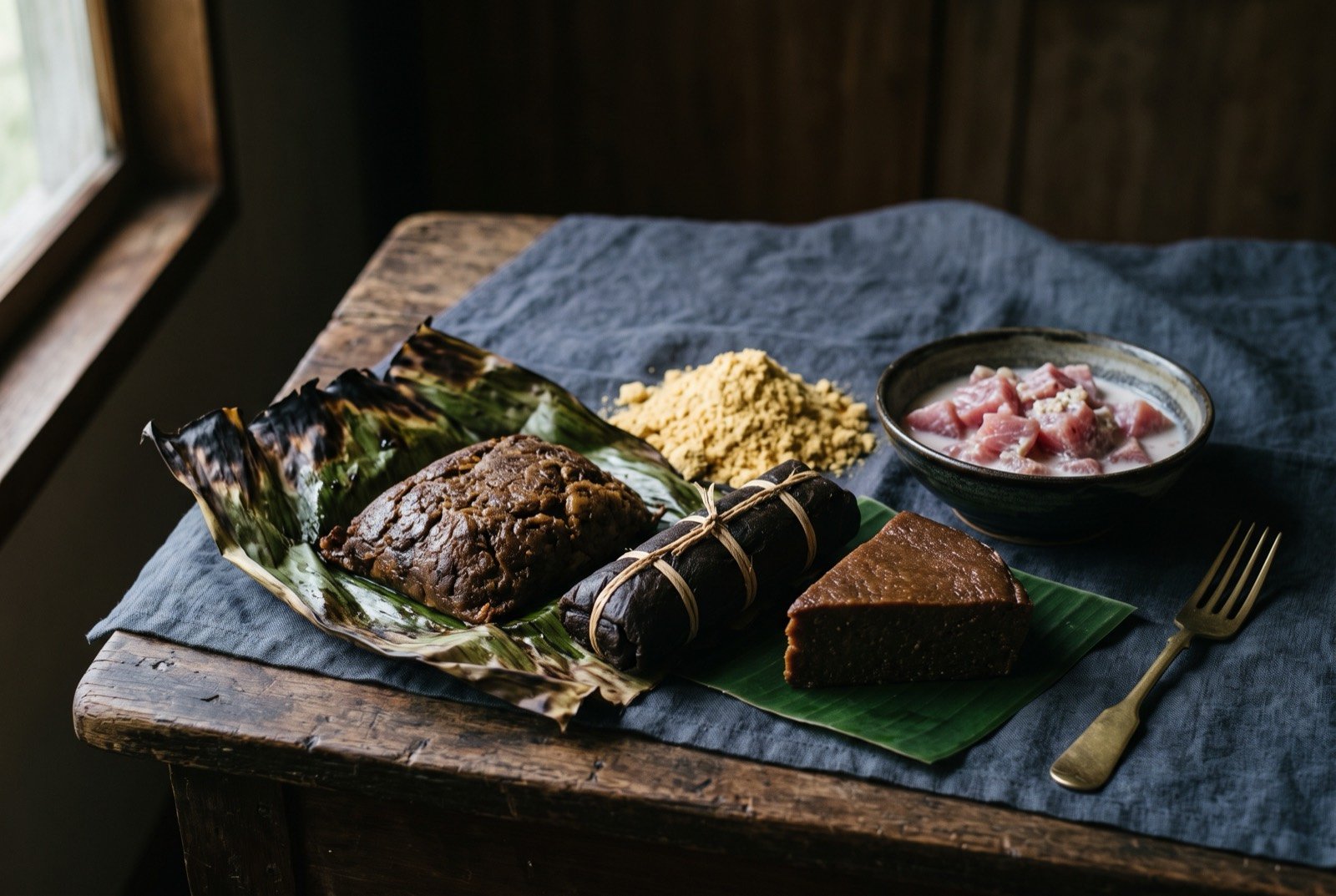
The Marshall Islands, Kiribati and Nauru, three nations taken together for a reason this chapter states outright: not a shared trade route, empire or faith, but the hardest ecology in the whole atlas. Coral atolls and one exhausted raised-coral rock, with almost no arable land, no rivers, and a diet built from the reef, the palm and a handful of salt-tolerant trees. This is honestly the thinnest volume this atlas has produced, and its case for standing together is ecological necessity, not history. Every dish as tradition built it, then what a modern chef would change, where there is enough tradition to elevate.
Sources and review · What this chapter does not assert · How we research · Spotted something wrong?
A Sense of Place
Say the hard thing first, because everything else in this chapter depends on it being said plainly. The Marshall Islands, Kiribati and Nauru are bound to each other by nothing except the ecology that a coral atoll, or in Nauru's case a single raised and then strip-mined coral island, forces on anyone trying to feed themselves from it. There is no single trade route, faith or empire running through all three the way there is across the Mediterranean or the Swahili coast, and this chapter does not pretend otherwise. What binds them is that none of the three has a river, a mountain, or meaningful soil, and each has built a food system from the same short list of salt-tolerant trees, breadfruit, coconut and pandanus, plus, where the geology allows it, a labour-intensive pit-grown giant swamp taro, and the reef and lagoon for protein. That is a real argument. It is also a thinner one than most of this atlas's volumes get to make, and the chapter says so rather than smoothing over the difference.
The Marshall Islands (Aolepān Aorōkin Ṃajeḷ) is 29 coral atolls and 5 single islands arranged in two parallel chains, the Ratak (sunrise) and the Ralik (sunset), totalling only around 181 square kilometres of dry land scattered across roughly two million square kilometres of ocean. No point rises more than a few metres above sea level. Rainfall is markedly higher in the southern atolls than the northern ones, and the precolonial diet tracked that gradient: wetter southern communities leaned on taro and breadfruit, drier northern ones on pandanus and coconut. History of the Marshall Islands, Wikipedia, aggregating the cited archaeological and ethnographic literature
Kiribati is 33 islands and atolls spread across roughly 3.5 million square kilometres of the central Pacific, straddling both the equator and the 180th meridian, so the country sits in all four hemispheres at once. It falls into three groups: the Gilbert Islands in the west (16 atolls, the historic and demographic core), the mostly uninhabited Phoenix Islands, and the Line Islands in the east, including Kiritimati, the world's largest atoll by land area. One island, Banaba, is a raised phosphate island geologically distinct from the rest of the Gilberts, and its story, told below, is essentially Nauru's rehearsed a generation earlier on a smaller scale. Only about 2.5% of Kiribati's land, some 340 square kilometres, is fit for cultivation at all. Geography of Kiribati, Wikipedia; Kiribati turns to climate-resilient food systems, Islands Business, 12 August 2026
Nauru is a single raised coral island of about 21 square kilometres, the world's smallest independent island nation by population, at around 10,800 people. Where Kiribati's problem is dispersal across a vast ocean, Nauru's problem is concentration and depletion on one spot: a century of phosphate strip-mining stripped away roughly 80% of the island's interior, the plateau known locally as Topside, leaving jagged coral pinnacle where the fertile cap and the trees on it used to be. This is arguably the single most extreme food ecology anywhere in this atlas. Nauru, Wikipedia; Effects of mining in Nauru, Wikipedia
| Nation | What the land will grow | What actually organises the food |
|---|---|---|
| Marshall Islands | Breadfruit, coconut and pandanus everywhere; giant swamp taro (iaraj) only where a freshwater lens sits deep enough to dig to | The gradient between wetter southern atolls (taro, breadfruit) and drier northern ones (pandanus, coconut); nuclear contamination of the tree crops themselves at Bikini and Enewetak |
| Kiribati | Babai (giant swamp taro) grown in hand-dug pits reaching the freshwater lens; pandanus and coconut everywhere; almost nothing else | The reef and lagoon, since only 2.5% of land is cultivable at all; a fragile freshwater lens under porous coral sand that the whole babai system depends on |
| Nauru | Almost nothing, after a century of phosphate mining destroyed the arable cap; a narrow coastal strip of coconut and pandanus is what remains | Near-total dependence on imported food; the reef and the coastal strip are what is left of an indigenous food supply, not what feeds the country |
A word on language and searching, stated honestly rather than glossed over. This chapter's research made real, direct attempts to search in Marshallese (bwiro, jaanikun, jekaro, mā, bōb, um, iaraj and the named taro dishes were searched as terms, not glossed in English) and in Gilbertese, te taetae ni Kiribati (te babai, te kabubu, te karewe and related vocabulary). Neither search surfaced meaningfully more than the English-language results already found, which most likely reflects a genuinely small online corpus in both languages rather than a failed search: the Marshall Islands Journal and Kiribati's own two weekly papers, the government-run Te Uekera and the privately owned Kiribati Newstar, could not be reached at article level through general search, only described from the outside. Nauruan-language searching found even less, and no Nauruan-authored food writing of any kind was located anywhere. This chapter treats that absence as a real, stated limitation rather than evidence that no such record exists.
The History in Layers
One founding crop package, carried by voyagers
Austronesian settlers, plausibly reaching the Marshall Islands via the Solomon Islands through a long island-hopping migration, brought the entire founding tree crop package with them: coconut, giant swamp taro, breadfruit and domesticated chickens. History of the Marshall Islands, Wikipedia Radiocarbon dates from earth-oven (um) charcoal at Laura village, Majuro, and at Kwajalein anchor settlement to roughly the first century CE; an older claim of Bikini Atoll habitation from 1200 BCE, based on driftwood-derived charcoal, is treated with real scepticism in the archaeological literature because drifted wood can be centuries dead before it is ever burned, and this chapter follows that caution rather than repeating the older date. A 2025 archaeological paper on Ebon Atoll's taro pits, among the most extensive continuous pit-cultivation zones found anywhere in Oceania, dated cultivation sediment there to between 2690 and 2390 years before present, with microfossil evidence of giant swamp taro, ordinary taro, banana, candlenut, pandanus and coconut all present in the same fill. Horrocks et al., Journal of Pacific Archaeology, 2025 Kiribati's own settlement history runs on a comparable timescale and is thought to be part of the same broad westward Micronesian and later Polynesian movement through the central Pacific, though this chapter found no comparably precise Kiribati dating to set against the Marshalls' archaeobotany.
Three colonial administrations, and one that mined the land itself
The Marshall Islands passed through three distinct colonial regimes, each of which bent the food system further away from subsistence. Germany ran the islands as a protectorate from 1885 to 1914, establishing the copra tax economy through the Jaluit Company, in which the traditional chiefs (irooj) collected a copra tax from commoners and kept a third; the Marshallese population fell by more than 30% under German rule, from 13,000 to 15,000 people before annexation to 9,200 by 1908, driven by a 1905 typhoon and dysentery epidemics in 1907 and 1908. Japan held the islands as a League of Nations mandate from 1914 to 1945, making them the largest copra producer anywhere in the Japanese mandate under a single trading-company monopoly, while forbidding Marshallese schoolchildren to speak their own language. The United States administered the islands as a UN Trust Territory from 1947, and the Marshall Islands became self-governing under a Compact of Free Association in 1979 and sovereign in 1986, in exchange for continued US military use of the Kwajalein Atoll missile range. History of the Marshall Islands, Wikipedia
Kiribati's Gilbert Islands became a British protectorate in 1892 and a crown colony in 1916. Banaba was annexed separately in 1900, after British prospectors identified it as holding exceptionally high-grade phosphate rock, a discovery that turned out to be the single most consequential fact in the island's history. The Gilbert and Ellice Islands were administratively split in 1975 amid ethnic and political tension between the two groups; the Ellice Islands became independent Tuvalu in 1978, and the Gilbert Islands, together with Banaba, became independent Kiribati on 12 July 1979. Banaba, Wikipedia; Gilbert and Ellice Islands, Wikipedia
Nauru's colonial history is shorter and more singular. Germany forcibly annexed the island in 1888, holding its twelve traditional chiefs, each head of a matrilineal clan, under house arrest until they agreed. German Protestant missionaries standardised Dorerin Naoero, the Nauruan language, from 1888 onward. Phosphate mining began in 1906 under a German-British arrangement and continued, through German, then joint British-Australian-New Zealand, then post-independence Nauruan government control, for most of the twentieth century. History of Nauru, Wikipedia
The land itself as the thing that was taken
This is the through-line that actually unites this volume, more than any dish does, and it deserves to be named as plainly as the checklist that scoped this chapter named it: in two of these three nations, empire did not just tax or administer the food supply, it destroyed the physical ground the food supply depended on.
Banaba. Phosphate mining ran from 1900 to 1979 and stripped away roughly 90% of the island's surface, dropping its mean elevation from around 80 metres to 20 to 30 metres and destroying, in the process, hundreds of the drought-resistant coconut and pandanus trees that had underpinned Banaban subsistence, along with the natural caves that had stored the island's fresh water and let Banabans survive droughts that would otherwise have been fatal on such a small, dry island. After the Second World War, British colonial authorities declared Banaba effectively uninhabitable and, having bought Rabi Island in Fiji in 1942 for the purpose, forcibly relocated most of the Banaban population there in 1945, with further waves of emigration in 1977 and 1981 to 1983. Rabi's Banaban population grew from around 1,000 in 1945 to roughly 5,000 by 1995; only around 300 people remain on Banaba itself today, an island still without reliable fresh water. Banabans sued the British government in 1971 over royalties and environmental compensation; in 1981 the community accepted a one-off trust payment of AUD 10 million in place of further litigation. The Displacement and Dispossession of Banaba, ICAAD, 27 February 2023 The Banaban story matters here for a reason beyond its own history: it explains why a diaspora community on Rabi Island, Fiji, several hundred miles from Kiribati proper, is today the most actively documented keeper of Gilbertese coconut-toddy knowledge available in English, a point this chapter returns to below.
Nauru. Phosphate-rich rock covering roughly 80% of the island was identified by the prospector Albert Ellis in 1899, and some 34 million tonnes were extracted across the twentieth century. After independence in 1968, Nauru bought out the mining rights itself and phosphate royalties briefly gave Nauruans the highest per-capita income of any sovereign state in the world. The cost was total: strip-mining left more than 80% of the island's interior a stripped, jagged coral pinnacle landscape incapable of supporting agriculture, forest, or in most places even soil, and the reserves themselves were essentially exhausted by the 2000s, ending the income that had followed. History of Nauru, Wikipedia; How phosphate mining ruined Nauru, ThinkLandscape / Global Landscapes Forum Nauru's own pre-mining food ethnography is thin in every source this chapter could find: general statements about fishing and small-scale gardening around coconut, pandanus and reef fish exist, but nothing with the granular, named-dish detail available for Kiribati's babai and toddy practice. That gap is stated here rather than papered over with an invented ethnography.
The Marshall Islands' rupture was different in kind: not the land dug away, but the land poisoned. The United States conducted 67 nuclear tests at Bikini and Enewetak Atolls between 1946 and 1958, including the 1952 Ivy Mike hydrogen bomb test, which physically destroyed the island of Elugelab, and the 1954 Castle Bravo test, whose fallout contaminated a far wider area than planned. The mechanism by which this became a food story, not just a land story, is documented by the US Department of Energy's own successor monitoring programme: the dominant human exposure pathway to residual fallout was not external radiation but eating locally grown tree crops, specifically coconut, breadfruit and pandanus, which take up caesium-137 from contaminated soil. Lawrence Livermore National Laboratory, Marshall Islands Program, Bikini Atoll The 167 Bikinians were moved to Rongerik Atoll in 1946, found to be starving there by 1948, and moved again to Kwajalein and then to Kili Island, where most of their descendants remain. A resettlement attempt on Bikini itself between 1969 and 1978 was abandoned when 1978 whole-body monitoring showed residents' caesium-137 body burden had risen elevenfold since the return began, and the island's own coconut crabs were found too radioactive to eat by 1975. Bikini remains uninhabited today bar a small caretaker crew. As one advocacy source states plainly, and this chapter treats the claim as informed synthesis rather than a single measured finding: "the displacement of populations and the destruction of ancestral lands meant people needed to depend on imported food, shifting the population from a stable, traditional diet to an unhealthy one." Heinrich Böll Stiftung, The Ongoing Consequences of the U.S. Nuclear Testing Program on the Marshall Islands
The present day: rice, the nutrition transition, and a climate crisis that is not future tense
New Zealand anthropologist Nancy Pollock's fieldwork found the pre-war Marshallese diet drew roughly 80% of its calories from breadfruit and its preserved paste, with pandanus, fish eaten as a side rather than a main. Reported via Hektoen International, Trentman, "Nutritional disruption in the Marshall Islands," 2017 By the early 2000s, as much as 90% of all food consumed in the Marshall Islands, and 80 to 90% of calories in the capital Majuro specifically, was imported, with white Calrose rice, a variety whose glycemic index of around 83 is higher than table sugar's roughly 68, structurally replacing breadfruit, taro and pandanus at the centre of the plate. Today's Dietitian, "Defeating Diabetes: Lessons From the Marshall Islands" A University of Arkansas dissertation on the Marshallese diaspora dates the rice-for-breadfruit substitution as far back as the 1930s in the home islands, under Japanese administration, well before the postwar period usually blamed. Chen, "Got Breadfruit?," University of Arkansas, 2018
A popular figure of 47% diabetes prevalence circulates widely in health writing about the Marshall Islands, but it does not survive checking against the country's own most recent national health survey. The WHO STEPS survey, fieldwork conducted July 2017 to April 2018 across 2,869 adults on Majuro, Kwajalein, Arno, Jaluit, Wotje and Kili, found 27% of adults with diabetes, with 65% of cases undiagnosed. WHO, Republic of the Marshall Islands Hybrid Survey, Final Report 2018 This chapter uses that figure rather than the widely repeated one, and flags the discrepancy rather than quietly picking whichever number sounds more dramatic. Whichever figure is used, the direction and scale are not in doubt.
Nauru's own version of this history is starker still. A clinical study recorded 40% of Nauru's adult population as diabetic by 1979, within a decade of the phosphate income boom; more recent figures put the country at or near the highest national adult diabetes rate on earth, around 31% overall and as high as 45% in the 55 to 64 age bracket, with more than two-thirds of Nauruan men and three-quarters of Nauruan women recorded as obese. The High Prevalence of Diabetes Mellitus in Nauru, ScienceDirect; Obesity in Nauru, Wikipedia Nauru and the Cook Islands recorded the fastest-rising BMI rates in the world between 1980 and 2008, more than four times the global average rate of increase, a pattern the academic literature attributes directly to the collapse of the traditional fishing-and-gardening economy under phosphate mining meeting sudden mid-century wealth that made imported, processed, high-status food newly affordable, in a culture where a large body had historically signified wealth. Obesity emergence in the Pacific islands, PubMed
Kiribati's crisis is not principally metabolic but literal: the freshwater lens that babai cultivation depends on is being breached by storm surge and rising seas today, not in some modelled future. Roughly 41% of the population is currently classed as food insecure by the country's own National Statistics Office, and food imports, chiefly rice and sugar, make up over a third of all merchandise imports. Adaptation programmes run with UNDP and FAO support are now explicitly promoting the old atoll diet, babai, breadfruit, pandanus and coconut, as the more climate-resilient choice against imported alternatives, an institutional return to tradition as a hedge against the world that displaced it. Islands Business, 12 August 2026; UNDP, Locally-sourced: how Kiribati is shoring up food security
The Marshallese diaspora, and the Kiribati-Tuvalu boundary
Springdale, Arkansas holds the largest Marshallese population outside the RMI itself, roughly 15,000 people as of 2020, drawn largely by Tyson Foods poultry plant work under the residency rights the Compact of Free Association grants. Marshallese people in Springdale, Arkansas, Wikipedia The Chen dissertation cited above found breadfruit named the single most important and socially shared traditional food by Marshallese respondents there, yet it is not readily available for purchase in the town, and reports 46.5% adult type 2 diabetes prevalence in the diaspora community, a figure that lines up with the RMI's own WHO STEPS number rather better than the widely repeated 47% does.
Kiribati's own southernmost Gilbert Islands share close ecological and cultural affinity with Tuvalu, already covered in this atlas's Polynesia volume alongside Samoa, Tonga and Niue, particularly around the pit cultivation of a closely related giant swamp taro that Tuvalu calls pulaka, grown by the same basic method of digging down to the freshwater lens. This chapter has deliberately not re-treated Tuvalu or pulaka here, in line with the atlas's one-home-volume rule; readers wanting that material should follow it to OC-12. The one distinction worth carrying across the link: Kiribati, straddling the equator, sits largely outside the cyclone belt that affects Tuvalu's more southerly islands, so the two nations' vulnerability profiles under climate change, though both severe, are not identical.
The Flavour Arsenal
Starches
Breadfruit (mā, Marshall Islands). The primary starch across the whole atoll world, seasonal in its fresh glut but preserved into a fermented paste, bwiro, that carries a household through the gap between harvests. Pre-war, breadfruit and its paste supplied roughly 80% of Marshallese caloric intake.
Giant swamp taro (iaraj, Marshall Islands; babai, Kiribati; Cyrtosperma merkusii, also given as C. chamissonis). The one substantial land crop a coral atoll's soil will support at all, because it tolerates the constant wet, muddy conditions no other atoll food plant will grow in, and it is grown accordingly: not in an open garden but in a pit dug straight down through the sand to the level of the freshwater lens itself, sometimes a few square metres, sometimes over a quarter of a hectare, each plant grown in a compost-filled hole and often wrapped in its own straw or leaf cage to hold the compost around the swelling corm. Growing periods run 9 to 14 months, though a corm is frequently left far longer, since an oversized babai carries more prestige. Atoll agroforestry on Tarawa and Abemama, UNU archive In the Marshall Islands, five named varieties are recorded, and the University of Hawai'i's Pacific crops guide names five distinct dishes built on it: wūdeñ (taro mixed with breadfruit, banana and coconut), jebwater (grated taro with coconut milk, baked), totaimon (taro mixed with coconut oil and coconut sap), kōmālij (a mashed preparation) and jukjuk (pounded taro with coconut). hawaii.edu/cpis, Iaraj In Kiribati, babai carries a ceremonial and status weight well beyond its calories, comparable to yam further west in Melanesia: a large corm is a display piece for feasts (botaki) and life events, while smaller corms and the leaves feed the household day to day. This chapter could not confirm the specific rituals, songs or exchange customs around presenting a babai, only the general fact of its prestige, and says so rather than inventing ceremony to fill the gap.
Pandanus (bōb, Marshall Islands; te kaina, Kiribati; Pandanus tectorius). Unlike swamp taro, pandanus tolerates the poor, salty coral soil across every one of these islands, which is exactly why it matters so much as insurance against the failure of everything else. The fruit is processed into a preserved paste, and the paste can be taken a stage further into a dried flour, detailed under the dishes below.
Rice, chiefly Calrose. Not indigenous to any of these three nations and not a flattering inclusion, but an honest one: rice is now the single most eaten starch across the whole volume, and its arrival and dominance, not any indigenous grain, is the central food story of the twentieth century here. This chapter includes it in the arsenal because leaving it out would understate what people actually eat.
Fats
Coconut, in every form the tree offers, milk, cream, oil and flesh, is the universal fat across all three nations, and, as copra, the historic cash crop around which every colonial economy in this volume was built.
Protein
Reef fish and tuna are the everyday protein base across the whole volume; coconut crab is a shared festive delicacy, increasingly conservation-restricted region-wide. Tinned corned beef, tinned fish and other imported protein deserve real weight rather than a passing mention: they are genuinely central to everyday eating today across all three nations, a legacy of colonial-era and wartime supply that never went away, and, in Nauru's case, close to the only protein most households now rely on alongside what little fishing remains viable.
Sweeteners
Coconut toddy (jekaro, Marshall Islands; te karewe, Kiribati), sap tapped from the cut flower spathe of the coconut palm, is the sole indigenous sweetener across this whole ecology, reduced by boiling into a syrup, kamaimai, that stands in for sugar in a diet with no other source of it. Its production is detailed under the Ferment and Preserve Bench below.
Aromatics: a negative finding worth stating plainly
No source consulted for this chapter, across any of the three nations, supports a built-in spice or aromatic tradition of any real depth. Salt, citrus (usually lime), and, for curing raw fish, coconut milk itself are essentially the entire seasoning vocabulary. This is worth stating as a finding rather than a gap: it is not that research failed to find a hidden spice complex, it is that starch, reef protein and coconut are the whole grammar of this cooking, and a reader should not go looking for something that was never there.
The Technique Ladder
Four rungs, each a real, sourced mechanism from these three kitchens.
Rung 1. Two kinds of pit, and the difference matters
Every other volume in this atlas that documents an earth oven is describing a cooking technology: stones heated, food buried, covered, left to steam. That technology exists here too, the um, used to bake breadfruit, taro and fish under leaves, and it anchors the cooking of bwiro, jāānkun and buatoro below. But this volume has a second, entirely different kind of pit that no other Pacific volume in this atlas needs: an agricultural one, dug not to trap heat but to reach water, straight down through dry coral sand until the digger meets the freshwater lens itself, deep enough and wet enough to grow giant swamp taro in ground that would otherwise support nothing at all.
What a cook does with this rung. The cooking pit, the um, translates directly to a Big Green Egg run in indirect mode, exactly as it does elsewhere in this atlas. The growing pit has no kitchen equivalent and does not need one; it belongs in this chapter as the single most distinctive piece of food technology in the whole volume, worth understanding on its own terms rather than forcing it into a cooking metaphor it does not fit.
Rung 2. Fermentation and sun-drying as the only refrigeration an atoll has ever had
Bwiro's method, breadfruit peeled, cored, cut, packed into a porous bag and buried or otherwise stored with drainage so that liquid can escape as it ferments, and jāānkun and te kabubu's method, pandanus fruit cooked, crushed, spread thin on leaves and sun-dried over several days, are two different chemical routes to the same problem: a hot, humid climate with no refrigeration, ever, and a need to carry food across the gap between one harvest and the next, or through a storm, a drought, or a season that fails. Properly made bwiro keeps twelve months or more; a properly dried and wrapped pandanus paste needs no manufactured preservative or packaging at all, leaves, pandanus fibre and coconut husk cordage doing the whole job.
What a cook does with this rung. A dehydrator run at a low, controlled temperature reproduces the pandanus sun-drying method far more evenly than an open-air dry manages in a British climate, and a small, deliberately built lactic ferment, breadfruit flesh packed under weight with a modest salt brine rather than buried in sand, offers a home approximation of bwiro's souring without pretending to replicate a method this research found no living practitioner of outside the Marshall Islands itself.
Rung 3. Paste, then flour: preservation as a two-stage technology
Pandanus paste is not the end of the process in either Kiribati or the Marshall Islands, it is the first stage of one. Te tuae, the dried Kiribati paste, can be baked a second time in the um and pounded into te kabubu, a dry flour stored indefinitely and mixed with water as needed, eaten as a paste or drunk as a gruel. No distinct flour form was found under a separate Marshallese name in the sources this chapter could reach, but the same two-stage logic, wet paste for medium-term keeping, dry flour for long-term keeping, runs through both islands' pandanus economy.
What a cook does with this rung. A high-power blender reduces a dried, baked pandanus paste to a genuinely fine flour in seconds rather than the hand-pounding the tradition depends on, and a spice grinder finishes it to the fineness te kabubu's gruel form wants.
Rung 4. Toddy into syrup: the atoll's one sugar
Coconut toddy cutting is skilled, physically demanding work, traditionally done by men who climb before dawn, while the sap runs coolest, and massage and bind the cut spathe to keep it flowing, drawing it several times a day. The Banaban community's own account of the practice distinguishes te karewe, the raw sap; te katete, sap given only a light boil and drunk unfermented; kamanging, sap left to ferment into an alcoholic drink traditionally drunk at communal dances; and te moan tari, the very first, unboiled toddy of the day, reserved for nursing mothers and infants. Banaban Tradition: Cutting Coconut Toddy, banaban.com, essay by Linda Karakaua, 1995 Boiled down over four to six hours, the raw sap reduces to kamaimai, a reddish-brown syrup close in use to date syrup or dark honey, with a genuinely low glycaemic index, one of the only things in this whole volume's diet that can make that claim.
What a cook does with this rung. A controlled stovetop reduction, watched with a thermometer rather than judged by eye over an open fire, reaches the same syrup consistency with a repeatable endpoint, and a chinois strains out the fibre a traditional open reduction cannot avoid carrying through.
The Ferment and Preserve Bench
Coconut toddy, detailed as Rung 4 above, is this volume's clearest standalone preservation practice, worth returning to briefly here because it is a living, present-tense craft rather than a historical curiosity, and because it is genuinely under threat. Both a Fiji Times report on Banaban kamaimai production and a National Geographic Society field account of an outer-island Kiribati cooperative describe the practice in the present tense as a deliberate act of cultural and economic preservation: a Rabi Island toddy cutter interviewed for the Fiji Times piece reports younger people increasingly finding the whole practice "old fashioned" in favour of bought sugar, and both pieces frame their cooperatives explicitly as trying to keep the knowledge from dying with the current generation of practitioners. Fiji Times, Reviving the art of Kamaimai; Coconuts and Co-Ops, National Geographic Society Newsroom, 2015 This chapter names that fragility rather than treating toddy cutting as settled, permanent folklore.
Sourcing in Britain
The honest headline, stated once rather than repeated ingredient by ingredient: there is no dedicated UK retail, import, or community food infrastructure for Marshallese, I-Kiribati, or Nauruan food, and this is worse than the atlas's previous thinnest volume (OC-06, Solomon Islands, Vanuatu and New Caledonia), which at least found an adjacent Fiji-branded importer and a slightly larger diaspora footprint. The UK's entire Pacific Islander population, every Pacific nation combined, was 12,395 people across England and Wales at the 2021 census, under 0.1% of the population, and the census does not publish a nation-level breakdown for a group this small. Birmingham City Council, Pacific Island Community Health Profile 2022 Of the three nations in this volume, only Kiribati has any organised community presence in Britain at all: the Kiribati Tungaru Association, founded in 1994 and explicitly described as one of the UK's smallest diaspora groups, holds an annual cultural gathering and has partnered with the British Museum on documentation work, but it is a cultural and social body, not a food importer, and shows no evidence of trading in food. British Museum, Object Journeys: working with the Kiribati community in the UK No trace of any Marshallese or Nauruan community organisation, shop, or cultural association was found anywhere in the UK; the only Marshall Islands connection located was an academic arts partnership at the University of Edinburgh researching climate displacement, with no food dimension at all. A Fiji-branded importer trading in the UK does exist, but it is Fiji-specific, and this chapter names it here only to rule it out: Fiji's colonial history, diaspora size and larder are all genuinely different from these three nations', and treating one Pacific country's shop as evidence for another's sourcing would be exactly the false positive this atlas's house style exists to avoid.
What is genuinely sourceable. Breadfruit is available, but only via the Caribbean and West African supply chain, tinned and Jamaican-branded (Tropical Sun) through African and Caribbean grocers, or fresh at high, intermittent cost through exotic-fruit specialists such as Windrush Bay, priced closer to a joint of meat than a pantry staple. Coconut in every mainstream form needs no separate note. Coconut toddy syrup, the practical stand-in for kamaimai, is sold through the UK health food trade as coconut nectar or coconut blossom syrup, genuinely the right product functionally, though Indonesian or Filipino sourced with no Pacific link at all. Sashimi-grade tuna, sold by UK fishmongers for the sushi trade, is a solid, honestly framed substitute for the reef fish this volume's raw fish dishes actually use, a species and fishing-method substitution rather than a sourcing win.
What needs a substitute, named honestly. Giant swamp taro, babai or iaraj, is not available in the UK in any form, even as seed stock for growers; ordinary taro and eddo, Colocasia rather than Cyrtosperma, sold widely through African and Caribbean grocers, is a workable culinary substitute for the eating experience but a genuinely different species, smaller and without any of babai's ceremonial weight, and this chapter says so rather than implying continuity. Pandanus leaf, used for aroma, is easily found through Southeast Asian grocers, but the large-fruited cultivar actually pounded into te kabubu and jāānkun's pandanus flour is a different plant entirely and is not available in the UK in any form; substituting the leaf for the fruit would misrepresent the dish, and this chapter does not do so.
Kava, named only to rule it out. Kava is not part of the core traditional foodways of the Marshall Islands, Kiribati or Nauru the way it is for Fiji, Tonga, Vanuatu or Pohnpei; none of the three nations in this volume are kava-growing or kava-ceremony societies in their own right, and both Nauru and the Marshall Islands are, in fact, net importers of kava from Fiji for occasions borrowed from wider Pacific practice. Civil Beat, Kava: The Pacific's Economic 'Diamond' This chapter therefore does not force a kava sourcing section in, unlike several of this atlas's other Pacific volumes. For completeness, the UK's ban remains in force regardless: the Medicines for Human Use (Kava-kava) (Prohibition) Order 2002 took effect in January 2003, was reviewed and upheld by an Expert Working Group in 2006, and has not been revisited since. legislation.gov.uk, SI 2002/3170
Voices and Sources
From inside the tradition, and its diaspora
- Ramsey Reimers, of Robert Reimers Enterprises, whose commercial bōb juice, bōb shakes and Atoll Hooch pandanus spirit are the clearest, most concretely documented example anywhere in this volume of the atlas's own thesis that every restaurant technique has an indigenous ancestor. His work is agricultural and commercial rather than restaurant cooking, and this chapter names that distinction rather than overstating it.
- Giff Johnson, editor of the Marshall Islands Journal, the country's own newspaper and the strongest local press source this chapter found for any of the three nations, whose reporting on both Mejit's bwiro production and Reimers's pandanus business anchors two of this chapter's dishes.
- Judy "Judee" Tatios, a Marshallese-American chef in Springdale, Arkansas, working at food-truck and community-kitchen level and partnered with Brightwater: The Center for the Study of Food to introduce Marshallese cuisine to a wider audience. Her venture's operating status could not be confirmed as of this research, and this chapter states that honestly rather than presenting her as a settled restaurant success.
- The named contributors to Boki ni Kuuka: Recipes from Kiribati, published by Live & Learn Environmental Education's Atoll Food Futures Project, drawing on communities in South Tarawa, North Tarawa, Abaiang and Kiritimati Island, the strongest in-tradition Kiribati source this chapter located, community-authored for food security rather than for tourism.
- Linda Karakaua, whose 1995 Banaban Literary Prize winning essay on coconut toddy cutting, published by the Banaban community's own heritage site, is treated in this chapter as a primary in-tradition source, not a secondary one.
- Danian Singh, Ruiti Aretaake and Kelera Railoa, authors of the 2025 Folk, Knowledge, Place paper on traditional ecological knowledge and fishing practice in Kiribati, built on elder interviews and the strongest single piece of Pacific-authored ethnography this chapter found for any of the three nations.
- Chikin Meḷeḷe, a bilingual Marshallese-English digital publication with named contributors, treated here as a legitimate diaspora publication rather than excluded as generalist food media.
The gap, named plainly
No Nauruan-authored food writing, cookbook, or named Nauruan chef, at home or in any diaspora anywhere in the world, was found despite real search effort, in English, Nauruan and via the country's diplomatic and academic record. This chapter's Nauru material rests substantially on environmental, public health and mining history rather than on anyone from Nauru writing about their own food, and that imbalance is worth a reader knowing rather than smoothing into false parity with the Marshall Islands' or Kiribati's rather better documented sections. No named chef of Marshallese, I-Kiribati or Nauruan descent anywhere, home country or diaspora, was found working at a level this atlas would otherwise call restaurant technique or fine dining; Judy Tatios, at food-truck level with her venture's opening status unconfirmed, is the closest this research came, and this chapter says so directly rather than manufacturing an elevation case study to match its usual structure.
Things this chapter has deliberately not asserted
- That 47% of Marshallese adults have diabetes, a figure repeated across popular health writing but not supported by the RMI's own most recent national health survey, which found 27%. This chapter uses the WHO STEPS figure.
- "Wajur" as a named Marshallese term for coconut-cream-marinated raw fish. It appears only in travel-guide sources and could not be corroborated in any glossary, newspaper or academic source consulted.
- "Jemañin" as a cooked coconut toddy preparation distinct from jekaro. Reported by only one source.
- Any precise fermentation or drying timing for bwiro, jāānkun or te kabubu beyond the ranges given, which rest on convergent secondary reporting rather than one authoritative citation.
- Any antiquity for chukuchuk beyond stating it as a modern dish built on imported rice. This chapter found no evidence it predates the postwar rice economy, and no evidence that it does not; it asserts neither.
- That "Kaimati Restaurant" in Tarawa is a real, currently trading business. The name appears only in a small cluster of low-quality travel content and could not be corroborated against any local or tourism-authority source.
- Exact ratios or a precise earth-oven timing for buatoro. No source consulted gave either.
- That Nauru's coconut fish is definitively a raw, cured dish rather than a cooked, coconut-coated one, or vice versa. Sources genuinely disagree, and this chapter presents both rather than resolving the disagreement by preference.
- The Nauruan pandanus terms edongo and ekareba as independently confirmed. Both rest on a single reference.
- Whether "te tuae" and "te bero" name the same Kiribati pandanus preparation, different stages of it, or two genuinely different products.
- The origin, indigenous or post-contact, of roast pig as the centrepiece of a Kiribati botaki feast. Its present-day centrality is well attested; its history before European contact is not addressed by any source found.
- That Judy Tatios's Springdale food truck has opened and is currently trading. Her venture's status could not be confirmed as of this research.
- That a Kiribati embassy exists in London. It does not; UK relations with Kiribati are handled through the British High Commission in Suva, Fiji, and an earlier claim to the contrary traced back to an unreliable visa-information aggregator, exactly the kind of source this project's house rules exist to exclude.
- That the existence of a Fiji-branded importer trading in the UK constitutes evidence of a sourcing route for Marshallese, I-Kiribati or Nauruan ingredients. It does not, and this chapter names it only to rule it out.
- The precise antiquity of Bikini Atoll settlement at 1200 BCE. The archaeological literature itself treats this date with scepticism due to contamination risk in the underlying radiocarbon samples; this chapter uses the more secure first century CE dating from Laura and Kwajalein instead.
Two kinds of pit, and the difference matters
Every other volume in this atlas that documents an earth oven is describing a cooking technology: stones heated, food buried, covered, left to steam.
Fermentation and sun-drying as the only refrigeration an atoll has ever had
Bwiro's method, breadfruit peeled, cored, cut, packed into a porous bag and buried or otherwise stored with drainage so that liquid can escape as it ferments...
Paste, then flour: preservation as a two-stage technology
Pandanus paste is not the end of the process in either Kiribati or the Marshall Islands, it is the first stage of one.
Toddy into syrup: the atoll's one sugar
Coconut toddy cutting is skilled, physically demanding work, traditionally done by men who climb before dawn, while the sap runs coolest, and massage and bind...
The dishes
- Bwiro Marshall Islands
- Jāānkun Marshall Islands
- Marshall Islands style raw tuna Springdale, Arkansas and Majuro
- Chukuchuk Marshall Islands
- Te kabubu Kiribati
- Buatoro Kiribati
- Coconut fish Nauru
Sources and review
- Researched
- 36 sources cited
- Reviewed
- Not yet reviewed from inside the tradition
- Cooked
- Not yet cooked and reported
Where this volume comes from
6 research briefs on file for this volume, researched to the rules on How we research. Published 3 September 2026. Last changed 12 September 2026.
The brief's own account of its sources
Rough split. Of the sources actually used as the basis for a claim above (as opposed to search results skimmed and discarded), the split is roughly: Local or in-tradition, high confidence: the Marshall Islands Journal article by Giff Johnson (the country's own newspaper); the UH Mānoa Tobin anthropology glossary and photograph collection (fieldwork based, 1950 to 1985, though the ethnographer himself was American); the University of Hawai'i Pacific Island Studies traditional crops pages, which draw on named Pacific scholars including a Marshallese author (Ione Heine deBrum) for the pandanus