Oceania and the Pacific · Volume 07
Fiji
The Reef, the Earth Oven and the Girmit Table
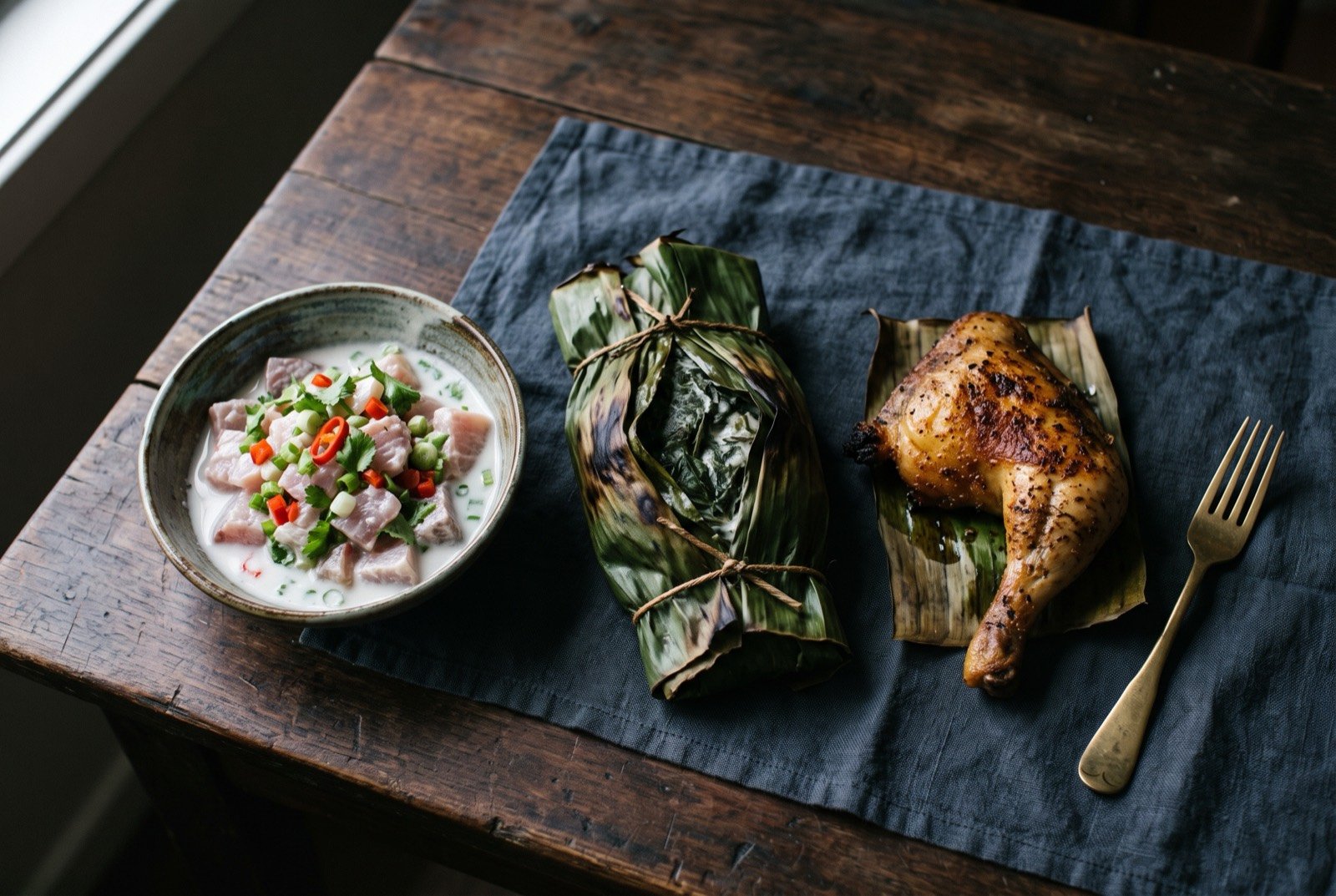
Fiji carries two food worlds under one flag. The first is indigenous iTaukei cooking: reef-and-root-crop, built on the earth oven, coconut cream and a citrus cure older than the word ceviche. The second is Indo-Fijian, girmit-descended cooking, built by 60,000 Indian indentured labourers shipped to Fiji between 1879 and 1916, its own ancestry, staple bread and history of hunger. Not a footnote: the other half of the book.
Sources and review · What this chapter does not assert · How we research · Spotted something wrong?
A Sense of Place
iTaukei Fiji: the reef, the earth oven, and a kin-based claim on the land and the sea
Fiji is roughly 330 islands, splitting structurally into high volcanic islands, Viti Levu and Vanua Levu, broken and mountainous with river valleys and heavy windward rainfall, and low coral islands, flat and ringed close to the reef. Reefs surround nearly all of Fiji's roughly 840 islands and islets, so reef access is close to universal, but the balance of the diet differs by geography: high-island villages combine garden root-crop plots with river fishing and reef trips, while low coral-island communities lean harder on the reef and on pelagic fish. The fat of this cuisine is coconut cream, lolo, not a garnish but the medium the food is cooked and served in, pressed fresh over kokoda, cooked down into soups and stews, poured hot over a steamed pudding. The starch is a rotation of four staples in order of everyday importance: dalo (taro), tavioka (cassava), uvi (yam) and breadfruit, at nearly every meal, boiled, baked or grated, with the young leaves of the root crop itself, rourou, eaten as a separate vegetable while the root is still growing underground. The protein is reef fish, above all walu (Spanish mackerel), freshwater fish, and kai, a freshwater mussel hand- or foot-fished from Viti Levu's larger rivers and a genuine cash-income source for river villages, some of which draw up to three-quarters of household income from the kai harvest. Pork and chicken, both introduced but naturalised for three thousand years, are feast proteins, reserved for the lovo and for ceremony rather than daily eating.
None of this is open access. Land is held not by individuals but by mataqali, kin groups, a structure Britain formalised administratively after annexing Fiji in 1874 but did not invent; roughly 87 per cent of Fijian land remains customary land today, administered through the iTaukei Land Trust Board. The same kin-group logic extends into the sea: a mataqali's customary fishing ground, its qoliqoli, is a real, mapped territory, thirty-three of them across Fiji's Great Sea Reef alone, ranging from about 28 to 1,300 square miles, and within a qoliqoli a chief can declare a tabu, a no-take zone, historically held for a hundred nights after a senior chief's death and then lifted for a harvest that fed the funeral feast. This is not folklore dressed up as ecology. It is a working resource-management institution, now formally recognised by the Fijian state and increasingly re-adopted as conservation through the Fiji Locally Managed Marine Area network. The Fijian phrase for the whole relationship, na qau vanua, "my land, the land that sustains me and from which I eat," names food access as a feeding relationship across generations rather than a plot on a map, and that is a genuinely different starting point from a supermarket's idea of where dinner comes from.
Indo-Fijian Fiji: the girmit inheritance, and a cuisine built by necessity into something its own
Between 1879 and 1916, Britain's colonial government shipped over 60,000 Indian indentured labourers, girmitiyas, to Fiji under five-year contracts to work the Colonial Sugar Refining Company's cane fields. Most came from the eastern districts of Uttar Pradesh and Bihar, the Bhojpuri and Awadhi-speaking belt; a smaller South Indian contingent, roughly 15,000 people and about a quarter of the total, arrived later, from 1903, from Madras Presidency districts, via a separate depot. Fourteen per cent of all indentured arrivals died during indenture, the highest death rate of any girmit colony anywhere the system operated. What this cuisine inherited from that history is not a transplanted regional Indian kitchen but something built new: Bhojpuri and Awadhi foodways as the numerically dominant base, a distinct and smaller South Indian layer that has had to actively defend its own identity against assimilation into the majority, and, from the 1920s, a further layer of free, non-indentured Gujarati traders and Punjabi farmers who arrived under their own means and, in at least one well-documented case, brought a Gujarati leaf-vegetable dish that found a new leaf to wrap around in Fiji's taro plants (see Seina, in the Dishes section).
The fat of this cuisine is ghee for festivals and ritual, vegetable oil for the everyday pot. The starch, and this is worth stating plainly because it inverts the ancestral pattern, is roti, not rice, as the default daily bread in most households, despite the Bhojpuri and Bihar homeland being rice-and-pulse country and despite the girmit-era plantation ration itself being explicitly rice and pulse by policy. Rice remains important, in palau, in biryani, but the everyday staple that marks a proper home-cooked Indo-Fijian meal is a soft, tawa-cooked roti. The aromatic is chilli, garlic and ginger, with turmeric, cumin, mustard seed and a home-ground curry masala behind them, and Fiji genuinely grows a meaningful share of its own curry spices: turmeric from the hills of Viti Levu, a small hot local chilli, hand-processed by local growers, only cardamom routinely imported. The protein backbone is dhal, cooked in most households at least once a week, typically a mixed-lentil blend rather than a single pulse, toor, masoor and urad in roughly equal parts, stored dry in bulk the way rice is stored elsewhere. Indo-Fijians today make up roughly a third of Fiji's population, down from a near-majority in the mid-twentieth century, following two waves of emigration after the political upheavals of 1987 and 2000/2006.
The structural logic, at a glance
| iTaukei | Indo-Fijian | |
|---|---|---|
| Fat | Coconut cream (lolo) | Ghee (festive), vegetable oil (everyday) |
| Starch | Dalo, tavioka, uvi, breadfruit | Roti (daily), rice (festive, palau/biryani) |
| Protein backbone | Reef fish, kai, pork and chicken for feast | Dhal (mixed toor/masoor/urad), goat, fish |
| Aromatic | Chilli, citrus (moli), coconut | Chilli, garlic, ginger, home-ground masala |
| Land and sea claim | Mataqali (kin-group land), qoliqoli (kin-group reef) | No customary land claim; cane-lease and, later, market-garden tenancy |
| The defining technique | The lovo, the earth oven | The curry pot, built in a fixed sequence from bloomed whole spice to a final tempering |
The History in Layers
Lapita voyagers, and a crossroads rather than a border
The Lapita people reached Fiji from Melanesia by roughly 1100 to 1000 BC, part of the wider Austronesian expansion into Remote Oceania, and from Fiji the same voyaging culture moved on into Tonga and Samoa by 1000 BC. They carried, island to island, the plant and animal package that still structures the cuisine: taro, yam, breadfruit, banana and coconut, plus domesticated pig, dog and fowl. One university teaching source frames the earth oven as displacing Lapita pottery across much of the Pacific because it suited tree and root crops better than a clay pot could, a genuinely interesting technological-substitution claim, though it comes from a teaching resource rather than a peer-reviewed paper and should be read as plausible synthesis rather than settled fact. Archaeological evidence for the Lapita presence in Fiji includes pottery sherds and, at Bourewa Beach, a cache of roughly three-thousand-year-old jewellery, widely reported though not confirmed here against the primary excavation report.
This is the strand that generalises across the whole atlas's argument. Fiji is not a Polynesian cuisine and not a Melanesian one cleanly; it is a genuine crossroads where a shared Lapita inheritance, the earth oven, the root crop, the coconut, was elaborated in both directions afterwards. The clearest evidence of this sits on a plate: the technique of curing raw fish in citrus and coconut cream appears independently named right across the wider region, kokoda in Fiji, ika mata in the Cook Islands, ota ika in Tahiti and Tonga, oka i'a in Samoa, "coconut fish" in Nauru. This is not one cuisine borrowing from another, and it is not shared descent from Latin American ceviche either. It is one acid-cure chemistry, citric acid denaturing muscle protein to mimic what heat does by a different mechanism, arrived at independently on both sides of the Pacific rim, then carried in Fiji's own direction by the same Lapita voyagers who carried the taro and the coconut. Kokoda's full recipe treatment belongs here, in the volume where it is most identified; its Pacific cousins get named and cross-linked from their own future volumes rather than re-treated.
Christian mission, and a Sunday that never lost its earth oven
Christian missionaries arrived from 1835, and Fiji is now majority Christian, predominantly Methodist, then Catholic. Sunday is kept free of work, and the lovo, often started before dawn or even the previous evening, has become the customary post-church communal meal, structurally identical in social function to the Samoan and Tongan Sunday umu. One account frames this as a genuine syncretism, Christianity absorbed into an existing communal framework of kerekere, customary requesting and sharing, and sevusevu, the welcome and presentation ceremony, rather than a new religion simply displacing an old one. It is an attractive reading and consistent with what is generally known about Methodist mission strategy in the Pacific, but no Fiji-published or academic source was found making the same claim with the same confidence, so it belongs in this chapter as a plausible frame rather than a settled fact.
Cession, the land held in common, and a sea held the same way
Britain annexed Fiji by the Deed of Cession in 1874 and, in doing so, made an administrative choice that still governs food production today: it formalised customary landownership at the level of the mataqali, the kin group, rather than the individual. This is not incidental colonial trivia; it is the reason a Fijian garden plot is lent between neighbouring kin groups under customary arrangement rather than bought and sold, and the reason a reef's fish belong to the mataqali that holds its qoliqoli rather than to whoever gets there first with a net. The same year that Fiji was ceded, Fiji's chiefs were already looking for cheap agricultural labour for the sugar economy the new colonial administration wanted to build, and the answer Britain reached for was the same one it had already used in the Caribbean and East Africa: indenture from India.
Girmit: the ship, the ration, and a hunger that outlived the contract
The first indenture ship, the Leonidas, reached Levuka in May 1879. What the labourers were fed on the plantation is now unusually well documented, thanks to a 2025 peer-reviewed paper written by four academics who themselves identify as girmit descendants, drawing on colonial-era inspection reports. The daily ration was approximately 1,750 calories, overwhelmingly white rice, with only about 130 calories' worth of protein coming from dried lentils, and the ration itself was tiered by age in a way that reads as deliberately punitive: full rations for adult workers for the first six months only, half rations for twelve to eighteen year olds, and nothing at all, officially, for children under twelve, so that mothers split their own share with their dependants. An 1881 plantation inspector described the food as "filth not even good enough for a superior class of poultry," and the labourers as looking "half starved." Of 17,813 recorded deaths between 1879 and 1919, 48 per cent of child deaths and 32 per cent of adult deaths were judged nutrition-related.
The paper's central argument is a difficult one and worth stating plainly rather than softening: it proposes that genetic and epigenetic adaptation to extreme caloric restriction during the girmit period has plausibly become maladaptive in food-abundant modern conditions, and links this directly to today's markedly elevated rates of low birth weight, type 2 diabetes and cardiometabolic disease among Indo-Fijian descendants specifically, higher than in other Fijian populations even outside urban settings. It also identifies behavioural legacies passed down the generations: an intolerance of food waste, a tendency to overfeed children, altered hunger and satiation cues, a plausible and directly sourced line from ration-era deprivation to the present-day Indo-Fijian hospitality norm of insisting on second and third helpings. A separate first-hand account, Totaram Sanadhya's Bhut Len Ki Katha, published in English as My Twenty-One Years in the Fiji Islands, the first book written by a girmitiya about the experience, describes weekly rations "exhausted in only four days," forcing labourers to go hungry or beg food from already-freed "free Indians" for the rest of the week.
This is the fact that should sit behind every dhal pot and every roti in this chapter's second half: the cuisine that follows was built by people who had just spent an indenture contract being deliberately underfed, and the shape it took afterwards, generous, roti-forward, dhal cooked weekly whether or not there was a special occasion, is not incidental to that history. It is a response to it.
A cuisine assembling itself off the plantation
The plantation ration was rice and pulse by policy. What Indo-Fijian households built afterwards, once labourers had wages, land leases and their own kitchens, was something else: roti as the everyday staple, not rice, a genuine and documentable inversion of the ancestral pattern. The reasons are not fully recorded, but the shape is clear in Fiji's own press: the University of the South Pacific's own Girmit Day commemoration names roti, dhal and spices explicitly, alongside bangles and other material culture, as items that "represent legacies brought by indentured labourers 143 years ago," framing Indo-Fijian identity as "a melting pot of Girmit experience, Indian inheritance and Fijian integration." Adaptation to Fijian ecology filled in the rest: taro and dalo leaves standing in for greens that would not grow on a cane lease, cassava and breadfruit alongside rice, reef fish and shellfish where the Gangetic plain would have offered a river fish nobody here had ever seen, tropical fruit, mango and guava, feeding a mango achar tradition the Uttar Pradesh homeland never quite made in the same way.
A later, separate migration reinforced and complicated the picture. From the 1920s, free, non-indentured Gujarati traders and Punjabi farmers arrived under their own means rather than under contract; of six hundred businesses registered in Fiji between 1924 and 1945, Gujaratis held three hundred trading licences, and this "free Indian" layer is generally credited with reinforcing vegetarian and Gujarati-inflected technique. The clearest single dish carrying this layer is Seina, taro-leaf rolls filled with a spiced ground-lentil paste, documented independently across several sources as the direct Fijian adaptation of the Gujarati and Maharashtrian patra, or alu vadi, dish, in which Fiji's abundant taro leaf simply replaced the colocasia leaf of the original. It is worth pausing on this one dish, because it is exactly the kind of crossing this atlas exists to name honestly: an Indo-Fijian household technique, landing on an indigenous Fijian plant, producing something that belongs fully to neither ancestry alone.
Bully beef, and an honest colonial ingredient inside an honestly indigenous dish
Canned meat reached the Pacific in the late nineteenth century through missionaries and colonial trading networks, and its uptake accelerated through two world wars, when bully beef, tinned corned beef in a small amount of gelatin, was standard British and Commonwealth military ration from the Boer War through the Second World War. Rather than being experienced as a foreign imposition displacing tradition, corned beef was thoroughly absorbed into Pacific-wide feast cuisine, eaten and specifically gifted at weddings, funerals and feasts, to the point that Pacific food writers today treat it as part of the cooking tradition rather than external to it. Palusami with tinned corned beef, treated by most retellings as the definitive modern version of the dish, is the clearest example in this chapter, and it deserves to be told as exactly what it is: a genuinely colonial ingredient, fully absorbed into a genuinely indigenous dish, without the dish becoming any less authentically Fijian for carrying it. The same pattern shows up from the Indo-Fijian side of the table too, in a household recipe for palusami filled with coconut cream, onion and corned mutton rather than corned beef, documented by the Indo-Fijian food writer Jeet Thakker as his own family's version of an indigenous Fijian dish, genuine evidence that the exchange between these two food worlds runs in both directions.
The first Chinese arrival, and a third thread worth naming
In 1808, the American brig Eliza wrecked off Nairai Island, and the sandalwood trade that followed brought the first recorded Chinese presence to Fiji. It is a minor thread against the scale of Lapita voyaging and girmit indenture, but it left a real mark on the country's food, a Fijian-Chinese fusion register that shows up today in dishes like Fiji-style chow mein, documented as a genuine, actively cooked part of the contemporary Indo-Fijian food landscape rather than an invented crossover, and, more directly relevant to the modern chapter of this book, in the name of the late chef Lance Seeto's own restaurant, 1808, built explicitly around that date.
Decolonisation, coups, and a diaspora that now writes this food from three other continents
Fiji became independent in 1970. Political upheaval in 1987 and again in 2000 and 2006 drove a substantial wave of Indo-Fijian emigration, mostly to Australia, New Zealand, Canada and the United States, and this diaspora is now, by a considerable margin, the strongest surviving voice writing about Indo-Fijian food in public: cookbook authors, food writers and at least one well-documented restaurant success story, none of them still living in Fiji. The indigenous Fijian side of the story has followed a different, resort-shaped path in the same period, discussed in full in Part Two of this chapter. Both halves of the country's food are, in their own way, still being actively made rather than simply inherited, and this chapter tries to say so rather than freezing either tradition in an imagined precolonial or pre-indenture past.
A restricted history, named honestly rather than smoothed over
One more layer belongs here, precisely because leaving it out would be a smaller kind of dishonesty than getting it wrong. Turtle, vonu, holds genuine ceremonial status in iTaukei culture, classed alongside the tabua (sperm whale tooth), masi (barkcloth) and ibe (woven mat) as a high-status i yau, historically reserved for chiefly installation, weddings and funerals, and regulated by specialist fishing clans, the gonedau, whose knowledge of nesting and foraging grounds fed directly into customary fishing calendars and taboos. That history is real and worth stating. It is equally true, and non-negotiable for this chapter, that turtles are now fully protected under Fiji's 2014 Offshore Fisheries Management Regulation and its 2002 Endangered and Protected Species Act, that five of the world's seven sea turtle species occur in Fijian waters including the critically endangered hawksbill, and that a 2021 to 2022 WWF-Pacific survey across 136 villages and ten provinces found an estimated 2,420 turtles illegally harvested in a single year, targeted deliberately and consistently rather than caught incidentally. Turtle's history belongs in this book. It must never appear as something a modern reader could source or cook, and this chapter does not present it that way anywhere. Dugong, by contrast, barely belongs in Fiji's waters at all: the only recorded specimen, a single dead animal found on Kiuva Beach in 2018, over six hundred kilometres from the nearest known population, was almost certainly a lone vagrant, and this chapter does not treat dugong as part of the Fijian food tradition, because there is no real tradition there to document.
The Flavour Arsenal
Coconut: the fat that is also the sauce
Lolo, coconut cream, is the base fat of the whole indigenous kitchen, pressed from grated mature coconut flesh and used at every register from a raw dressing on kokoda to a slow-cooked base for palusami and duruka to a hot pouring sauce over a steamed pudding. A genuine and honestly stated gap in this research: no source could confirm whether Na Vosa Vakaviti has a first-press, second-press vocabulary parallel to Swahili's tui la kwanza and tui la pili, the terminology this atlas's East African volume uses to distinguish a thick, high-fat first pressing from a thinner second one; general sources simply use "lolo" without distinguishing pressing grade. Treat the recipes below as calling for a genuine first-press-strength cream, close to what UK grocers sell as "coconut cream" rather than "coconut milk," and see Sourcing in Britain for the specific brands that hold up.
Miti: the standing condiment, and the reason kokoda is not the only coconut-and-citrus dish in the house
Coconut cream, finely chopped onion, lime juice, tomato, salt and chilli, combined into a standing dip and dressing used on fern shoots, sea grapes, and fish both raw and cooked. Miti shares kokoda's exact flavour logic, coconut, citrus, chilli, but it is not kokoda; several outside accounts conflate the two and this chapter keeps them distinct.
Dalo, tavioka, uvi: the root-crop rotation
Taro (dalo), cassava (tavioka) and yam (uvi) rotate as the everyday starch, alongside breadfruit, boiled, baked or grated depending on the dish. Cassava demands a genuine food-safety step before it can be eaten: prolonged soaking, several hours to overnight, to leach cyanogenic compounds from the flesh, a step this chapter treats as real technique rather than folklore. Taro's leaf, rourou, is eaten as a separate vegetable, most often simmered in coconut milk, while the root beneath it is still growing.
Duruka: the season-bound speciality
The unopened flower head of Saccharum edule, a sterile sugarcane relative, called "Fijian asparagus" in English though it is nothing of the sort. Fiji's own market vendors name four sequential varieties through the season, sevakarua, navua, duruka makawa and cokecoke, the season itself genuinely contested across sources, most narrowly May to June, more broadly stretching from April to November depending on region and staggered planting. It is fibrous and absorbs liquid well, which is exactly why it suits a coconut-cream sauce, and Fiji's own most common preparations, smoking it over open fire or cooking it in thick coconut cream, already point a UK cook with a live-fire kit toward the right instinct. It does not travel; a fuller honest account of why is in Sourcing in Britain.
Reef fish, and kai, the river mussel with its own taxonomy
Walu (Spanish mackerel) is named across sources as the classic kokoda fish, though nuqa (rabbitfish) and other reef fish appear in home versions too; no single Fiji-published source pins one species down as canonical, and this chapter treats "walu is traditional" as the majority view rather than settled fact. Kai, a freshwater mussel (Batissa violacea), is hand- or foot-harvested from Viti Levu's larger rivers and named by shell shape into three local varieties, kai buli (round), kai bukivula (thin, oval, with an eroded umbo) and kai dina (intermediate), genuine local taxonomy worth using rather than flattening into "mussel." Sea grapes, nama (Caulerpa racemosa), and fern shoots, ota, round out the coastal and riverine vegetable register, both harvested by named market vendors whose livelihoods this book found genuinely documented in the Fiji Times, real people selling real bundles for real prices, not an anonymous "local tradition."
Corned beef and tinned fish: the colonial protein that stayed
Covered in full in The History in Layers. Present in this arsenal because it is genuinely part of the modern indigenous kitchen's ingredient list, not despite its colonial origin but because Pacific cooking absorbed it completely.
Yaqona: named here, treated fully elsewhere
The pounded, water-mixed root of Piper methysticum, strained through hibiscus-bark fibre (vau) in a carved wooden bowl (tanoa) and central to Fijian social and political life. This atlas's crossover rule gives yaqona's full home to a future Vanuatu volume, its botanical and ceremonial heartland; this chapter gives it real space in the Ferment and Preserve Bench below rather than a full recipe treatment, and says so plainly rather than pretending completeness it does not have.
Toor, masoor, urad: the Indo-Fijian dhal blend
Dhal is the single most load-bearing dish in the Indo-Fijian kitchen, cooked in most households at least weekly, and the standing pot is typically a mixed-lentil blend, split toor (pigeon pea), masoor (red lentil) and urad (husked black lentil, sold pale once the skin is removed), stored dry in bulk the way rice is stored, rather than a single named pulse. Yellow split peas and moong appear as other households' variants.
The home-ground masala, and the spices Fiji grows itself
There is no commercial "Fiji masala" product, in Fiji or in its diaspora; every account of it describes a home-roasted, home-ground blend, tamarind-forward, balanced with coriander, cumin, ginger, turmeric, mustard, black pepper, fenugreek, cardamom, cinnamon and cloves. Genuinely worth knowing: Fiji grows a meaningful share of its own curry spices, turmeric hand-processed in the hills of Viti Levu, a small hot local chilli grown, dried and powdered locally, with cardamom the one spice routinely noted as imported. For the reader's own spice grinder, this is a blend to build from named whole spices, not a jar to hunt down.
Achar spice, and the mango season it was built for
A reusable base blend, fenugreek seed, cumin seed, mustard seed and kalonji (nigella) seed dry-fried and ground, with chilli added after frying rather than with the rest, gives an Indo-Fijian household its standing flavour base for a quick achar without fresh garlic or chilli every time. Fiji's own mango season supplies both the unripe, salted, chilli-dusted immediate snack and the fruit for a longer, oil-cured achar; see the Ferment and Preserve Bench for the full technique.
The Technique Ladder
The argument, from inside
Every technique in this chapter answers the same underlying claim the whole atlas keeps testing: that a restaurant technique reaching for citrus curing, low-and-slow smoke, or a properly bloomed spice base is not importing French or Indian-restaurant method onto Fijian ingredients, but doing, more deliberately, what a kokoda cure, a lovo pit and a working Indo-Fijian curry pot were already doing. None of this needs a tasting menu to matter. It needs attention.
Rung 1. Cure with acid, not heat, and know exactly what firmness you are curing toward
Citric acid at the fish's surface disrupts the hydrogen bonds and electrostatic interactions holding muscle protein in its folded shape, causing it to unfold and re-set in a configuration structurally similar to what heat produces, opaque, firm, without applying any heat at all. Fish denatures faster than land-animal muscle, since its fibres are more delicate and carry far less connective tissue, and different curing windows produce genuinely different dishes rather than degrees of the same one: three to five minutes gives a thin opaque skin over a still-translucent centre, close to sashimi; fifteen to thirty minutes gives opaque flesh throughout, the firmer texture most people picture when they think of kokoda. Lime is more acidic than lemon and cures faster, a real variable for a UK cook substituting citrus. The late chef Lance Seeto's own published framework, worth taking seriously precisely because it comes from a named Fijian-context chef's own words rather than a food writer's paraphrase, treats kokoda as three independently variable elements, the cured protein itself, a raw salsa, and the coconut cream, and states plainly that citrus alone cures fish, shellfish, octopus and squid fully, but denser land proteins such as beef, duck and chicken need further cooking after the citrus cure. That distinction, not "citrus cooks everything," is the actual rule.
Rung 2. Build heat mass first, then trap steam under earth and leaf
The lovo works on three mechanisms operating together, not one: radiant and conductive heat from stones heated for hours over an open fire; steam, generated as moisture in the food and in its green banana-leaf wrapping turns to vapour once the whole pit is sealed with more leaves and then soil; and a smoke and char note picked up by anything not fully wrapped, or by the outer leaf itself. The result, typically one to four hours depending on what is inside and how much of it there is, is close in principle to a low, long, indirect barbecue cook with the lid shut, which is exactly why a kamado-style ceramic cooker is the right home analogue, not a coincidence of similar equipment but a genuine kinship of physics: high initial thermal mass, then slow, falling, trapped heat.
Rung 3. Cook the crystal blunt, not just the leaf soft
Raw taro leaf contains needle-shaped calcium oxalate crystals, raphides, which cause a genuinely acrid, stinging sensation if eaten raw or undercooked, and the common folk belief that "cooking removes the oxalate" is not quite right: total oxalate content does not fall much with heat. What sustained heat actually does is change the crystals' physical structure. A peer-reviewed study on taro leaf found boiling for sixty minutes the most effective method tested, achieving a mean 84.2 per cent reduction in soluble oxalate; a separate 2024 study on a related taro tissue found that roughly two hours of sustained steam heat reduces needle-crystal count by around 80 per cent and crystal size by around 70 per cent, as rising heat increases calcium oxalate's solubility and dissolves the sharp raphide structures into smaller, blunter ones. This sits in real, useful tension with the folk instruction to blanch taro leaf for thirty to sixty seconds for texture alone, a duration nowhere near long enough to do the safety work the chemistry above describes. Fiji's own traditional practice, leaf and coconut cream wrapped, then cooked again inside a lovo running for its full one-to-four-hour cycle, already errs on the safe side of this; a UK cook working from shop-bought leaf of unknown freshness should do the same rather than trust a quick blanch.
Rung 4. Bloom the whole spice, then brown the onion further than feels comfortable
The Indo-Fijian curry sequence, consistent enough across every source examined to state with confidence: whole spices and curry leaves bloomed in oil or ghee first; onion cooked down, often to a deep gold or fully caramelised stage that recipe writers repeatedly describe as the actual marker of a properly built curry rather than a quick sauté; garlic, and ginger for meat or fish, added once the onion has coloured; ground spices, turmeric plus the home masala, cooked briefly into the hot fat before the protein goes in, the classic bhuna-style blooming step rather than a wet masala added from the start; protein seared and coated; tomato added partway through, not at the beginning, for tang and body; then a low, slow, largely undisturbed simmer, roughly two and a half hours for a bone-in goat. Coconut milk, where it appears, goes in late, for richness, not as a cooking medium throughout.
Rung 5. Temper at the end, not the start
Dhal's defining technical move is that its tempering, the spiced, hot-oil finish called tarka elsewhere in the subcontinent, is built as a separate pan and folded into the already-cooked pot at the end, rather than as the base the dhal is built on: curry leaves fried first, then asafoetida, cumin, mustard and fenugreek seed until aromatic and popping, then onion to crisp brown, then garlic to gold, the whole thing stirred carefully into the finished lentils and finished with ghee and fresh coriander. This preserves the volatile aromatic compounds a long simmer would otherwise cook away, a genuinely different technical logic from building the pot's flavour from the bottom up.
Rung 6. Reduce for the bread it is going to meet
A curry meant to be eaten with roti is built to a different final consistency than one meant for rice: reduced until the oil visibly separates and the spice coats the meat directly, thick enough to be scooped and wrapped without dripping. This is a real, specific technical distinction, not simply the same curry served two ways, and it is the single most useful thing a UK cook can know before attempting a roti parcel rather than a bowl of curry and rice.
The Ferment and Preserve Bench
1. Mango Achar
The genuine Indo-Fijian preserved condiment this book can actually give a full technique for. A reusable achar masala, dry-fried and ground fenugreek, cumin, mustard and kalonji seed, chilli added after frying, flavours a quick achar without fresh garlic or chilli every time. For the fuller, longer-keeping version: 8 to 10 green, unripe mangoes, deseeded and cut into wedges, salted and sun-dried for two days, then mixed with garam masala, roasted fenugreek, roasted kalonji, roasted cumin, minced garlic and chilli, packed into an airtight jar and covered completely with cooled, pre-heated mustard oil, left to mature a couple of weeks, the jar sun-exposed once a week, uncovered but towel-draped. This is a real preserve, doing real preserving work through salt, sun-drying and an oil seal, not simply a fresh relish, and it deserves to be understood that way.
2. Cassava Detoxification
Not a ferment, but a genuine preservation-adjacent food-safety technique worth including here rather than burying in a recipe method line: several hours to overnight soaking of peeled cassava, to leach cyanogenic compounds from the flesh before cooking. Real technique, not folklore, and worth doing properly every time rather than treating as an optional extra step.
3. Yaqona (Kava)
Not a home technique, and this chapter is deliberately not giving it a full recipe treatment, since this atlas's crossover rule sends yaqona's full home to a future Vanuatu volume, its botanical and ceremonial heartland. What is worth understanding here: the dried root is pounded to a fine powder, traditionally by hand, mixed with water in a large carved wooden bowl, the tanoa, kneaded and strained through hibiscus-bark fibre, vau, to remove solids, producing an earthy, peppery, mildly numbing drink, mildly sedative rather than intoxicating in the alcohol sense. The formal presentation of kava to a host, sevusevu, involves stating explicitly who you are and where you are from; serving proceeds strictly by rank, the highest-status guest drinking first, a single clap before drinking and three in return. A genuine sourcing dead end worth stating plainly rather than working around: the sale of kava as food or drink remains prohibited by law across England, Scotland and Wales in 2026, and this chapter does not name a retailer, since doing so would recommend an act illegal for the seller. See Sourcing in Britain for the full legal detail.
Sourcing in Britain
Verified August 2026. Where a claim could not be confirmed, that is said plainly rather than smoothed over.
The one genuine legal correction this chapter needs to make loudly. Contrary to widely repeated claims that the UK's kava ban was lifted around 2015 or 2016, it was not. The Kava-kava in Food (England) Regulations 2002, and equivalent Scottish and Welsh instruments, remain in force in 2026, confirmed directly against legislation.gov.uk's own status pages and against a July 2025 written parliamentary answer stating that the prohibition, reviewed once in 2006 and found "justified and proportionate," has not been reviewed since. It is not a criminal offence to personally drink kava in Britain, but it is illegal for anyone to sell it to you as food, and this chapter does not name a retailer, since doing so would be recommending an illegal act.
The ranked list: what decides great from grim
- A genuine first-press coconut cream, not a diluted "coconut milk drink." Kara fresh coconut cream, 99.9% coconut with stabilisers, 24% fat, sourced from Indonesia and marketed as free of the trained-monkey labour some investigations have implicated in parts of the Thai supply chain behind Chaokoh and Aroy-D, both also widely stocked and both fine products if that distinction does not weigh on you. Buy the tin labelled "coconut cream," never "lite coconut milk."
- Fresh taro leaf, sourced by its correct name, not by the ambiguous word "callaloo." AfroBox sells genuine fresh taro leaf under that name. "Callaloo" means taro leaf, dasheen bush, in Trinidadian-leaning shops, but amaranth, a different plant entirely, in Jamaican-leaning ones; search "dasheen bush" or "taro leaf," never "callaloo," to avoid the wrong plant entirely. Frozen or freeze-dried dasheen bush, genuine taro leaf, is available from Golden Rootz via My Trini Shop. Where none of this can be sourced in time, chard or spinach are the honest fallback, clearly not equivalent in texture, mineral character or oxalate content.
- Fresh taro corm, sold under the Caribbean name "dasheen," from any well-stocked Afro-Caribbean grocer, including London Grocery.
- Cassava, fresh or frozen, one of the best-sourced items in this whole dossier, available from multiple named UK African and Caribbean grocers including Niyis African Supermarket and Green Oranges.
- A firm white fish for kokoda, in place of unavailable walu. Bream, gilt-head or black, from a proper fishmonger, is the best available substitute for texture and holding through the citrus cure; snapper, usually imported, is repeatedly named in Fijian recipe sources themselves as an acceptable stand-in. Check the current MCS Good Fish Guide rating for whichever species and catch method you buy, since this shifts.
- Standard UK-supermarket limes, for kokoda, and genuinely no more exotic substitution required. No source names a specific Fijian citrus cultivar; ordinary Persian limes are correct and sufficient.
- Toor, masoor and urad dal, and any standard curry spice, all ubiquitous in any UK South Asian grocer. Southall and the Ealing Road strip in Wembley, including Ganapathy Cash & Carry, which mills its own whole grains and spices in house, a strong option for a spice-grinder-owning reader building the home masala above rather than buying a substitute.
- Green, unripe mango, specifically, for achar, from a South Asian grocer rather than a mainstream supermarket, which stocks almost exclusively ripe eating mango.
- Jaggery, besan and cardamom for Indo-Fijian sweets and achar, all standard stock at the same South Asian grocers above, including Veena's online.
The genuine gap, named rather than hidden. Duruka cannot be reliably sourced in the UK, fresh or frozen. The one specialist lead, a US supplier claiming international shipping, has no confirmed record of successful UK delivery and is named in this book only so a determined reader has somewhere to start, not as a recommendation.
Kit notes for this volume
A Big Green Egg, run low and slow with genuine wood, not chips, and food wrapped in banana leaf, sold fresh or frozen by most UK Asian and Caribbean grocers, is the honest, non-equivalent approximation of a lovo's heat and smoke, stated plainly in this chapter as an approximation rather than a reproduction: the Egg cooks by controlled, enclosed convection, while a lovo cooks by conducted stone heat plus trapped steam under an earth seal, a moister result at a scale no domestic cooker can match. Sous vide earns its place across half the dishes in this chapter, for kokoda's cure temperature, for lovo's chicken, for goat palau's long braise and for fish suruwa's delicate fish, in every case doing the "long, even, gentle" half of a two-stage reconstruction that then needs a second step, live fire or a hot pan, to supply the char or smoke a sealed bag cannot. A spice grinder is essential rather than optional for this volume specifically, since there is no commercial "Fiji masala" or Indo-Fijian achar spice product to buy; both are built at home from named whole spices, exactly the task the reader's equipment already exists for.
Voices and Sources
From inside the tradition
- Lance Seeto (died 2026). Naturalised Fijian, ran Restaurant 1808 at Castaway Island and KANU in Suva, hosted the six-season TV series Taste of Paradise, wrote for the Fiji Times, including the kokoda technique column drawn on directly in this chapter's Rung 1. Not indigenous Fijian by birth, and not presented in this chapter as speaking for indigenous tradition, but the single most consequential figure in Fijian food's modern elevation, and it would be dishonest to omit him.
- Shailesh Naidu, the first Fijian-born five-star executive chef in the country, Outrigger on the Lagoon, honorary president of the Fiji Chefs Association, and a genuine, still-under-documented voice this chapter hopes a future edition can draw on more fully.
- Robert Oliver, raised in Fiji and Samoa, author of Me'a Kai: The Food and Flavours of the South Pacific, winner of Best Cookbook in the World 2010 at the Gourmand World Cookbook Awards, and the source, always attributed rather than treated as settled fact in this chapter, for kokoda's seawater-cure history.
- Fuzz Ali, Sydney-based Indo-Fijian, Indigenous Fijian and wider Pacific-heritage food writer and broadcaster, whose own goat palau recipe is used directly and attributed in this chapter's dishes section.
- Nalini Naidu, author of Annapurna: Gastronomic Delights from my Fiji Indian Childhood, winner of the Gourmand World Cookbook Awards 2019, South Pacific category.
- Jeet Thakker, co-author of My Love for Fiji, whose own family's history, a girmit-descended mother and a post-war free-migrant father, embodies this chapter's account of how Indo-Fijian food assembled itself from more than one migration.
- Shivangni S. ("That Fiji Taste") and Sneh Singh, diaspora home cooks and food bloggers whose detailed, quantified, named recipes for dhal and achar are used directly in this chapter, exactly the kind of in-tradition voice this atlas prioritises over a commercially published outsider.
- Narayan, P., Deo, R., Parshu Ram, T. and Singh, N., "Subsisting on boiled rice and pulse," Kōtuitui: New Zealand Journal of Social Sciences (2025), the peer-reviewed, girmit-descendant-authored paper behind this chapter's account of the plantation ration and its long health legacy, and the single strongest academic source used anywhere in this volume.
- Dr S. Apo Aporosa, University of Waikato, the leading contemporary academic researcher on yaqona in Fiji, named here for a future edition to draw on directly for ceremony mechanics rather than travel-site description.
The UK diaspora, honestly named as thin
No dedicated Fijian restaurant and no dedicated Indo-Fijian restaurant were found anywhere in the United Kingdom in the course of researching this chapter. The Fiji Cultural & Social Club in London is a genuine, long-serving community body, but a social club, not a food business. Indo-Fijian cooks in Britain shop, as far as this research could establish, at ordinary South Asian grocers rather than at any dedicated Indo-Fijian outlet, which is itself a real fact about how this tradition is kept alive here, not a gap to apologise for.
Things this chapter has deliberately not asserted
- That Na Vosa Vakaviti has a first-press, second-press coconut cream vocabulary parallel to Swahili's tui la kwanza and tui la pili. No source confirmed this either way; it is a genuine gap, not a confirmed absence.
- Any island-by-island or vanua-by-vanua variation in lovo pit construction. Every source found describes lovo as a single generalised technique; this chapter does not invent regional colour it cannot support.
- A single, precise duruka season. Sources genuinely conflict, from a narrow May-to-June window to a broader April-to-November spread; this chapter presents the range rather than asserting one figure.
- Robert Oliver's claim that coconut milk was added to kokoda by a named Suva restaurant owner in the 1930s, as settled food history. It is repeated across several tourism and recipe sites but always traces back to Oliver alone, and is attributed to him explicitly in this chapter rather than stated as fact.
- That "kanivaa" or "farra" are real, distinct Indo-Fijian dish names. Neither could be verified; "farra" as documented online is an Uttar Pradesh dish with no confirmed Fijian usage.
- That "maar" is a distinct Indo-Fijian dish separate from kadhi. Could not be verified.
- Any specific, named Ram Naumi dish beyond general feasting and temple prasad. No dish-specific documentation was found.
- A granular, sourced roti dough hydration ratio or exact tawa timing specific to Fiji. The roti technique given in this chapter is standard flatbread method, honestly presented as such; the genuinely Fijian element is the roti-parcel eating practice, which is properly sourced.
- A specific Fiji Hindi word for the tempering technique this chapter calls tarka. No source confirmed which term, if any, is actually used in Fiji.
- The precise current percentage of Fiji's population that is Indo-Fijian. "Roughly a third" is the commonly repeated figure, not independently checked here against a current Fiji Bureau of Statistics release.
- Any specific dish attributable with confidence to the Gujarati or Punjabi free-migrant layer, except seina. This is the one dish with genuine cross-corroborated evidence of that lineage; broader claims about this layer's influence exist but without dish-level specificity.
- Turtle or dugong as cookable or sourceable ingredients in any modern context. Turtle's ceremonial history is real and stated in full; it is also fully protected by Fijian law and in active poaching crisis, and this chapter never frames it as something a reader could obtain. Dugong has no genuine Fijian food tradition to document at all.
- That kava can be legally bought as food or drink anywhere in the United Kingdom. It cannot, as of 2026, and this chapter names no retailer as a lawful source.
- That the one identified US supplier of frozen duruka reliably delivers to the UK. The listing and its shipping claim exist; no independent evidence of a completed UK delivery does.
- Any named chef, in Fiji or its diaspora, publicly known for fine-dining-level reinterpretation of roti, dhal, fish curry or goat curry. This chapter looked for one across multiple research angles and found none. That absence is reported as a genuine finding, not a shortfall in the search.
Cure with acid, not heat, and know exactly what firmness you are curing toward
Citric acid at the fish's surface disrupts the hydrogen bonds and electrostatic interactions holding muscle protein in its folded shape, causing it to unfold...
Build heat mass first, then trap steam under earth and leaf
The lovo works on three mechanisms operating together, not one: radiant and conductive heat from stones heated for hours over an open fire; steam, generated as...
Cook the crystal blunt, not just the leaf soft
Raw taro leaf contains needle-shaped calcium oxalate crystals, raphides, which cause a genuinely acrid, stinging sensation if eaten raw or undercooked, and the...
Bloom the whole spice, then brown the onion further than feels comfortable
The Indo-Fijian curry sequence, consistent enough across every source examined to state with confidence: whole spices and curry leaves bloomed in oil or ghee...
Temper at the end, not the start
Dhal's defining technical move is that its tempering, the spiced, hot-oil finish called tarka elsewhere in the subcontinent, is built as a separate pan and...
Reduce for the bread it is going to meet
A curry meant to be eaten with roti is built to a different final consistency than one meant for rice: reduced until the oil visibly separates and the spice...
The dishes
- Kokoda iTaukei Fiji
- Lovo: Chicken, Dalo and Palusami from the Earth Oven iTaukei Fiji
- Palusami iTaukei Fiji, and now also Indo-Fijian by adoption
- Duruka in Coconut Cream iTaukei Fiji
- Vakalolo iTaukei Fiji
- Fiji Dhal Indo-Fijian
- Roti Parcel Indo-Fijian
- Goat Palau Indo-Fijian
- Fish Suruwa Indo-Fijian
Sources and review
- Researched
- 9 sources cited
- Reviewed
- Not yet reviewed from inside the tradition
- Cooked
- Not yet cooked and reported
Where this volume comes from
3 research briefs on file for this volume, researched to the rules on How we research. Published 28 August 2026. Last changed 8 September 2026.
The brief's own account of its sources
Overall balance across both halves of this brief. Both research agents lean considerably more on English-language sources than house style prefers, though a meaningful minority of the strongest sources in each half are genuinely local, and in a few cases genuinely in the relevant local language. Indigenous Fijian half.