Melanesia, Micronesia and Polynesia · Volume 07, The Reef, the Earth Oven and the Girmit Table
Kokoda
iTaukei Fiji
Illustration
- Time
- 2 hours
- Researched
- 9 sources cited
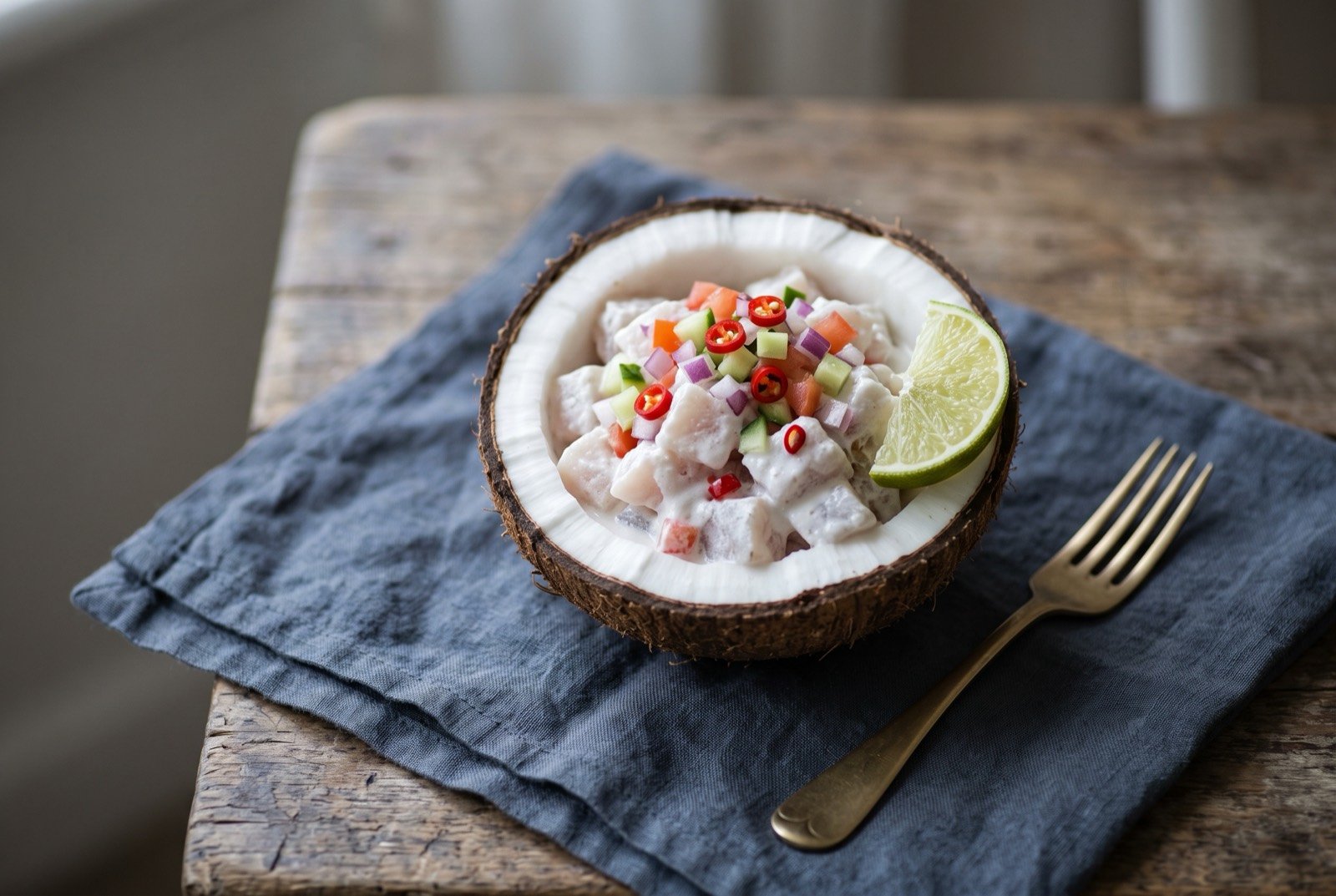
Fish, most often walu, cut into small pieces and cured in citrus until opaque, then finished with coconut cream, chopped onion, tomato, cucumber and chilli. What most retellings leave out: chef Robert Oliver, raised in Fiji and the author of the internationally recognised Pacific cookbook Me'a Kai, is repeatedly quoted saying kokoda was traditionally cured with citrus, chilli, onion and seawater, with coconut milk a comparatively recent restaurant addition, credited in several accounts, though only ever traced back to Oliver himself, to a Suva restaurant owner in the 1930s. Treat that specific date as attributed to Oliver rather than settled food history, but the underlying point, that the citrus cure long predates the coconut cream now considered essential, is worth stating plainly.
As tradition built it
Serves 4 as a starter. 2 hours to overnight.
Ingredients
- 500 g walu or other firm white fish, skinned, cut into 1.5 cm dice
- 6 to 8 limes juice of 6 to 8 limes, enough to fully submerge the fish
- 1 small red onion, finely diced
- 1 tomato, deseeded and finely diced
- ½ cucumber, finely diced
- 1 to 2 bird's eye chillies, finely chopped
- 200 ml fresh coconut cream (first press)
- to taste salt
Method
- Submerge the fish fully in lime juice in a non-reactive bowl.
- Cure in the fridge, 2 hours to overnight, until the flesh is opaque throughout, tasting from the two-hour mark to judge your own preferred firmness.
- Drain off most of the lime juice, reserving a splash.
- Fold through the onion, tomato, cucumber and chilli.
- Stir in the coconut cream and a little reserved lime juice, season with salt, and serve at once, in coconut shells if you have them.
What a modern chef changes
The cure held at a controlled temperature, and the structure treated as three independently variable parts
Rung 1
Method
- Cure at a controlled cold temperature, in an ice-bath-jacketed bowl, judging by time rather than by eye. A warm British kitchen cures faster and less evenly than a Fijian veranda; holding the fish and citrus properly cold lets you hit the three-to-five-minute "still translucent centre" stage precisely, rather than guessing and overshooting into fully opaque every time.
- Treat protein, salsa and coconut cream as Lance Seeto's own framework describes them, three separately built elements, not one bowl assembled at once. Cure raw scallop or squid alongside the fish, since citrus alone genuinely cures shellfish and cephalopod as fully as fin fish; build the salsa around a tart fruit, mango or pineapple, in place of the traditional tomato, for a genuine flavour variation rather than a random addition; scorch a portion of the grated coconut before pressing it for the cream, for an earthy note against the bright cure.
- Fish sourcing, honestly stated. Walu is not available in Britain. A firm, fresh, low-oil white fish that holds its shape through citrus curing, bream, or a very fresh trevally-type fish from a good fishmonger, is the honest substitute, not a compromise dressed up as equivalent.