Oceania and the Pacific · Volume 08
Guam and the Northern Mariana Islands
The Reducción, the Fiesta and the Fishing Stone
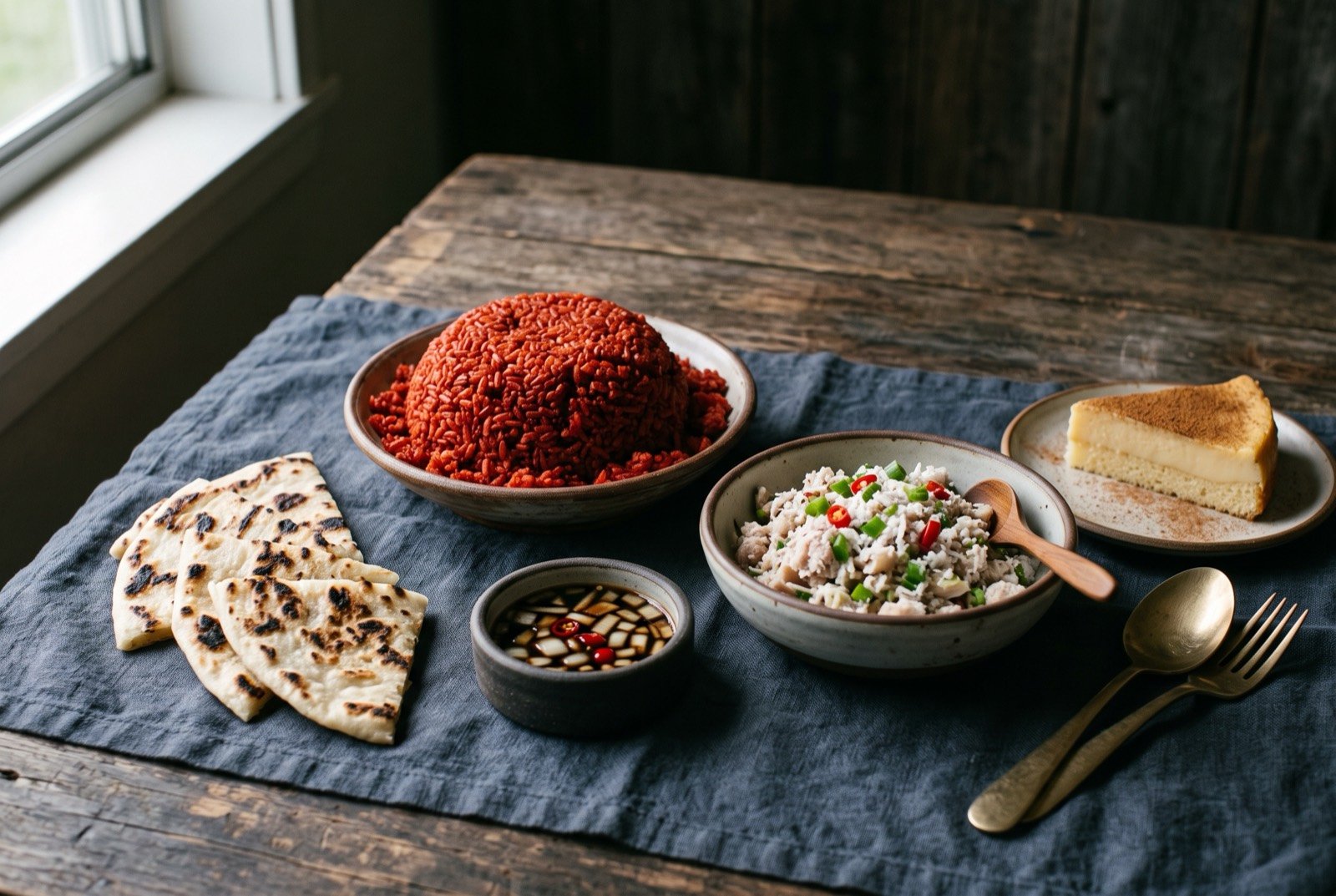
One archipelago, two indigenous traditions, and four colonial administrations stacked one on top of another on the CHamoru side of the table: Spanish for 230 years, Filipino as a nearly continuous undercurrent for 400, Japanese for a generation in the Northern Marianas and a brutal 32 months on Guam itself, American since 1898 with that one wartime interruption. The Refaluwasch, or Carolinian, community of Saipan is not a variant of CHamoru food wearing a different name: it is a genuinely separate Pacific tradition, carried from the outer Caroline atolls in the 1810s, that has built its surviving public identity on land, language and craft rather than on food, and this chapter says so honestly rather than papering over the gap with borrowed CHamoru material. Every dish as tradition built it, then what a modern chef would change.
Sources and review · What this chapter does not assert · How we research · Spotted something wrong?
A Sense of Place
Guam and the Northern Mariana Islands sit on a single volcanic and limestone chain running roughly north to south through the western Pacific. Guam and Rota are limestone-topped, with genuine freshwater lens aquifers and reef flats; the islands further north, Saipan, Tinian and beyond, sit on a mix of limestone terrace and, further north still, active volcanic core. This is not incidental geography: the reducción, the single most consequential event in this chapter's CHamoru history, is a political fact with an ecological signature, because it moved a scattered agricultural population off distributed swamp-rice, taro and yam plots and into a handful of coastal mission towns, and the låncho system, a second household kept at a distance purely to retain access to land, is the still-visible workaround CHamoru families built around that displacement, and largely still keep.
Two indigenous peoples share this territory, and this chapter treats them as genuinely distinct rather than as one culture with a regional accent. The CHamoru are indigenous to the whole Mariana archipelago, present in an agriculturally sophisticated form since at least the Latte Period, roughly AD 900 to 1521. The Refaluwasch, more commonly written Carolinian in English, are a separate Chuukic-speaking people from the outer central Caroline Islands, principally Satawal, who settled a Saipan the Spanish reducción had emptied of its own CHamoru population, after a typhoon devastated their home atoll around 1815. They are famous, if the reader knows the name at all, for one thing that has almost nothing to do with a plate: traditional wayfinding navigation without instruments, the tradition Mau Piailug, born on Satawal, carried into the modern era through the Hōkūleʻa voyages. This chapter's honest finding, stated plainly here because it shapes everything that follows, is that Refaluwasch identity in Saipan today is documented and actively resourced through land tenure law, an annual civic holiday, a humanities-council research programme, a taught floral-garland craft (mwar) and navigation heritage, but not, so far as any source reachable for this chapter shows, through a distinct, named cuisine comparable to what exists for CHamoru food. Where the record allows it, this chapter gives Refaluwasch food real weight, in the history, the technique ladder and the sourcing section. Where the record does not allow it, this chapter says so rather than dressing CHamoru material up under a second name.
| Tradition | What organises the table | What actually shaped it |
|---|---|---|
| CHamoru | The village fiesta: red rice, meats, seafood, kelaguen, then vegetables, desserts apart | Four colonial administrations laid over an already sophisticated Latte-period agricultural base, mediated through the reducción's forced concentration into mission towns |
| Refaluwasch (Carolinian) | Communal fishing tied to feasts, baptisms, weddings and celebration; the uumw earth oven at the close of Cultural Heritage Month | A single documented migration in the 1810s from Satawal, carried outer-atoll fishing technology and matrilineal land tenure into a Saipan the Spanish had already depopulated |
A word on language and searching, stated honestly rather than smoothed over. Guam and the CNMI are English-language US territories, so there is no equivalent here to the French, Arabic or Swahili research this atlas runs for other volumes; the useful second language for the Spanish colonial period specifically is Spanish itself, and this chapter's research used it, reaching a partially readable Spanish-language academic chapter on food and colonialism in the Marianas, though the single most relevant Spanish-language source found, a doctoral thesis on exactly this subject, could not be retrieved past an access error and remains a named gap. Fino' CHamoru itself was not separately searched as a language, only mined for the individual words this chapter uses to trace each colonial layer, which is a real limitation. Refaluwasch-language sources were sought and not found at all; the researchers involved judge that undocumented food knowledge most likely survives among Carolinian elders, manamko, in a form no web search reaches, and this chapter names that gap rather than guessing what it might contain.
The History in Layers
Latte-period CHamoru food, before any of this
The CHamoru diet at European contact was not a foraging economy dressed up by later romanticism; it was genuinely sophisticated agriculture. Latte-period archaeology, roughly AD 900 to 1521, shows cultivation of rice, two kinds of taro, two kinds of yam, seeded and seedless breadfruit, coconut, banana, sugar cane, ginger and arrowroot, worked by slash-and-burn clearing and deliberate soil enhancement: coconut shell and coralline rock worked into the ground at Manenggon Hills, dated to between AD 986 and 1210. Protein came overwhelmingly from the reef and lagoon rather than the land: parrotfish, red snapper, rabbitfish, coconut crab, freshwater eel, fruit bat, jungle fowl, clams and sea urchins, cooked in earth ovens (chahan), boiled in earthenware pots, or ember-roasted, with few foods eaten raw at all. Pre-contact society was stratified into a land-owning coastal caste, chamorri, and an inland caste, mangachang, who needed permission to farm and were restricted to freshwater fishing, with food itself crossing that line: chamorri supplied fish, mangachang supplied farmed produce.
Rice deserves particular emphasis because English-language tourist writing routinely asserts it arrived with Spain. It did not. Archaeological work by Takayama and Egami found a rice-grain impression on Rota pottery dated well before European contact, and Guampedia's own synthesis states plainly that CHamorus were "the only Pacific Island people who cultivated rice in the tropics dating back to ancient times," present by the mid-1300s, grown in natural swamps near Hagåtña, Hågat, Talo'fo'fo' and Malesso', planted at the lunar month of Fa'gualo and harvested roughly six months later with bamboo knives or conch-shell tools. It carried real ceremonial weight beyond nutrition: offered at Fouha Rock to the ancestor-spirit Fu'una, baked into pyramid-shaped wedding cakes, exchanged in pandanus baskets portioned by a guest's social standing, and, per the Franciscan friar Fray Juan Pobre de Zamora's 1602 account, served as a rice drink offered to the skulls of ancestors after a successful fishing trip. That specific rice-farming geography, the swamps at Talo'fo'fo' and Malesso' specifically, is why those two villages built real pre-contact wealth and status on rice cultivation and trade, a fact worth carrying forward, because it is the same ecological logic that later made those villages' displacement under the reducción so consequential.
Spanish colonisation, 1668 to 1898: the reducción as the hinge of this whole chapter
Formal Spanish colonisation began in 1668 with the Jesuit mission of Father Diego Luis de San Vitores, who renamed the archipelago Las Marianas for Mariana of Austria, and ran until Spain ceded Guam to the United States in 1898 and sold the rest of the chain to Germany in 1899. The most food-consequential thirty years of that span were the Chamorro-Spanish Wars that followed San Vitores's arrival almost immediately. Population figures are contested between sources but converge on catastrophic decline: San Vitores himself reported roughly 100,000 CHamorus in 1668; the historian Francis Hezel's working estimate is around 40,000; other scholars place contact-era population as low as 24,000. Guampedia's own depopulation article gives a documented census sequence rather than a single estimate: 3,539 by 1710, roughly 3,000 by 1749, 1,711 CHamorus by 1758 (the nadir, on some scholars' reading, though others place it later, in 1786), a slow recovery to 8,207 by 1856, immediately before an 1856 smallpox epidemic cut that figure to 3,644.
The reducción itself, concentrating a scattered population of perhaps 180 villages into a handful of mission towns, is the single most consequential event in this whole chapter, because it is what determined which indigenous food knowledge survived and which did not. Governor Juan Antonio de Salas's counter-insurgency campaign moved most of Guam's population into seven towns; Governor José Madrazo is separately credited with forcibly relocating CHamorus from eight northern islands, everything north of Guam and Rota, then collectively called Gani, into six church-centred villages on Guam itself, Hagåtña, Hågat, Humåtak, Malesso', Inalåhan and Pågo, at a cost estimated at 3,000 lives in the relocation alone. By 1730 most of the islands north of Guam and Rota, including Saipan, were effectively depopulated and stayed that way into the nineteenth century. That single administrative fact is the reason Saipan sat empty for the Refaluwasch to settle roughly a century later: their story does not begin as a displacement of an existing CHamoru population, it begins on land the Spanish reducción had already cleared for reasons of its own.
What the reducción changed about food specifically: it moved people off distributed swamp-rice, taro and yam plots and into compact, priest-governed pueblos built around a church, under local principales tasked with enforcing the relocation. From the 1680s families kept a village home but also maintained a separate ranch, a låncho, at a distance purely to retain access to trees and gardens, a dual-residence pattern that survives in CHamoru culture today and is a direct, still-visible legacy of a seventeenth-century counter-insurgency policy. Spanish-language academic treatment of this period specifically is thinner than the English-language Guampedia record: the strongest source located, a doctoral thesis titled Alimentación y colonialismo en las islas Marianas, framing the period explicitly as "a story of conflicts, resistance and adaptation," could not be retrieved past an access error and is named here as a genuine gap rather than silently dropped. A partially readable companion source, a Spanish state cultural-agency book chapter by Verónica Peña Filiu and Enrique Moral de Eusebio, argues that Spanish and other European chroniclers used descriptions of CHamoru food practice and CHamoru sexuality together to build a rhetoric of "barbarism" that justified conquest, contrasting Antonio Pigafetta's comparatively neutral 1521 account with Marcelo de Ribadeneira's markedly more hostile 1601 one, eighty years later, as evidence the moral framing hardened over time rather than arriving fixed.
Livestock, and with it the raw material of dried beef, tinala' katne, and eventually kelaguen's meat variants, arrived with the Spanish administration in the seventeenth century; by the 1700s hunting parties travelled to Tinian specifically to catch feral cattle and pigs, descended from earlier Spanish stock, and dried the meat for shipment back to Guam to feed the garrison. Achote, the seed behind red rice, "most likely came from Mexico" through the same Spanish Pacific network; corn, the base of titiyas, is a similarly New World crop that "flourished on the islands and was easily stored in clay jars or barrels" once introduced. Both are the Columbian Exchange arriving in the Marianas by way of Spain's own trans-Pacific administration, not by direct contact with the Americas.
The Refaluwasch settlement of Saipan, 1810s onward
After a typhoon devastated Satawal, and by most accounts several neighbouring central Caroline atolls, around 1815, Chief Aghurubw of the Ghatoliyool clan petitioned the Spanish Governor of the Marianas, Farallon de Medinilla, governing from Guam, for permission to settle his people on the now-empty Saipan. Permission was granted; Medinilla is reported to have given Aghurubw a certificate, a cane and a top hat as symbols of the new arrangement's authority. The academic anchor for this is the French naval officer and scientific voyager Louis de Freycinet, who visited the Marianas in the 1810s and 1820s and recorded that Carolinians "were allowed to settle there by decree of the Spanish Government on Guam in the early 1800s following typhoons and droughts in the Caroline Islands," a near-contemporary account rather than a later retelling, though this chapter reaches it only through a peer-reviewed citation rather than the original text directly. Garapan, Saipan's main town and the historic seat of the Refaluwasch community, takes its name from the Refaluwasch Arabwal. Settlers are generally described as coming from Satawal specifically, with continuing waves from other central Caroline atolls, Chuuk and Yap among them, consistent with the historical pattern of these communities being closely bound by intermarriage and voyaging rather than settled by a single island alone. What could not be established from any source reached for this chapter is the exact composition of the founding voyages, how many canoes, how many people, one wave or several through the 1820s, and this is named as a gap rather than filled with an invented figure.
Chief Aghurubw Day is a living annual commemoration held at his grave and memorial on Managaha Island, an offshore Saipan islet: Mass is said, community members lay woven coconut-leaf offerings and lavalavas on his statue, and a communal lunch follows. It has been marked at least 53 times as of 2023, meaning the community observance long predates its formalisation as a CNMI holiday under a 2018 gubernatorial proclamation naming September, alongside it, Chamorro and Carolinian Cultural Heritage Month.
Filipino influence: structurally continuous, not a single wave
Unlike the other three colonial layers, Filipino influence on CHamoru food never arrived as one identifiable event; it has run structurally continuous for nearly 400 years, and that continuity is itself the point worth making. The mechanism is the Manila Galleon Trade: from 1565 until roughly 1815, an annual route linked Acapulco to Manila with Guam as its mid-Pacific stopover, carrying Filipino soldiers, missionaries, catechists, administrators, exiles and convicts, some of whom stayed, on top of two centuries in which Guam and the Philippines shared the same Spanish colonial administrative structure, the Marianas governed as an extension of the Philippine captaincy-general. Filipino settlers under Spanish rule are credited specifically with introducing the technique of tapping coconut palms and fermenting the sap into tuba, a vinegar that became the base of fina'denne' before soy sauce ever arrived, and with cooking corn tamales and tortillas alongside CHamorus without CHamorus losing their own identity in the process, a detail Guampedia states outright, worth preserving because it resists the flattening story that Filipino food simply merged in unremarked. Spain also recruited Kapampangan-speaking soldiers from the Philippines into the Marianas garrison; many married CHamoru women, and Kapampangan words entered Fino' CHamoru as a result, though no specific food-vocabulary example of one has been located for this chapter, a small gap worth naming rather than filling with a guess.
A second, much later and better-documented wave followed the Second World War: in May 1947 the US Navy signed a recruitment agreement with the Philippine government for construction labour to rebuild and massively expand Guam's military bases, since the island lacked sufficient local manpower on its own. Many of these contract workers stayed on past their terms and became permanent residents, and this second wave, distinct from the galleon-era continuity above, is the more precise source of dishes like pancit entering the everyday Guam table.
The most consequential single dish-level claim tied to this whole layer is genuinely contested, and this chapter treats it as such rather than picking a side silently: whether kelaguen itself, rather than an indigenous CHamoru technique merely extended to new proteins under Spanish rule, is substantially a Filipino import. See the Technique Ladder below.
Japan: two entirely different experiences under one name
These are two different histories and this chapter keeps them apart rather than blending them into one "Japanese period." Following the Treaty of Versailles and the formal League of Nations mandate of December 1920, Japan administered the Northern Mariana Islands, but not Guam, which stayed a US naval station, as part of its South Seas Mandate. Development under the mandate centred on sugar: the businessman Haruji Matsue introduced large-scale sugarcane plantations and narrow-gauge cane railways to Saipan in the 1920s, building refineries on Saipan and Rota with thousands of Japanese settlers and labourers drawn from Japan's other colonies. This is the source of a sustained, generations-long Japanese cultural and culinary presence specific to the CNMI, structurally different from Guam's experience, and the likelier long channel through which soy sauce eventually reached fina'denne', alongside its more violent wartime route.
Guam's own wartime experience was categorically different, much shorter, and far more traumatic: Japanese forces invaded and occupied the island from 10 December 1941, when Naval Governor George McMillin surrendered at roughly 7am, until liberation on 21 July to 10 August 1944. The occupation authority confiscated cars, radios and cameras, imposed a strict overnight curfew, required CHamorus to carry ID passes known locally as "dog tags," used forced labour, and rationed food until supplies ran out entirely. The direct food-history consequence of the occupation's end is Spam. When American forces retook Guam in 1944, fresh food was scarce, much of the island having just been bombed, and the US military distributed vast quantities of tinned rations, Spam prominent among them, from military stores. The historian Dr Pedro Sanchez recorded that CHamorus "ate to their hearts' delight" and "hoarded cases and cans" of rations, home shelters coming to resemble "mini-warehouses." Spam's appeal was not novelty: no refrigeration needed, a long shelf life, and a real, felt security against future shortage after the trauma of near-starvation under occupation, plus its status as a purchasable, cash-economy good rather than something farmed or fished. Guam is cited as averaging over 16 tins of Spam per person annually today, among the highest rates anywhere.
America, 1898 to the present, with that one interruption, and the CNMI's separate path
The United States captured Guam in June 1898 under Captain Henry Glass, as part of the Spanish-American War settlement; the Navy administered the island directly, with appointed governors, until 1949, when the Organic Act of 1950 granted CHamorus American citizenship, a bill of rights and civilian government. Post-war American administration is the direct source of Guam's barbecue culture as it now exists, and this chapter states plainly that this is not the same as saying barbecue itself is old. Guampedia's own dedicated article is explicit that CHamoru barbecue "as we know it today" only became frequent from the early 1960s, once pre-packaged commissary meat, spare ribs, whole chickens, frozen cuts shipped from the mainland to feed the large post-war military population, became cheap and available to anyone with commissary access. Grilled meat had a place at the fiesta table before that, prepared by women alongside everything else in the outside kitchen; the 1960s shift to cheap frozen meat is what turned it into a distinct, large-scale event, and, notably, moved it specifically into men's work. The underlying practice of cooking meat over embers for a feast, tunu, an old word shared with other Pacific peoples, is genuinely ancient; the barbecue-as-institution is a dateable 1960s American commissary-economy development laid on top of that older word and habit, and both things are true at once.
The Northern Marianas took a different political path after the war. Both territories fell under the UN Trust Territory of the Pacific Islands, US-administered from 18 July 1947, but unlike Guam, the CNMI negotiated a Covenant with the United States, concluded February 1975 and signed into US law in March 1976, becoming a self-governing Commonwealth in political union with the US; its own constitution was adopted in 1977 and its first constitutional government took office in 1978.
The Flavour Arsenal
Chillies
Donne' sali. Small, bright red, wild-harvested and very pungent, roughly 4,000 to 4,250 Scoville heat units by one measurement, the everyday Guam chilli, known locally in English as the boonie pepper. Donne' ti'au, a longer red pod, sits alongside it. Both have grown on Guam "since the time of the Spanish arrival," per local press reporting, though this chapter treats their indigeneity as an open question rather than a settled one: as a Capsicum species, donne' sali is almost certainly a Spanish-period New World introduction like corn and achote, the same Columbian Exchange logic that reached the Marianas by way of Spain's Pacific administration, but no source consulted states this explicitly for donne' sali by name, so this chapter reports it as a reasonable inference, not a sourced fact.
Seeds and colouring agents
Achote (annatto). The seed behind hineksa' aga'ga', red rice's distinctive orange-red stain, arriving through the Spanish Pacific network, most likely from Mexico, in the seventeenth century.
Ferments and preserved protein
Tuba. Fermented coconut-sap vinegar, introduced by Filipino settlers under Spanish administration and the historically prior base of fina'denne', before soy sauce arrived with Japan.
Tinala' katne. Dried beef, the direct product of Spanish-introduced cattle and the Tinian hunting-and-drying trade described above.
Spam and other tinned meat. Not a pantry curiosity but a load-bearing, everyday protein, its embedding traced precisely to the 1944 liberation and the trauma that preceded it, see above.
Starches
Rice. Pre-contact and genuinely CHamoru, cultivated in Guam's swamps since the mid-1300s, carrying ceremonial as well as nutritional weight, see above.
Corn. A New World crop introduced under Spain, the base of one of titiyas's three forms.
Taro, yam, breadfruit, cassava. All present in the pre-contact Latte-period agricultural base described above; cassava's cultivation on Guam and Saipan today continues that same starch line under a later-introduced crop.
The absence worth naming
No source consulted for this chapter supports a strong built-in spice or aromatic tradition anywhere in this volume comparable to, say, West Africa's seed-and-pod pantry or the Horn's berbere. Citrus, salt, soy, vinegar and hot pepper carry nearly everything: fina'denne' is not a spice base in that sense, it is an acid-salt-heat condiment assembled fresh at the table, and this chapter treats that as a real, stated finding about the cuisine's actual grammar rather than a gap in its own research.
The Technique Ladder
Five rungs, each a real, sourced mechanism from this chapter's own two kitchens.
Rung 1. Acid as a cooking medium, not a marinade
Kelaguen's central technique: citrus juice, salt and hot pepper "cook" raw or lightly pre-cooked protein chemically, the acid denaturing surface proteins until the flesh firms and turns opaque without heat ever touching it. This is real, transferable kitchen chemistry, and it is also the single most contested claim in this whole chapter, worth stating plainly rather than flattened into an uncomplicated origin story.
Guampedia's own account (Judy Flores PhD) holds that early CHamorus most likely used the acid-cure technique on fish first, citing the German colonial District Officer Georg Fritz's early-1900s description of a dish called "fala" resembling modern fish kelaguen, and a chopped, saltwater-soaked banana-flower kelaguen, fafalu, "probably used in ancient times," with the technique extended to meat only "as meats were introduced by the Spanish administration in the seventeenth century."
A detailed counter-reading comes from Fr. Eric Forbes, a Capuchin priest and respected Chamorro-language commentator, who argues on his own Chamorro-language blog that kelaguen was probably not indigenous at all, but derived from Filipino kilawin, itself from the Tagalog root hilaw, "raw," on three specific grounds: no European chronicler across roughly 300 years of otherwise close Spanish-period food documentation describes anything resembling it; lemons and limes are not native to the Marianas and did not grow there before the Spanish introduced them, so a citrus-based cure could not predate contact in its present form; and the word "kelaguen" itself is a plausible CHamoru-phonetic rendering of "kilawin," since CHamoru has no independent W sound.
Both readings can be true at once: the fish-cure technique plausibly predates contact, while the word and the now-canonical citrus-meat format are Spanish-period and quite possibly Filipino-mediated.
What a cook does with this rung. Citrus curing is not casual seasoning; treat the citrus volume, salt level and rest time as deliberately as a heat-based cook would treat temperature and time, since the chemistry is doing the same job.
Rung 2. The slow braise, arrested by a hard fry
Estufao's documented method explicitly warns against fast cooking, which the 1985 Guam government cookbook recipe states plainly will leave the pork "stringy": the meat is simmered low and slow in garlic, bay, vinegar and soy or salt until genuinely tender, then removed, drained, and fried briefly in hot oil to crisp the surface, before the braising liquid is diluted, reduced and thickened with cornstarch to serve alongside.
This two-stage structure, a long gentle braise followed by a short hard sear, is a real, documented mechanism, not this chapter's own invention.
What a cook does with this rung. A sous vide braise at a controlled low temperature reproduces the "never stringy" result far more reliably than an open pot watched by eye, and a final hard sear in a very hot pan or on a Big Green Egg run direct reproduces the crisping fry with more control over colour and crust than a shallow fry in a home kitchen typically achieves.
Rung 3. Infusion as colouring, not garnish
Hineksa' aga'ga's method steeps achote seeds in warm water with a little oil and salt to build a colouring liquid before the rice is ever cooked in it, rather than dusting a spice over finished rice for colour.
What a cook does with this rung. A longer, gently warmed infusion, rather than a quick steep, extracts more of achote's fat-soluble colour compounds; a small quantity of the achote-infused oil held back and finished over the cooked rice at the end gives a cleaner, more even colour than relying on the cooking water alone to carry it.
Rung 4. One earth-oven technology, two names, on the same two islands
Guam's chahan and Saipan's uumw are, on the evidence available to this chapter, the same Pacific earth-oven technology under two names, in the same way OC-06's motu, kanak and Vanuatu earth oven turned out to be one continuous mechanism rather than three separate inventions.
Chahan is CHamoru's own pre-contact earth-oven cooking method, attested from the Latte period onward. Uumw is the Refaluwasch community's own underground oven, still in active public use today at Puengin Chahan Uuwm, "night of the uumw cooking," the closing event of the CNMI's annual Chamorro and Carolinian Cultural Heritage Month each September, though this chapter states honestly that no source it could reach describes what specific foods go into that oven, in what quantity, or for how long, only that the event is real, dated and currently running.
What a cook does with this rung. A Big Green Egg fully stabilised in indirect mode, deflector plate in, before loading, reproduces an earth oven's stored, even heat far more reliably than an open fire pit in a British garden, and the same principle applies whichever of the two kitchens a given dish is drawn from.
Rung 5. Chum as flavour, introduced before the fish ever reaches the kitchen
The single most distinctive Refaluwasch technique this chapter could document, and the strongest thread of real, specific, sourced Refaluwasch food practice found anywhere in the research behind it.
Poiu, sometimes transliterated poio, is a fishing device combining a smoothed, egg-shaped limestone sinker, holed for cordage, with an inverted half coconut shell packed with mashed young coconut meat as chum, lowered on a line to attract fish, historically used to catch payúr, mackerel scad, and hachuman.
A named 2003 informant, Estanislao "Stan" Taisacan of Rota, of mixed CHamoru and Carolinian descent, described his own contemporary use of the method: spotting unicorn fish, an indicator species, through a glass-bottomed box, then lowering the poio to around 25 metres and shortening the line day by day.
The same source records that these fishing trips were never purely for feeding a small group; they supplied village parties, baptisms, confirmations, marriages and other celebrations, tying the technique directly to communal and ceremonial life. This is a fishing method, not a cooking technique proper, and this chapter does not stretch it into an invented recipe it cannot source.
What a cook does with this rung. Treat grated or blended fresh coconut as an active flavouring medium introduced before a fish is ever cooked, packed into the cavity or worked into a marinade the way the poio's own chum works on the fish in the water, rather than added only afterward as a garnish or a sauce component.
The Ferment and Preserve Bench
Two real CHamoru practices, and one honest absence on the Refaluwasch side that this chapter states directly rather than guessing at.
1. Tuba
Tuba, fermented coconut-sap vinegar, is the historically prior base of fina'denne', predating soy sauce's arrival by roughly two centuries, and still named as an ingredient option in some documented fina'denne' variants today.
2. Tinala' katne
Tinala' katne, sun-dried, salted beef, is the direct descendant of the Tinian cattle-hunting trade described above, drying meat specifically for shipment and storage rather than immediate eating.
3. The absence: pit-fermented breadfruit on Saipan
What Saipan's Refaluwasch community does not do, so far as this chapter's research could establish: pit-ferment breadfruit. On the outer central Caroline atolls the Refaluwasch's ancestors came from, Satawal among them, breadfruit and coconut are confirmed abundant, and pit-fermentation of breadfruit in leaf-lined pits, producing a sour, doughy paste that keeps for a year or more, is a real, widely attested Micronesian preservation technique under genuine atoll food-scarcity pressure. No source reached for this chapter states that Saipan's Refaluwasch community carries this practice today, or ever did. This is a meaningful absence rather than a gap in searching: Saipan is a wetter, higher volcanic island with none of the atoll food-scarcity pressure that made the technique necessary at Satawal, so it is entirely plausible the practice was simply left behind at the point of migration, precisely because it was no longer needed. This chapter states that as the honest, most likely reading, without claiming it as a settled fact the sources do not actually support either way.
Sourcing in Britain
The honest headline, stated once rather than repeated ingredient by ingredient: there is no dedicated Guamanian, CHamoru or CNMI retail or community presence in the UK at all, and everything genuinely sourceable here comes through three unrelated trade routes rather than any direct Marianas connection. A direct search for a UK Chamorro or Guamanian community organisation returned nothing but general Guam-history reference pages and one unrelated hit, the UK Chagos Support Association, a completely different Indian Ocean displacement story. No bottled fina'denne' or other Guam-branded food product exists anywhere in UK retail; the only "Finadene"-branded item found on Amazon at all, on the US site, was a novelty T-shirt.
Fina'denne': assembled, not bought
Build it from Filipino-grocer stock, a real historical route given Guam and the Philippines' shared Spanish- and American-era trade history, rather than expecting a bottled product. Datu Puti soy sauce and its companion cane vinegar, the closer analogue to tuba vinegar than a UK malt or wine vinegar, are both stocked with UK-wide delivery by Filipino Grocery Store, The Asian Cookshop, Oriental Mart and Zing Asia.
Calamansi: a genuine win
Fresh calamansi is imported weekly and sold with UK delivery by London Grocery, The Philippine Store Glasgow, Kolden Fruit and Phil Am Market, the real fruit used exactly as it is across the Philippines, not an approximation. Frozen or bottled concentrate serves as a shelf-stable fallback; ordinary UK lime is the standard substitute in general CHamoru-diaspora cooking practice when fresh calamansi is out of season.
Donne' sali: name the substitute honestly
Donne' sali is not sold under this name, or as "boonie pepper," anywhere in the UK. Fresh Thai bird's eye chilli, the same Capsicum genus and a comparable heat register, stocked with UK delivery by Thai Food Online and Tuk Tuk Mart, is the honest working substitute. State plainly to a reader: it is not donne' sali, only the nearest thing actually on sale here.
Achote and coconut: no real difficulty
Steenbergs and Spice Mountain both stock annatto seed with UK-wide shipping. Coconut milk and cream are mainstream UK supermarket stock throughout, though this is a generic Thai and Indonesian-sourced global supply chain with no cultural link to the Marianas worth claiming.
Breadfruit, taro and cassava: the established Pacific-volume pattern repeats
Tropical Sun's tinned Jamaican breadfruit is widely stocked by Caribbean grocers and Asda; fresh whole breadfruit exists only through exotic-produce specialists at real cost, with Sunland Caribbean Foods in Walthamstow the one physical shop found stocking it. State plainly, matching this atlas's established house honesty on the point: tinned, pre-cooked breadfruit is a genuinely different product from a whole fruit roasted for lemmai, not an equivalent. Fresh taro, sold as cocoyam, arbi or eddoe, and fresh cassava are both well stocked via the same West African and Caribbean grocer network, Niyis African Supermarket among them, that this atlas's other Pacific volumes have already documented, on the same species-overlap logic: the same plant, a different cultivar to what a Marianas cook would recognise.
Betel nut: legal, sourceable, an entirely unrelated supply chain
Betel or areca nut carries no UK import restriction and is sold openly through South Asian grocers stocking paan ingredients. No UK supplier with any Pacific or Carolinian connection exists; this is a generic-commodity route only, and the same sources carry a genuine health caveat on frequent use, oral and gastrointestinal cancer risk, worth stating alongside the sourcing rather than only the fact of legality.
Why the trail is this thin
The 2021 England and Wales census recorded 12,395 people in the whole combined "Pacific Islander" ethnicity grouping, all of Melanesia, Micronesia and Polynesia together, out of a population of roughly 60 million, under 0.1 per cent, with no breakdown by individual nation, so Guam and the CNMI cannot be isolated within the figure any more than Solomon Islands or Vanuatu could be in this atlas's Melanesia volume. This figure is carried forward from this atlas's own prior, independently verified use of the same source; a re-check of the source page returned an access error on this chapter's own research day rather than a fresh confirmation, and that is stated honestly here rather than presented as newly checked.
Voices and Sources
From inside the tradition
- Shawn Naputi, CHamoru chef, born and raised on Guam, trained at the California Culinary Academy of San Francisco and in respected San Francisco kitchens (Incanto, Foreign Cinema) before opening Prubechu in 2014, the clearest documented case anywhere in this chapter of CHamoru food being cooked with real technique-consciousness and real national food-press attention, even though the restaurant sits in the diaspora rather than on Guam itself.
- Peter Duenas, classically trained chef and native CHamoru, founder of Meskla Chamoru Fusion Bistro in Hagåtña, the one restaurant found actually on Guam with a local reputation for elevated CHamoru cooking, though this chapter is honest that independent food-press verification at Prubechu's depth does not exist for it.
- Fr. Eric Forbes, Capuchin priest and Chamorro-language commentator, whose named, argued case against kelaguen's indigeneity is treated throughout this chapter as a real, attributed position rather than folded silently into the record.
- Chief Aghurubw, Ghatoliyool clan, led the founding 1810s Refaluwasch migration to Saipan, commemorated annually.
- Estanislao "Stan" Taisacan, named 2003 fishing informant, the single most concrete individual voice this chapter has for any specifically Refaluwasch food-related technique.
- Florence Peter, contemporary Refaluwasch mwar-making teacher, the strongest example this chapter found of a named, living Refaluwasch culture-bearer, even though her craft is not food.
The researchers and institutions
- Guampedia, the University of Guam-linked, locally governed online encyclopaedia, signed throughout by named CHamoru or Guam-based scholars, Judy Flores PhD, Michael Lujan Bevacqua PhD, Tanya M. Champaco Mendiola, Dominica Tolentino, Darlene Moore MA, Nicholas J. Goetzfridt PhD, Donald R. Shuster EdD and Velma Yamashita among them, and the single strongest and most load-bearing source in this whole chapter.
- Lepblon Fina'tinas Para Guam: Guam Cookbook, 1985, published by the Guam government's women's association Y Inetnon Famalaó'an under then-Congresswoman Madeleine Z. Bordallo, the genuinely in-tradition source behind every gram-quantified recipe this chapter carries.
- Judith R. Amesbury and Rosalind L. Hunter-Anderson, whose 2003 fisheries-management report, combining archaeology with named-informant oral history, is the strongest single source this chapter has for Refaluwasch food practice specifically.
- Amy Owen, University of Guam, whose 2011 peer-reviewed, 1,144-respondent comparative fieldwork study underpins this chapter's account of Refaluwasch land tenure and social status.
- The Northern Marianas Humanities Council, the clearest institutional home for ongoing Refaluwasch cultural documentation, including a 1982 oral-history recording made on Satawal itself.
The gap, named plainly
No named Refaluwasch cook, food culture-bearer, or food-specific cultural organisation comparable to Florence Peter for mwar-making was found anywhere in the research behind this chapter, and no restaurant or chef anywhere, on Guam, on Saipan or in any diaspora, was found doing serious, technique-conscious Refaluwasch cooking. This chapter treats that as a genuine, confirmed finding rather than a search failure: where the literature wanted to point to living evidence of Refaluwasch distinctiveness, it reached for land tenure law, language, dance, mwar and navigation, not for food, and this chapter reports that pattern honestly rather than manufacturing a food chapter the sources do not support.
Things this chapter has deliberately not asserted
- That kelaguen, in its now-canonical citrus-meat form, is an ancient or purely indigenous CHamoru dish. Guampedia's own account already concedes the format is Spanish-period at earliest for meat; Fr. Eric Forbes makes a specific, sourced case that even the format and the name are Filipino-derived, from kilawin, not merely CHamoru technique extended to new proteins. Both readings are attributed above rather than one picked silently.
- That rice arrived in the Marianas with the Spanish. This circulates in English tourist and even encyclopaedic writing but is directly contradicted by the archaeological record: rice-grain pottery impressions on Rota predating European contact, cultivation established by the mid-1300s.
- That CHamoru barbecue is an ancient practice in its present form. The underlying ember-cooking word, tunu, is old; the barbecue-as-institution, with packaged commissary meat and a male-coded division of fiesta labour, is a specific, dateable 1960s American development. Both things are true at once.
- That donne' sali is indigenous to the Marianas. As a Capsicum species it is almost certainly a post-contact, likely Spanish-period New World introduction, like corn and achote, even though no source consulted states this explicitly for donne' sali by name; this chapter reports it as a probable but unconfirmed inference, not a settled fact.
- Exact recipe quantities for kelaguen in any variant, tinaktak, apigigi or kalamai. No local or in-tradition source consulted gave gram, millilitre or precise timing figures for these specific dishes.
- That Saipan's Refaluwasch community pit-ferments breadfruit, or ever has. The technique is real and well attested on the outer Caroline atolls the community's ancestors came from; no source found states it survives, or ever needed to survive, on Saipan itself, and this chapter does not assert either way beyond that.
- That Refaluwasch food is simply CHamoru food under a different name. It is a genuinely separate tradition, but this chapter is honest that food specifically has not been documented as a marker of that distinctiveness the way land tenure, language and craft have been.
- That Prubechu's reported Esquire "Best New Restaurants 2020" placement is confirmed. Found only via a secondary aggregator, not Esquire's own archive.
- That Meskla's "Pika's Best" five-time award is confirmed against the award body's own materials. It recurs across secondary listings only.
- That any chef anywhere trained in a Michelin-starred kitchen and returned to Guam or Saipan to cook indigenous food, the pattern this atlas found in New Caledonia's Alphonse Kocé. No such figure was found; Michelin does not cover Guam or the CNMI at all.
- A "Carolinian Utt Museum" as a discrete institution. The Carolinian Utt in Garapan is real and current, but functions as a community meeting house and sports centre, historically the men's canoe-building and gathering house, not a museum with food-culture documentation.
Acid as a cooking medium, not a marinade
Kelaguen's central technique: citrus juice, salt and hot pepper "cook" raw or lightly pre-cooked protein chemically, the acid denaturing surface proteins until...
The slow braise, arrested by a hard fry
Estufao's documented method explicitly warns against fast cooking, which the 1985 Guam government cookbook recipe states plainly will leave the pork "stringy"...
Infusion as colouring, not garnish
Hineksa' aga'ga's method steeps achote seeds in warm water with a little oil and salt to build a colouring liquid before the rice is ever cooked in it, rather...
One earth-oven technology, two names, on the same two islands
Guam's chahan and Saipan's uumw are, on the evidence available to this chapter, the same Pacific earth-oven technology under two names, in the same way OC-06's...
Chum as flavour, introduced before the fish ever reaches the kitchen
The single most distinctive Refaluwasch technique this chapter could document, and the strongest thread of real, specific, sourced Refaluwasch food practice...
The dishes
- Kelaguen CHamoru, Guam
- Hineksa' aga'ga' CHamoru, Guam
- Fina'denne' CHamoru, Guam
- Kaddon pika CHamoru, Guam
- Estufao CHamoru, Guam, Spanish-derived
- Tinaktak CHamoru, Guam
- Titiyas CHamoru, Guam, Spanish-derived
- Buñelos aga' CHamoru, Guam
- Latiya CHamoru, Guam, Spanish-derived
Sources and review
- Reviewed
- Not yet reviewed from inside the tradition
- Cooked
- Not yet cooked and reported
Where this volume comes from
4 research briefs on file for this volume, researched to the rules on How we research. Published 3 September 2026. Last changed 8 September 2026.
The brief's own account of its sources
Breakdown of sources used. Genuinely Refaluwasch/Carolinian-specific, and either local/in-tradition or serious academic: Amesbury & Hunter-Anderson, *Review of Archaeological and Historical Data Concerning Reef Fishing in the U.S. Flag Islands of Micronesia*, Western Pacific Regional Fishery Management Council, 2003 (commissioned fisheries-management report combining archaeology and named-informant oral history; the single strongest source used). Amy Owen, "Culture Change Dynamics in the Mariana Islands," *Pacific Asia Inquiry*, University of Guam, vol. 2, no.