Melanesia, Micronesia and Polynesia · Volume 08, The Reducción, the Fiesta and the Fishing Stone
Fina'denne'
CHamoru, Guam
Illustration
- Researched
- Researched from 44 sources in the brief
The everyday condiment, and the clearest single artefact of the whole four-layer colonial stack: its ingredient list changed with each administration in turn.
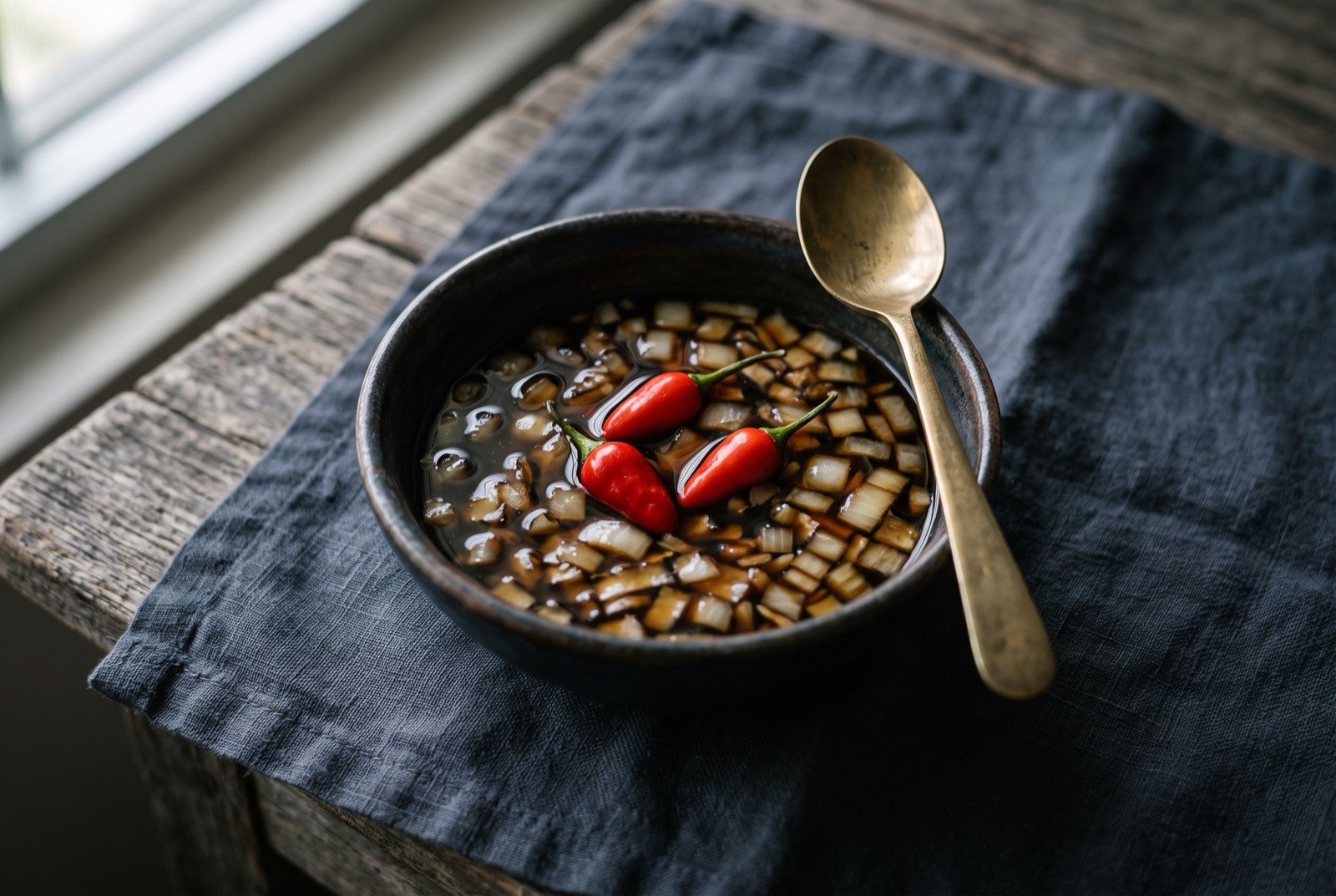
The earliest, pre-Spanish version was simply salt and red pepper. Filipino settlers under Spanish administration introduced tuba, giving a Spanish-period fina'denne' of tuba, salt, lemon, water and fresh pepper. Soy sauce arrived with Japan, producing the now-familiar "black" version. The name itself translates from Fino' CHamoru as "made with chili pepper." "Black" fina'denne' (soy and vinegar based) is the meat and chicken version and sits at the table's centre; "white" fina'denne' (lemon or vinegar based, no soy) accompanies fish and tinala' katne.
As tradition built it
Recipe credited to Tanya M. Champaco Mendiola.
Ingredients
- ⅔ cup soy sauce
- ½ cup vinegar
- ¼ white onion, diced
- 4 donne' or other hot peppers
Method
- Combine the soy sauce and vinegar in a small bowl.
- Stir in the diced onion.
- Add the whole or sliced peppers.
- Serve at room temperature, spooned over meat, fish or rice as each diner chooses.
What a modern chef changes
The white and black versions built as a genuine pair, and the peppers' heat controlled rather than left to chance.
Method
- Build both the black (soy, vinegar) and white (lemon, vinegar) versions to a fixed, repeatable ratio, tasting and adjusting salt and acid by percentage rather than volume alone, since this is a table sauce a diner will use liberally and inconsistency shows immediately.
- Deseed a portion of the peppers before adding them, holding a separate small dish of the whole, seeded peppers alongside, so a diner can calibrate their own heat rather than the sauce forcing one level on the whole table.