Melanesia, Micronesia and Polynesia · Volume 08, The Reducción, the Fiesta and the Fishing Stone
Estufao
CHamoru, Guam, Spanish-derived
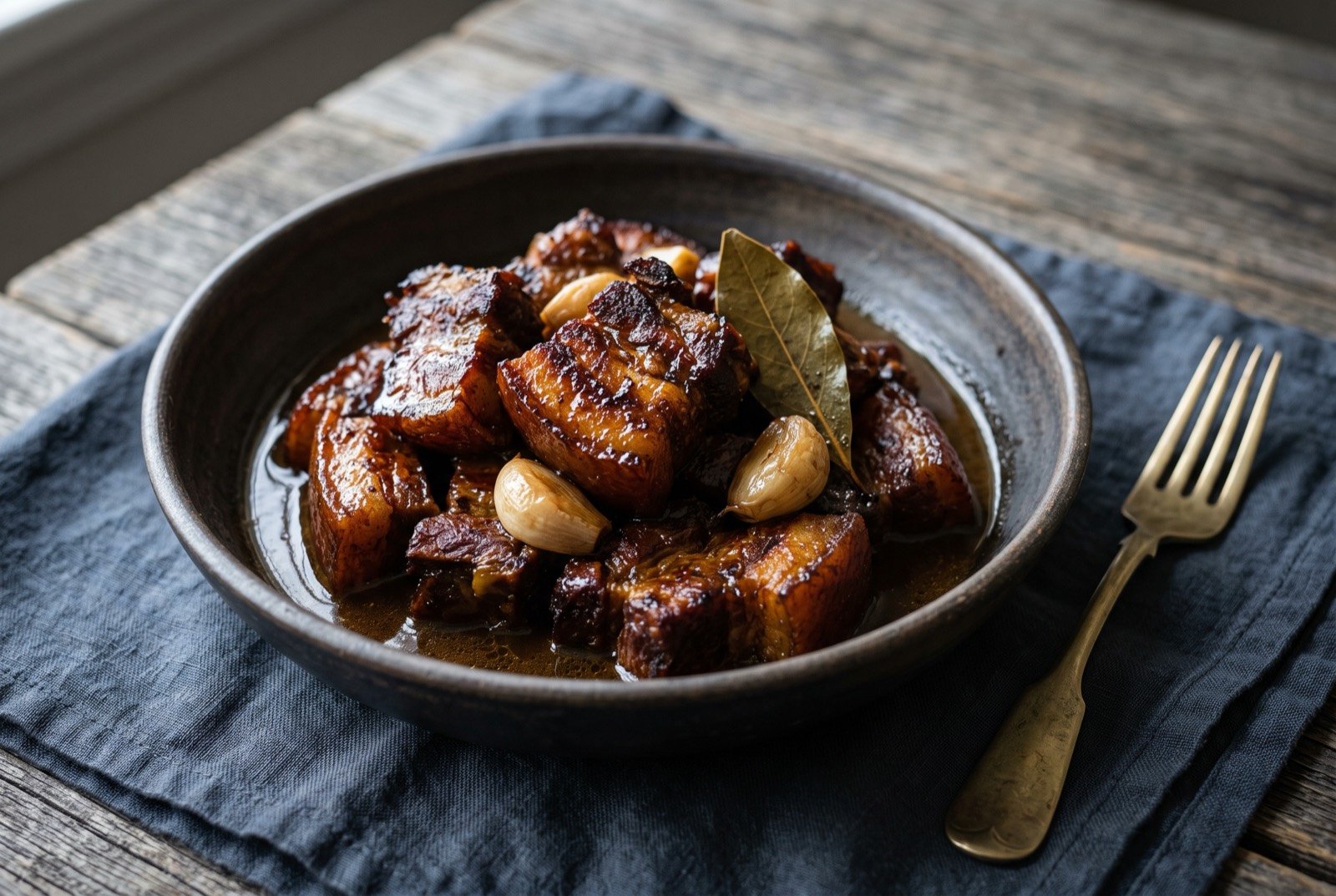
An illustration of the dish, not a photograph of it cooked.
- Time
- Not statedNo source states a time and the atlas has too few comparable dishes to estimate one.
- Reviewed
- Not yet reviewed from inside the tradition
- Cooked
- Not yet cooked and reported
The Spanish-derived pork braise, closely related to Filipino adobo, both plausibly sharing a Spanish colonial ancestor given the Philippines' and the Marianas' shared administration; no source consulted gives a definitive derivation either way.
As tradition built it
Recipe credited to Lupe C. Reyes, same 1985 cookbook.
Ingredients
- 2 to 3 lb pork, cubed
- 6 to 10 cloves garlic, crushed
- 1 large bay leaf
- 2 tbsp soy sauce, or salt to taste
- ½ cup white cider vinegar (or ¾ cup tuba vinegar, the historically prior version)
- 2½ cups water
Method
- Combine the pork, garlic, bay leaf, soy sauce, vinegar and water in a large saucepan, bring to the boil, cover and reduce to a simmer.
- Cook slowly over low heat until the pork is very tender; the recipe warns explicitly against fast cooking, which leaves the meat stringy.
- Remove the pork and garlic and drain well.
- Fry the drained pork briefly in hot oil to crisp the surface.
- Dilute the remaining braising liquid with ½ to 1 cup water, bring back to the boil, thicken with cornstarch, and adjust seasoning.
- Serve the gravy with the pork, or separately.
What a modern chef changes
The braise-then-sear structure staged with controlled equipment, exactly as documented.
Rung 2
Method
- Braise the pork sous vide at a controlled low temperature in the garlic, bay, soy and vinegar liquid, reproducing the "never stringy" result the traditional recipe explicitly warns must be protected.
- Sear the drained pork hard on a Big Green Egg run direct, rather than a shallow pan fry, for a more even, more deeply coloured crust.
- Reduce and thicken the braising liquid separately, straining through a chinois before finishing with cornstarch, for a completely smooth gravy.