The Horn · Volume 10, The Highland Ferment
Doro wat / dorho tsebhi
Amhara and Tigrinya, and the feast dish of both countries
Illustration
- Time
- 6 hours
- Researched
- Researched from 149 sources in the brief
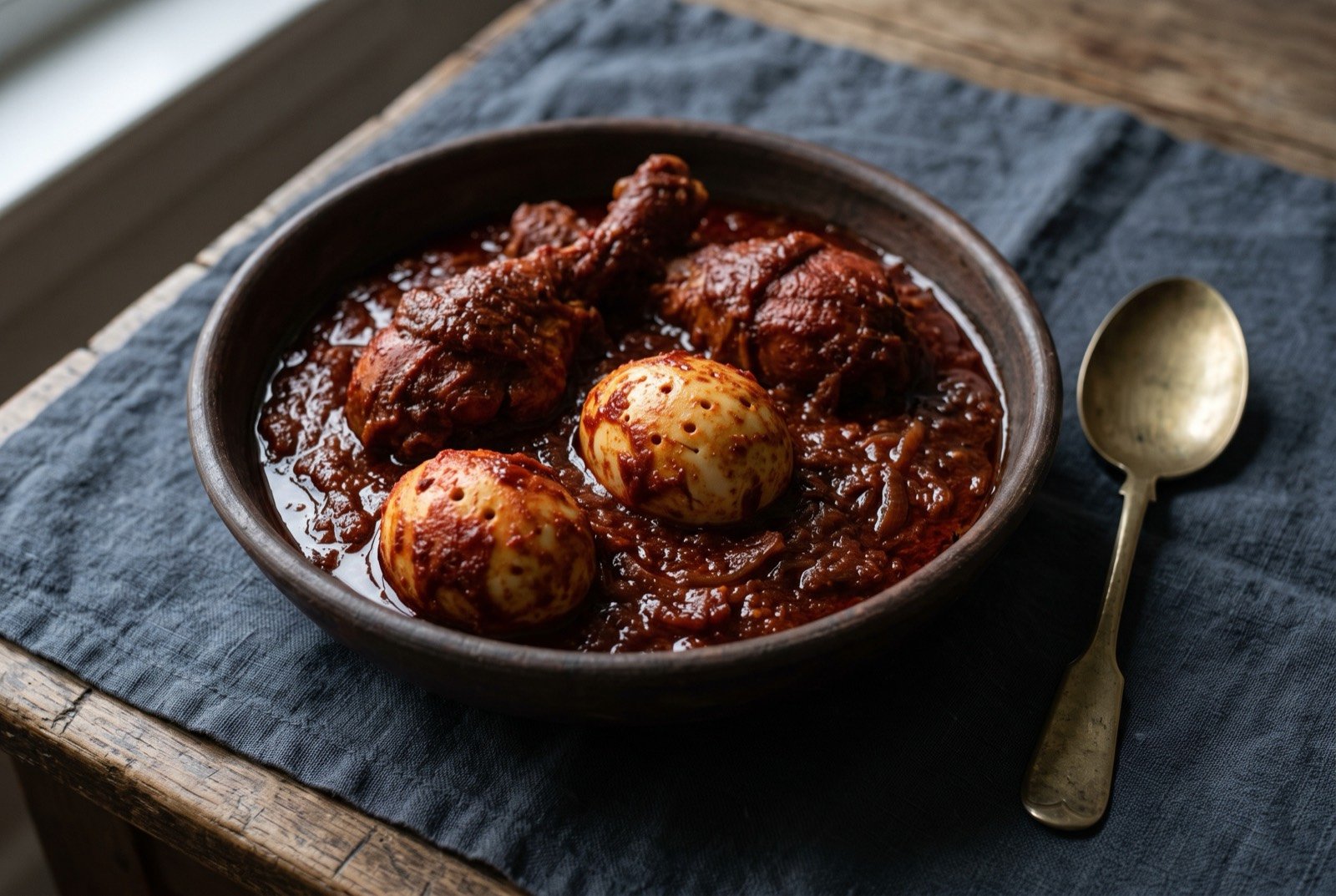
The dish that breaks a fast, eaten at Genna, Fasika, Enkutatash and at weddings, and rich precisely because it arrives at the end of an abstinence. The chicken is jointed into twelve pieces, and it is traditionally a stewing hen, because the dish needs a bird that survives an hour in acid and fat without shredding. Two preparatory steps are usually skipped abroad and both matter: the bird is marinated in water, lemon juice and salt for 3 hours to overnight with all skin and fat removed, which firms the flesh and draws out blood and slackness, and the eggs are pierced all over with a fork so the sauce penetrates rather than sliding off.
As tradition built it
Serves 6. 4 to 6 hours.
Ingredients
- 1 chicken, jointed into 12, skin and fat removed
- 1 lemon, juiced, plus water and salt for the marinade
- 1.1 kg sweet or red onions, minced to a chunky purée
- 220 g shallots, minced, and 2 tomatoes, chopped
- 240 ml niter kibbeh
- 150 to 200 g berbere, by weight, not by cup
- 4 garlic cloves and 20 g ginger, pounded
- 500 ml chicken stock
- 6 to 12 eggs, hard boiled and pierced all over
- 1 tbsp besobela, plus 1 tsp each koseret and korarima
- 3 pieces timiz, and 1/4 tsp cumin
- to taste salt, tasted against your berbere
Method
- Marinate the chicken in salted water with the lemon juice, 3 hours to overnight, refrigerated. Drain and pat dry.
- Put the sweet or red onions, shallots and tomatoes in a wide heavy pan over low heat, with no fat and no water. Stir more or less constantly for 1 hour, until the water has gone and the mass is golden and collapsed. For the long version, hold it up to 5 hours, stirring every 30 minutes, until dark and jammy.
- Add the niter kibbeh and cook on low 7 to 10 minutes, until the fat separates and the onions are slicked.
- Add the berbere gradually, with a quarter cup of the chicken stock at a time to stop it catching, and cook 5 to 10 minutes until it darkens and gloss appears.
- Add the chicken, the garlic cloves and 20 g ginger, pounded to a paste, and the rest of the stock. Simmer 45 to 60 minutes.
- Add the eggs, finish with the besobela, koseret, korarima, timiz, cumin, salt to taste and a last 2 tbsp of niter kibbeh, and cook 5 minutes more and no longer.
Notes
After Samra Cooks, whose is the shorter of the two documented onion timings, with the longer given as a variant.
What a modern chef changes
The onion cooked to a measured endpoint, the berbere on a clock, and the egg treated properly
Rungs 3, 4 and 5
Method
- Weigh the onion against the bird and commit to the long stage. Onion mass should equal or exceed the trimmed chicken. Dry at 110 to 120°C for 4 to 5 hours, stirring every 30 minutes, to the colour of dark marmalade. Rung 3: if you want to thicken the finished sauce, you did not do this.
- Bloom the berbere for sixty seconds, once. Off the flame, into the hot slicked onion, count to sixty, add liquid. Every further minute of direct heat moves it from bloomed toward scorched. Rung 4.
- Assay the berbere and salt at the end, off the actual injera. Taste a pinch neat; if it reads salty, halve the salt and correct at the finish. Rung 5.
- Cook the eggs separately. Sous vide at 75°C for 30 minutes gives a set yolk that is still tender. Pierce them, then hold them in a ladleful of sauce for 10 minutes so they take colour without becoming rubber.