Maritime Southeast Asia · Volume 45, The Mortar, the Wok and the Roti Board
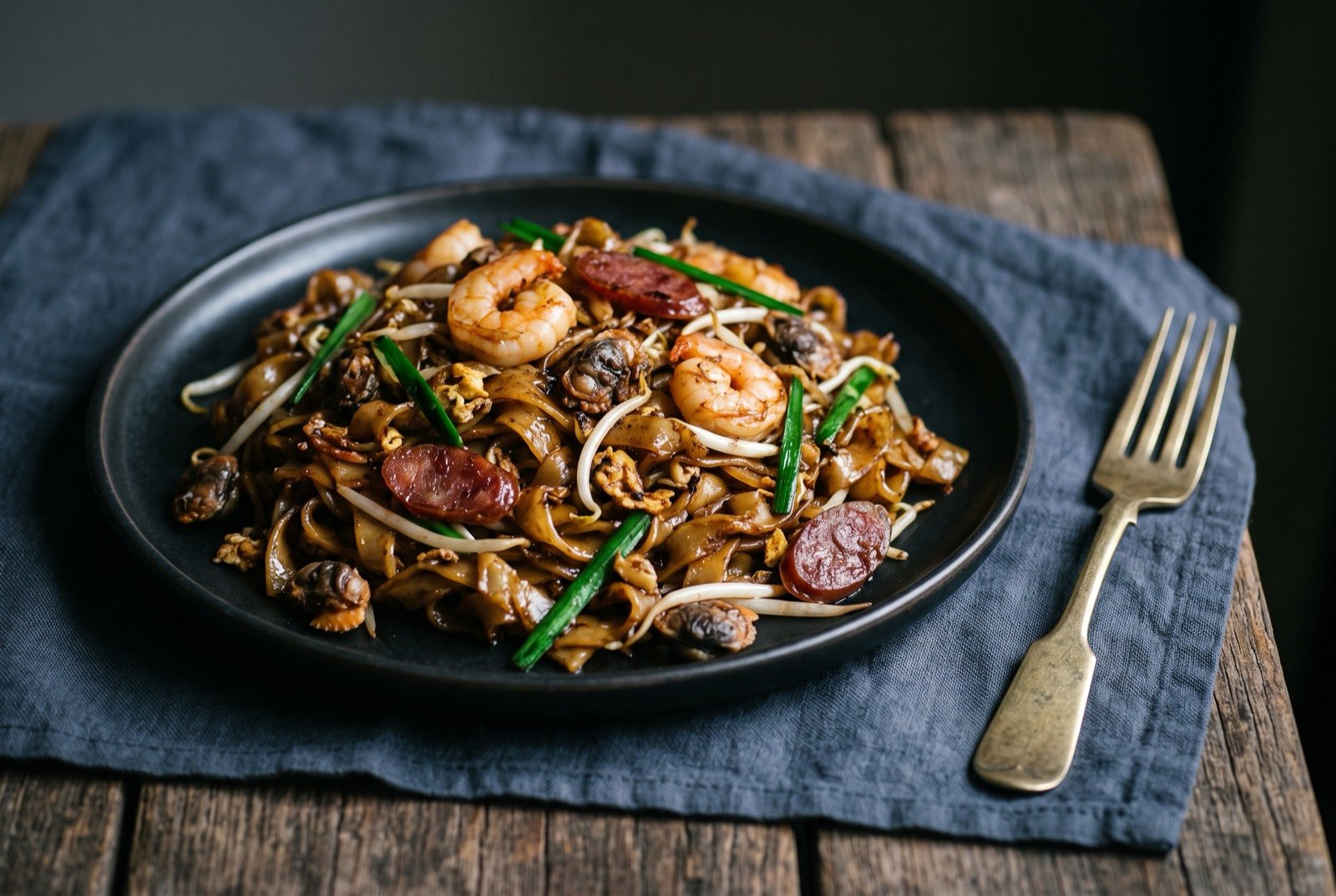
Char kway teow
Penang and Singapore, Teochew and Hokkien hawker
Illustration
- Time
- 5 minutes
- Researched
- Researched from 231 sources in the brief
Penang's version omits the sweet dark soy Singapore's leans on, staying lighter and drier with a stronger showing of pure wok hei; Singapore's is sweeter, moister, and rarely served without blood cockles, an ingredient the dish's Teochew ancestor in Chaoshan never used, a genuinely Straits-specific addition rather than an inherited one.
As tradition built it
Serves 2 . Fried hard and fast in about 5 minutes, one portion at a time
Ingredients
The method as the tradition gives it, with the ingredients named. Quantities follow as we verify them, lead dishes first.
- 200g flat rice noodles (kway teow) flat rice noodles (kway teow)
- 1 egg egg
- 80g bean sprouts bean sprouts
- 3 stalks garlic chives, cut into 5cm lengths garlic chives
- 100g prawns prawns
- 2 heaped tbsp fresh cockle meat cockles, blood cockles in Singapore's version
- ½ Chinese sausage (lup cheong), sliced Chinese sausage
- 1 tbsp rendered pork fat (lard) pork fat
- 1 tbsp dark soy sauce dark soy sauce
Method
- Flat rice noodles, egg, bean sprouts, garlic chives, prawns, cockles and Chinese sausage, fried hard and fast in pork fat and dark soy over the highest heat available, one portion at a time, never batched, since batch cooking cannot generate or hold the same char.
What a modern chef changes
Clarified pork fat, and cockles added back only at the last toss
Rung 4
Method
- Accept rung four's honest limit rather than fight it: no home setup, Big Green Egg included, will produce a hawker stall's wok hei, so put the effort instead into the noodle and the fat.
- Render pork fat separately and clarify it, so the frying fat itself carries no burnt milk solids to compete with the noodle's char, and cook the cockles apart, briefly, in the same fat, adding them back only at the very last toss, so they arrive barely warmed through rather than rubberised by the noodle's longer cooking time.