Maritime Southeast Asia · Volume 45, The Mortar, the Wok and the Roti Board
Roti canai
Tamil Muslim (mamak), Straits Settlements
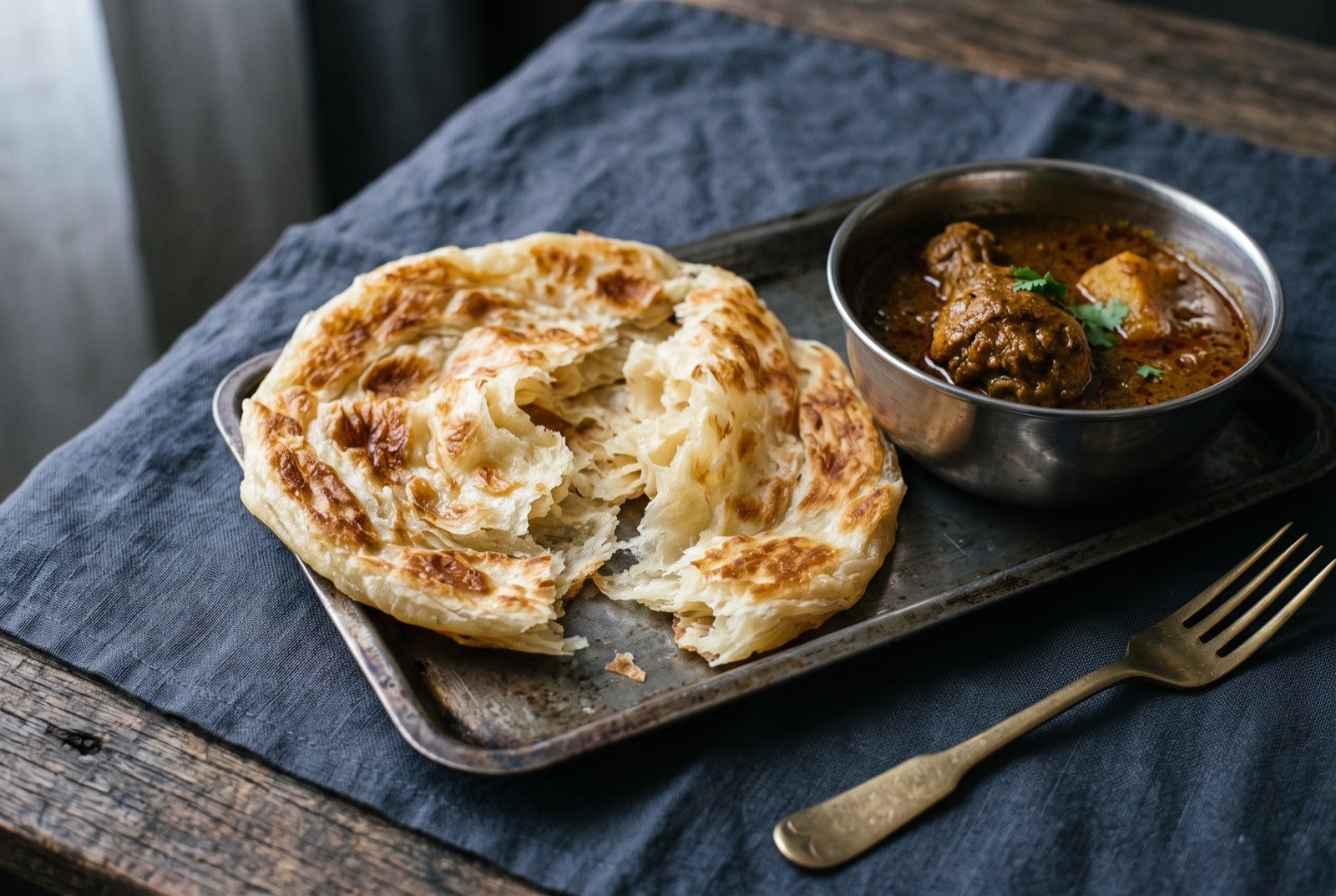
An illustration of the dish, not a photograph of it cooked.
- Time
- 4 hours
- Reviewed
- Not yet reviewed from inside the tradition
- Cooked
- Not yet cooked and reported
Tamil Muslim traders, called Chulias in the colonial-era record, from merchant lineages such as the Lebbai, Rawther, Marakayyar and Kayalar of India's Coromandel Coast, were sailing into the Malay world and Ceylon from at least the eighth century. This is the community that built the mamak stall: mamak cooking is a specific Tamil Muslim tradition, not a Hindu one, and in 2026 the community is still actively correcting the assumption that speaking Tamil makes you Hindu.
As tradition built it
Dough rested a minimum of 4 hours, ideally overnight
Ingredients
- 500g flour flour
- 1 egg egg
- 2 tsp salt salt
- 2 tsp sugar sugar
- 225ml water water
- 1 tbsp condensed milk condensed milk
- 1 tbsp ghee or margarine, plus more for coating ghee or margarine, for coating
Method
- A simple dough, flour, egg, salt, sugar, water and condensed milk, is divided into balls coated in ghee or margarine and rested a minimum of four hours, ideally overnight, so the fat fully separates the flour's gluten layers rather than being kneaded back into them.
- Each ball is flattened, then repeatedly flipped and stretched by hand until, per Singapore's own Intangible Cultural Heritage documentation, it is paper thin and four to five times its original size, the hardest single step in the whole craft, taking practitioners around six months to learn to a professional standard.
- The stretched sheet is folded and griddled until golden and blistered, the same lamination mechanism as a croissant, alternating fat and gluten layers flash-steaming apart under heat, worked in by hand rather than by rolling pin.
What a modern chef changes
Laminated with clarified butter, and finished on a plancha over direct heat
Method
- Laminate the roti dough with clarified butter rather than margarine, for a cleaner, more distinct fat flavour through each layer, and finish it not on a griddle but on a plancha heated by the Big Green Egg run direct, hot enough to blister the exterior in seconds while the interior layers stay soft.