Maritime Southeast Asia · Volume 45, The Mortar, the Wok and the Roti Board
Ayam buah keluak
Peranakan, Straits Settlements
Illustration
- Time
- 1 hour
- Researched
- Researched from 231 sources in the brief
In 2022 the Singapore-Malay food historian Khir Johari argued in The Peranakan magazine that ayam buah keluak descends from the Javanese beef dish rawon, tracing the word to a twelfth-century Old Javanese poem. A fellow Peranakan writer, Baba Peter Lee, rebutted him directly in the same magazine, correcting the poem's actual title and its authoritative dictionary entry, which mentions no buah keluak at all, and proposing instead that a nineteenth-century Javanese cookbook's sambel keluwak is the true ancestor dish. Both writers agree the deeper point, that Peranakan and Javanese food and genealogy are closely entangled, and disagree entirely on the textual specifics. This chapter states both positions and adjudicates neither, because the people who actually own this history have not settled it either.
As tradition built it
About 30 to 60 minutes braising
Ingredients
- 1kg chicken pieces chicken, sometimes with pork or chicken ribs added for body
- 18g candlenut candlenut
- 8g galangal galangal
- 20g fresh turmeric fresh turmeric
- 20g dried chilli dried chilli
- 100g shallot shallot
- 35g garlic garlic
- 12g belacan belacan
- 15 prepared buah keluak nuts prepared buah keluak nuts
- 50g tamarind pulp dissolved in 250ml water, strained tamarind water
- 60g minced pork or shrimp minced pork or shrimp, for the nut stuffing
- to serve plain rice, to serve
Method
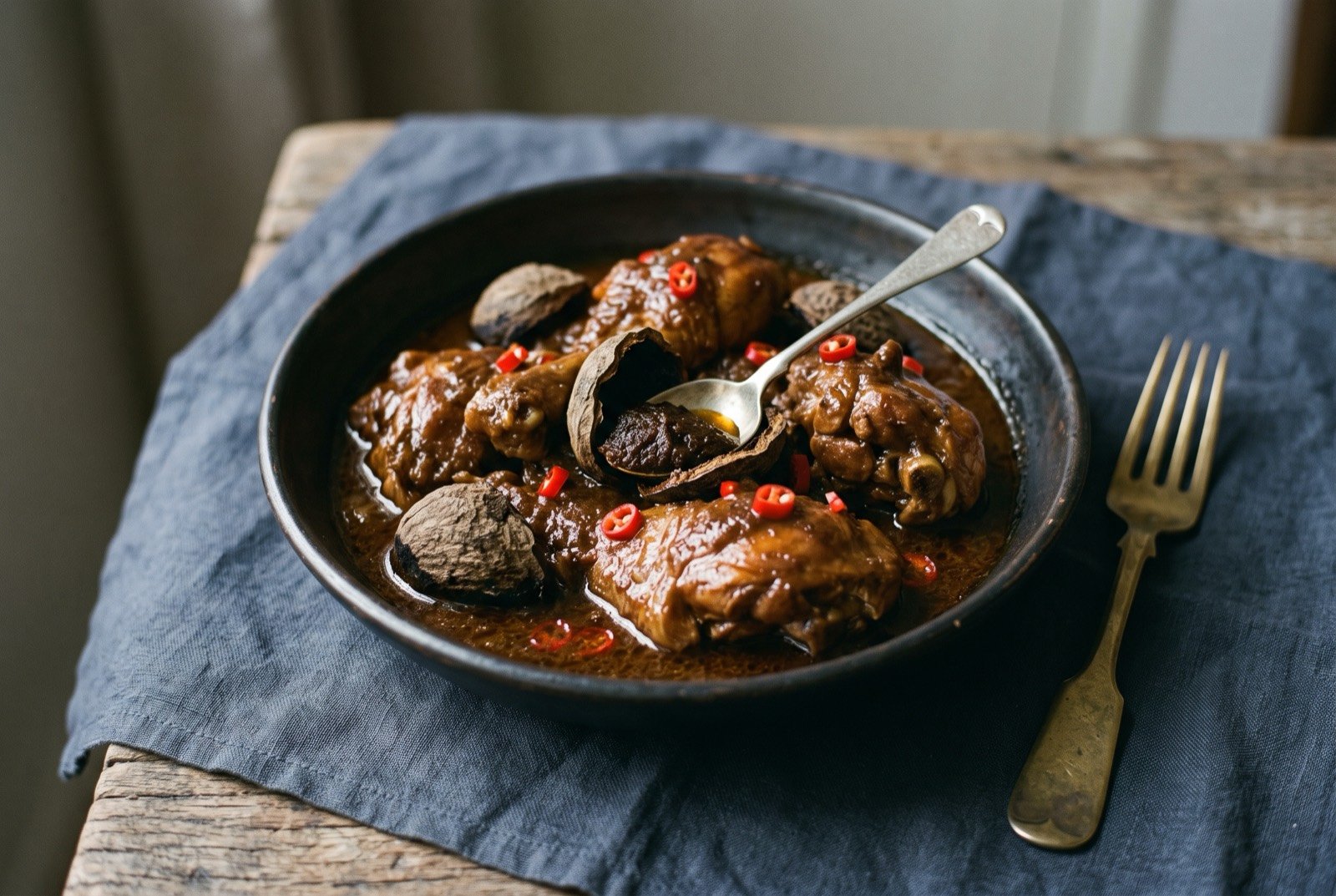
- Chicken, sometimes with pork or chicken ribs added for body, braised in a rempah of candlenut, galangal, fresh turmeric, dried chilli, shallot, garlic and belacan, fried to pecah minyak, with prepared buah keluak nuts and tamarind water.
- The nut's dark, oily flesh is scraped out, mixed with minced pork or shrimp and a portion of the rempah, then packed generously back into the empty shell, under-filling risks the paste falling out during cooking, before the stuffed nuts braise alongside the chicken and tamarind water for thirty to sixty minutes until the meat is tender.
- Serve with plain rice, the shells cracked open at the table and the paste sucked from inside them with a small spoon, the traditional and correct way to eat it.
What a modern chef changes
A sous vide braise, and the fried paste cooked twice, once wet and once dry
Method
- Sous vide the chicken thigh at 63°C for ninety minutes to hold it precisely at the point of doneness the traditional braise can only approximate by eye, then finish it hard and fast in the reduced braising liquid to lacquer the skin without overcooking the meat beneath it.
- Dehydrate a portion of the rempah's fried paste into a thin, crackable tuile to scatter over the dish for textural contrast against the braise's softness, the same paste, cooked twice, once wet and once dry.
- Candlenut restaurant in Singapore has taken buah keluak further still, into an ice cream with Valrhona chocolate, chilli and a warm chocolate espuma, proof that the nut's bitter, almost cocoa-adjacent depth was always closer to a dessert ingredient than its savoury reputation suggests; that dish is offered here as a direction to understand, not a home recipe to attempt without the training behind it.
Notes
This chapter's own sous vide specifics for this dish are a proposed technique, not confirmed restaurant practice: the detail that Candlenut's kitchen actually uses sous vide equipment appears only in restaurant-adjacent marketing copy, not in the chef's own words, and is offered as a plausible direction rather than a confirmed fact.