Maritime Southeast Asia · Volume 45, The Mortar, the Wok and the Roti Board
Bak kut teh
Hokkien and Teochew, contested (Klang, Singapore or Fujian)
Illustration
- Time
- 4 hours
- Researched
- Researched from 231 sources in the brief
English-language coverage treats this mostly as a national argument: Malaysia's tourism ministry credited a Chinese physician in Klang, Selangor, in the 1930s, and pushed back publicly against a documentary suggesting a Singapore origin as recently as 2024. But a Malaysian Chinese-language newspaper, Sin Chew Daily, names two specific 1930s Klang hawkers, Lee Boon Teh and Chan Sui, and states both came from Yongchun county in Fujian, a specific, named, in-tradition detail no English-language source carries. A Singapore food historian meanwhile argues the dish may predate the modern port city altogether, tracing its ingredients, pork, garlic, pepper, to gambier and pepper plantation settlements worked chiefly by Teochew labour from the 1730s, a century before Raffles founded Singapore's port.
As tradition built it
Simmered 2 to 4 hours
Ingredients
- 900g pork ribs pork ribs and bones, sometimes with belly
- 1 whole garlic bulb, unpeeled garlic
- 2 tbsp dark soy sauce dark soy sauce
- 1 tbsp light soy sauce light soy sauce
- 2 star anise star anise
- 1 cinnamon stick cinnamon
- 6 cloves cloves
- 1 tsp fennel seed fennel seed
- 30g wolfberries wolfberries
- 10 dried red dates dried dates
- 3 slices dang gui and 50g Solomon's seal rhizome dang gui and Solomon's seal, Hokkien style
- to serve rice, to serve
- for dipping youtiao, for dipping
- to taste chilli
Method
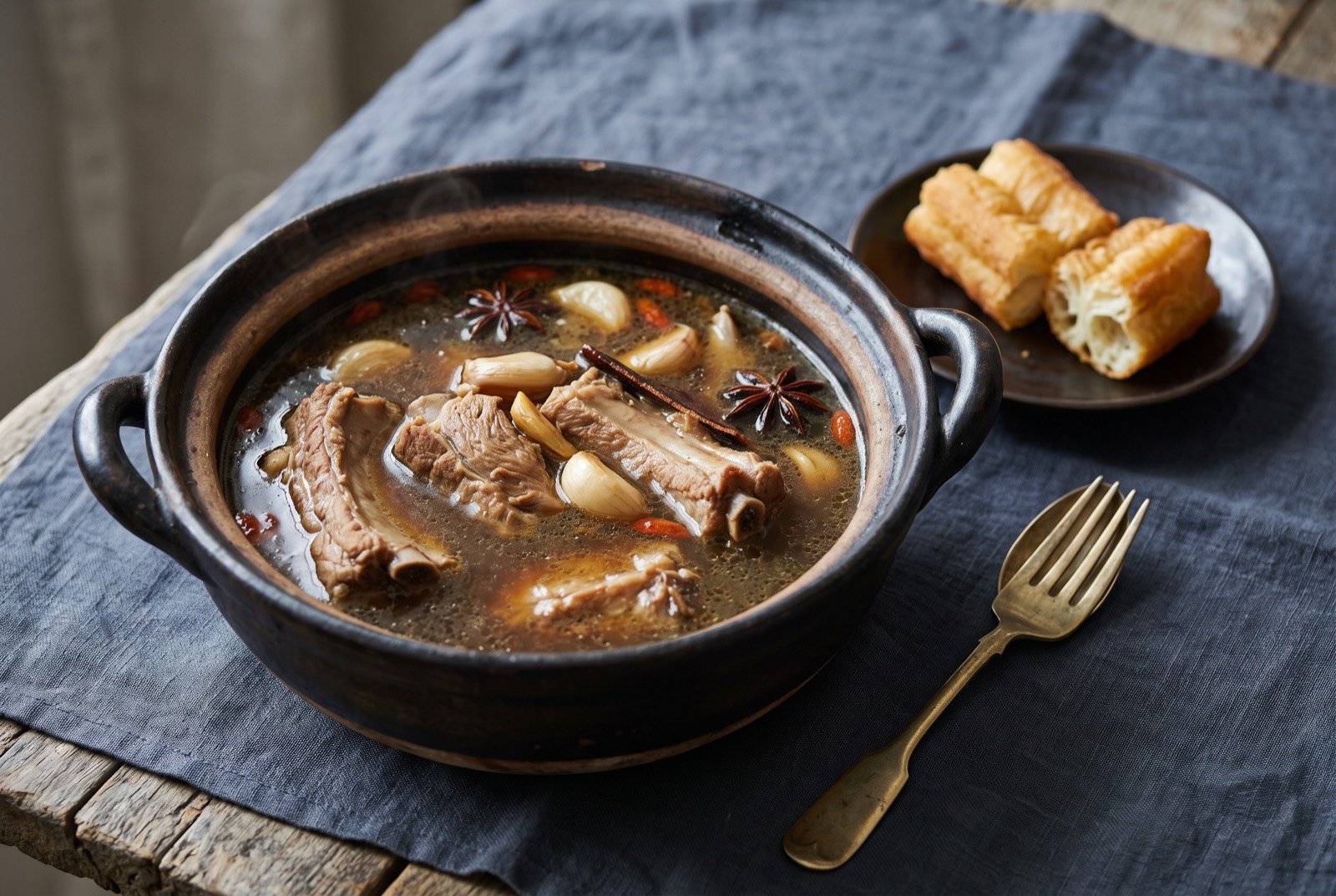
- Pork ribs and bones, sometimes with belly, simmered two to four hours in garlic, dark and light soy, and a herb mix typically including star anise, cinnamon, cloves, fennel seed, wolfberries and dried dates, the Hokkien style running darker and more herbal with dang gui and Solomon's seal, the Teochew style, dominant in Singapore today, lighter and more purely peppery.
- Served with rice, youtiao for dipping, and a side of chilli and dark soy.
What a modern chef changes
Two separate infusions, bones first, whole spices only once strained
Method
- Build the broth in two separate infusions rather than one long simmer, a short, hard extraction of the pork bones for body, and a gentler, later infusion of the whole spices, added only once the base stock is strained, so the spice character stays bright and distinct rather than boiling into a muddier, single note over four hours.
- Serve the pork rib itself glazed and finished separately, the broth poured at the table rather than around it from the start.