Maritime Southeast Asia · Volume 45, The Mortar, the Wok and the Roti Board
Babi pongteh
Peranakan
Illustration
- Researched
- Researched from 231 sources in the brief
Peranakan cooking keeps specifically Chinese technique, slow soy-based braising, stir-frying, layered on top of the Malay aromatic base, rather than adopting Malay method wholesale, and its food carries genuine ritual weight inside Chinese ancestor worship that has no equivalent function in a Malay Muslim household even where the ingredients on the plate look almost the same.
As tradition built it
Braised at least 2 hours
Ingredients
- 1kg pork belly pork belly, sometimes with trotter
- 2 tbsp taucheo (fermented soybean paste) taucheo
- 11 garlic cloves garlic
- 150g shallots shallot
- 6 dried shiitake mushrooms, soaked shiitake mushroom
- 1 cinnamon stick cinnamon stick
- 2 tsp dark soy sauce dark soy sauce
- 1 tbsp gula melaka gula melaka
Method
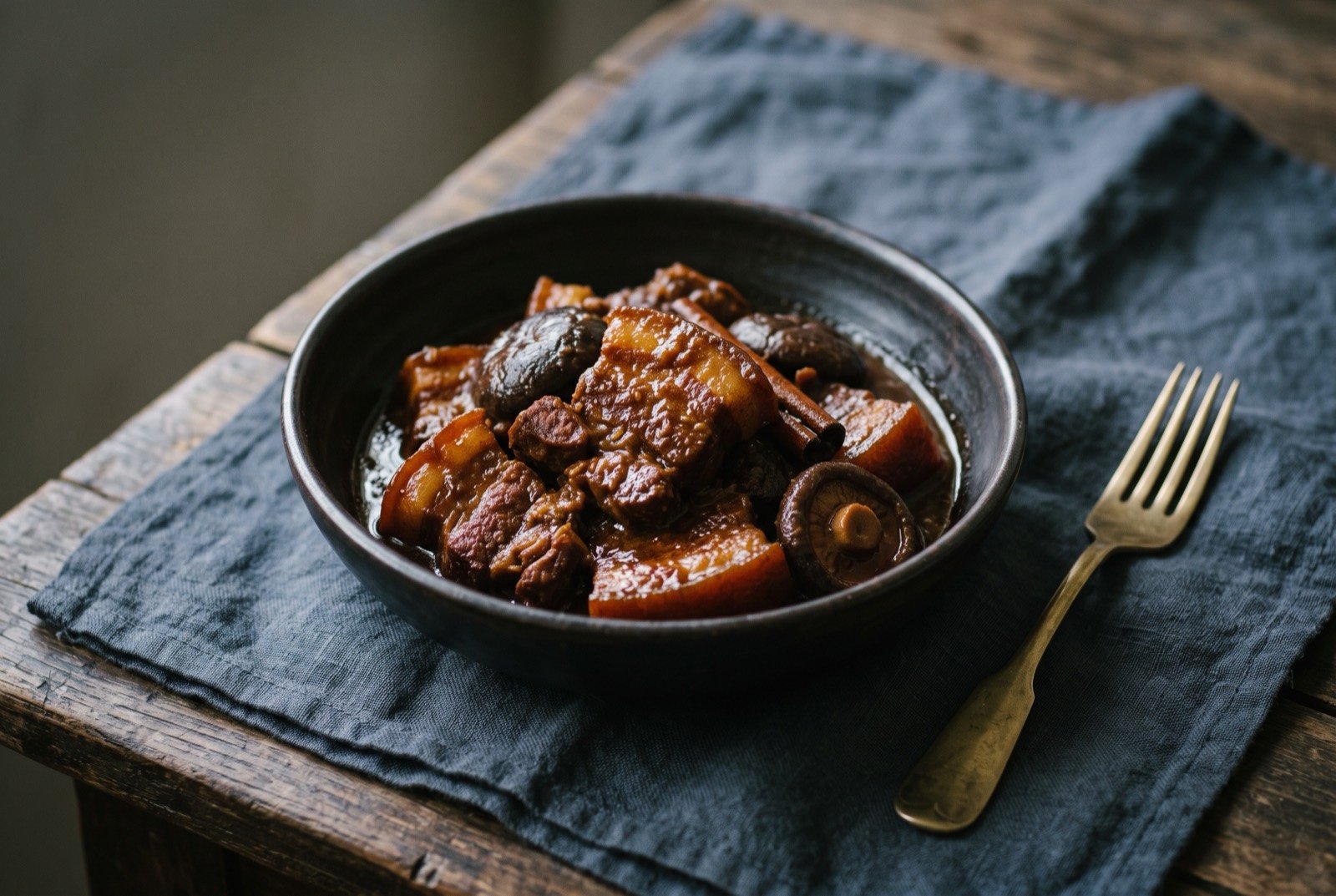
- Pork belly, sometimes with trotter for the fat and skin the dish depends on, braised at least two hours in taucheo, garlic, shallot, shiitake mushroom, a cinnamon stick, dark soy and gula melaka.
- A dish every source agrees is Chinese in its bones, taucheo-braised pork of a kind found across the whole Hokkien and Teochew world, and definitively Peranakan in its specific sweet-salty balance and its status as a signature dish each family's matriarch made her own.
What a modern chef changes
The trotter's collagen reduced to a glaze, shiitake dehydrated for crunch
Method
- Pressure the trotter separately until the collagen fully renders, then strain and reduce that liquid into a glossy, standalone glaze to finish the belly with at the end, rather than letting the whole braise run to one uniform texture.
- Dehydrate rounds of shiitake into a crisp garnish, restoring a textural contrast the long braise otherwise dissolves entirely.