Mainland Southeast Asia · Volume 41, The Coconut and the Court
Kuy teav
Cambodia
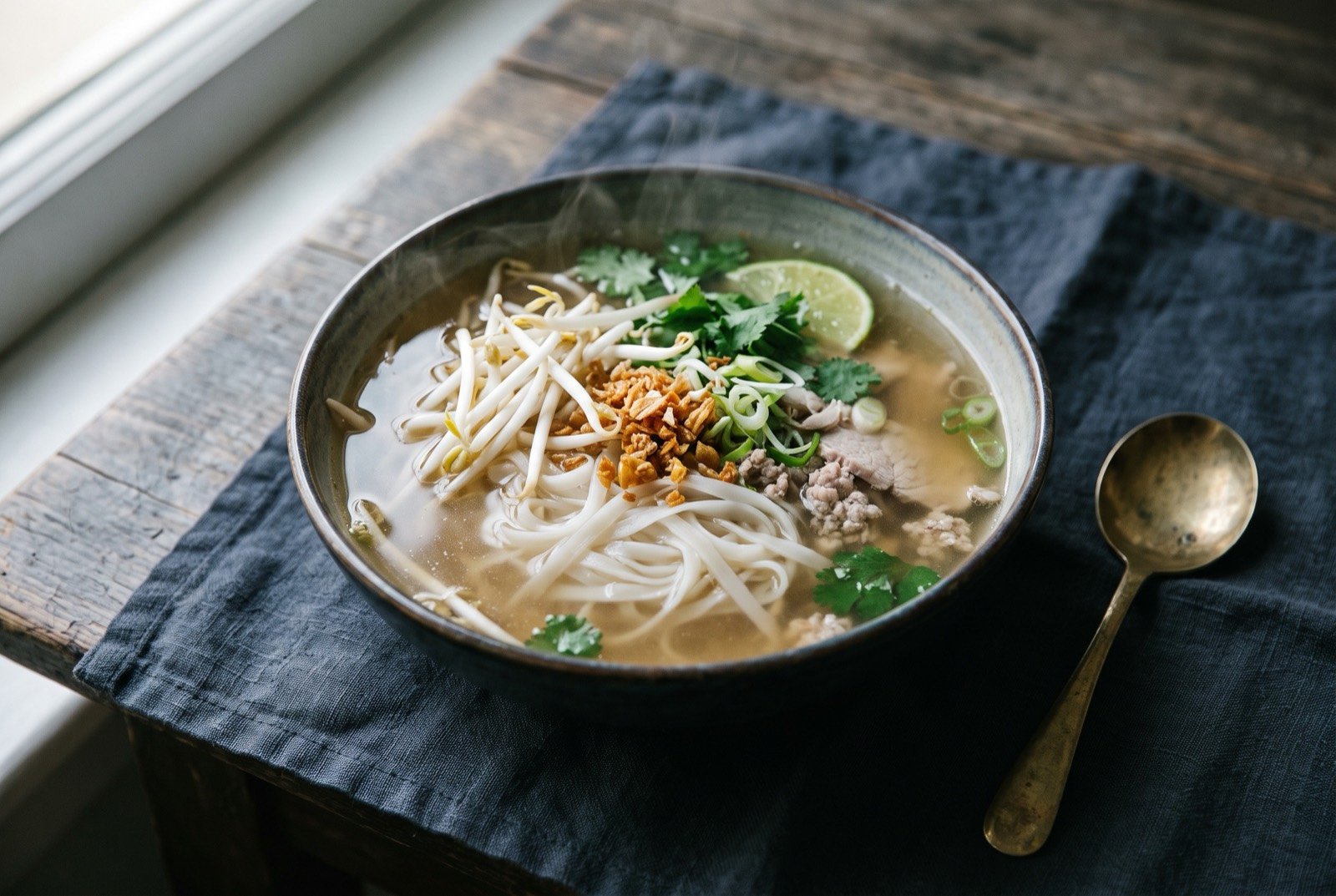
An illustration of the dish, not a photograph of it cooked.
- Time
- 3 hours
- Researched
- 8 sources cited
- Reviewed
- Not yet reviewed from inside the tradition
- Cooked
- Not yet cooked and reported
The etymology is the clearest fact here, and it is worth stating plainly rather than smoothed over: kuy teav derives from the Teochew Chinese gue diao, referring to both the flat rice noodle and the noodle soup dish itself, carried into Cambodia, and separately into Vietnam as hủ tiếu, by Teochew immigrants. Cambodia's own Ministry of Commerce has since registered kuy teav as a collective mark specifically asserting Cambodian origin and quality, even as the dish's own etymology openly points to Chinese immigrant origin, a live example of a state institution claiming ownership of a dish it does not itself dispute arrived from elsewhere. Both things are true at once and neither displaces the other.
As tradition built it
Serves 6. About 3 hours.
Ingredients
- 1kg pork bones
- 1 tsp dried shrimp, or 1 medium dried squid dried shrimp, dried squid
- 1 daikon, chopped
- 1 onion, charred
- 500g flat rice noodles
- as available bean sprouts, fried garlic, herbs, to serve
- as available pig blood, liver and heart, Phnom Penh style, optional
Method
- Blanch the pork bones 5 minutes at a boil, then drain and rinse clean of scum.
- Return the bones to a clean pot with fresh water, the dried shrimp, dried squid, daikon and charred onion.
- Simmer long and low, 2 to 3 hours, skimming regularly and topping up as needed.
- Strain the finished stock, season with fish sauce and salt.
- Blanch the rice noodles briefly, portion into bowls, and ladle the hot stock over.
- Top with bean sprouts, fried garlic and fresh herbs, and, for the Phnom Penh style specifically, pig blood, liver and heart.
What a modern chef changes
The clarifying steps this stock already demands, done with more precision.
Rung 6
Method
- Char the onion directly and deliberately on a Big Green Egg run hot, rather than simply slicing it raw into the pot, before it goes into the stockpot.
- Strain the finished stock through a chinois for real clarity rather than the cloudier result a simple ladle-and-skim gives.
- Hold the strained stock at a bare simmer rather than a rolling boil while assembling bowls, so it stays clear through service.