Mainland Southeast Asia · Volume 41, The Coconut and the Court
Nom banh chok
Cambodia
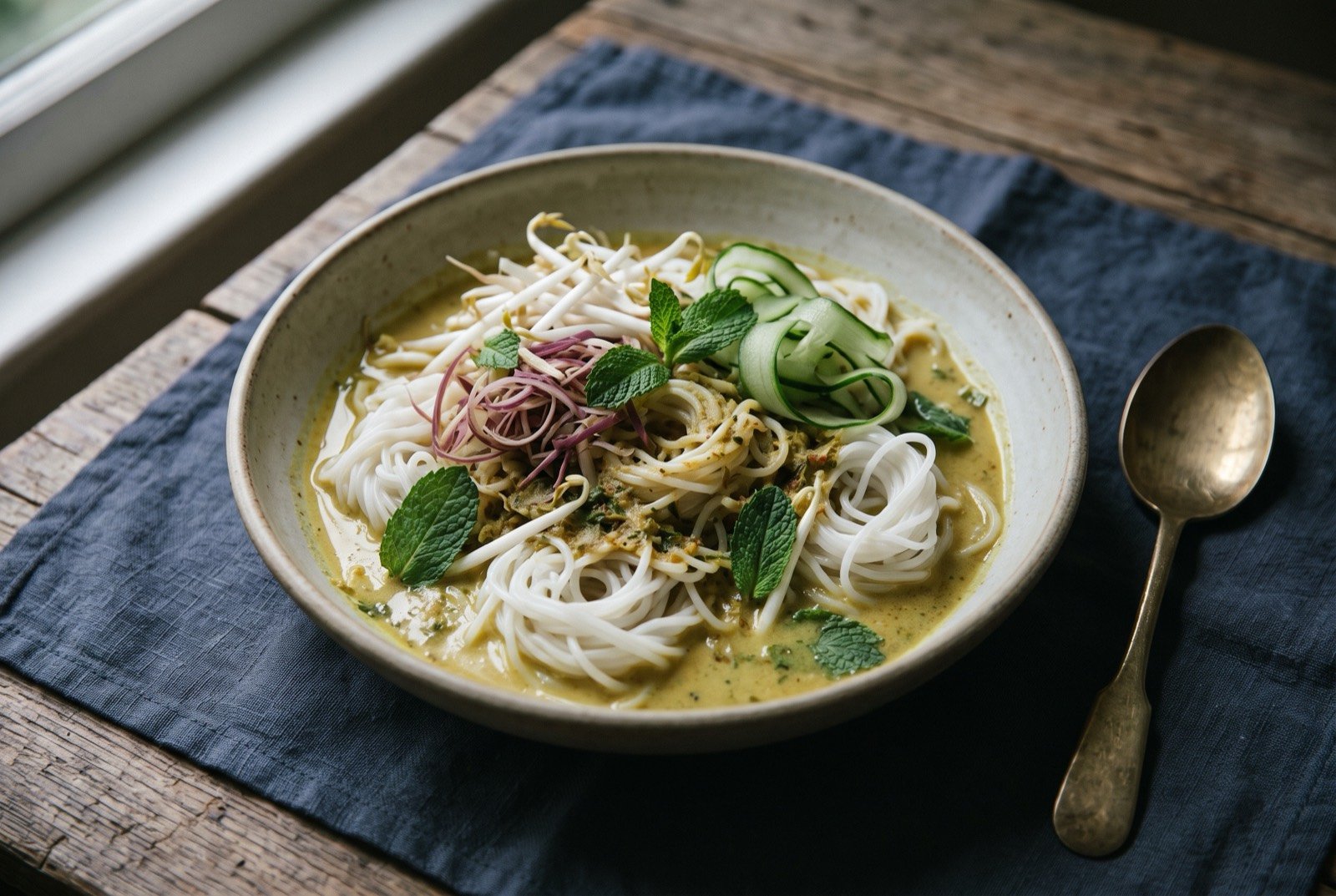
An illustration of the dish, not a photograph of it cooked.
- Time
- Hands on 2 hours · Waiting 8 hours
- Researched
- 8 sources cited
- Reviewed
- Not yet reviewed from inside the tradition
- Cooked
- Not yet cooked and reported
An origin legend, reported as legend. Khmer sources place the dish's invention in the thirteenth century reign of Jayavarman VIII, a Khmer scholar captured by the Song dynasty in 1270 said to have devised an ingenious device that won his freedom and, on his return, gave the dish its original name, num phen chok, referring to the press used to force the rice dough into boiling water. This is presented as legend in the Khmer source itself, and this chapter treats it the same way rather than as documented history.
As tradition built it
Serves 6. About 2 hours, plus overnight soaking.
Ingredients
- 500g new season rice, soaked overnight
- 400g freshwater fish fillet
- 200ml coconut milk
- 3 tbsp yellow kroeung
- to taste fish sauce, sugar, salt
- as available bean sprouts, cucumber, banana blossom, mint, to serve
Method
- Drain the soaked rice, grind to a wet dough, then drain and dry the dough further and pound it into a workable mass.
- Force the dough through a small holed press directly into a pot of gently boiling water, cutting the falling strands to length with a wooden implement as they cook.
- Rinse the cooked noodles in clean water and portion onto banana leaves or plates.
- For the sauce, simmer the fish gently in water until tender, then pound the kroeung and work it through the fish.
- Stir the coconut milk into the fish and kroeung mixture, season with fish sauce, sugar and salt, and simmer to a light curry sauce.
- Serve the sauce ladled over the noodles, with bean sprouts, cucumber, banana blossom and mint alongside.
Notes
This chapter could not confirm whether the rice itself undergoes a genuine fermentation before grinding, as opposed to simply being soaked; sources genuinely disagree, and this is stated as an open question rather than resolved either way.
What a modern chef changes
The press extrusion respected as its own noodle technology.
Rung 6
Method
- Strain the finished curry sauce through a chinois for a cleaner, silkier texture than the traditional pounded version gives.
- Poach the fish gently rather than boiling it hard, the same custard logic as amok, to keep it from breaking down into the sauce before it is pounded in deliberately.
- Serve the sauce only just warm rather than hot, closer to how the dish is actually eaten as a breakfast or afternoon dish, rather than as a Western style hot lunch curry.