Mainland Southeast Asia · Volume 41, The Coconut and the Court
Gaeng khiao wan
Thailand
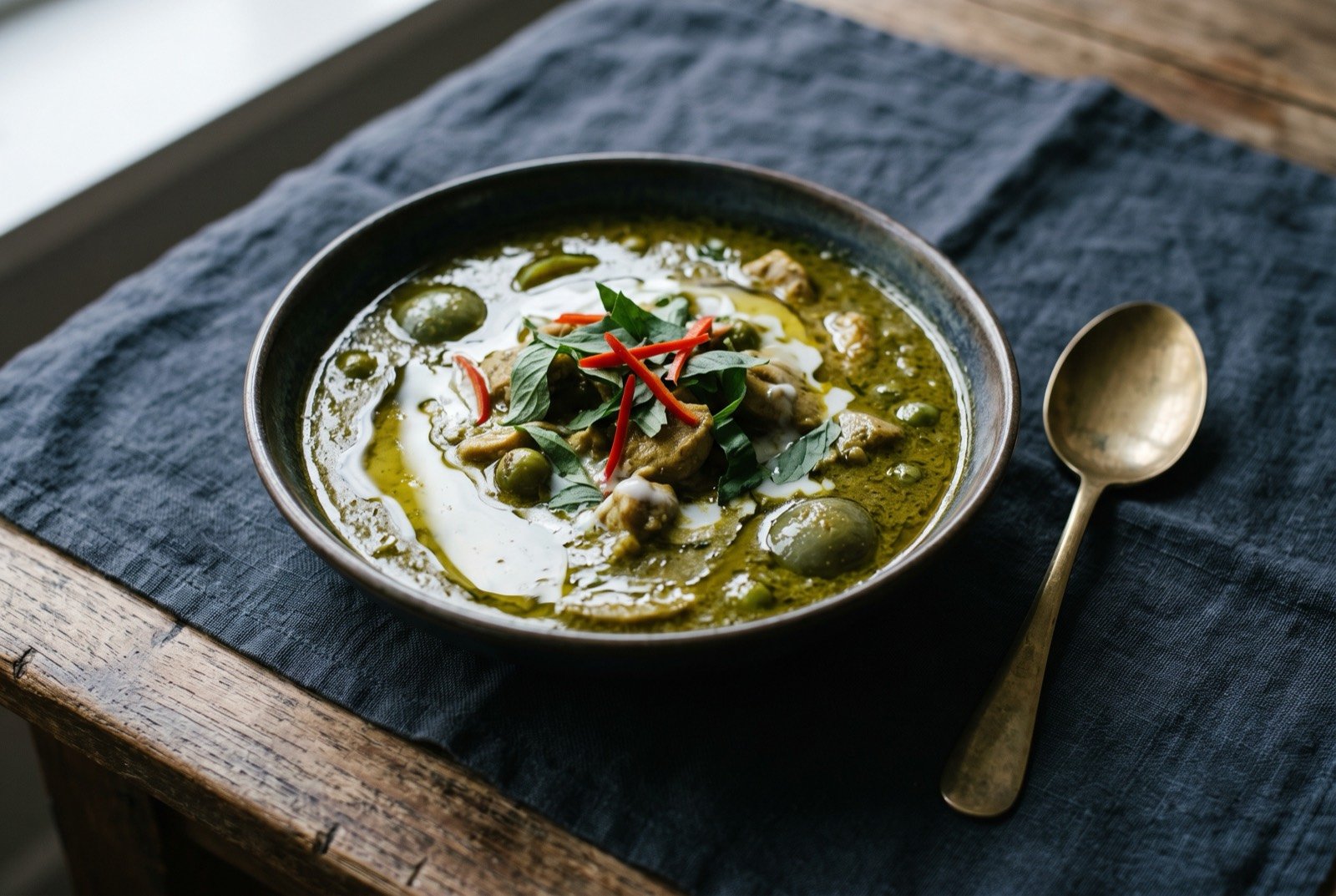
An illustration of the dish, not a photograph of it cooked.
- Time
- 45 minutes
- Researched
- 8 sources cited
- Reviewed
- Not yet reviewed from inside the tradition
- Cooked
- Not yet cooked and reported
The dish most people call ancient is, in its modern form, barely a century old. Thai food history traces green curry's roots to an Ayutthaya era, coconut milk free plain aromatic broth, closer to a clear soup than a rich curry, with the coconut milk and fresh green chilli version now recognised developed specifically during the reign of Rama VI or Rama VII, roughly 1908 to 1925. The fresh, rather than dried, chillies give the dish both its colour and, per Thai sources, its name: wan, sweet, describing the mellowing effect of coconut cream and palm sugar against the chilli's heat, not any literal sweetness in the dish itself.
As tradition built it
Serves 4. About 45 minutes.
Ingredients
- 500ml coconut milk, split into cream and thin milk
- 45 to 70g green curry paste
- 200g chicken thigh, sliced
- a large handful of each Thai aubergine, pea aubergine
- a few leaves, torn, and a small handful kaffir lime leaf, sweet basil
- to taste palm sugar, fish sauce
Method
- Heat the coconut cream alone until it visibly separates and the oil rises. See Rung 2.
- Fry the curry paste directly in this separated fat until fragrant.
- Add the chicken and coat it thoroughly in the fried paste.
- Add the thinner coconut milk and stock to loosen the curry to its final consistency.
- Add the aubergines last, to keep their texture and colour, and simmer briefly.
- Finish with palm sugar, fish sauce, kaffir lime leaf and torn sweet basil.
Notes
The wide range given for curry paste, 45 to 70g per 200g of chicken, reflects genuine recipe to recipe variation in Thai sourcing rather than an error; this chapter gives the range rather than a false single figure.
What a modern chef changes
The cracking technique given its full attention.
Rung 2
Method
- Never skip the cream cracking stage. This is the single highest leverage fix for a thin, watery curry, and it needs no equipment, only the discipline not to rush it.
- Add the basil only in the final seconds, off the heat, so its anise note stays bright rather than stewed flat.
- Hold the aubergine briefly in acidulated water before it goes in, a small step that keeps its colour clean through the final simmer.