Mainland Southeast Asia · Volume 40, One Bank to the Other
Laab
Both banks, Laos and Isaan
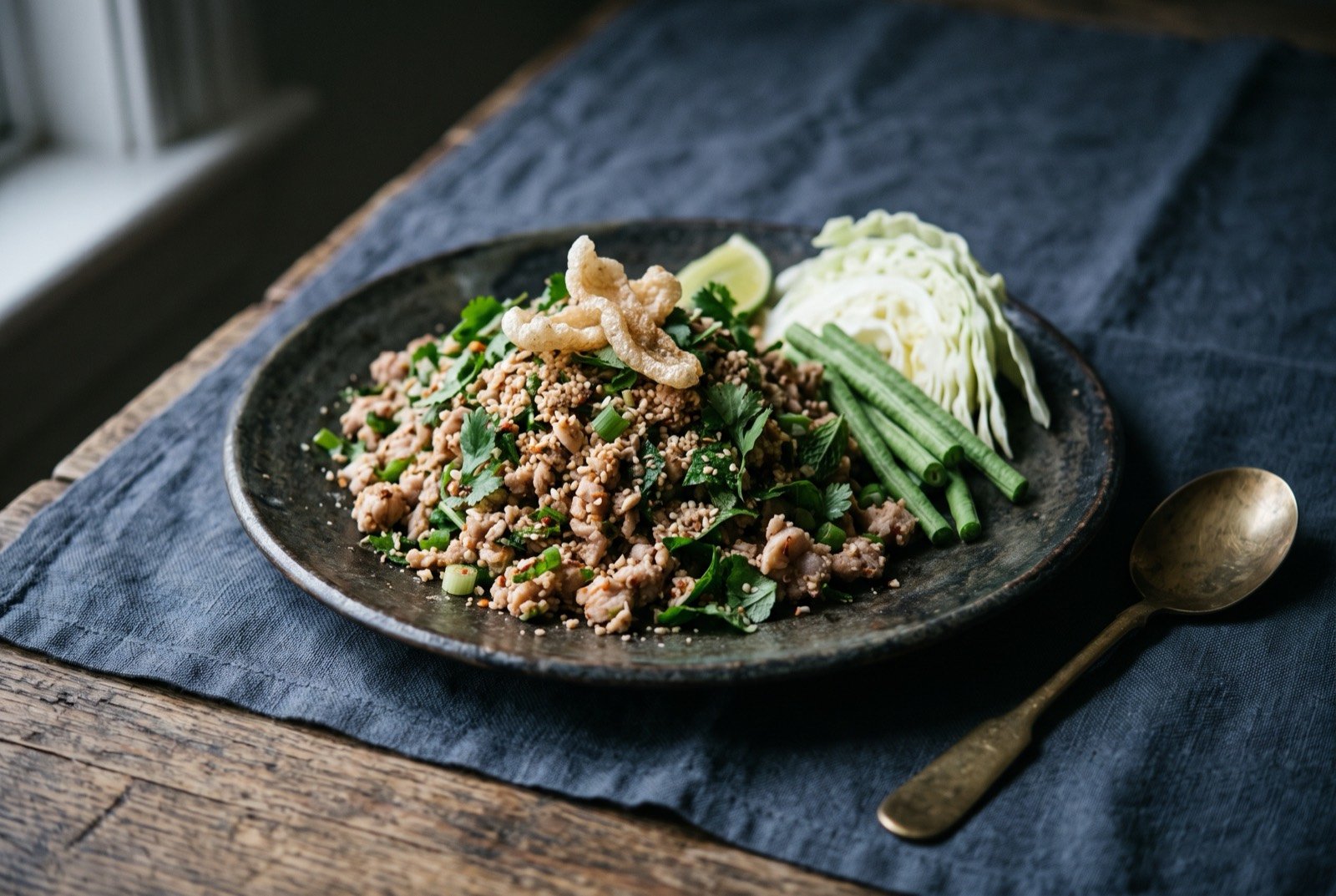
An illustration of the dish, not a photograph of it cooked.
- Time
- 15 minutes
- Reviewed
- Not yet reviewed from inside the tradition
- Cooked
- Not yet cooked and reported
Lao laab is built on padaek and contains no sugar, giving it a funkier, more savoury-sour, sharper character. The commercial "Thai larb" most familiar in Britain, sweeter and lighter, typically leaves padaek out altogether; the Isaan home version sits much closer to the Lao original than that commercial version does, by ethnicity and history rather than coincidence. On the Isaan side specifically, laab and its close cousin koi are distinguished by cut rather than seasoning: laab is finely minced, traditionally by knife, koi sliced or shredded into thinner pieces rather than ground to a paste, and the most extreme versions of either mix in raw blood, laab leuat, in which case the lime juice below is left out, the blood's own liquid doing that job instead.
As tradition built it
Lao laab moo, pork.
Serves 3 to 4. Prep 15 minutes, cook about 35 minutes.
Ingredients
- 500 g pork leg meat
- 225 g pork skin, thinly sliced
- pinch pinch salt
- 120 ml hot water
- 2 tbsp padaek
- 1 tsp ground dried bird's eye chilli
- 1 tbsp galangal, minced
- ½ tbsp kaffir lime leaf, finely chopped
- 2 tbsp khao khua
- 2 tbsp lime juice
- 1 cup spring onion, thinly sliced
- 1 cup coriander, roughly chopped
- 1 cup Vietnamese coriander (rau răm), roughly chopped
Method
- Pan-fry the sliced pork skin until golden and crisp. Reserve.
- Cut the pork leg into thick slices, season lightly with salt, and bake at 200°C for 30 minutes, flipping halfway, then finish under a hot grill for a further 6 minutes, flipping once, for char.
- Cool slightly and chop the meat finely by hand.
- Combine the chopped meat, crispy skin and hot water, then mix in the padaek, chilli, galangal, lime leaf and khao khua.
- Fold through the lime juice, spring onion, coriander and Vietnamese coriander (rau răm) at the very end, off any heat.
- Serve with sticky rice and raw vegetables alongside.
Notes
No source consulted for this chapter gives an exact khao khua-to-seasoning ratio beyond what is above; treat the quantities as workable and consistent with the tradition rather than as a single definitive figure. Isaan laab and its blood-mixed variant, koi and laab leuat, are real and documented, but no source reached for this chapter gave usable quantities for them, and this chapter does not invent any.
What a modern chef changes
The two textures, meat and skin, treated as separate problems
Rung 1
Method
- Grind the toasted rice for khao khua only after toasting it fresh in a dry pan, pulsed briefly in the dedicated spice grinder rather than bought ready-made, the single highest-leverage move available for this dish.
- Cook the pork skin to a genuinely brittle crackling in a dehydrator finished briefly in hot oil, rather than pan-frying alone, for a more dramatic textural contrast against the soft minced meat.
- Fold the herbs through at the very last moment, off the heat entirely, so the Vietnamese coriander and dill keep their sharpness rather than wilting into the warm meat.