Asia · Volume 40
Isaan and Laos
One Bank to the Other
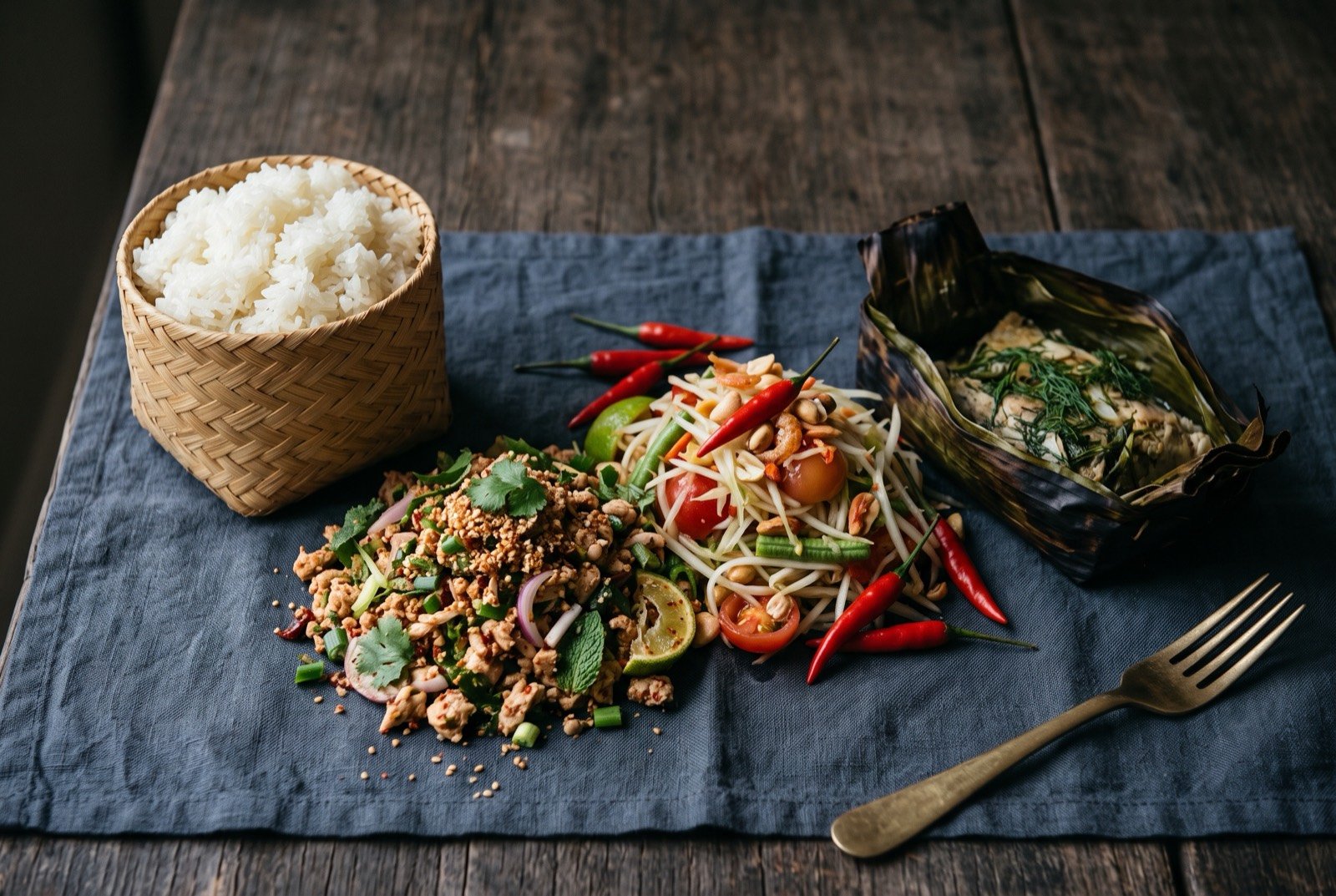
One ethnic Lao food world, sticky rice, minced meat pounded with toasted rice powder, fish fermented for months in a jar, cut in two in 1893 by a river the French decided should be a border. The two halves now belong to different states, Laos and Thailand, and eat under different flags, but a cook in Vientiane and a cook in Khon Kaen are doing the same thing with the same hands, and each shares more with the other than either does with their own capital, Bangkok's rice bowl to the south or the Lao government offices a few streets from the Mekong. Every dish as tradition built it, then what a modern chef would change.
Sources and review · What this chapter does not assert · How we research · Spotted something wrong?
A Sense of Place
Cross the Mekong at Nakhon Phanom and you have not left a food world, you have changed which government prints the banknotes. On both banks people eat sticky rice from a personal basket, pinched into a small ball and eaten by hand rather than with a spoon or fork. On both banks the base seasoning is not salt but a jar of fish that has been fermenting for the better part of a year. On both banks the signature salad is made by pounding, not slicing, not blending, in a mortar, and its name on both banks starts with the same word, tam, to pound. This is not a coincidence of parallel development. It is one people, cut in half.
The people are ethnically Lao. In Laos itself they are simply Lao. In northeastern Thailand, a region the Thai state calls Isaan, a directional word meaning roughly "northeast" rather than an ethnic name, they are usually the majority, commonly put at around 80 percent of a population of some 22 million, with Northern Khmer speakers and Kuy speakers making up most of the rest, concentrated toward the Cambodian border. Isaan is Thailand's poorest and largest region, contributing around a tenth of national GDP while holding roughly a third of the population, sitting on the Khorat Plateau's mostly sandy, saline, acidic soil, with rainfall erratic enough that flood and drought can strike the same fields in the same year. Sticky rice, not the jasmine long-grain rice of the central plain, is the everyday starch here for exactly the reason it is in Laos: it is what the ecology and the ethnicity both hand you.
Writer Chatchawan Khotsongkhram, interviewed on this question by the Thai current-affairs outlet The 101 World, puts the split plainly: by nationalist and state standards, he says, "we are Thai," but by way of life, culture and language, "we are Lao." He rejects "Isaan" itself as a directional label imposed from Bangkok and identifies instead as Lao Lan Xang, from the old Lao kingdom, on the right bank of the Mekong, a formulation that is this whole chapter's argument in one sentence, offered by someone the argument is actually about rather than assembled from outside. It is not a simple story of a suppressed identity, though: a separate academic analysis of survey data across four national waves suggests Isaan respondents report stronger Thai national identification than central Thai speakers themselves, the fruit of more than a century of centralising language and education policy since the reign of King Chulalongkorn. Both things are true at once, and this chapter reports both rather than picking the tidier one.
Within Laos itself, "Lao food" as usually written, including in this chapter, means the food of the Lao Loum specifically, the lowland, Tai-speaking, wet-rice-paddy majority along the Mekong valley, roughly two thirds of the country's population. Laos also has upland Lao Theung communities, historically pushed off paddy land into swidden farming by Tai in-migration, and highland Lao Sung communities including Hmong and Yao people, with their own dry-rice, upland-forage foodways. Those are real, separate food traditions, under-documented in what reaches an English-reading cook, and this chapter does not fold them into "Lao food" as a footnote. It is honest, instead, that everything below concerns the lowland majority.
What both banks share at the level of ingredients: sticky rice as the staple, a fermented freshwater fish paste (padaek in Laos, pla ra in Isaan) as the seasoning backbone rather than the thin marine fish sauce used further south and east, toasted ground rice as a thickener and garnish, dill used more heavily than anywhere else in the region, and insects, particularly red weaver ant eggs, as an unremarkable, seasonally relished protein rather than a novelty. Laos, being landlocked, ferments freshwater river and paddy fish rather than the marine fish behind Thai and Vietnamese fish sauce, which is the actual ecological reason padaek exists as a distinct product at all, not an accident of taste.
| Where | Defining logic | The dishes that carry it |
|---|---|---|
| Vientiane and the lowland Mekong valley, Laos | wet-rice paddy, padaek, French-colonial remnant (baguettes, coffee) | khao jee pâté, tam mak hoong, laab |
| Luang Prabang | royal court cuisine, documented by name | or lam, jeow bong, mok pa |
| Isaan, the Khorat Plateau | poor sandy soil, sticky rice, pla ra, the same Lao ethnic base under a different flag | som tam, laab, sai krok Isan, kai yang |
| The Isaan-Bangkok migrant corridor | Isaan food carried south by labour migration since the 1940s, now the most-ordered street food in the country | som tam, laab, kai yang |
The History in Layers
Before there was a border here there was Lan Xang, "the land of a million elephants," a Lao kingdom that from the fourteenth century held loose, ill-defined hegemony over both banks of the middle Mekong under a tributary rather than territorial system. What is now Isaan sat within that same world, sparsely populated after the earlier Khmer empire's decline, its people the same Lao-speaking farmers as those on the Vientiane and Luang Prabang side. Padaek's presence in the region is dated by food historians back to Lan Xang, corroborated independently by two seventeenth-century European travellers, a Dutch merchant and an Italian missionary, who both documented the region's fermented-fish culture on their own visits.
The break came in 1893. A violent incident at Kaeng Chek in June that year, a Frenchman killed on the Mekong bank, gave France the pretext to send gunboats up the river to Bangkok, and the resulting Franco-Siamese treaty of 3 October 1893 fixed the Mekong itself as the new border between French Indochina and an independent but diminished Siam. Siam ceded its claims to everything east of the river and was compelled to withdraw its administration, and in large part its population, from that bank, while keeping the ethnically Lao-populated plateau on the west, now Thai, side. This was not the first such forced movement: Siam had already been transferring ethnic Lao communities west across the river since the seventeenth century, hardening after a failed 1826 to 1828 rebellion against Siamese overlordship. No source consulted for this chapter narrates the cuisine itself, as opposed to the population, being split by this line. That reading, food history seen through a political border, is this chapter's own synthesis of political and culinary sourcing that otherwise sit in separate literatures, not a claim any single source makes outright, and it is offered as such.
What happened next differed sharply on each bank, even as the food did not. On the Thai side, a sustained assimilation programme ran from the 1880s into the 1930s and intensified again during the Cold War: Lao script was pushed out of state schools, the monastic system was restructured along central Thai Buddhist lines, and by the late 1930s Lao-language Buddhist manuscripts were being actively destroyed "in order to eliminate Lao culture, especially Lao literacy." Khotsongkhram makes the same point from the inside: no law ever explicitly ordered Lao people to become Thai, he says, but administrative, linguistic and curricular pressure achieved it regardless. One small, concrete case: the Thai state absorbed the Phu Thai ethnic name into Thai identity by literally inserting a single Thai letter, rendering "Phutai" as "Phutaiy." Even the region's own name is part of this history: "Isaan," a directional rather than ethnic word, replaced whatever this plateau's Lao inhabitants would otherwise have called their own home.
On the Lao side of the river, French rule lasted from 1893 to 1954, and its culinary mark is real but shallow next to what French colonialism did to Vietnamese food a few hundred miles east. Baguettes are sold on Vientiane's streets and French restaurants remain common there, and Laos has its own named baguette sandwich, khao jee pâté, but nothing like the depth of technique and sauce-work Vietnam absorbed. Exactly why Laos absorbed so much less is not well established in the sourcing available for this chapter, and this chapter does not guess at a cause; the underlying comparative fact, that Vietnam went considerably deeper, is safe, but the reasons are not asserted here.
What the French period does hand this chapter, reliably, is Phia Sing. Chaleunsilp Phia Sing, who died in 1967, was Master of Ceremonies and chef to the royal palace at Luang Prabang, and, by the account of the British diplomat and food writer Alan Davidson, also a physician, architect, choreographer, sculptor, painter and poet in his own right. Shortly before his death he wrote out 124 recipes by hand in two notebooks. They passed to Crown Prince, later Prime Minister, Souvanna Phouma, who lent them to Davidson, then serving as British ambassador in Vientiane, in the early 1970s. Davidson arranged their translation, and the bilingual Lao and English edition, illustrated with roughly a hundred ink drawings by the Lao artist Thao Soun Vannithone, was published in Britain in 1981 as Traditional Recipes of Laos. A contemporary French academic review, in the Journal d'agriculture traditionnelle et de botanique appliquée, praised the book's clarity and precision and its genuine ethnographic content on Lao food habits, equipment and terminology. Phia Sing is called, without much argument from anyone, the godfather of Laotian food, and this chapter leans on his recipes, at second hand through his translators and the diaspora cooks who cite him directly, wherever it can.
What followed his death is the single largest gap in this chapter's own research. In December 1975 the Pathet Lao took Vientiane, the king abdicated, and the Lao People's Democratic Republic was founded; private trade was banned, foreign trade nationalised, and Soviet-style agricultural collectivisation attempted through the late 1970s, meeting real peasant resistance and giving way in the 1980s to a return toward family farming. About a tenth of the country's population left after 1975, and by 1991 the World Bank counted Laos among the world's ten poorest nations. What that period did to restaurant life, to the transmission of royal or palace cooking, to public food culture generally, no source reached for this chapter says. It is named here as an honest hole rather than papered over with inference from the general economic collapse.
Back on the Thai side, the twentieth century's real culinary story is migration, and it is well documented by name. The first identifiable Isaan restaurant in Bangkok, a wooden shophouse called Saep Eli near Saphan Khao selling sticky rice, laab and som tam to migrant labourers, is reported to have run from roughly 1944 to 1975. A second, better-documented account places the true commercial turning point around the Ratchadamnoen boxing stadium, completed in 1945: as post-war Isaan migrants settled nearby for work, a vendor named Duang Thong began selling som tam there around 1950 and opened her own shop in 1958, reportedly moving a hundred papayas and 120 chickens a day at its peak, and the area became the recognised concentration of Isaan restaurants that wider Bangkok learned this food from. The scale of that conquest is measurable now: delivery-platform data cited for 2022 shows som tam received over 6.8 million orders in an eleven-month span, the single most-ordered dish on that platform anywhere in Thailand. A regional dish born of poverty and displacement is now the country's most popular order, which is worth sitting with rather than treating as a footnote.
One popular claim did not survive checking and belongs here, in the interest of getting the record straight before it is asserted anywhere else in this book: the story, common in Western writing, that American servicemen at the Vietnam War-era airbases scattered across Isaan (Korat, Nakhon Phanom, Ubon Ratchathani, Udon Thani all hosted major US installations) are somehow responsible for the spread or popularity of Isaan grilled chicken. The best-documented named origin story for a regional grilled chicken tradition, at Wichian Buri in neighbouring Phetchabun province, credits a vendor known as Ta Pae, who began selling from a bus-stop stall around 1962 and was later publicised nationally by a Thai Rath newspaper food columnist, a purely domestic commercial story with no American connection anywhere in it. There is a real Vietnam War economic history in Isaan, and it did transform towns like Nakhon Phanom, but this chapter found no route from that history to a specific dish, and it does not invent one.
The Flavour Arsenal
Padaek and pla ra are the same idea, whole freshwater fish salted and packed with roasted rice bran to ferment, but they are not quite the same product, and this chapter treats them as siblings rather than synonyms. Padaek is generally the more intense of the two: a larger proportion of rice bran in the ferment, a darker colour, a stronger smell, a thicker, chunkier body with visible pieces of fish rather than a clarified liquid, the product of Laos's landlocked geography, since there is no marine fish to turn to instead. Pla ra, on the Isaan side, tends to be milder and more rounded, built to let the toasted rice powder still register over the top of it. Ratios vary by source and household, but they converge on the same rough shape: fish, salt and rice bran in something close to equal parts by weight, packed under a weight in a sealed jar, and left a minimum of six months, ideally a year, before it is ready, keeping for two years or more once opened and refrigerated.
Khao khua, toasted and ground sticky rice powder, is the clearest single fact in this whole chapter for the argument that Isaan and Lao food are one tradition rather than two. It is documented as a Lao invention, traceable specifically to Phia Sing's own recipes from the Luang Prabang palace, and adopted wholesale into Isaan cooking on the strength of shared Lao ethnicity alone. The method does not vary much either side of the river: raw glutinous rice dry-toasted in a bare pan, stirred constantly for ten to twenty-five minutes until it turns a deep gold and smells like popcorn, cooled completely, then ground coarse, in a mortar traditionally, never to a fine flour, which would lose the crunch that gives laab its characteristic texture.
Dill is the marker herb of this whole food world, and central Thai cuisine's own vocabulary proves it without meaning to: Thai cooks call dill "Laotian coriander." It appears, without exception, in every mok dish, in laab, in tam mak hoong, in kaeng awm, favoured here and largely ignored by the cuisines either side of it.
The chilli, salt and sugar balance is the most openly discussed divergence between this food world and the central Thai cooking most British diners already think of as Thai food. Central Thai som tam is built around dried shrimp and roasted peanuts, sweet and sour and, by design, gently balanced, sugar and lime doing most of the work. The Isaan and Lao version this chapter treats as the region's own dish is built on fermented fish and green papaya, leading with salt and a specific umami depth Thai cooks call "nua," heat trailing close behind rather than sugar. Thai food writers themselves describe their own national cuisine's food as comparatively moderate against Isaan's "extreme heat, sourness, and umami from fermented fish." This is a real, widely asserted, consistently described difference, not a laboratory-tested one, and this chapter states it at that level of confidence.
Insects are ordinary food here, not a stunt. Red weaver ant eggs, khai mot daeng, are described by Lao Airlines's own in-flight magazine as "without doubt the most popular food from Laos' wild larder," in season from January to April and frozen for the rest of the year, eaten in a fish soup with wild greens, in an omelette, and pounded into a laab-style salad, koi khai mot. On the Isaan side, crickets, grasshoppers and a wide range of other insects have moved from a poverty-driven protein source toward a marketed "future food," with FAO figures on cricket nutrition circulating in Thai agricultural press.
Jeow, sometimes written jaew, is not one sauce but a whole family of pounded chilli dipping sauces built from grilled or fresh chilli, garlic, shallot, herbs and fish sauce or padaek, ranging from thick chunky pastes to thin liquid dressings. Luang Prabang's own signature version, jeow bong, is distinguished from the rest of the family by shredded water buffalo or pork skin worked through it, and is treated below as a dish of its own.
The Technique Ladder
The argument, from inside
The clearest indigenous-elevation argument found anywhere in this chapter's research comes from Bangkok rather than Vientiane. Chef Chalee Kader of 100 Mahaseth, cooking Isaan-inflected nose-to-tail offal, braised beef entrails with bile, grilled pig's heart, dry-aged ox tongue, frames his own kitchen not as importing a Western zero-waste ethic but as recovering "traditional but often forgotten Thai dining practices," which is precisely this atlas's own animating idea stated by a working chef rather than argued by this book. In Khon Kaen itself, the restaurant Kaen, founded by chefs Phaisan Cheewinsiriwat and Kanyarat Thanomsaeng, both with decades in the industry, describes its own project as presenting local Khon Kaen and Isaan ingredients "in a form the world can recognise," the closest thing this research found to a provincial, hometown version of the same argument, rather than one made only in the capital. On the diaspora side, chef Seng Luangrath of Thip Khao in Washington DC, who learned to cook from elders in the Nakhon Phanom refugee camp before building what American food press calls the Lao Food Movement, supplies the sharpest available diagnosis of what goes wrong when this food travels badly: her own distinction between "Tum Lao," assertive chilli heat and fish-sauce funk, and "Tum Thai," a sweeter, palm-sugar-balanced version, names exactly the substitution that most Western-restaurant Isaan and Lao food makes without saying so.
Rung 1. Toast and pound, don't blend
Khao khua is toasted rice ground coarse, never to a flour, and it exists to add crunch and body, not a fine dusting. The mortar work that goes with it in laab and tam mak hoong follows the same logic in reverse: red chilli and garlic are pounded first to a rough paste, other ingredients added and cracked rather than pulverised, the entire point of the tool being controlled fracture rather than purée. Over-pounding, not under-pounding, is the marked line between a good version of this food and a bad one.
What a cook does with this rung. The reader's high-power blender is the wrong tool for the salad stage of this cuisine and should be put away for it: it purées where the dish needs shards and bruised, unevenly broken texture. The dedicated spice grinder is exactly right for khao khua once the toasting itself has been done by hand in a dry pan, pulsed briefly rather than run to a powder. For the mortar work itself, a stone or wood mortar, pounded by hand, is not a rustic compromise here, it is the only correct tool, and the reader should own one specifically for this volume rather than reach for the blender out of habit.
Rung 2. Read the fire, and let its own fat baste
Kai yang, Isaan grilled chicken, is marinated well ahead of cooking, commonly two hours to overnight, with lemongrass, garlic, pepper, fish sauce and pounded coriander root, so the marinade tenderises as much as it flavours, then grilled slowly over charcoal, the bird often butterflied flat so its own rendering fat drips onto the coals and the resulting smoke bastes the skin from below rather than a sauce being brushed on from above. This is a direct, recognisable ancestor of the technique that shows up again and again in modernist restaurant cooking across this atlas's African volumes: cook slowly over live fire and let the fat do the basting, an indigenous ancestor for a move that gets marketed elsewhere as a chef's discovery.
What a cook does with this rung. This is built for a Big Green Egg run low and indirect rather than hot and direct: the chicken butterflied and weighted flat with a plancha or a brick, the coals doing slow, steady work rather than a fast sear, the bird's own fat supplying the smoke. The coriander-root-and-lemongrass paste should be pounded in the mortar from Rung 1, not blended, for the same textural reason.
Rung 3. Ferment under salt and rice, patiently
Padaek is whole freshwater fish packed under salt and rice bran in roughly equal parts by weight and left a minimum of six months, ideally a year, to become the funky, thick, unfiltered condiment this whole cuisine leans on. Sai krok Isan, the region's fermented pork and rice sausage, runs on the same principle over a much shorter clock: ground fatty pork mixed with cooked sticky rice, garlic and salt, stuffed into casing, and held at a steady tropical ambient temperature, around 30 degrees Celsius, for two to four days while lactic-acid bacteria feed on the rice's sugar and sour the meat, the drying time itself controlling how sour the finished sausage tastes, a few hours for barely sour, two days for assertively so.
What a cook does with this rung. Padaek itself is not a home project for a British kitchen: the timescale, the specific freshwater species and the safety profile of an unregulated multi-year ferment make it a source-it-don't-attempt-it ingredient, and this chapter says so rather than offering a home version that would not be the real thing anyway. Sai krok Isan is a different matter: the reader's dehydrator, run with a temperature-hold function, reproduces that steady 30 degree tropical fermentation reliably and more safely than an open kitchen counter, with ordinary charcuterie hygiene, cured salt, clean casings, watched humidity, and the sous vide bath is a workable second chamber if the dehydrator is busy with something else.
Rung 4. Seal it in the leaf
Mok pa, and its Isaan twin mok pla, wrap pounded lemongrass, galangal, shallot and chilli around cubed or minced fish with dill, egg and a spoonful of padaek or pla ra, sealed inside a banana leaf parcel and cooked by the heat trapped inside the leaf rather than heat applied directly to the food, either steamed or set over the fire itself. It is one of the clearest points of direct, identical technique across the whole river, found independently on both the Lao and the Isaan side of this chapter's research with almost nothing to distinguish the two versions beyond which fermented fish goes in.
What a cook does with this rung. Banana leaf, softened briefly over a flame to make it pliable, is worth sourcing fresh or frozen rather than substituting; the parcel can go on a Big Green Egg run at a moderate, steady heat as readily as into a steamer, and the leaf itself is doing real work, holding in moisture and a faint vegetal sweetness a foil parcel does not replicate.
Rung 5. Thicken with rice, not flour
Or lam, Luang Prabang's buffalo-skin stew, is thickened at the very end of its cooking not with flour, not with cream, but with a paste of raw sticky rice, soaked and pounded or blended with a little water and stirred through in the last few minutes, a genuinely distinctive mechanism next to the fried-flour or reduction-based thickening a British cook is more likely to reach for by habit.
What a cook does with this rung. The reader's high-power blender, put away for the salad work above, is exactly right here: blitz the soaked sticky rice with a splash of water to a smooth, thick paste and stir it through the stew off the height of the heat, watching the consistency rather than following a fixed quantity, since the rice's own starch content will vary by grain.
The Ferment and Preserve Bench
1. Padaek
Whole freshwater fish, salt and roasted rice bran in roughly equal parts by weight, packed under a weight in a sealed jar, matured a minimum of six months, ideally a year, keeping two years or more once opened and refrigerated. Source it rather than attempt it at home; see Rung 3 and the sourcing dossier below.
2. Sai krok Isan
Ground pork and cooked sticky rice, stuffed into casing, fermented 2 to 4 days at a steady 30°C. See the dish above for the full method.
Som moo, the fermented pork sausage folded through naem khao, crispy rice salad, elsewhere in this cuisine, is named repeatedly across sources but no method or timing for it was found with enough confidence to give here; it is not included as a recipe in this chapter for that reason, in keeping with the house rule against inventing quantities.
Sourcing in Britain
Verified September 2026. This cuisine is better served by British retail than most volumes in this atlas, with one real gap at its centre. London alone has half a dozen genuine Thai grocers, Sriracha Supermarket in Hammersmith, Muay Supermarket in Earl's Court, Tawana in Bayswater, Khun Ya in Rotherhithe, Raya at Borough Market, plus a large pan-Asian tier, Longdan and Wing Yip, that between them cover fresh lemongrass, galangal, Thai basil, bird's eye chilli, sticky rice in several brands and grades, and the correct deep clay mortar, sold explicitly in the trade under the name "Laos style" by several UK retailers including Thai Food Online, Sous Chef and Yum Yum Thai Shop, and genuinely the right tool rather than a marketing flourish: buy the clay one specifically for this volume's dishes, not the harder granite mortar meant for curry pastes, which will crack under the looser pounding action this cuisine's salads need.
What is missing is anything actually sold under the Lao name. No UK retailer, physical or online, stocks a product labelled padaek. What is sold instead is Thai commercial pla ra, under the brands Zab Mike, Mae Boonlam and Super Zaap, and Pantai's ground fermented fish products, which in-tradition cooks on both sides of the Atlantic use as the practical stand-in, and which this chapter recommends for the same reason, with one honest caveat: Pantai's own product listing for its Bu-Do Sauce states it is 70 percent anchovy, salt and fish sauce, a different thing from the whole, long-fermented freshwater fish Lao households make at home. It is the closest thing sold in Britain, not the same thing, and the reader should know that going in rather than discover it by taste.
There is no dedicated Lao grocery, temple or community shop anywhere in the UK that this chapter's research could find. The Lao community here organises around a Facebook group, the Lao Association in the UK, and the London embassy, rather than the kind of shop network the much larger Thai community has built around Wat Buddhapadipa in Wimbledon. Two ingredients are genuine closed doors rather than things worth hunting harder for: kaipen, Lao river weed pressed into dried sheets, has no working UK retail channel at all, and red weaver ant eggs cannot lawfully be sold in Britain under current Food Standards Agency rules, which currently authorise only three insect species for sale, none of them this one. Sanpatong-grade sticky rice, the specific grade most praised by North American in-tradition cooks, is not stocked under that name by any UK retailer found, though Royal Umbrella and Longdan's own-brand glutinous rice are an honest, workable substitute.
Ingredients that decide great from grim, ranked
- Padaek, or its Pantai stand-in. Nothing else in this cuisine matters if the fermented fish is thin and characterless.
- Fresh, not dried, dill. Its absence is the single fastest way to make a mok dish taste generically Southeast Asian rather than specifically Lao.
- A clay, not granite, mortar. For the reasons given above.
- Freshly toasted, freshly ground khao khua, made at home rather than bought. This is one of the few places in this whole cuisine where the traditional method is simply better suited to a British kitchen's own equipment than any packet product on a shelf.
Voices and Sources
Phia Sing's Traditional Recipes of Laos, translated and published in English by Alan Davidson in 1981, remains the single most important named source behind Lao cooking anywhere it is written about seriously, and this chapter leans on it, at second hand through the diaspora cooks and reviewers who cite him directly, wherever it could. Chef Seng Luangrath of Thip Khao, Padaek and Baan Mae in Washington DC is the strongest living in-tradition voice reached for this chapter, a refugee-camp cook turned restaurateur whose own account of what separates Lao food from its commercial Thai imitation anchors much of the technique section above. Saeng Douangdara, the Lao-American chef behind Saeng's Kitchen and author of a forthcoming cookbook on Lao family recipes, supplied more usable recipe detail than any other single source. Chef Chalee Kader of 100 Mahaseth and the founders of Kaen in Khon Kaen represent the honest state of this cuisine's modernist elevation: real, serious, and concentrated in a handful of addresses rather than a movement the size of Bangkok's own fine-dining scene. Kiln in London, run by chef Ben Chapman, is named in this chapter deliberately as what it actually is, a Thai-borderlands restaurant drawing on real fieldwork and genuine claypot-and-charcoal technique, not an Isaan or Lao restaurant, and readers should not mistake one for the other.
Things this chapter has deliberately not asserted
- That American servicemen at Vietnam War-era Isaan airbases are responsible for the spread of Isaan grilled chicken or any other dish. The best-documented origin story for a named regional grilled chicken tradition is purely domestic and commercial, and this popular Western claim does not survive checking against Thai-language sourcing.
- A precise per-capita figure for Lao sticky rice consumption. The number varies meaningfully between the sources that quote it and none traces to a clean primary dataset.
- A specific causal account of why Laos absorbed less French culinary technique than Vietnam. The comparative fact is safe, the explanation is not sourced with any confidence.
- Anything about what happened to Lao restaurant life, palace cuisine or public food culture during the 1975 to 1986 socialist period. No source in any language reached for this chapter addresses it.
- A quantified difference in rice-bran content between padaek and pla ra. This rests on a single online forum discussion, not a food-science or ethnographic source, and is reported here only as a plausible, unverified claim.
- Real gram quantities for tam mak hoong, Isaan laab specifically, sai oua or khao piak sen beyond the indicative composites given where a recipe was included at all. No in-tradition source with stated ratios for these specific dishes was found despite genuine search effort in both Lao and Thai script.
- Any specific example of Thai royal-court or central-Thai culinary influence reaching Isaan's border areas, as distinct from the general political history of Thaification.
- That Yia Vang's celebrated Minneapolis restaurant Vinai, or any other Hmong-American chef's cooking, represents this chapter's ethnic-Lao tradition. It does not, and the two should not be collapsed into one story because both trace to the same country.
- That Kiln in London is an Isaan or Lao restaurant rather than what it says of itself. It is a Thai-borderlands kitchen with real technique and a separate claim.
Toast and pound, don't blend
Khao khua is toasted rice ground coarse, never to a flour, and it exists to add crunch and body, not a fine dusting.
Read the fire, and let its own fat baste
Kai yang, Isaan grilled chicken, is marinated well ahead of cooking, commonly two hours to overnight, with lemongrass, garlic, pepper, fish sauce and pounded...
Ferment under salt and rice, patiently
Padaek is whole freshwater fish packed under salt and rice bran in roughly equal parts by weight and left a minimum of six months, ideally a year, to become...
Seal it in the leaf
Mok pa, and its Isaan twin mok pla, wrap pounded lemongrass, galangal, shallot and chilli around cubed or minced fish with dill, egg and a spoonful of padaek...
Thicken with rice, not flour
Or lam, Luang Prabang's buffalo-skin stew, is thickened at the very end of its cooking not with flour, not with cream, but with a paste of raw sticky rice...
The dishes
- Khao niaw Both banks of the Mekong
- Laab Both banks, Laos and Isaan
- Tam mak hoong Both banks, under two names
- Or lam Luang Prabang, Laos
- Mok pa Both banks, mok pa in Lao, mok pla in Isaan
- Sai krok Isan Isaan, Thailand
- Kai yang Isaan, Thailand
- Jeow bong Luang Prabang, Laos
Sources and review
- Reviewed
- Not yet reviewed from inside the tradition
- Cooked
- Not yet cooked and reported
Where this volume comes from
3 research briefs on file for this volume, researched to the rules on How we research. Published 3 September 2026. Last changed 8 September 2026.