Asia · Volume 38
Hanoi to Huế
The Broth and the Banquet
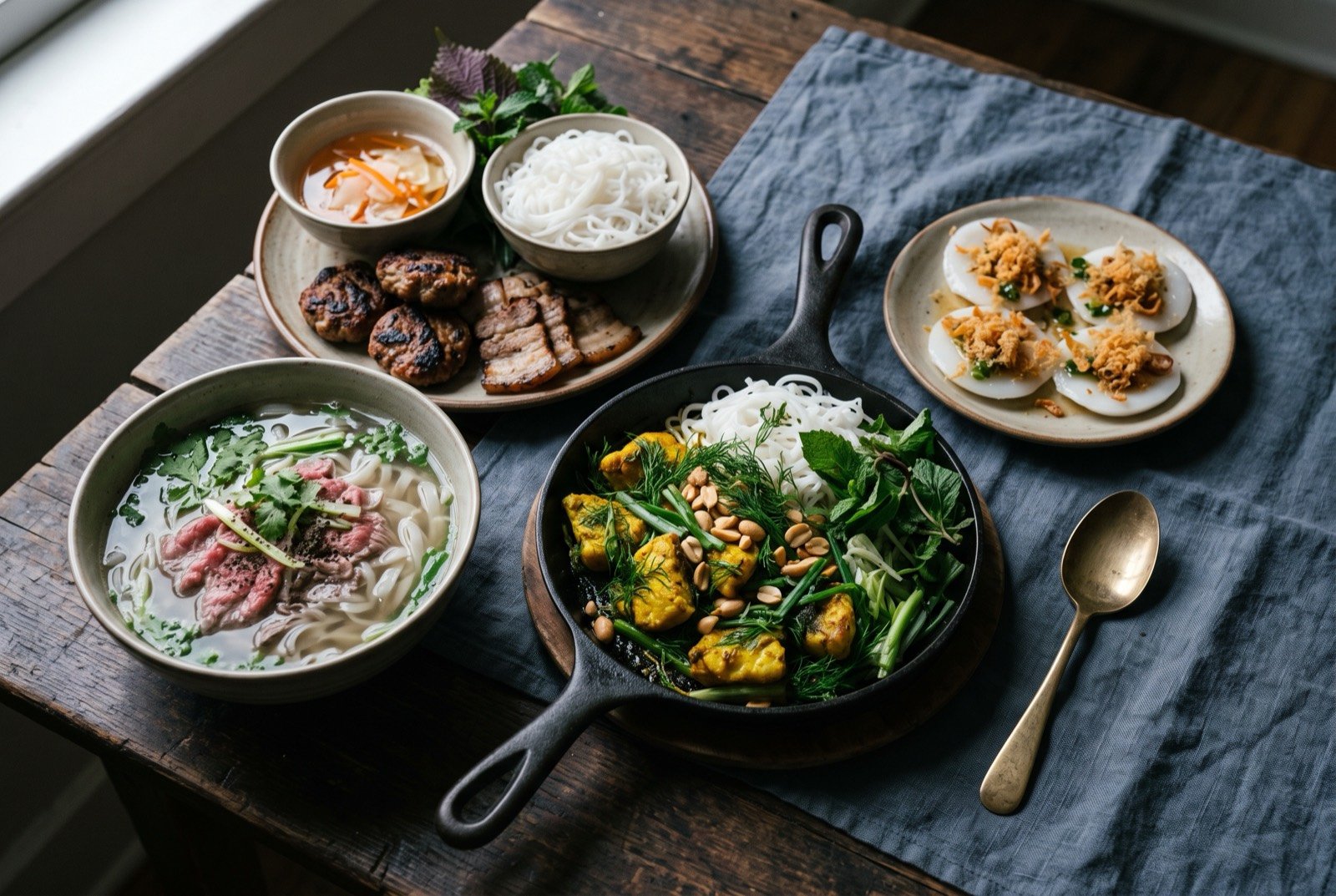
Vietnam does not hold together as one cuisine, and this atlas does not pretend it does. This volume takes the northern half: the Red River delta's wet-rice, freshwater-fish world, built around Hanoi's austere clear-broth table, carried south into a genuinely different register at Huế, the Nguyễn dynasty's former capital, where the same larder is miniaturised, coloured and plated for the eye before it is eaten. Every dish as tradition built it, then what a modern chef would change.
Sources and review · What this chapter does not assert · How we research · Spotted something wrong?
A Sense of Place
Vietnam's north and centre are separated by more than distance. Hanoi sits at the mouth of the Red River delta, a wet-rice, freshwater-fish plain that has fed a capital, with interruptions, since Emperor Lý Thái Tổ moved his seat there from Hoa Lư in 1010 and renamed it Thăng Long. Huế sits four hundred kilometres south, on the Perfume River, chosen in 1802 as the capital of the newly unified Nguyễn dynasty, and its food carries a different logic entirely: not a delta's daily protein, but a court's aesthetic. This chapter treats that difference as the argument, the way the atlas has already treated Georgia's corn-and-walnut west against its wheat-and-wine east, or Ghana and Nigeria's coastal south against its Sahel-facing north. Hanoi and Huế belong in one volume because their internal range, an everyday bowl of broth against a ceremonial plate small enough to eat with the eyes first, is a genuinely mainland Southeast Asian argument about what a food world can hold, not a excuse to treat two cities as interchangeably "northern Vietnamese."
The Red River delta and Hanoi
The delta is built from alluvium carried by the Red (Hồng) and Thái Bình river systems, the Red River alone running over 1,100 kilometres from Yunnan and depositing an estimated 120 to 130 million tonnes of silt a year onto the northern plains. It remains Vietnam's second largest rice-growing region after the Mekong delta, sloping gently from northwest terraces down through central sandbanks to tidal flats, and its dense village settlement has followed rice cultivation since antiquity. Freshwater life here is a daily protein source rather than a delicacy: freshwater crab is caught by hand from paddy stubble after harvest, the base of bún riêu; freshwater snail is delta-caught, the base of bún ốc. Hanoi's own cooking is characterised, across multiple independent Vietnamese sources, as ít ngọt, ít cay, less sweet and less spicy than the centre or south, restrained and harmonious rather than assertive. This chapter treats that as a broad tendency rather than an absolute rule: Hanoi cooking uses sugar freely in bún chả's dipping sauce and nem rán's, and the more precise version of "less spicy" is that the north substitutes black pepper's warmth for chilli's heat, not that it avoids seasoning altogether.
Huế: the citadel, the lagoon, the ceremonial register
Huế, then Phú Xuân, became the Nguyễn capital in 1802 when Nguyễn Ánh took the throne as Gia Long, after nine generations of Nguyễn lords had already used the site as their seat. The citadel was surveyed from 1803 and completed under Minh Mạng in 1832; Huế remained the dynastic capital until the 1945 abdication. Its food draws on three distinct ecological zones held together within a few kilometres of each other: the Perfume River and its tributaries; the Tam Giang to Cầu Hai lagoon system, Southeast Asia's largest brackish-water lagoon at roughly 68 kilometres along the coast; and the sandy coastal and foothill land that supplies chilli, lemongrass and shallot. The lagoon's brackish shrimp are specifically credited with giving mắm ruốc, Huế's fermented shrimp paste, its characteristic colour and depth, and by extension the broth of this volume's central dish, bún bò Huế.
Huế's food register is genuinely, not just rhetorically, distinct from Hanoi's, and this chapter can say so on real evidence rather than tourist framing. Vietnamese Wikipedia's dedicated "Ẩm thực Huế" article, citing named local scholars Lê Nguyên Lưu, Hoàng Thị Như Huy and Phan Thuận An, gives a specific three-tier conceptual framework used by Huế cooks and writers themselves: khẩu thực, eating for sustenance; nhãn thực, eating with the eyes; and tâm thực, eating with the heart. Huế dishes are characterised as small-portioned, elaborately plated and colour-coordinated, built for savouring rather than filling up. Vietnam's state news agency independently corroborates this, quoting the writer Nguyễn Tuân on Huế people preferring to "eat with their eyes," and states Huế cuisine runs to over 1,700 dishes across court, folk and vegetarian registers, though that specific figure is repeated across official sources without a named methodology and this chapter treats it as widely repeated tradition rather than an independently verified count. This chapter did not find a single source making the Hanoi-versus-Huế comparison explicitly; what exists is strong independent characterisation of each half, which this chapter is entitled to set side by side, without claiming either city's writers made that comparison themselves.
A table of peoples, logic and dishes
| Region | Defining logic | The dishes that carry it |
|---|---|---|
| Hanoi, the Old Quarter | clear broth, restraint, French-colonial overlay | phở, bún chả, chả cá Lã Vọng, cà phê trứng |
| Red River delta villages | freshwater crab and snail, ferment as souring agent | bún riêu, bún ốc, giấm bỗng |
| Thanh Trì and craft villages | rice-sheet precision, single-technique specialism | bánh cuốn |
| Huế, the citadel | miniaturisation, colour discipline, five-flavour balance | bánh bèo, bánh nậm, nem công chả phượng |
| Huế, the river and lagoon | mắm ruốc, lemongrass broth, humble-versus-ceremonial contrast | bún bò Huế, cơm hến |
The History in Layers
Phở, attributed rather than adjudicated
Vietnam's Ministry of Culture, Sports and Tourism recognised both "Phở Nam Định" and "Phở Hà Nội" as national intangible cultural heritage on the same day, 9 August 2024, which immediately reopened public argument over which city's claim runs deeper. The scientist Trịnh Quang Dũng, who has researched the dish's dating, sets out two schools of thought. One credits Nam Định: in the early twentieth century, phở-carrying poles from villages including Vân Cù and Tây Lạc travelled to Hanoi to work, apprenticed at Chinese-owned food stalls, and eventually opened their own phở shops there; Nam Định's own heritage dossier adds that a Nam Định city chef fused Vietnamese rice noodle with French-introduced beef, citing the city's status as Vietnam's largest colonial textile centre with a resident French management class. The other credits Hanoi directly, via Di Trạch village, developing independently in the same period. Hanoi's own municipal government account sides implicitly with street-vendor origin, dating phở to 1907 to 1910 as Vietnamese vendors repurposed unsold French beef bones and scraps, though it names no historian and this chapter treats its specific claims, especially a stated 1919 boycott of Chinese-run businesses handing the trade to Vietnamese vendors, as asserted rather than verified. A third strand traces the dish to xáo trâu, a pre-existing buffalo broth, and to Cantonese vendors whose presence produced the nickname "ngưu nhục phấn" for a related dish. The theory that "phở" derives from the French "feu" and descends from pot-au-feu is explicitly rejected by the Vietnamese scholarship this chapter consulted, which checked the dish against the Larousse pot-au-feu definition and found it shares nothing in form or content; this chapter attributes that rejection to Trịnh Quang Dũng's own research rather than treating the question as closed, since the pot-au-feu theory remains current in Western food writing. What is solidly dated: Nguyễn Công Hoan documented eating phở for two to five xu a bowl in 1913, Nguyễn Văn Vĩnh referenced street-vendor calls in 1906, and a 1913 Maurice Salge painting depicted a street phở vendor.
A thousand years of contact, and the French layer
Northern Vietnamese cooking sits closer to China than the centre or south does, a plain consequence of a millennium of Bắc thuộc, Chinese rule and proximity. This chapter can name specific, checkable evidence rather than a vague gesture at influence: quẩy, the fried dough stick eaten with cháo, phở and bún, is explicitly Chinese in origin, and the wok-and-stir-fry repertoire more broadly is part of the same inheritance. What this chapter cannot do is trace specific fermentation techniques or sauces to the Bắc thuộc period as opposed to later, ongoing contact; the research behind this chapter found the broad framing well supported and the fine-grained technique lineage under-evidenced, and says so rather than asserting more precision than the sources carry.
France's layer on Hanoi is better documented. Hàng Khảm street was the first paved with gravel and the first to carry European shops, a gas-water plant, a bánh mì shop, several coffee shops, all French-owned, in the 1870s and 1880s, immediately after France consolidated control of Tonkin. The earliest recorded Hanoi bánh mì shop is documented in an 1885 account: its owner, a retired French soldier named Camin, also supplied French-style restaurants on the same street. Coffee arrived from 1857, grown in the Central Highlands; Hanoi's first coffee shops clustered around Hoàn Kiếm lake. Cà phê trứng, egg coffee, has an unusually precise origin: Nguyễn Văn Giảng, a bartender at the Sofitel Metropole Hanoi, invented it during a First Indochina War milk shortage, whipping egg yolk, sugar and condensed milk in place of fresh milk, and opened Cà Phê Giảng on Cầu Gỗ street in 1946. His descendants still run it. One correction worth stating plainly, because the mistake is easy to make and this chapter's research made it before catching itself: cà phê muối, salt coffee, is sometimes listed alongside egg coffee as part of the same French-colonial inheritance. It is not. Multiple independent Vietnamese sources date its invention to 2010, created by Hồ Thị Thanh Hương and Trần Nguyễn Hữu Phong at a café on Nguyễn Lương Bằng street in Huế, and it only became internationally known roughly thirteen years later. It is a genuinely modern Huế invention, not a colonial holdover, and this chapter treats it as exactly that.
The Nguyễn court's kitchen, and how many dishes actually reached the table
The unit that fed the emperor changed names three times: established in 1802 as Nội Trù thuyền, renamed Tư Thiện đội in 1808, and settling as Đội Thượng Thiện from 1820 under Minh Mạng, one of seven units the court maintained for royal food and drink. Court dishes carried real symbolic weight: records from Minh Mạng's ninth year, roughly 1828, describe glutinous-rice cakes moulded into the shapes of the Tứ linh, dragon, kỳ lân, turtle and phoenix, the single most specific primary-adjacent citation this chapter's research could locate for court food practice.
How many dishes reached an imperial table is genuinely disputed, and this chapter presents it as unresolved rather than picking a figure. One line of sources gives 35 dishes, Khải Định's own specific requirement, not all eaten, the remainder redistributed to consorts and senior officials as a mark of favour; Đồng Khánh's table is separately said to have carried up to 50 dishes prepared by 50 cooks, of which he ate roughly ten. A different source gives 130 dishes a day, broken down by category: 47 kinds of cake, 8 of nem, 16 of tea, 5 of congee, 3 of sticky rice, 21 soups, 11 braises, 12 roasts, 6 boiled meats, 5 salt-cured fish preparations, 3 pickled vegetables, 6 sweets, 7 fish sauces. These are almost certainly not measuring the same thing, a single sitting's table setting against a full day's kitchen output, but no source this chapter's research found reconciles them or cites a primary court document, a châu bản or an entry in the Khâm định Đại Nam hội điển sự lệ, with page references behind either figure. Both numbers are repeated in Vietnamese secondary literature and neither is treated here as verified.
A genuine, surviving court-adjacent recipe text exists and deserves more weight than either disputed number: Thực Phổ Bách Thiên, 1915, by Trương Đăng Thị Bích, who married into the royal family. She compiled 102 seven-word quatrain poems, each teaching one recipe, covering roughly a hundred dishes, first published in a run of a thousand copies and described as the first cookery-instruction text in Huế's culinary history, mixing some thirty luxury dishes, bird's nest, shrimp-paste preparations, abalone, against seventy everyday recipes, preserved fish, vegetables, pickles. This chapter's own recipes below could not draw on the poems' individual content directly; a modern annotated transcription, if one exists, would be a considerably stronger source than anything used here, and is named as a real gap rather than papered over.
Palace to street: how the court's food survived 1945
After Bảo Đại's 1945 abdication and the dissolution of the court kitchens, former palace cooks and attendants dispersed into ordinary households and, later, tourism-era restaurants, carrying technique with them. This is not an abstract claim in this chapter; it is documented through two named individuals with real, checkable lineages. Hồ Thị Hoàng Anh, descended from Hồ Văn Tá, who headed Đội Thượng Thiện under Khải Định and Bảo Đại, learned directly from Lê Thị Dinh, a former palace attendant to Empress Từ Cung, Bảo Đại's mother, who died in early 2021, and drew further on families from Phước Yên village, a village that historically supplied palace staff, some of whom had emigrated to the United States but helped reconstruct recipes from memory. Tôn Nữ Thị Hà, whose family name is itself the honorific carried by female descendants of the Nguyễn royal house, was taught court technique as a child by an aunt married to a Thượng thư, a top-rank court minister. She is described in Vietnamese press as the sole successor of Huế royal cuisine after 1975, has authored more than twenty cookery texts used as teaching material by Vietnamese research institutes and by universities in Japan and China, and runs the restaurant Tịnh Gia Viên near the citadel, staging royal banquet reconstructions. Both women are also named among the master artisans behind a genuinely popular-register recognition: on 27 June 2025, the same ministry recognised "Tri thức dân gian về Bún bò Huế," the folk knowledge of Huế's beef noodle soup, as national intangible cultural heritage, tied to the noodle-making craft village of Vân Cù. The same individuals credited with preserving the high court register are credited with preserving the everyday noodle soup, which is itself real evidence for this chapter's central argument: one continuous Huế tradition, working across two very different registers, not two separate traditions that happen to share a city.
The Flavour Arsenal
Nước mắm, the spine ingredient, regionally distinct
Cát Hải, in Hải Phòng, is the named traditional northern fish sauce production centre, amber to golden and clear, with a sharp initial salt hit typical of northern styles settling into a deep, sweet umami finish. Traditional fish sauce runs 25 to 43 độ đạm, a measure of nitrogen and therefore protein content, with Vietnamese consumer sources explicitly warning that a higher number is not automatically better, since industrially boosted sauces can reach 50 to 60 độ đạm through additive processing rather than natural fermentation.
Mắm tôm and mắm ruốc: two products, not one, and the distinction this chapter insists on
Mắm tôm, the north's fermented shrimp paste, is made from moi, tiny shrimp, cleaned and blended with coarse salt and white spirit without added water, packed airtight and fermented five to six months, the jar sun-exposed several hours on clear days during fermentation. Its most specifically documented production tradition sits in Thanh Hóa, technically north-central rather than the delta itself, though the paste is used constantly in Hanoi cooking, chả cá and bún riêu among others. Mắm ruốc is a genuinely different product, Huế's own fermented shrimp paste, made from ruốc, a smaller brackish-water crustacean drawn from the Tam Giang to Cầu Hai lagoon, lighter brown with a pink-violet cast, less aggressively pungent to Vietnamese palates than mắm tôm, fermented seven to ten months. Both the bún bò Huế and cơm hến sources behind this chapter independently and explicitly insist that only genuine Huế mắm ruốc will do, not a real substitution but a real claim about the dish's identity: a reader reaching for whatever fermented shrimp paste is closest to hand and calling it equivalent has missed the point of both dishes.
Cà cuống, and the honesty this chapter owes it
Cà cuống, the giant water bug, carries a scent gland whose extract has a subtle, cinnamon-adjacent aroma, historically classed as a delicacy and reportedly sent as tribute to China roughly two centuries ago under the name "cinnamon worm." Traditionally used a single drop at a time, touched to chopstick tips and swirled through bún chả's dipping sauce, or worked into bún thang, chả cá and bánh cuốn, it has become genuinely rare through pesticide use reducing wild populations, and much of what Hanoi restaurants use today is synthetic essence imported from Thailand, markedly inferior according to the Vietnamese sources behind this chapter. This chapter will not pretend real cà cuống is a routinely obtainable ingredient, even in Hanoi itself, let alone for a British kitchen; where it appears in a recipe below, it is named honestly as a flourish most readers will never source, not a step to feel guilty about skipping.
Húng láng, and place-bound identity
Húng láng, a lemon-basil-type herb specific to the former Láng village, now absorbed into Hanoi, is called out repeatedly as irreplaceable in phở, bún thang, bánh cuốn, bún chả and chả cá, its aroma attributed directly to that district's own soil and water. This is not marketing language borrowed from a wine appellation; it is a real, place-bound ingredient claim, and it means this specific cultivar, grown in this specific soil, is essentially unobtainable anywhere outside Hanoi. A UK reader substitutes ordinary Thai or holy basil and loses something the tradition itself says cannot be recovered by any substitution, and this chapter would rather say that plainly than gesture past it.
Black pepper against chilli, and ớt Huế
Northern cooking favours black pepper over chilli, valued for a warm, gentle heat that spreads without chilli's sharp intensity, used to cut fishy or gamey odours without overpowering other flavours, and explicitly contrasted with central Vietnam's heavier chilli use. Huế's own relationship with chilli has a genuinely traced origin: Dr Bùi Minh Đức of the Trung tâm Nghiên cứu Huế, the Huế Cultural Research Centre and author of Văn hoá ẩm thực Huế, states that Huế's ancestors, migrating south into Thuận Hóa, adopted chilli-eating custom from the resident Chăm population as a means of adapting to a harsher new environment and resisting illness, embedded through generations of contact. This is the volume's clearest concrete instance of the Cham heritage crossover this atlas's own structure names as real: the Cham were a seafaring, Hindu, Austronesian kingdom whose own culinary lineage belongs at least as much to maritime Southeast Asia, and their imprint on Huế's chilli culture is a genuine trade-and-settlement mechanism, not folk colour. Chilli today is functionally non-optional in Huế cooking, appearing in nearly every household meal, using small, elongated, bright red varieties.
Ngũ vị, ngũ sắc: five flavour, five colour
Huế's plating principle is real, but its documented basis is aesthetic and medical rather than a codified formula with fixed ratios. The five colours correspond to the five elements of ngũ hành, metal, wood, water, fire, earth, deployed deliberately in presentation, with five-coloured pastries a direct example; white for rice and seafood, red for chilli and tomato, green for herbs and vegetables, yellow for turmeric and fried foods, black for soy-based preparations. Huế cuisine is described as operating as though each dish were a medicine, following yin-yang and five-element principles drawn from traditional medicine, intended to nourish health, a genuinely old conceptual system rather than an invention for tourists. This chapter treats the principle as a real aesthetic and philosophical framework a cook can apply to plating discipline, not as a precise formula requiring exactly five colours on every plate.
Bánh phở against bún
Both are rice-flour products, made by different methods that matter to a cook trying to reproduce either at home. Bún dough is fermented, then extruded through small perforations directly into boiling water and cooked about a minute, giving a round cross-section. Bánh phở dough is not fermented, must be cooked promptly after grinding or it sours, and is steamed in a thin sheet in the same manner as bánh cuốn before being cut into flat ribbons.
The Technique Ladder
The argument, from inside and from the diaspora
Two voices anchor this ladder from opposite ends of the same tradition. Sam Trần, chef and co-owner of Gia in Hanoi, one of the city's first three Michelin-starred restaurants, states plainly that Vietnamese food "is not 'rustic' in the simple sense. It is a reflection of aesthetic sensibility, craftsmanship, and experience passed down through generations," pointing to something as ordinary-sounding as "a jar of fish sauce carefully distilled over time" as evidence of that craft. Peter Cường Franklin, the Vietnamese-American chef behind Ănăn Saigon and, most recently, an entire tasting counter built around deconstructed phở, puts the same idea from the modernist end: "The broth is the soul of pho, even when pho is no longer just a bowl of broth." Both are describing the same discipline this ladder is built on: elevating this food means doing its own mechanisms properly and deliberately, not importing technique from elsewhere.
Rung 1. Blanch, scrub and salt late, before any long simmer
Vietnamese stock-building sources are consistent and specific: bones and meat are blanched briefly in water dosed with crushed ginger and a shot of white spirit, then scrubbed clean of the surfaced blood and membrane before the real simmer begins, and salt is withheld until near the very end of cooking. The mechanism is straightforward and worth stating precisely: the initial blanch denatures and expels surface proteins and blood that would otherwise break down into fine, broth-clouding particulate over a six-to-eight-hour simmer, and early salting is repeatedly cited as a direct cause of cloudiness because it interferes with the coagulation and skimming dynamics that keep a long-reducing broth clear. What a cook does with this rung. Blanch first, scrub the bones properly rather than giving them a token rinse, and hold salt back until the final thirty minutes, exactly as the Hanoi recipe behind this chapter's own phở does.
Rung 2. Clarify with a raft, the French method grafted onto a Vietnamese broth
Peter Cường Franklin's own technique for an elevated phở broth runs a genuine French consommé method on top of the Vietnamese base: a first day of conventional bone-and-meat simmering, then a second day in which an egg-white-and-lean-meat raft is introduced into the reheated stock. As the raft slowly coagulates at a bare simmer, it physically traps the fine particulates and emulsified fat responsible for cloudiness, without stripping the aromatic compounds, which stay dissolved in the liquid rather than bound to the coagulating solids. What a cook does with this rung. After the standard blanch-scrub-and-simmer above, strain the finished broth, cool it, then bring it back to a bare simmer with a whisked egg-white-and-minced-lean-beef raft floated on top; do not stir once it has begun to set, and ladle the clear broth out from beneath it once it holds. This is the single biggest visible difference between a competent home phở and a genuinely consommé-clear one.
Rung 3. Bank the coals for bún chả, and let the fat baste itself back on
Vũ Bằng's classic pre-war account of Hanoi street cooking describes a small charcoal stove actively fanned to hold its coals at a precise medium heat, not blazing, so that pork patties render fat slowly and evenly, the outside caramelising from Maillard browning and the marinade's own sugar and fish sauce, while the fat does not flash off and burn the surface before the centre finishes cooking. The cook brushes rendered fat back onto the meat periodically, doing real work rather than a decorative gesture, since Vietnamese pork fat carries the marinade's own aromatics absorbed during cooking. What a cook does with this rung. A Big Green Egg's precise airflow control is arguably a better tool for this than a Hanoi brazier ever was, and this chapter says so plainly: bank the coals for a hot centre and a cooler holding edge, hold the dome vents to a controlled medium rather than wide open, and baste with the meat's own rendered fat throughout the cook, not once at the start.
Rung 4. Fresh turmeric juice and late-stage dill in chả cá, treated as functional, not decorative
Fresh turmeric, pounded and strained for its juice rather than used as powder, several Vietnamese sources are explicit that powder is inferior here, masks the fish's off, fishy odour while colouring the flesh, worked into a marinade with warm lard and mắm tôm; fresh dill is added only at the final high-heat cooking stage rather than into the marinade itself. This chapter states the mechanism carefully, flagged as its own reasoning rather than a sourced food-science claim: turmeric and dill's own volatile aromatics plausibly compete with and mask the compounds responsible for fishy smell, and adding dill late preserves its own volatile oils, which would cook away if marinated in from the start; this explanation should be checked against a proper flavour-chemistry source before being treated as settled, and is offered here as a plausible account of why the technique works, not proof that it does. What a cook does with this rung. Pound fresh turmeric for its juice rather than reaching for the jar of powder, and hold the dill back until the fish is already in the pan.
Rung 5. Season Huế dishes at checkpoints, not once at the start
Huế court-cuisine sources are specific and consistent that a dish is seasoned a minimum of three to four separate times through cooking, once during, once as the heat is reduced, once off the heat, and a final check before plating, rather than seasoned once at the outset and left. What this rung actually rebuts is the idea that Vietnamese seasoning balance is an untrainable instinct: it is a specific, repeatable, checkpoint-based process, closer to a sous-vide cook adjusting a reduction at each stage than to a single Western home-cook gesture of seasoning to taste. It also explains directly why a dish cooked ahead and reheated, as diaspora versions so often are, loses its balance: the final one or two checkpoints are timed to the dish's exact state at that moment and do not survive holding. What a cook does with this rung. Taste and adjust bún bò Huế's broth at least three times through its simmer, not once, and treat the final adjustment immediately before serving as non-negotiable rather than optional.
Rung 6. Colour and portion discipline as the cheapest technique in this chapter
Huế's own plating principle, described in Vietnamese sources as nghèo mà sang, poor yet refined, arranges a raw vegetable plate by colour, green leaf base, yellow star fruit, red tomato, pale cucumber, white banana, to resemble a flower, portions kept small and thin so no single element overwhelms the eye or the palate, framed explicitly as restraint rather than scarcity. Dishes historically moved both ways between village and court, village food refined by court kitchens and returning to the village carrying that refinement, which is why Huế home food and court food share a visual grammar rather than being two separate traditions. What a cook does with this rung. Compose a garnish plate by colour deliberately, and serve smaller, more numerous plates rather than one large mixed dish; this needs no specialist equipment at all, and it is the most directly copyable technique in this whole chapter.
The Ferment and Preserve Bench
1. Nước mắm
Fish sauce underwrites every dish in this chapter and is treated in full in the Flavour Arsenal above. Traditional nước mắm is fish and salt only, typically a 3:1 or 10:4 ratio, fermented six months to a year, yielding a naturally high-protein liquid around 30 to 40 độ đạm; industrial versions built from roughly twenty ingredients, water, salt, sugar, flavour enhancers, preservatives, thickeners, can carry a higher nominal reading through additives rather than fermentation, which is not the same thing as quality.
2. Mắm tôm
The north's fermented shrimp paste, moi shrimp cleaned and blended with coarse salt and white spirit without added water, packed airtight and fermented five to six months, the jar sun-exposed several hours on clear days. See the Flavour Arsenal above for the distinction this chapter insists on between mắm tôm and mắm ruốc.
3. Mắm ruốc
Huế's own fermented shrimp paste, made from the smaller ruốc crustacean drawn from the Tam Giang to Cầu Hai lagoon, fermented seven to ten months, lighter in colour and character than mắm tôm. Bún bò Huế and cơm hến both treat it as genuinely non-substitutable.
4. Giấm bỗng
The delta's characteristic souring agent, distinct from plain rice vinegar and genuinely a byproduct of home rice-spirit distillation repurposed for the kitchen. Glutinous rice is steamed and fermented with rice-wine yeast, water added and distilled into white spirit, the process repeated on the leftover mash to produce second and third runs; a final small amount of mash is strained, bottled and left to sour naturally a day or two, becoming giấm bỗng. Low in alcohol, most having cooked or fermented off, and prized specifically for cutting fishy and gamey odours in bún ốc and bún riêu.
Sourcing in Britain
Verified September 2026. Where a supplier could not be fully confirmed, that is said rather than smoothed over.
The ranked list: what decides great from grim
- Mắm ruốc Huế, not generic mắm tôm. Getting the correct central-Vietnamese fermented shrimp paste rather than defaulting to the more common northern product is the single biggest authenticity fork in this volume's ingredient list, since the two are genuinely different products for different dishes. HuongViet Asian Supermarket sells Ngọc Liên brand mắm ruốc Huế, correctly labelled by name; HuongViet is a genuinely active UK company with shops in Feltham and West Drayton, shipping nationwide.
- Fish sauce grade. The gap between a 20°N mass-market bottle and a 40°N first-press bottle is large and directly audible in a finished broth or nước chấm. Red Boat, 40°N, first-press, fish and salt only, is stocked by Sous Chef UK and BoTree Farm. Three Crabs is a genuinely easy-to-find, good everyday alternative, not premium. Squid Brand, ubiquitous in UK Asian grocers, is Thai rather than Vietnamese and should be named as a substitute if used, not the real thing.
- Fresh rau răm, bought as a growing plant, not assumed available cut. No reliable UK cut-herb supply chain exists for it. Kitchen Garden Plant Centre, Newent, Gloucestershire, mail-orders live plants UK-wide. Do not dehydrate it: multiple sources agree rau răm loses almost all its aroma dried, so it is a fresh-only, grow-your-own herb for a British kitchen, not a dehydrator project.
- Bánh phở, dried but good quality. Fresh bánh phở is essentially unobtainable retail in Britain; the quality ceiling is set entirely by which dried brand is used and how carefully it is rehydrated. Sous Chef UK stocks it at multiple widths; Longdan sells its own brand.
- Dill, unglamorous but non-negotiable for chả cá. Ordinary supermarket dill is exactly the herb this dish needs; skipping it changes the dish's identity more than almost any other single swap in this chapter.
- Fresh turmeric, not powdered, for chả cá's marinade. Readily available: New Loon Moon, Gerrard Street, London Chinatown; also Waitrose and specialist grocers.
- Correctly-graded dried shrimp for bánh bèo's topping and Huế broths. Widely available at Longdan, HuongViet and London's Vietnamese shops; Cà Mau origin is named by sellers as a mark of quality, though this is a trade claim rather than independently verified provenance.
The honest gaps
Húng láng, the Láng-district landrace basil this chapter's own Flavour Arsenal calls irreplaceable in phở, bún thang, bánh cuốn, bún chả and chả cá, is not obtainable in Britain at all, and this chapter will not pretend otherwise; ordinary Thai or holy basil is the realistic substitute, with the loss named rather than disguised. Culantro (ngò gai) has no confirmed UK nursery offering it as a standing product, only marketplace listings; treat as grow-your-own or go without. The distinction between true Vietnamese basil (rau quế) and the Thai basil sold by UK herb nurseries could not be resolved in this chapter's research. No UK-based fresh Vietnamese rice-noodle producer was found; Longdan's "fresh" vermicelli is imported from Vietnam as a finished product, not domestically made. Real cà cuống, the giant water bug essence named in the Flavour Arsenal, is not sourced here at all: it is genuinely scarce even in Hanoi, and no British supply exists.
Physical shops and restaurants
Kingsland Road, Hackney, London's "Pho Mile," is real and long established, tracing to the first Vietnamese grocery opening on Upper Clapton Road in 1986; Longdan operates a flagship at 25 Hackney Road plus a Kingsland Road location, and is the UK's largest Vietnamese-goods distributor, shipping nationally online. Deptford High Street is a second, genuinely active Vietnamese community and restaurant cluster, with Eat Vietnam and Viet Rest among its named businesses. For eating this volume's food properly before cooking it: Hanoi Café, 98 Kingsland Road, explicitly markets Northern-Vietnamese-style phở with a broth cooked over ten hours, the clearest London match for this volume's Hanoi half. Cây Tre Soho, Dean Street, run by Hiếu Bùi, carries chả cá Lã Vọng described in Vietnamese travel press as carrying the true traditional flavour of Hanoi. No restaurant in the UK identifies itself, unambiguously, as a Huế-imperial-cuisine specialist, and this chapter says so directly rather than repeating a misattribution: House of Ho, sometimes assumed to be one, is a modern pan-Vietnamese fine-dining restaurant whose current menu does not support that framing.
Kit substitution, honestly
A bamboo steamer, reliably stocked by Sous Chef UK and The Asian Cookshop, is the direct equivalent for bánh bèo and bánh nậm; a 10-inch size suits batch-steaming bánh bèo's individual dishes. Banana leaf is a non-issue in practice, reliably available frozen UK-wide, though mostly under Thai-origin brand names rather than Vietnamese-specific ones, and should be fully thawed and patted dry before use.
Voices and Sources
From inside the tradition
- Sam Trần, Gia, Hanoi. One of the city's first three Michelin-starred restaurants; the chapter's clearest voice on Vietnamese food as craft rather than rustic simplicity, and a direct example of a northern classic, bún ốc nguội, feeding contemporary elevation.
- Tôn Nữ Thị Hà, Tịnh Gia Viên, Huế. Descended from the Nguyễn royal house by name, honoured by the Vietnamese state as a Meritorious Artisan, and credited with preserving both Huế's high court register and its everyday bún bò Huế.
- Hồ Thị Hoàng Anh, culinary artisan, Huế, descended from a former head of the royal kitchen, trained directly by a surviving palace attendant.
- Trương Đăng Thị Bích (1862 to 1947), author of Thực Phổ Bách Thiên, 1915, the surviving court-adjacent recipe text this chapter treats as its most reliable single window onto documented Huế technique.
- Hoàng Thị Kim Cúc and Hoàng Thị Như Huy, two later generations of the same documentary tradition, authors of Món ăn Huế and Nghệ thuật ẩm thực Huế respectively.
- Trịnh Quang Dũng, scientist and phở historian, whose research this chapter draws on for the dish's origin dispute and its rejection of the pot-au-feu theory.
- Dr Bùi Minh Đức, Trung tâm Nghiên cứu Huế, the named scholar behind this chapter's Cham-heritage account of Huế chilli culture.
- Vũ Bằng, whose pre-war essay collection Hà Nội ba mươi sáu phố phường remains the source this chapter draws on for bún chả's traditional charcoal technique.
- Peter Cường Franklin, Ănăn Saigon and Pot Au Pho 2.0. Saigon-based rather than Hanoi-based, and named as such throughout, but the clearest documented case of French clarification technique grafted onto a Vietnamese broth without losing, in his own words, "the soul of pho."
- Matt Le-Khac, Bolero, USA. The clearest elevated reinterpretation of a specifically northern dish found in this chapter's research: chả cá reworked with skate, fennel and pickled cantaloupe while keeping its turmeric-dill identity intact.
- Hữu Tài, Vietnamese-American writer, whose named, specific diagnosis of why diaspora phở fails, stock shortcuts, cost-driven additive use, the wrong noodle, over-seasoning with star anise, is this chapter's strongest single source on the gap between home and diaspora cooking.
The UK diaspora
- Hanoi Café and Cây Tre Soho, London, both named above under Sourcing in Britain.
- Uyen Luu, British-Vietnamese food writer and author of five Vietnamese cookbooks, a genuine UK diaspora authority on Vietnamese cooking generally. Named here with a direct caveat: her own family background is Saigon and southern, not Hanoi or Huế, and this chapter does not cite her as a northern or Huế specialist.
The gaps, named
No academic ethnographic source was reached for either half of this volume, and no chef anywhere, in Huế or internationally, was found doing a genuinely elevated, fine-dining interpretation of Huế's miniaturised court dishes. This chapter treats both as real absences worth stating plainly, not research failures to disguise.
Things this chapter has deliberately not asserted
- Any single figure for how many dishes reached an imperial Nguyễn table. Three mutually inconsistent figures surfaced, 35, up to 50, and 130, almost certainly measuring different things, and no primary court document was found behind any of them.
- Nem công chả phượng as an unbroken, continuously prepared court dish. Every source calling it the foremost of Huế's "four great treasures" also calls its origin disputed; no primary court document names it; the dish is absent from the one detailed 130-item menu breakdown found; and the version served today uses no actual peacock or pheasant meat, being entirely decorative pork and vegetable construction. This chapter has therefore left it out of the recipes above rather than repeat an unverifiable spectacle as settled history.
- Cơm hến's Emperor Thành Thái origin story as verified history. It recurs in near-identical wording across tourism sources, a pattern suggesting shared copy rather than independent reporting, with no primary source behind it.
- The French pot-au-feu theory of phở's etymology, as either proven or disproven. This chapter attributes its rejection to Trịnh Quang Dũng's specific research rather than treating the question as closed; the theory remains current in Western food writing.
- The claim that chả cá Lã Vọng's founder, Đoàn Xuân Phúc, was executed by French colonial authorities for sheltering anti-colonial rebels. This rests on a single English-language source that could not be cross-verified in Vietnamese sourcing.
- That "a thousand years of Chinese rule" shows up in specific, traceable technique lineage beyond a small number of named items (quẩy, the wok-and-stir-fry repertoire). The broad framing is well supported; fine-grained technique history is not, in the sourcing behind this chapter.
- Any single, correct ratio for bún chả's nước chấm. Real variation exists across credible sources; this chapter presents a working ratio, not a fixed rule.
- That Huế has been granted UNESCO Creative City of Gastronomy status. Sources describe an active bid through 2025 with no confirmed outcome found at the time of writing.
- The commonly repeated figure that Huế cuisine runs to exactly 1,700 dishes, beyond noting it as a widely repeated official claim without a named methodology or primary compendium behind it.
- Cà phê muối as a French colonial-era dish. It is a 2010 Huế invention, corrected explicitly in this chapter rather than left to stand alongside genuinely colonial-era items like cà phê trứng.
- That any UK restaurant, House of Ho included, is a genuine Huế-imperial-cuisine specialist. Current menu evidence does not support that framing for any restaurant found in this chapter's research.
- That real cà cuống is a routinely obtainable ingredient, in Hanoi or in Britain. It is genuinely scarce, and this chapter has not pretended otherwise.
- The precise chemical mechanism by which turmeric and dill mask a fish's off odour in chả cá. The technique itself is well sourced; the "why it works" explanation offered in the Technique Ladder is this chapter's own plausible reasoning, not a sourced food-science claim, and is flagged as such.
- Whether UK "Thai basil" and Vietnamese rau quế are the same cultivar. This chapter's research could not resolve the distinction and does not assert an answer either way.
Blanch, scrub and salt late, before any long simmer
Vietnamese stock-building sources are consistent and specific: bones and meat are blanched briefly in water dosed with crushed ginger and a shot of white...
Clarify with a raft, the French method grafted onto a Vietnamese broth
Peter Cường Franklin's own technique for an elevated phở broth runs a genuine French consommé method on top of the Vietnamese base: a first day of conventional...
Bank the coals for bún chả, and let the fat baste itself back on
Vũ Bằng's classic pre-war account of Hanoi street cooking describes a small charcoal stove actively fanned to hold its coals at a precise medium heat, not...
Fresh turmeric juice and late-stage dill in chả cá, treated as functional, not decorative
Fresh turmeric, pounded and strained for its juice rather than used as powder, several Vietnamese sources are explicit that powder is inferior here, masks the...
Season Huế dishes at checkpoints, not once at the start
Huế court-cuisine sources are specific and consistent that a dish is seasoned a minimum of three to four separate times through cooking, once during, once as...
Colour and portion discipline as the cheapest technique in this chapter
Huế's own plating principle, described in Vietnamese sources as nghèo mà sang, poor yet refined, arranges a raw vegetable plate by colour, green leaf base...
The dishes
- Phở Hà Nội Hanoi
- Bún chả Hanoi
- Chả cá Lã Vọng Hanoi
- Bún thang Hanoi
- Bún ốc nguội Hanoi
- Bánh cuốn Thanh Trì Hanoi, the Thanh Trì tradition
- Bún bò Huế Huế
- Cơm hến Huế, Cồn Hến
- Bánh khoái Huế
- Bánh bèo Huế
- Bánh nậm Huế
Sources and review
- Researched
- 9 sources cited
- Reviewed
- Not yet reviewed from inside the tradition
- Cooked
- Not yet cooked and reported
Where this volume comes from
3 research briefs on file for this volume, researched to the rules on How we research. Published 3 September 2026. Last changed 8 September 2026.
The brief's own account of its sources
Of roughly 65 combined search queries and targeted fetches across both passes: the substantial majority of citations are Vietnamese national or regional press (VnExpress, Tuổi Trẻ, Dân Việt, Thanh Niên, VTV, Vietnamnet, Công an Nhân dân), Vietnamese government or state bodies (thanglong.chinhphu.vn, baochinhphu.vn, bvhttdl.gov.vn, scov.gov.vn, vietnamplus.vn), Vietnamese Wikipedia, one Vietnamese academic journal (Nghiên cứu và Phát triển, via vjol.info.vn), and Vietnamese commercial/lifestyle content (VnExpress Cooking, Hướng Nghiệp Á Âu, FPT Shop, Mia.