Asia · Volume 41
Angkor and Ayutthaya
The Coconut and the Court
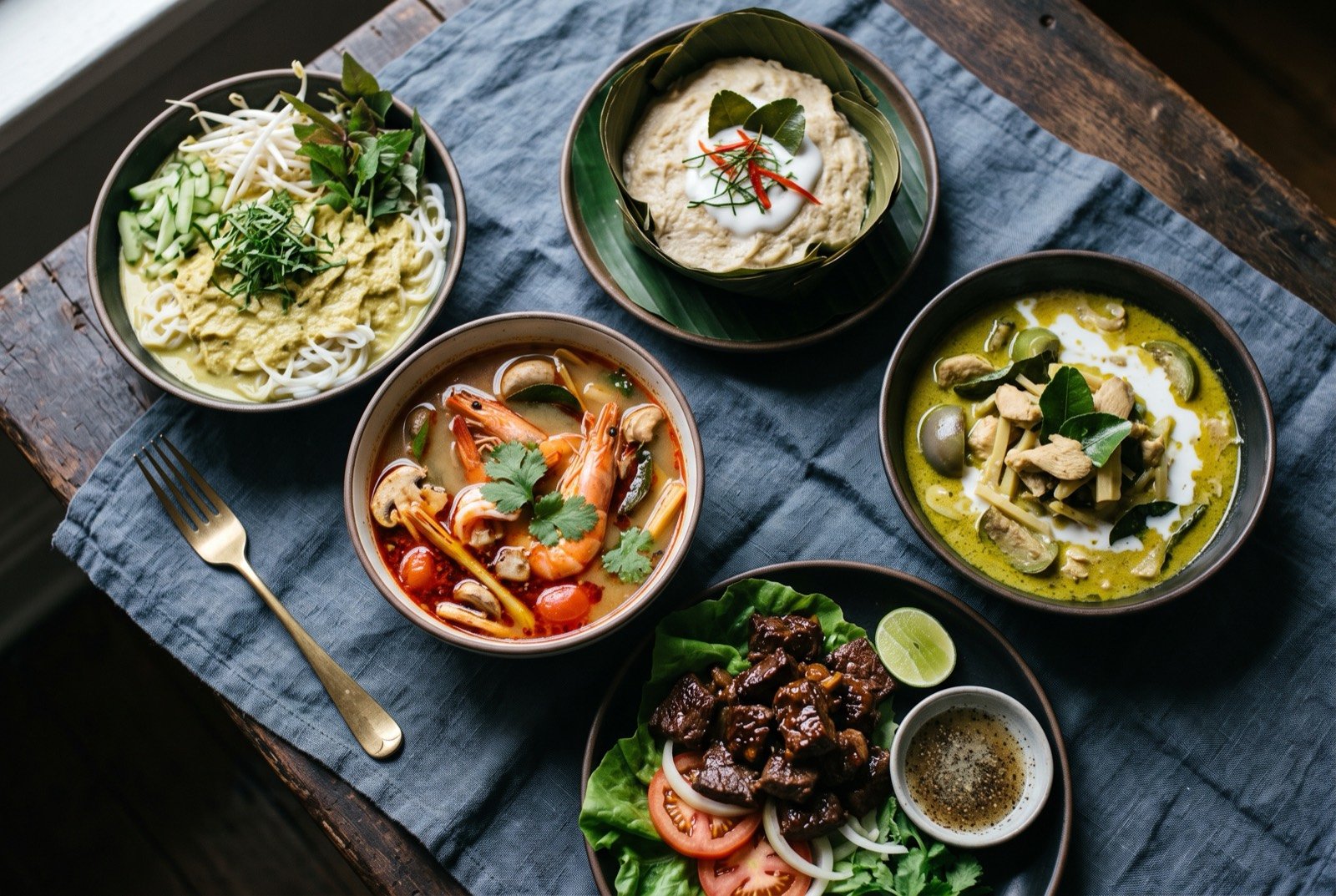
Two capitals built on the same flooded lowland, one on a lake that reverses its own current, the other on a river-and-canal delta that was, within living historical memory, navigated more than walked. Cambodia and central and southern Thailand share a coconut milk, pounded aromatic paste and fermented fish grammar built by that shared ecology, fought over for centuries by Angkor and then by Ayutthaya and Bangkok, and this chapter tests rather than assumes the deepest claim about how closely those two food cultures are actually related. Every dish as tradition built it, then what a modern chef would change.
Sources and review · What this chapter does not assert · How we research · Spotted something wrong?
A Sense of Place
Cambodia: a lake that breathes, and a cuisine built on its exhale
Cambodia's food culture is downstream of one hydrological fact rather than any single crop. The Tonlé Sap river reverses direction twice a year: in the wet season, roughly June to October, the swollen Mekong pushes water backward up the Tonlé Sap river into the lake, which swells from a dry season minimum of 0.8 to 2 metres deep and a few thousand square kilometres to many times that area, flooding the surrounding forest; as the Mekong falls again the flow reverses and the lake drains back into the river it came from. Khmer sources describe the lake and its tributary system as Southeast Asia's largest freshwater fishery, its flooded forest making it, in their own framing, the largest fish production centre in the world, with fishing continuing essentially year round except during the spawning season. This flood pulse, not rice paddies, is the right place to start: it makes Cambodia's food culture a freshwater fish culture at a scale most cuisines never have to reckon with.
Four things do almost all of the structural work in Khmer cooking. Kroeung, the pounded aromatic paste, comes in three colours built for three different jobs: yellow, turmeric and lemongrass forward, the workhorse behind amok and sour soup; red, built on the same base with dried chilli added mostly for its colour rather than its heat, which comes from fresh chillies added separately; and green, heavier on lemongrass leaf rather than stalk, plus a lesser rhizome, cinnamon and galangal, the base of samlar kako and, with prahok worked in and the cinnamon dropped, the raw vegetable dip teuk kroeung. Prahok, fermented freshwater fish paste, is not a condiment but a structural protein source, earning the nickname Khmer cheese for its pungency and captured in the vernacular saying that without prahok there is no salt. Coconut cream carries body rather than thin coconut water. Palm sugar, tapped from the sugar or toddy palm that lines the rice growing lowlands, rounds a savoury balance rather than sitting apart as a dessert ingredient only.
Two places carry documented, citable regional identity beyond this general picture. Battambang, in the northwest, became Cambodia's first UNESCO Creative City of Gastronomy, its nomination naming nem, prahok, amok, kralan sticky rice roasted in bamboo, papaya salad, the spicy mixed prahok preparation kantuy hes and teuk kroeung as dishes holding, in the nomination's own words, a special place in the daily lives of the province's people. Kampot, on the southern coast, carries two protected geographical indications: Kampot pepper, the first Cambodian product to receive EU PGI status, in 2010, and Kampot fish sauce, whose largest producer at Ta Ang village ferments saltwater fish with Kampot sea salt in wooden vats for up to two years, producing some 10,000 litres a day, a real, coastal, saltwater tradition distinct from the freshwater prahok of the Tonlé Sap.
Central Thailand: a rice bowl that was, until recently, a city of water
The Chao Phraya river, formed by the Ping, Wang, Yom and Nan rivers meeting at Nakhon Sawan and running 372 kilometres to the Gulf of Thailand, floods and silts a broad delta that has been Thailand's rice bowl since well before Bangkok existed, a gentler, more thoroughly engineered version of the same kind of hydrological fact the Tonlé Sap gives Cambodia. Bangkok itself was, within documented historical memory, a water city rather than a road city: seventeenth century Dutch survey maps show riverside and canal side settlement, and foreign accounts describe ordinary daily life, the dawn almsgiving round, cooking, washing, trade, organised around the river and its canals, the shift to a land based city a later, foreign observed change rather than an original condition.
Four elements do the same structural work here that kroeung, prahok, coconut cream and palm sugar do in Khmer cooking, and naming the actual differences between the two systems is the chapter's real technical job rather than treating them as interchangeable. Khrueang gaeng, curry paste, is not one paste but at least nine named types: red curry, gaeng khua, panang (red curry base plus roasted peanuts), green curry with fresh rather than dried chilli, massaman, a curry powder style paste, gaeng liang, yellow sour curry built on turmeric, and nam ya, heavy on galangal specifically to mask fish odour in fishcake based dishes. Thai food writing traces the paste's own name history usefully: it was originally called prik khing, chilli ginger, first recorded in print in 1908, even though a 1935 source itself noted the paste contains no ginger, an unresolved puzzle Thai scholarship has simply left open rather than invented an answer for. Coconut milk, split into hua kathi, thick first press cream, and hang kathi, thinner second press milk, does structural work through a specific, named technique, kathi taek man, the cream breaking its oil, covered in full in the technique ladder below. Nam pla, fish sauce, and nam tan pip, palm sugar, do the salting and sweetening work respectively.
Thai food writing does not describe the cuisine only through the familiar four taste balance of sweet, sour, salty and spicy, present and genuinely useful, but some culinary education sources, including Suan Dusit University's own school of culinary arts, teach a fuller eight taste vocabulary: spicy, sour, sweet, salty, bitter, rich or fatty, astringent and plain. This chapter treats the four taste balance as the operative, teachable skill a cook actually manages dish by dish, and the eight taste vocabulary as the fuller cultural palate concept sitting behind it, rather than picking one as more authentic than the other.
Southern Thailand is a genuinely different register, not central Thai food with more chilli. The clearest, most concrete marker is structural rather than a matter of degree: southern curry pastes add turmeric as standard, giving southern curries a characteristic yellow orange cast and slightly bitter, earthy edge that equivalent central pastes, red curry for instance, typically do not carry. Gaeng tai pla, built on fermented, salted fish innards, an ingredient class with no equivalent role anywhere in the central Thai pantry, is the sharpest single expression of this. A wide plate of raw and lightly blanched local herbs and vegetables, phak nueng, is eaten by hand alongside the fiercely seasoned southern table specifically to offset its heat, structurally close to the Khmer fresh herb course this chapter's own Cambodian half would recognise, with sator, stink bean, and luk niang, djenkol bean, named as the plate's most emblematic items. Phuket and the Andaman tin mining coast carry their own further layer again, a genuinely distinct Hokkien Chinese Peranakan food identity built by immigrants who worked the island's tin mines and intermarried locally, moo hong's soy braised pork belly traced directly to this community rather than to the Thai Malay Muslim south discussed below, a distinction worth keeping clean rather than folding every southern dish into one register. The Songkhla Lake basin carries a further, smaller fermented fish tradition of its own, jing jang and khoei nam, distinct from both central pla ra and the deep south's budu, ethnic Thai speakers around the lake using the first two terms where Pattani Malay speakers in the same broad region use budu, a genuinely useful linguistic marker of how many registers actually sit inside the single word southern.
A table of peoples, logic and dishes
| Region | Defining logic | The dishes that carry it |
|---|---|---|
| Tonlé Sap and the Mekong flood plain | freshwater fish at industrial scale, kroeung, prahok | amok trei, nom banh chok, samlar machu |
| Battambang | UNESCO documented regional identity | nem, kralan, kantuy hes, teuk kroeung |
| Kampot and the southern coast | saltwater fermentation, protected geographical indication pepper | Kampot fish sauce, Kampot pepper lok lak dip |
| The Chao Phraya delta and Bangkok | curry paste, coconut cream, the royal court repertoire | tom yum goong, gaeng khiao wan, massaman |
| Nakhon Si Thammarat and the wider Buddhist south | turmeric forward paste, chilli intensity, phak nueng | gaeng tai pla, khao yam khluk khrueang |
| Phuket and the Andaman coast | Hokkien Chinese Peranakan creolisation | moo hong |
| The Songkhla Lake basin | a third, smaller fermented fish register | jing jang, khoei nam |
| The Malay influenced deep south | Malay Muslim identity, a distinct fermented fish sauce | budu, khao yam nam budu, nasi dagang |
The History in Layers
What Angkor can honestly be shown to have eaten
The single best attested primary source for Angkorian era food is textual rather than archaeological: Zhou Daguan, a Yuan dynasty Chinese emissary who lived in Angkor for about a year in 1296 to 1297 and wrote The Customs of Cambodia, the only surviving first person account of daily life in the Khmer Empire, believed to survive today only in a truncated form, perhaps a third of its original length. What Zhou records can be stated with confidence and should not be over read into more than it is: rice and fish were the core of the diet, food was cooked in clay pots, ladles were made from coconut shells, soup was served in bowls woven from leaves, three stones were buried in the ground to form a hearth, crops could be harvested three or four times a year, and pepper was already grown and used in cooking. Angkorian temple bas reliefs depicting hunting, fishing, livestock sales, market scenes and feast preparation corroborate a genuinely complex food culture behind this, not merely rice and fish. What Zhou does not give us, and what this chapter will not pretend he gives us, is prahok, kroeung or amok by name. He gives hearths, pots and rice fish subsistence, not a documented recipe lineage running unbroken to the modern dish list.
The single most load bearing historical claim in this volume was tested from both sides, and neither side's own sources support it. The claim, repeated across English language secondary sources citing one named book, holds that when Ayutthaya sacked Angkor in 1431, the victors carried back to Sukhothai and Ayutthaya large numbers of Khmer people, including princesses, engineers, craftsmen, dancers, musicians, artists and cooks, and that these Khmer royal cooks subsequently shaped what became Thai royal cuisine, curry paste technique specifically said to have travelled from Khmer royal kitchens into Ayutthayan ones, where turmeric was later swapped for cardamom and tamarind. This chapter's research tested the claim directly and independently from both directions: a dedicated Khmer language search found nothing corroborating it beyond the same English secondary citation trail, and a dedicated Thai language search, using the conflict's own name and terms for war captives and palace cooks, found nothing on the Thai side either. This is reported here exactly as it should be: a real, historically plausible, widely repeated claim, resting entirely on outside observers rather than on either tradition's own memory of itself, and this chapter states it with that caveat attached rather than as settled fact. It remains the strongest available account of why these two food cultures share as much grammar as they do, and it deserves real prominence for that reason, but prominence is not the same as proof.
The broader shape of the contest is well documented on both sides without needing the cook transfer claim to stand: the Khmer Empire's territory around Angkor came under sustained Tai pressure from the mid fourteenth century, with wars recorded across 1351 to 1431 and again in the 1590s, as Ayutthaya, founded around 1350 and once itself an administrative province of the Khmer Empire before independence, pressed east. The Angkorian empire's conventional end date, 1431, coincides with the sack of Angkor and the Khmer capital's eventual relocation toward Phnom Penh.
The French layer, and the one Portuguese name worth knowing
Cambodia was a French protectorate from 1863 to 1953, and two through lines from that period are well evidenced rather than simply assumed. Kampot pepper's commercial identity is substantially a French colonial creation: cultivation in the region is described as dating to at least the thirteenth century, but its documented commercial history truly begins at the end of the nineteenth century, expanding under the protectorate to peak production in the 1930s and 1940s of roughly 100 tonnes a year from about 100 hectares, with France importing thousands of tonnes annually across the first half of the twentieth century. Separately, the royal palace kitchen absorbed direct French staffing and standards, palace specifications by the colonial period mandating butter rather than animal fat and a wide fruit range, and by 1932 the palace kitchen staff included a European head chef, two cooks, a pastry chef baker and six waiters.
Ayutthaya's own contact with European and Persian trade runs deeper and earlier, and deserves the same care in separating what is well evidenced from what is merely plausible. The kingdom traded documented relationships with China, Vietnam, India, Japan, Persia, Portugal, Spain, the Netherlands, England and France. The Portuguese thread is earliest and best attested as a military and diplomatic relationship, Portuguese mercenaries serving in King Naresuan's personal guard after Afonso de Albuquerque's 1511 capture of Malacca, but this research could not confirm a specific culinary transfer traceable to that early contact. What it found instead is better, because it is genuinely dated and named. Maria Guyomar de Pinha, known in Thai as Thao Thong Kip Ma, of mixed Japanese, Bengali and Portuguese descent, headed the royal dessert kitchen at the Ayutthayan court under King Narai and King Phetracha, and is credited with introducing and adapting a family of Portuguese derived egg and sugar sweets into what are now treated as canonically Thai desserts: thong yip, thong yod, foi thong, the golden egg threads close kin to Portugal's own fios de ovos, thong prong, thong muan, sangkhaya coconut custard and several others. This is exactly the kind of dish this volume's own animating idea would predict handled honestly rather than absorbed silently, a specifically dated, specifically named, genuinely foreign transfer that became, and remains, thoroughly and unambiguously Thai in practice, and the chapter names her directly rather than gesturing vaguely at Portuguese influence. The Persian thread, by contrast, is real but thin for food specifically: strong for Ayutthayan court dress under King Narai, and the specific, widely repeated claim that massaman curry entered Thai cooking directly via seventeenth century Persian and Indian Muslim merchant contact rests on inference from the trade relationship's existence and the dish's own Persian derived name, musalman, meaning Muslim, not on a named period source describing the dish itself.
The Khmer Rouge rupture, and what survived it
This is a real and serious break in culinary transmission, not a footnote. Democratic Kampuchea, 1975 to 1979, produced a famine that killed, by widely cited estimates, somewhere between 500,000 and 1.5 million people out of a population of roughly eight million, alongside the wider genocide. Food itself was weaponised: collectivised communal kitchens replaced household cooking, and the everyday practice of home cooking, the primary vector by which recipes, ratios and technique had always passed down in a tradition that was overwhelmingly oral rather than written, was interrupted at national scale for four years. What survived, survived through people, not documents, and an unknown amount of household specific technique died with people who did not.
Nite Yun, a Cambodian American chef born in 1982 at the Khao I Dang refugee camp in Thailand, to a mother who crossed landmine seeded jungle while pregnant to escape the regime, gives this rupture its clearest concrete case. Her parents rarely spoke about their life in Cambodia or the genocide; she pieced their story together specifically through cooking, food becoming her family's way of storytelling where words had failed. She opened Nyum Bai in Oakland in 2018, closed in 2022, now runs Lunette in San Francisco, appeared on Netflix's Chef's Table: Noodles in 2024 and published My Cambodia in 2025. This is a genuine, well documented case of food functioning as intergenerational trauma transmission and recovery at once, and it belongs in this chapter directly rather than as generic diaspora colour.
Cambodia's own post war culinary recovery, fine dining in Siem Reap and Phnom Penh, Battambang's UNESCO listing, a growing diaspora restaurant and cookbook presence in the United States, postdates the 1991 Paris Peace Agreements and accelerates from roughly the 2000s onward, in step with Kampot pepper's own revival, production halted under the Khmer Rouge and only reviving from the early 2000s before its 2010 EU protection.
Rattanakosin court cuisine, and a curry whose date is written down
This is the strongest and most specific historical material available on the Thai side, and it deserves to anchor the chapter's royal register rather than a vague gesture at royal Thai cuisine generally. King Rama II, who reigned 1809 to 1824, composed Kap He Chom Khrueang Khao Wan, a royal boat song poem praising the culinary skill of his consort, describing an extensive sequence of savoury dishes, fruits and sweets in verse, later repurposed as an actual royal barge procession rowing song under Rama V. The poem contains the single strongest textual date in this whole chapter: a named line praising massaman as the jewel of curries, fragrant with cumin, fiercely warming, a curry any man who tastes it will be driven to distraction with longing, which fixes massaman's presence in the Thai court repertoire by name, in writing, to 1809 to 1824. This is a materially different, and more defensible, claim than the seventeenth century Persian trade origin: the trade contact and a plausible earlier oral existence of the dish are one claim, and the poem is a separate, textually certain data point roughly a hundred and fifty years later, and this chapter keeps the two apart rather than collapsing them into a single date.
Mae Khrua Hua Pa, published 1908 to 1909 by Thanpuying Plian Phasakornwong and compiled from her own newspaper cookery columns, is independently well documented as Thailand's first published cookbook in the modern sense. It is the source that fixes phrik khing, the original name for curry paste generally, in print, and is also cited as the earliest or near earliest print reference for tom yam kung song khrueang, tom yum fully dressed, the earliest documented named ancestor of tom yum goong, though this research could not fully settle its priority against a separate 1898 comparative cookery compendium and states that as a minor, genuinely unresolved dating question rather than asserting one source over the other. What can be stated with confidence is the shape of the change: the historical recipe is described directly in Thai food history writing as very different from the coconut cream, roasted chilli paste enriched tom yum goong most people now know, built instead from simply boiled shredded pork, roasted and dried fish, pickled garlic, cucumber and a sour fruit called madan, seasoned with only fish sauce, pickled garlic brine, sugar and lime juice, a genuinely leaner dish than the modern restaurant standard.
Royal Thai cuisine's institutional origin sits with this same era and belongs to a specific social history rather than to aesthetics alone: aharn chao wang, palace food, is documented as an early Rattanakosin era synthesis credited to elite women of mixed Ayutthaya refugee, Chinese, Mon and Muslim household background working in the Thonburi and early Bangkok palace, producing what Thai sources describe as a genuinely new, more elaborate style distinct from what came before it, refined rather than simply preserved, structured by the Rama V era into at least seven named categories running from the royal rice course through curry accompaniments to a dedicated Indian or Muslim accompaniment category, itself a small, useful data point for this whole volume's cross cultural argument. Fruit and vegetable carving belongs within this same tradition, confirmed as a real, named royal court practice, though this research could not trace it to the same textually fixed date as Rama II's poem or Thao Thong Kip Ma's desserts, and the chapter does not pretend otherwise.
Pad thai, correctly dated and correctly complicated
This is exactly the kind of claim the house style exists to get right rather than repeat as folklore, and Thai language sources are themselves usefully split on the mechanism, which this chapter reports as a live disagreement rather than an artificially resolved one. What is not disputed: the Thai government under Field Marshal Plaek Phibunsongkhram ran an active state campaign through the 1940s and into the 1950s encouraging citizens to eat kuaitiao and grow their own bean sprouts, part of the same wartime and postwar nation building programme that also standardised the country's change of name from Siam to Thailand. What is disputed, and should be reported as such: popular Thai food writing repeats the claim that Phibunsongkhram's government deliberately invented pad thai as a national dish, printing and nationally distributing the recipe as an act of culinary nation building. Named Thai commentators, including Jiravat Punyarachun, push back directly, pointing out that a near identical stir fried noodle dish already existed wherever ethnic Chinese communities lived in Thailand before the campaign, meaning the more defensible claim is that the government promoted and nationally rebranded, in Thai styling, tamarind rather than a Chinese sauce base, no pork, an already existing Chinese immigrant dish, rather than inventing it from nothing. The government campaign, its timing and its printed recipe distribution are well evidenced; that Phibunsongkhram personally invented the dish is not, and this chapter does not assert it.
This nation building layer sits on top of a genuinely older noodle history that belongs to Cambodia's Khmer Krom border as much as to central Thailand. Kuaitiao, the general Thai noodle term, and kuy teav, its Khmer cousin, both derive from Teochew Chinese, gue diao, and were carried into both Cambodia and Vietnam separately by the same Teochew migration wave, accelerating under King Taksin, himself of part Teochew descent, and reaching its largest scale under Rama III, with a further wave following a natural disaster in the Chaozhou region around 1790 to 1791. Wok based stir frying itself arrives with this same nineteenth century wave, layered onto a rice, curry paste and fermented fish tradition whose own working assumption in both Khmer and Thai food writing is considerably older, though neither this chapter's Khmer nor its Thai research could pin that older tradition's own origin to a specific date with archaeological or textual precision, and this chapter does not invent one. Cambodia's own version of this story runs the opposite direction from pad thai's nationalist branding: kuy teav's Teochew etymology is openly acknowledged even within Cambodia, yet the country's own Ministry of Commerce has registered kuy teav as a collective mark specifically asserting Cambodian origin and quality, a live example, running the other way from the usual pattern, of a state institution claiming ownership of a dish it does not dispute arrived from elsewhere.
Two boundaries this volume names rather than absorbs
The Mekong Delta, known in Khmer as Kampuchea Krom, Lower Cambodia, was Khmer territory before French colonial administration carved it out as Cochinchina and it was ceded to Vietnam in 1949, a transfer Cambodian irredentist narrative treats as illegitimate. This volume does not yet have a Mekong Delta and Sài Gòn chapter, the unwritten Volume AS-39, so Khmer Krom food heritage properly belongs partly there and only partly here. What this chapter can state directly: a Khmer language feature found in the research behind it documents num banh chok teuk maam, a fermented fish curry variant of Cambodia's own signature noodle dish, still made today by Khmer women in Trà Vinh province, southern Vietnam, across three generations of one family and locally celebrated for its flavour, confirming this heritage is actively, currently practised rather than only remembered. The deeper question of whether Khmer Krom cooking has developed a genuinely distinct character under nearly two centuries of separation from the Cambodian mainland is a real open question this chapter cannot answer and hands forward to whoever eventually researches AS-39.
The Malay influenced deep south of Thailand, Pattani, Yala and Narathiwat, with parts of Songkhla, is the second boundary. More than sixty percent of the population across these provinces is ethnic Malay Muslim, and the line between this world and the Buddhist Thai south this chapter treats above has a real, dateable historical anchor: Thai academic sourcing describes Nakhon Si Thammarat, Sathing Phra and Phatthalung adopting and rapidly developing Sri Lankan lineage Theravada Buddhist culture from the early eighteenth century, at the same period that evidence of Buddhist practice in the Pattani Gulf area disappears from the record, a real bifurcation rather than an eternal, undated cultural boundary. Budu, the deep south's fermented fish sauce, is covered in the ferment bench below; its name and a local origin story crediting Indonesian sailors who settled at Sai Buri, Pattani, point the whole tradition's lineage toward maritime Malay and Indonesian trade rather than toward the Chao Phraya delta or the Bangkok court, exactly the reason this thread belongs more naturally with maritime Southeast Asia's own future volumes than absorbed silently into southern Thai food here.
The Flavour Arsenal
The turmeric marker, read across all three registers at once
The single most useful comparative fact this chapter can offer a reader trying to hold Khmer, central Thai and southern Thai cooking apart in the same kitchen is this: turmeric is structural in Khmer kroeung, largely absent from central Thai curry paste, and structural again in southern Thai curry paste, an arc that runs turmeric forward, turmeric light, turmeric forward rather than any simple gradient of chilli heat. Fresh turmeric root, used far more heavily in Khmer cooking than in Thai, is repeatedly named across both Khmer and Thai food writing as the single clearest technical marker separating the traditions, and it is worth building a mental map of this volume's three curry families around that one fact before anything else.
Kroeung and khrueang gaeng, side by side
Kroeung's core, across all three colours, runs lemongrass, kaffir lime zest and leaf, galangal, turmeric, garlic, shallot, dried red chilli and a lesser rhizome. Khrueang gaeng's nine named types, by contrast, range far wider in construction: red curry and its peanut enriched cousin panang; green curry, using fresh rather than dried chilli; massaman, built on whole warm spices, coriander, cumin, cardamom, clove and cinnamon, the clearest single marker of its own South Asian and Persian trade route ancestry within the Thai paste family; a curry powder style paste; gaeng liang; yellow sour curry, turmeric coloured; and nam ya, heavy on galangal specifically to mask fish odour. Southern Thai paste narrows this back toward Khmer practice by adding turmeric as standard where central paste generally does not.
Prahok, pla ra, budu and Kampot fish sauce, one family with three real differences
Prahok is made from small freshwater fish, traditionally trei riel and related species drawn from Tonlé Sap stocks, cleaned, gutted and, per popular Khmer practice, drained roughly a day before salting. Here the popular and the scientific accounts genuinely disagree, and this chapter states both rather than picking one: Khmer sources describe prahok as edible from twenty days, reaching better quality up to three years; peer reviewed food science gives salt at four to five percent by weight and a minimum of three months, commonly six months or longer, for a genuinely stable, quality product, with finished salt concentrations of 170 to 270 grams of sodium chloride per kilogram actively suppressing spoilage bacteria. Both figures are real; the twenty day figure describes a rougher, faster product, the three to six month figure the technically correct standard for a proper ferment, and a reader should treat the difference as a real choice about intensity rather than a contradiction to resolve. Prahok is not incidental protein: it accounts for a genuine share of protein in the ordinary Khmer diet, and its production is documented as overwhelmingly women's work, continued even where it has become less profitable because doing so demonstrates a maker's skill as, in one academic study's own framing, a good cook and therefore a good homemaker, a tradition under active pressure today from declining Tonlé Sap fish stocks rather than a static heritage item.
Nam pla, Thai fish sauce, follows a comparable but distinct process: the industrial centre is Rayong, where at least one producer describes natural fermentation over fourteen months from anchovy to finished hua nam pla, the first, most concentrated draw, using naturally occurring salt tolerant enzymes rather than an added culture, run in open fermentation ponds rather than the sealed clay pots prahok uses.
Budu, the deep south's own fermented fish sauce, is a third register again, distinct from both: fermented from small fish and salt over 8 to 15 months, a real range across sources rather than an error, producing a cloudy, sediment bearing liquid that must be shaken before use, structurally and texturally distinct from filtered, clear nam pla and made without the multi stage filtering central Thai production uses. Kampot fish sauce, the coastal Cambodian saltwater tradition already named above, is a fourth, geographically specific strand again, its own long, wooden vat fermentation closer in spirit to budu's unfiltered character than to prahok's freshwater, clay pot tradition, though built from saltwater fish rather than budu's Malay technique.
Kapi and the rest of the bench
Shrimp paste, kapi, a term shared across Khmer and Thai, is genuinely well documented on the Thai side specifically, Kapi Tha Kham from Trang province and Kapi Koi from Ko Lanta, Krabi, both named, provincially branded products made by crushing small krill before fermentation, drying and grinding, with real, unreconciled variation by locality in salt ratio and duration. Cambodian kapi production could not be documented with the same specificity in this chapter's research and should not be assumed to follow the Thai method exactly. Galangal and ginger are genuinely not interchangeable across either tradition, galangal's milder, more fragrant heat suited to tom kha and tom yum specifically where ginger's sharper character belongs elsewhere; Thai basil is at least three distinct plants rather than one, horapha, sweet, anise forward, the basil of green curry and stir fries; kaphrao, holy basil, sharply serrated and peppery hot, specific to pad kaphrao; and maenglak, lemon basil, used in soups. Palm sugar, finally, is genuinely two different products wearing one English name: Cambodian palm sugar comes from the sugar or toddy palm, Borassus flabellifer, the palmyra, the same species the Thai tradition calls nam tan tanot and distinguishes from its own more common coconut palm sugar, nam tan maphrao, itself regionally anchored specifically to Phetchaburi province, where the traditional method scrapes the coconut inflorescence to collect sap, boils it down, then lifts it from the heat and stirs vigorously to aerate it pale and speed its setting.
The Technique Ladder
Rung 1. Pound, do not blend
Thai household sources are specific and mechanistic about why a stone mortar beats a blender for curry paste, and Chef Nak's own account of kroeung technique makes the identical case from the Khmer side without either tradition needing to borrow the argument from the other. The instruction: pound rhythmically and with real force, angling the pestle to drag ingredients down and around the mortar's curve rather than straight down, which tears and crushes plant cell walls faster than a straight vertical pound and releases bound essential oils directly into the paste's own liquid. A blender, even run to visual smoothness, tends to shear rather than rupture the same fibres, leaving more aromatic compound trapped rather than released, and needs added liquid a mortar does not, which then has to be fried back out, meaning a blended paste stews rather than fries at the start of cooking. Order matters as much as tool: dry, fibrous aromatics, galangal, lemongrass, turmeric, garlic, shallot, are pounded first until fully smooth, and shrimp paste is added last, specifically because adding it earlier makes the whole mixture spit and scatter.
What a cook does with this rung. The honest translation for a reader without daily mortar practice is a two stage compromise: pulse the toughest fibres, lemongrass and galangal, in the high power blender first with the absolute minimum of liquid, then finish and integrate the shrimp paste and any soft aromatics by hand in a large, six to eight inch granite mortar, never a small one, which gives the pounding action proper leverage. This is the single highest leverage equipment decision in the whole chapter, and it covers Khmer kroeung and Thai khrueang gaeng identically.
Rung 2. Crack the cream before the paste goes anywhere near it
Kathi taek man, the coconut cream breaking its oil, is a named, precisely described technique in Thai household sources, not a vague folk method. Thick, first pressed coconut cream is simmered alone over medium low heat, stirred only once as it first comes to the boil to stop it forming lumps, then simmered on with occasional stirring for roughly 15 to 30 minutes depending on volume, until the fat visibly separates and pools glossily on the surface. Only once this separation is visible does the curry paste go in, fried directly in the separated coconut fat rather than a neutral oil, which both cooks the raw paste through and lets it bind with and be carried by the fat itself, producing both the glossy oil slick surface of a well made curry and a rounder, deeper fried flavour than frying in plain oil ever gives. Fresh, hand pressed cream splits far more readily and reliably than boxed or tinned commercial coconut milk, a real, named quality distinction rather than a snobbish one.
What a cook does with this rung. This needs no special equipment at all, only patience and the discipline not to skip it, and it is arguably the single highest leverage flavour fix in this entire cuisine family: the most common failure mode in a thin, flat, watery curry is frying paste in neutral oil and stirring in raw tinned coconut milk, which never actually fries the paste in coconut fat at all, it stews in a water heavy liquid from the very first minute.
Rung 3. Steam gently for a custard, not a boil
Amok trei blends yellow kroeung into thick coconut cream, thickened with a little rice flour, folded around fish, and steamed inside a folded banana leaf cup until it sets to a firm, mousse like custard, roughly 20 to 30 minutes depending on portion size. A hard boil splits the coconut mixture and toughens the fish; the target is a gentle, low, even steam throughout, mechanically the same logic behind a French fish mousseline or a savoury egg custard, protein set by indirect, moist heat rather than agitated by direct boiling water.
What a cook does with this rung. A Big Green Egg run at a stable, low dome temperature with a water bath or steamer insert gives far more even, controllable heat than an open wok steamer, exactly the kind of consistency Rosewood Phnom Penh's Brasserie Louis reaches for when its kitchen borrows sous vide and other French technique specifically, in its own senior sous chef's words, because it allows greater consistency and tenderness while the flavours remain completely Cambodian.
Rung 4. Salt, pack, and do not rush the wait
Prahok's real method, in full: small freshwater fish are cleaned, gutted and drained roughly a day, salted at four to five percent by weight, mixed thoroughly, and packed into sealed clay vessels for a minimum of three months, extending to six months or longer for a genuinely stable, high quality product, reaching finished salt concentrations of 170 to 270 grams of sodium chloride per kilogram, driven by salt tolerant bacterial genera rather than fungal activity, and covered in full in the ferment bench below.
What a cook does with this rung. A dehydrator is the direct, controllable substitute for the open air sun drying some prahok makers use to finish and concentrate the paste further, running low and steady rather than depending on weather, genuinely useful for finishing a home ferment or building a milder, faster analogue where months of clay pot fermentation are impractical in a British kitchen. Sombok, a serious Phnom Penh kitchen, softens its own teuk kroeung to more palatable, sweeter tones than the traditional pungent version and says so plainly rather than hiding the choice, exactly the honesty a home cook deserves when deciding how far to dial prahok's real intensity back.
Rung 5. Toast the rice, grind it fine, and stir without stopping
Samlar kako, sometimes loosely compared to a French ratatouille for its all in one pot vegetable abundance, a comparison this chapter treats as descriptive convenience rather than genealogy, is thickened not by roux or coconut cream but by roasted ground rice, worked into a green kroeung base alongside prahok, catfish, pork or chicken and a wide vegetable mix. Kako itself means to stir, describing the continuous stirring the thick mixture needs to stop it catching on the pot base as the ground rice releases its starch.
What a cook does with this rung. Toasting rice to a deep amber before grinding is a controllable, repeatable step in a dedicated spice grinder, giving a consistent fine powder that dissolves cleanly rather than leaving grit, a genuine improvement over hand pounding for this one ingredient specifically. The continuous, near porridge like stirring the dish demands is, honestly, one of the few techniques in this whole chapter better suited to a heavy pot on a controlled hob than to any live fire equipment, and this chapter says so rather than forcing every technique onto the same tool for the sake of tidiness.
Rung 6. Build the stock, season last, and take it off the heat before the lime goes in
Tom yum's aromatic base, prawn shells and heads briefly boiled with a pinch of salt, then lemongrass, galangal, shallot, kaffir lime leaf, mushroom and chilli, followed separately by nam prik pao, a cooked paste of chilli, tamarind, fish sauce and dried shrimp, stirred in for body and a savoury sweet depth distinct from the stock's own sour heat, is a genuinely teachable sequence rather than everything going into the pot at once. The single most specific, most repeated instruction across Thai household sources is that lime juice goes in last, off the heat, with the burner switched off before souring, because boiling lime juice is said to turn it bitter, a small, precise, easily skipped step that separates a bright, balanced bowl from a flat one. Kuy teav's broth runs on the same clarifying logic at greater length: pork bones blanched five minutes at a boil, drained and rinsed clean of scum, then simmered long and low, commonly two to three hours, with dried shrimp, dried squid, daikon and grilled, charred rather than raw, onion, skimmed regularly throughout.
What a cook does with this rung. Both stocks are a straightforward chinois application, exactly the equipment this volume assumes a reader owns. Charring the onion directly on a Big Green Egg run hot before it goes into the stockpot is a small, real step worth doing deliberately rather than skipping. The sous vide has a genuine, if reasoned rather than directly sourced, use for the prawn shell stock specifically: shells and aromatics sealed and held at a controlled low temperature for an extended time extract flavour without ever reaching a rolling boil, concentrating aromatics while avoiding the bitterness a hard boiled shell stock can pick up.
Rung 7. Remember the wok is a recent guest at this table
Wok based stir frying and noodle culture generally are Chinese imports layered onto an older rice, curry paste and fermented fish core, not indigenous techniques of equal antiquity, and this chapter treats that as a genuinely useful piece of technique history rather than trivia. Kuaitiao derives from Hokkien or Teochew Chinese, its earliest documented Thai presence traced to the late Ayutthaya period via a Chinese run household making dried rice noodles for sale; Teochew households historically made fresh rice noodle sheets by steaming a thin layer of wet rice batter over a wok of boiling water for around ten minutes before cutting the sheet into noodles, a genuinely different, steam based noodle technology from the dry milled, press extruded method Cambodia's own nom banh chok uses, covered in the dishes section below. Khua kling, the dry fried southern minced meat dish given in this chapter, makes the contrast concrete in the other direction: it resembles rendang, popular across the Malay world, but specifically lacks rendang's coconut milk as a cooking medium, run instead entirely dry, paste and meat fried directly together until the fat renders and the mixture rolls in it, no liquid reduction stage at all.
What a cook does with this rung. A dry, properly hot wok or a flat plancha attachment run hot and completely dry on a Big Green Egg replicates khua kling's dry fry mechanism closely; the point worth carrying forward is simply that not every technique in this chapter is ancient, and knowing which ones are late Chinese imports rather than old indigenous grammar changes how a reader should think about substituting or varying them.
The Ferment and Preserve Bench
1. Prahok
Salt, pack, wait: covered in full at Rung 4 and Dish 3 above. Popular Khmer practice gives twenty days as edible; peer reviewed food science gives three to six months as the standard for a genuinely stable, quality product. Both figures are given rather than collapsed into one.
2. Kampot fish sauce
Saltwater fish fermented with Kampot sea salt in traditional wooden vats for up to two years, the largest producer at Ta Ang village claiming some 10,000 litres a day, a coastal counterpart to prahok's freshwater tradition rather than a variant of it.
3. Nam pla
Thailand's fish sauce, industrially centred on Rayong, at least one producer describing natural fermentation over fourteen months from anchovy to finished hua nam pla, using the fish's own naturally occurring salt tolerant enzymes rather than an added culture, in open ponds rather than prahok's sealed clay pots.
4. Budu
The Malay influenced deep south's own fermented fish sauce, 8 to 15 months, a real range across sources, producing a cloudy, sediment bearing liquid that must be shaken before use, unfiltered where nam pla is filtered clear, its lineage pointing toward maritime Malay and Indonesian trade rather than the Chao Phraya delta.
5. Palm sugar, two products under one name
Cambodian palm sugar, from the sugar or toddy palm, Borassus flabellifer, and Thai coconut palm sugar, nam tan maphrao, regionally anchored to Phetchaburi province, are related but genuinely distinct products; Thai sourcing itself distinguishes the two clearly, calling the palmyra version nam tan tanot.
Sourcing in Britain
Verified this research pass. The headline finding is worth stating plainly rather than smoothed over: Thai sourcing infrastructure in Britain is genuinely strong, and Cambodian sourcing infrastructure is genuinely thin, and the two halves of this chapter's shopping list need to be approached differently. Every kroeung and khrueang gaeng aromatic, fresh lemongrass, galangal, turmeric, kaffir lime leaf, garlic and shallot, is covered by the same real Thai fresh produce network; where Cambodia genuinely diverges is prahok, ready made kroeung, and dedicated retail infrastructure of any kind.
The ranked list: what decides great from grim
- Fresh, not dried or powdered, aromatics, for every paste in this chapter. Lemongrass, galangal, kaffir lime leaf, fresh turmeric and fingerroot are all sold fresh, in person and by mail order, through Tuk Tuk Mart and Zing Asia. Colonial Growers, based in Weeley Heath, Essex, are Britain's specialist kaffir lime grower, supplying London's wholesale markets for over a decade.
- A genuine six to eight inch stone mortar, not a food processor. Thai Food Online stocks a Thai granite six inch mortar, the correct scale for a household batch, and the technical point stands regardless of cuisine: a blade shears fibre where a stone pestle crushes and releases it.
- Genuine Kampot pepper over any generic peppercorn, the one point where Cambodian sourcing is genuinely well served. Sous Chef stocks Terre Exotique's Kampot pepper; Kadode, a small UK direct trade importer, sells black, red, white and long Kampot peppercorns plus Kampot sea salt and Cambodian palmyra sugar.
- Fish sauce chosen for style, not whichever bottle is nearest. Squid is Thailand's reliable everyday brand; Megachef, aged two years rather than the standard eight to twelve months, is the newer premium choice increasingly favoured in Thailand itself; Tiparos gives a bolder, more assertive style. All are stocked at any UK Thai grocer and at Wing Yip.
- True palm sugar, sold as a block, never a bag of coconut sugar loosely labelled palm sugar. Maesri, Thai Taste and X.O. are genuine nam tan pip, stocked by Sous Chef and Thai Food Online; Kadode's Cambodian palmyra sugar, above, is the one verified UK stockist of the specifically Cambodian product.
- Holy basil, not Thai sweet basil, for anything cooked hard and fast. The two are genuinely different plants, and a supermarket packet labelled Thai basil is very often the sweet variety mislabelled; UK seed suppliers including Naturalgrower label holy basil correctly for a reader wanting to grow it, though it needs real heat, 22 to 25°C, to germinate and rarely thrives outdoors through a British summer.
- Block tamarind, soaked and strained fresh, over jarred concentrate, which runs roughly three times stronger and carries a harsher edge than the bright, rounded sourness a fresh soaked block gives.
Prahok, the genuine gap
No genuine, Cambodian fermented prahok was found stocked anywhere in the UK, physical or online. The one findable product sold under the name is made in the San Francisco Bay Area by a Cambodian American producer, an honest American approximation rather than a Cambodian import, and reaches Britain, where it reaches it at all, only through an international resale marketplace rather than a shop holding real stock. The honest nearest substitute is Thai pla ra, fermented fish sauce with visible fish pieces, sold at any well stocked Thai grocer, though the difference genuinely matters: prahok is pounded to a coarse paste from freshwater mudfish and carries a thicker, more mineral character than pla ra's liquid form, and this chapter does not pretend the substitution closes that gap, only that it is closer than leaving prahok out or reaching for ordinary fish sauce instead.
Kroeung, and what genuinely cannot be bought here
Every raw component of kroeung is covered by the shared Thai fresh produce network above. A single small UK producer, Hidden Street Food, based in Burton on Trent, sells a ready made Cambodian style kroeung paste, though it was showing out of stock at the point of this research and should be checked before a reader plans a menu around it; it is a British made condiment in the Cambodian style rather than an import, and making kroeung from scratch, per Rung 1, remains the more reliable route. Genuine fermented Khmer nom banh chok noodles, traditionally sold and eaten fresh within a day of production, have no confirmed UK stockist at all; the realistic substitute, used even by diaspora cooks abroad, is fresh Vietnamese rice vermicelli, widely stocked at Wing Yip and most London Chinatown and Vietnamese grocers, an honest substitution for texture rather than a claim that it replicates the fermentation.
Specialist shops
London, physical. Sri Thai, Shepherd's Bush Road, Hammersmith, is repeatedly named as the strongest source of fresh Thai produce and made to order curry paste in west London; Khun Ya, Jamaica Road, Bermondsey, is the equivalent for south London; Talad Thai, Upper Richmond Road, Putney, a further established Thai grocer. No dedicated Cambodian grocery shop, physical or online, anywhere in the UK, was found in this research, despite multiple search angles, a gap this chapter states plainly rather than papering over with a vague suggestion to search online.
Elsewhere. Wing Yip operates four Oriental superstores, in Birmingham, Manchester, north London and south London, plus a smaller Watford branch, each stocking a dedicated Thai range of curry pastes, fish sauce, coconut milk and rice noodles, commercial brand rather than the fresh produce depth of a dedicated Thai grocer, but the single most useful stop for a reader outside London.
Online, verified. Thai Food Online is the most comprehensive dedicated Thai online supermarket found, covering fresh produce, pastes, rice, cookware and Kampot pepper alike. Sous Chef is the strongest single stop for reliably good branded goods. Tuk Tuk Mart, Talard Thai and Zing Asia round out the field for fresh aromatics and speciality items.
Kit and a genuine gap
Fresh banana leaves for amok and other steamed dishes are, in practice, sold frozen rather than fresh anywhere in Britain, a standard stock item at Wing Yip and most Chinese and Southeast Asian grocers; frozen, thawed and wiped, is the realistic and largely equivalent option, a smaller gap than it first appears given the leaf is a wrapper and steaming vessel rather than something eaten.
Voices and Sources
From inside the tradition
- Chef Nak (Rotanak Ros), Phnom Penh, deliberately runs no restaurant, spending eighteen years as a self-taught cultural anthropologist, historian and cook, her SAOY: Royal Cambodian Home Cuisine reconstructing Princess Norodom Rasmi Sobbhana's 1950s and 60s royal repertoire, named Best Cookbook in the World at the 2023 Gourmand World Cookbook Awards.
- Luu Meng, Malis, Phnom Penh and Siem Reap, travelled the country six months collecting traditional recipes before opening Cambodia's first Cambodian fine dining restaurant in 2004, explicitly restorative in mission after the Khmer Rouge period's rupture in transmission.
- The Kimsan Twins, Sombok, Phnom Penh, an entirely female staffed kitchen, whose honest choice to soften teuk kroeung's traditional intensity for a fine dining room, stated plainly rather than hidden, this chapter treats as a model of the disclosure a home cook deserves.
- Chanthern Uch, Brasserie Louis, Rosewood Phnom Penh, learned family recipes at home in Kandal province rather than through culinary school, and gives this chapter's clearest working justification for borrowing French equipment while keeping the flavour completely Cambodian.
- Supaksorn "Ice" Jongsiri, Sorn, Bangkok, self-taught, raised by his grandmother in Nakhon Si Thammarat, led Thailand's first three Michelin starred restaurant to that status in 2025, built specifically on southern Thai technique.
- David Thompson, Nahm, apprenticed to an octogenarian Bangkok cook trained in the Thai royal palace kitchens, and built, through Nahm London in 2001, the first Thai restaurant anywhere to hold a Michelin star, the single most influential technique transmission point between Bangkok's own culinary elite and London's Thai restaurant scene.
The UK diaspora
- Lemongrass, north London, run by Thomas Tan, who left Cambodia as a teenager in 1969, described in press as London's only dedicated, permanent Cambodian restaurant.
- AngloThai, Marylebone, John Chantarasak, the only Thai restaurant in the UK with a Michelin star, trained at Nahm under David Thompson, earned its star while serving no rice at all.
- Kolae, Borough Market, Andy Oliver and Mark Dobbie, both Nahm alumni, specialising in the far south's kolae grilling technique.
- Plaza Khao Gaeng, Luke Farrell, who grows his own southern Thai aromatics, betel leaf, kaffir lime, wild turmeric, in tropical greenhouses at Ryewater Nursery, Dorset, a genuinely unusual and directly verifiable UK solution to this chapter's own fresh aromatic sourcing problem.
The gap, named
The Bangkok restaurant scene is documented across substantial, independent Thai language press, Forbes Thailand, Thairath, The Standard, Amarin TV all separately covering Sorn's three star award. Cambodia's own food press could not be found at anything like the same depth in Khmer, this chapter's research surfacing mostly Wikipedia, Facebook and TikTok content rather than substantive Khmer language food journalism or chef interviews. This reflects thinner Khmer language food criticism online relative to Thai, not a less serious cuisine, and this chapter states that plainly rather than manufacturing a false balance between the two.
Things this chapter has deliberately not asserted
- That captured Khmer royal cooks, after the 1431 sack of Angkor, directly shaped Ayutthayan or later Thai court cuisine. This chapter's research tested the claim independently from both the Khmer and the Thai side and found nothing corroborating it beyond one named English language secondary source in either tradition's own sourcing. It is reported as real, plausible and widely repeated, not as settled fact.
- That Field Marshal Plaek Phibunsongkhram personally invented pad thai. His government's 1940s to 1950s promotion campaign and printed recipe distribution are well evidenced; named Thai commentators dispute that the dish itself, as opposed to its national branding, was his invention rather than an already existing Chinese immigrant stir fried noodle.
- A single fermentation time for prahok. Popular Khmer sourcing gives twenty days as edible; peer reviewed food science gives three to six months as the standard for a genuinely stable, quality product. Both are given, not collapsed into one number.
- Lok lak as an ancient or indigenous Khmer dish. Khmer Wikipedia's own account describes it as Vietnamese in origin and French inspired, entering Khmer cooking during nineteenth century Vietnamese administration or the French Indochina period, genuinely Cambodianised today and sometimes called a national dish despite that.
- Kuy teav as an indigenous Khmer dish, despite Cambodia's own Ministry of Commerce registering it as a collective mark asserting Cambodian origin. Its etymology is openly Teochew Chinese; both the Chinese root and the state's ownership claim are reported together.
- Khao yam's popular royal Nakhon Si Thammarat physician origin story, actively searched for and not traced to any named period, governor or primary source.
- Whether nom banh chok's rice undergoes a true fermentation or only a soak. A genuine disagreement between sources, not resolved here.
- A single, universal fermentation timeline for Thai nam pla or a canonical salt to krill ratio for Thai kapi. Real regional variation is acknowledged in the sourcing itself; no figure is presented as an industry standard.
- A distinct, independently confirmed deep south curry paste tradition, structurally separate from the wider turmeric forward southern paste family. Not established either way in this chapter's research; a real gap handed forward rather than guessed at.
- A well evidenced, distinct Khmer Krom culinary identity separate from mainland Khmer cuisine, beyond the one directly confirmed example of an actively practised nom banh chok variant in Trà Vinh. This belongs properly to unwritten Volume AS-39.
- The Malay influenced deep south as simply an intense variant of southern Thai food. Its own fermented fish sauce, dialect, religion and dish vocabulary point toward maritime Malay and Indonesian trade, and this chapter treats it as a boundary this volume touches rather than a region it absorbs.
Pound, do not blend
Thai household sources are specific and mechanistic about why a stone mortar beats a blender for curry paste, and Chef Nak's own account of kroeung technique...
Crack the cream before the paste goes anywhere near it
Kathi taek man, the coconut cream breaking its oil, is a named, precisely described technique in Thai household sources, not a vague folk method.
Steam gently for a custard, not a boil
Amok trei blends yellow kroeung into thick coconut cream, thickened with a little rice flour, folded around fish, and steamed inside a folded banana leaf cup...
Salt, pack, and do not rush the wait
Prahok's real method, in full: small freshwater fish are cleaned, gutted and drained roughly a day, salted at four to five percent by weight, mixed thoroughly...
Toast the rice, grind it fine, and stir without stopping
Samlar kako, sometimes loosely compared to a French ratatouille for its all in one pot vegetable abundance, a comparison this chapter treats as descriptive...
Build the stock, season last, and take it off the heat before the lime goes in
Tom yum's aromatic base, prawn shells and heads briefly boiled with a pinch of salt, then lemongrass, galangal, shallot, kaffir lime leaf, mushroom and chilli...
Remember the wok is a recent guest at this table
Wok based stir frying and noodle culture generally are Chinese imports layered onto an older rice, curry paste and fermented fish core, not indigenous...
The dishes
- Amok trei Cambodia
- Nom banh chok Cambodia
- Prahok ktis Cambodia
- Lok lak Cambodia
- Kuy teav Cambodia
- Samlar kako Cambodia
- Tom yum goong Thailand
- Gaeng khiao wan Thailand
- Gaeng tai pla Thailand
- Massaman Thailand
- Khao yam Thailand
Sources and review
- Researched
- 8 sources cited
- Reviewed
- Not yet reviewed from inside the tradition
- Cooked
- Not yet cooked and reported
Where this volume comes from
3 research briefs on file for this volume, researched to the rules on How we research. Published 3 September 2026. Last changed 8 September 2026.
The brief's own account of its sources
Roughly 30 web searches and 6 direct page fetches were run in this pass, split across English, Khmer script and Thai script queries, plus one attempted academic fetch that failed. What is well sourced. The Bangkok restaurant scene is the strongest part of this brief by a wide margin, corroborated by substantial Thai-language press (Forbes Thailand, Thairath, Thai Rath, The Standard, Amarin TV all independently covering Sorn's three-star award) as well as English-language Michelin Guide material and Wikipedia, which in turn cites primary press.