Asia · Volume 39
The Delta and Sài Gòn
Broken Rice, Fermented Fish and a City Built on Borrowed Ground
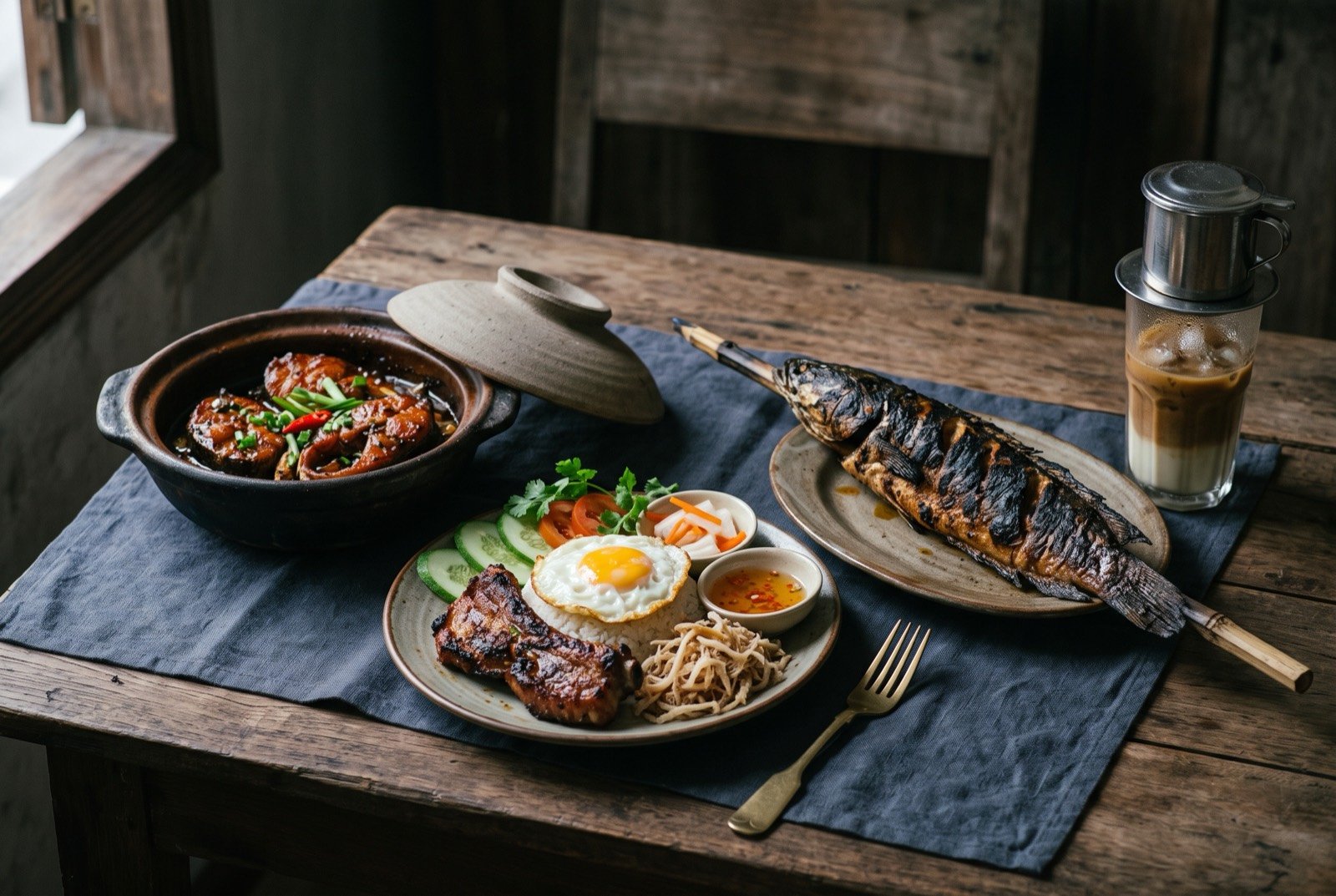
Two food worlds sharing one river system, and neither of them native to the ground it now stands on. Before either was Vietnamese, the whole of this territory was Khmer: Sài Gòn itself was Prey Nôkôr, a Khmer settlement, before Nguyễn lords placed a tax post there in 1623 and formally annexed it in 1698, and the Mekong Delta they annexed with it was farmed by Khmer people using tools built for its acid, saline soil before a single Vietnamese rice farmer arrived. Every restaurant technique in this cuisine has an indigenous ancestor, the idea this atlas returns to in every volume, and here that ancestor is not only Vietnamese. The delta's sourness, its coconut richness, its fermented fish, carry a documented Khmer layer this chapter names honestly rather than folds silently into "southern Vietnamese food." Sài Gòn, meanwhile, took that delta larder, added a Chinese quarter as old as the city's own charter and a French colonial layer on top of both, and turned the lot into something distinctly urban: a city that grows none of its own rice but built its fortune milling and trading the delta's, and that eats breakfast the way other cities hold elections, as a genuine civic institution. Every dish as tradition built it, then what a modern chef would change.
Sources and review · What this chapter does not assert · How we research · Spotted something wrong?
A Sense of Place
Before Vietnam: Prey Nôkôr and the delta's deeper layers
Before Khmer or Vietnamese settlement as either community understands it today, this ground belonged to Óc Eo culture, the material record of the Phù Nam (Funan) kingdom, an early Indianised Southeast Asian polity trading across the Indian Ocean from roughly the 1st to 7th, possibly early 8th, century CE. Vietnamese sources treat this as the delta's deep history rather than claiming it for either later people, which is the right instinct and this chapter follows it.
What became Sài Gòn was Khmer territory, Prey Nôkôr, likely settled from around the 11th century. Vietnamese presence is documented from the late 15th century, but the decisive turn came in 1620, when the marriage of Nguyễn princess Ngọc Vạn to Khmer king Chey Chetta II opened peaceful movement between Đại Việt and Cambodia; in 1623 the Nguyễn lords requested, and were granted, permission to place a tax post at Prey Nokor and at Kas Krobei, the old name for the Sài Gòn riverside now called Bến Nghé, itself derived from Khmer Kompong Krâbei, "buffalo landing." Formal Vietnamese administration followed in 1698, when Nguyễn Hữu Cảnh established Gia Định prefecture over territory that already contained these settlements. On the city's own name, Vietnamese scholarship offers three competing theories and settles none of them: from Khmer Prey Nôkôr/Prey Kôr, "kapok forest"; from Cantonese-inflected Chinese Tây Ngòn, "western tribute"; from Lao Cai Ngon, also "kapok forest," though no trace of an actual kapok forest at the site has ever been found to support that last one. This chapter names all three and adjudicates none, because the scholars themselves have not.
Vietnamese sources are explicit that settlement of the wider delta from the 17th century was multi-ethnic from the start: "từ thế kỷ XVII, ba tộc người là Việt, Khơme và Hoa đến khai phá sinh cơ lập nghiệp," from the 17th century three peoples, Việt, Khmer and Hoa, came together to clear and settle the land. Khmer communities had already developed wet-rice technique suited to the delta's specific acid-sulfate and saline soils, using a long-handled clearing blade, cái phảng, in place of a plough, and a rake-like tool, cù nèo, to clear grass, tools this atlas has found nowhere else in its research and which speak directly to its own founding claim: elevating this food starts with recognising whose hands actually built the technique.
The delta: nine dragons, a flood that is a season, not a disaster
The delta's Vietnamese name, Cửu Long, "nine dragons," comes from settlers who watched the Mekong reach the sea through nine mouths and saw nine dragons in it. The river historically split into two main branches discharging through those nine mouths; today only seven remain functionally active, one closed by a salinity-control dam and one silted over naturally. The delta covers roughly 3.3 million hectares and holds about 17 million people, built by millennia of Mekong alluvium into the country's rice granary.
Mùa nước nổi, the flood-pulse calendar, running roughly the 7th to 10th lunar months, is a working season for the rural poor, not a disaster: floodwater rises over the fields carrying fish, shrimp and fresh silt, and fishing, foraging and boat-building all intensify rather than stop. Two flood-season foraged foods anchor the delta's flavour in this window. Bông điên điển, sesbania flower, grows wild along the canals, mildly sweet with a light bitterness, and canh chua cá linh nấu bông điên điển, sour soup of young flood-season fish and sesbania flower, is called locally "the soul of flood-season cuisine." Bông súng, water lily stem, pairs proverbially with fermented fish in Đồng Tháp province specifically: "muốn ăn bông súng mắm kho, thì về Đồng Tháp ăn no đã thèm," want to eat water lily with fermented-fish hotpot, go to Đồng Tháp and eat your fill. Cá linh, a small freshwater fish migrating down from Cambodia's Tonlé Sap with the flood pulse, can make up 60 to 70 percent of the entire fish catch in An Giang province during flood season, and its young, soft-boned, fatty-bellied form at the season's start is the base of mắm cá linh, the delta's own fermented fish paste, cured 10 to 12 months.
This is a live threat, not a historical footnote. China's eleven dams on the upper Mekong are widely cited as a major driver of the region's recent extreme floods and droughts, and the Mekong River Commission's own estimate is that fish stocks on this stretch of river have fallen more than 40 percent against ten years ago; a full build-out of eleven more dams planned downstream by 2030 is projected to cut fish yields by a further 26 to 42 percent against 2000 levels. Cá linh, mắm production, and the whole flood-season food culture described above sit directly downstream of that engineering, in every sense.
Before large-scale dyke construction from the mid-1980s enabled triple-cropped rice, farmers grew lúa mùa nổi, floating rice, which rose with the water itself, and harvested both rice and fish from the same flooded field. Coastal provinces now run a different, engineered system, tôm lúa, rotating one rice crop with one shrimp crop on the same land as saline intrusion has worsened; Kiên Giang alone has around 70,000 hectares under it, roughly half its total shrimp area. Whether this rotation is old adaptive practice or a late-20th-century response was not settled by any source this chapter could reach, and the two systems, flood-pulse rice-fish and engineered rice-shrimp, should not be collapsed into one continuous tradition.
Bến Tre, "xứ dừa," land of coconuts, sits on alluvial ridge soil built from millennia of river-borne sediment, terrain that holds moisture while draining well, giving Bến Tre coconuts a reputation for higher oil content than the rest of the country's. Southern Vietnamese food generally, against a saltier north and a spicier, sourer centre, is consistently described as built around sugar, coconut water and cream, and abundant sweet fruit, the state news agency VietnamPlus framing this as an expression of a specifically "water-based cultural region," văn hoá miệt vườn sông nước, shaped by canals, waterways and orchards. Exactly why, beyond that broad framing, is widely asserted and not rigorously demonstrated by any academic food history this chapter could find; the causal chain, climate to crop base to taste, is repeated everywhere and proven nowhere.
Sài Gòn: a canal city built on someone else's rice
Sài Gòn/Hồ Chí Minh City sits at the downstream confluence of the Đồng Nai and Sài Gòn river system, in the transitional hinge between the Southeast region and the delta proper, not fully delta itself. Its markets, Bến Thành, Thị Nghè, Chợ Lớn, all formed along its rivers and canals. Its commercial rise is tied directly to rice it does not grow: southern Vietnam's rice exports were recorded at 42,470 tonneau in 1862, and between 1860 and 1896 Sài Gòn exported over 11 million tonnes; the French-built Chợ Gạo Canal, cut specifically to move delta rice into Sài Gòn-Chợ Lớn for export, lifted southern rice exports from 53,000 tonnes in 1860 to 294,500 in 1880, and from 1881 to 1933 rice was the port's leading export by both volume and value. The city mills, trades and eats the delta's rice; it is a rice city structurally without being one agriculturally, and that fact underwrites cơm tấm below as directly as it underwrote the port.
Breakfast here is a civic institution, not a private meal, and Vietnamese sources say so plainly: "muốn làm giàu ở đất Sài Gòn chỉ cần giỏi một trong bốn nghề: cơm tấm, hủ tiếu, phở và bún bò," to get rich in Sài Gòn you need only master one of four trades, cơm tấm, hủ tiếu, phở or bún bò, is a widely repeated local saying. Vietnamese travel and culture writing frames the city explicitly as a crossroads, where regional Vietnamese cuisines and Chinese, Khmer and Cham traditions converge, adapt and re-emerge distinctively "Sài Gòn" rather than staying regional imports, against the delta's own self-presentation as garden and waterway authenticity, eaten in situ rather than reinvented for a city palate.
A table of peoples, logic and dishes
| Place | Defining logic | The dishes that carry it |
|---|---|---|
| The delta's flood plain | mùa nước nổi, coconut, tamarind, wild-caught fish | canh chua, mắm cá linh, cá lóc nướng trui, bông điên điển |
| Sóc Trăng and Trà Vinh | roughly a third Khmer, three-way Kinh-Khmer-Hoa cohabitation | bún nước lèo, bánh cống, num banh chok |
| Cà Mau, the delta's far point | brackish-saltwater fermentation at the mangrove's edge | ba khía, mắm, dried fish |
| Chợ Lớn | the five bang, Cantonese roast meats, Teochew noodle trade | hủ tiếu Hồ, heo quay, cà phê vợt |
| Sài Gòn's own street grammar | breakfast as institution, broken rice turned into a plate | cơm tấm, hủ tiếu Nam Vang, bánh mì |
| The French layer | bread, coffee, pastry, grafted onto Vietnamese technique | bánh mì, cà phê sữa đá, bánh patê sô |
The History in Layers
The Khmer Krom question, attributed rather than adjudicated
This is the volume's most sensitive ground, and this chapter takes the position it takes everywhere a history is contested: report who claims what and from where they speak, and adjudicate none of it. The Khmer Krom are ethnic Khmer people indigenous to the Mekong Delta, Kampuchea Krom, "lower Cambodia," in their own language, with what their diaspora advocacy organisations describe as the oldest continuously recorded history of habitation in the region, predating its incorporation into Vietnam. The Khmer Empire held much of what is now southern Vietnam from the 9th century; Vietnamese-language sources by contrast root organised Vietnamese Nam Bộ presence from the late 17th century under the Nguyễn lords, described above. The Khmers Kampuchea-Krom Federation, founded 1985 in New York, frames June 1949, when French colonial authorities transferred Kampuchea Krom to Vietnam without Khmer Krom consent, as the pivotal loss-of-territory event, and campaigns on human rights, religious freedom and self-determination grounds. A Vietnamese international-relations research site explicitly rebuts Khmer Krom territorial claims as "vô lý," unreasonable. This chapter states both positions and settles neither.
What this chapter can say with more confidence is the food itself, and even there the sourcing has a real gap this chapter names rather than smooths over. Mắm bò hóc, prahok in Khmer, is the fermented fish paste made by Khmer people in Cambodia and the delta alike, freshwater fish gutted, scaled, salted, sun-dried and pressed under salt in a jar for months; it differs from Vietnamese-style mắm in a specific, checkable way, the head is removed where Vietnamese mắm typically keeps it, and it is less selective about fish species. Bún mắm is understood to originate in Cambodia from mắm bò hóc, and on arrival in Vietnam the Khmer fermented-fish base was substituted with the delta's own abundant cá linh or cá sặc, the dish reaching wider popularity in Sài Gòn from around the 1970s; bún nước lèo's own name is a Vietnamisation of a Khmer term, Trà Vinh's version keeping a stronger, saltier Khmer character and Sóc Trăng's leaning sweeter with more Chinese influence. Bánh cống, a fried lentil and shrimp fritter, is documented specifically to the Khmer community of Đại Tâm commune, Sóc Trăng. Gỏi đu đủ đâm, the pounded papaya salad of Tri Tôn, An Giang, is explicitly adapted from Cambodian papaya salad, sweeter and gentler than its Thai cousin, built on a Khmer fermented fish sauce.
The honest limitation, stated plainly rather than papered over: this chapter's research reached these facts almost entirely through Vietnamese-language sources describing Khmer communities from the outside, not through Khmer Krom or Cambodian voices describing their own food culture in the delta. Direct search in Khmer script returned generic Cambodian material, prahok definitions, fish species, royal cuisine categories, with almost nothing specific to the delta or to Khmer Krom communities in Vietnam. This is a real gap in what this chapter could reach, not a decision to omit, and a future edition should close it with Khmer Krom or Cambodian-authored sourcing this one does not have. This volume's Khmer Krom heritage crossover belongs as much to Cambodia's own volume, AS-41, Angkor and Ayutthaya, as it does here, and a reader wanting the Khmer side of this history from inside Cambodia itself should read that volume alongside this one.
Trà Vinh today counts approximately 318,231 Khmer residents, 31.6 percent of the province, about a quarter of Vietnam's entire Khmer population; Sóc Trăng counts approximately 362,029, some 30.18 percent, the largest Khmer population of any Vietnamese province in absolute terms. Ok Om Bok, the Khmer Moon Festival marking the end of harvest, centres on cốm dẹp, pounded flattened young rice offered to the moon in gratitude, and in Trà Vinh draws Kinh and Hoa participants alongside Khmer ones at Chùa Âng, a temple over ten centuries old by local claim, a genuine instance of the three-way cohabitation this chapter returns to throughout.
Chợ Lớn: a Chinese city inside a Vietnamese one
Chinese migration into the delta began with the Phù Minh diệt Thanh wave, Ming loyalists refusing Qing rule, settling in southern Vietnam under Nguyễn protection from the late 17th century. In 1698, alongside Gia Định prefecture's formal establishment, the Nguyễn created two Chinese communities, Minh Hương, who intermarried with Vietnamese, and Thanh Hà, Thất Phủ merchants from seven prefectures across three Chinese provinces, who did not. After the Tây Sơn-Nguyễn Ánh conflict damaged Cù Lao Phố in the 1770s and 80s, most Thanh Hà Chinese relocated into what became Chợ Lớn, formally a city from 1865, merged administratively with Sài Gòn only in 1931. By the 1830s Chinese merchants held near-monopoly control of the region's rice and salt trade; by 1931 roughly 75 rice mills operated in Chợ Lớn, overwhelmingly Chinese-owned.
The five bang, community associations organised by dialect and origin group, each historically dominant in different trades, structured Chợ Lớn's economy for two centuries: Quảng Đông, Cantonese, in metalworking and textiles; Phúc Kiến, Hokkien, in trade and shipping; Triều Châu, Teochew, in small retail, restaurants and general stores; Hải Nam, Hainanese, in the seafood trade; Khách Gia, Hakka, in small industry, blacksmithing, ice-making, bakeries. Cantonese now functions as the community's lingua franca regardless of individual family origin. Chinese population in Vietnam today runs to roughly 750,000 nationally, over 500,000 of them in HCMC, concentrated in Districts 5, 6 and 11; Chợ Lớn's own population was over 90 percent ethnic Chinese in the 1950s, roughly 60 percent today. Before 1975 the five bang collectively ran 11 newspapers and 166 schools, a depth of institutional life since substantially reduced, though precise post-1975 decline figures were not found.
Chợ Lớn's roast-meat trade, heo quay, vịt quay, xá xíu, is explicitly Cantonese in lineage, built on five-spice seasoning and controlled dry-roasting for crisp skin; restaurant accounts treat heat control, not recipe, as the real differentiator between shops. Đường Tạ Uyên, District 5/6, is still famous specifically for it, one shop running 40 years. Thanh Niên's own reported series on Chợ Lớn's working lives gives a first-hand account: on An Điềm street, second-generation noodle-shop proprietor Bà Quan Huệ Châu, 61 at the time of reporting, trained two years under her mother before independently running the wok, her stir-fry technique described physically as constant turning and flipping, gathering vegetables to one side of the pan while tossing pork-fat crackling to the other.
Hủ tiếu, the deepest thread of all
Multiple noodle traditions converge under the single name "hủ tiếu," and they are genuinely distinct dishes, not variants of one. The word itself is Teochew and Hokkien in origin, reaching Mỹ Tho in the late 17th century with Chinese migration and spreading through the six southern provinces from there. Hủ tiếu Hồ, thickened with tapioca starch to a paste-like consistency, "hồ," is explicitly identified by Chợ Lớn's own Teochew community as their dish. Hủ tiếu Mỹ Tho is made with noodles from the Gò Cát area specifically, a paddy irrigated by a canal running six months brackish and six months fresh, said to give the rice, and the noodle, its distinctive chew; southern eaters are credited with converting the dish from its originally soft Chinese form into the chewy one that became the region's preference, described in Vietnamese sources as "Việt hóa" from the Chinese "cổ thiếu." Hủ tiếu gõ, the itinerant street-cart form named for vendors knocking two metal bars to announce themselves, layers a later central-Vietnamese vendor tradition onto the same Chinese-Teochew base dish.
Hủ tiếu Nam Vang is the clearest single point where this whole volume's argument becomes one dish. Nam Vang is the Sino-Vietnamese name for Phnom Penh, and the dish was prepared originally by Khmer cooks there, though it traces further back again to Teochew Chinese migrants in Cambodia. In its original Cambodian form it was simple, lean pork and minced pork only, lettuce and bean sprouts the only vegetables. In the 1970s, Vietnamese people who had been living in Cambodia returned home and brought the Nam Vang preparation with them to Sài Gòn, where it was greatly enriched, shrimp, squid, snails, offal, additions entirely absent from the Cambodian original. Khmer-prepared, Teochew-descended, Vietnamised on arrival: this is not a fusion dish invented by a marketing department. It is the actual, documented shape of how food moves through this region, and this chapter's dish list treats it accordingly.
The French layer, checked rather than assumed
Coffee's cultivation is not a Sài Gòn story at all. It arrived via French missionaries in 1857; the first plantations, 1888, were in Ninh Bình and Quảng Bình, north and central Vietnam. Early Arabica suited the country poorly; Robusta was introduced around 1908 as the better-adapted alternative, and commercial-scale cultivation at Buôn Ma Thuột, the variety and place most associated with Vietnamese coffee today, dates specifically to after 1930, on French plantations in the Central Highlands. Sài Gòn's coffee identity is a consumption, roasting and blending culture, not a growing one; the beans travel down from the mountains, and the city's contribution is the café, the phin, the sweetened milk, and the street-corner ritual. Cà phê sữa đá, an early 20th-century adaptation of French café au lait, swaps sweetened condensed milk for fresh, because Vietnam's dairy industry was undeveloped and fresh milk spoiled fast in the heat while imported condensed milk did not; dark-roast Robusta was favoured specifically because its bitterness balances the milk's sweetness, and ice was a direct climate adaptation.
What is less often said is that Sài Gòn's coffee culture actually runs on two separate brewing lineages, not one. Alongside the French phin sits cà phê vợt, sock or net coffee, brewed through a large cloth filter rather than a metal drip cone, a technique specific to Chợ Lớn's Chinese coffee shops that spread from there into the city's wider street-coffee culture through the 20th century. Cà phê Ba Lù, in Phùng Hưng market, has run over 70 years, still roasting the traditional way over wood fire with butter, salt and spirit added to the roast for aroma; Cheo Leo Cafe, over 80 years old, is among the oldest vợt shops in the city. The phin exists wherever the French went; vợt-brewing is Chợ Lớn's own, and arguably the more distinctively Sài Gòn of the two. Bạc xỉu, the milk-forward, low-coffee drink, is traced to Sài Gòn-Chợ Lớn's Chinese community in the 1950s and 60s, its name argued to derive from Cantonese 白小, băk siú, white and little, invented as a gentler drink for those, especially women and children, who found straight black coffee too bitter but were drawn to its aroma. It is one of the cleanest linguistic fingerprints of Chợ Lớn's own culture still in daily use across the whole city.
Bánh mì's history is real and dated, not folk etymology. The baguette arrived from the late 1850s as an expensive, wheat-only colonial luxury, eaten the French way, bread and cold cuts served alongside each other, not inside one thing. During the First World War, French wheat-flour imports were disrupted, and Vietnamese bakers blended in rice flour to stretch it, producing a cheaper, softer, lighter loaf that democratised the bread beyond the colonial elite, a specific wartime mechanism, not aesthetic preference. The modern stuffed form emerges in the 1950s: Bánh mì Hòa Mã, opened 1958 by Mr Hòa and Mrs Tịnh, is widely credited as the pioneering shop, bread cut long enough for a full breakfast and filled with meat, chả lụa and pâté, built for the portability office workers, dockers and students needed. Bò kho, bánh patê sô and Café Givral's own story, all covered in the dishes and voices below, show the same pattern: French technique landing in a colonial city and being worked, deliberately, into something the French themselves would not recognise as their own.
The floating markets, in real and documented decline
Chợ nổi Cái Răng, formed in the early 20th century when waterway transport was still the region's dominant mode, is over a century old; Chợ nổi Cái Bè, formed in the 17th and 18th centuries, is cited in the Nguyễn-era gazetteer Đại Nam nhất thống chí as already a bustling trading point; Chợ nổi Ngã Bảy formed in 1915 at the meeting of seven canals French colonial authorities dug between 1903 and 1914, and drew over 300 boats daily at its height. All three are in real, well-documented decline, and this is not travel-writer exaggeration. Rural road development now lets trucks reach orchards and farms directly, cutting river-boat middlemen out; supermarket chains and e-commerce draw customers who once bought on the water; dyke construction directly obstructs boat access at some sites. A Cái Răng district official is quoted stating peak boat counts once reached roughly 500, now down to around 200; tourist boats reportedly now outnumber merchant and resident boats at the country's last consistently active floating market. Government and cultural bodies are running active preservation and tourism-linked revival projects as of 2024 and 2025, but the water trade the markets were actually built for is genuinely receding, not merely photographed as if it were.
The Flavour Arsenal
The mắm family, not one product but several. Nước mắm, the base fish sauce, is made from black anchovy and sea salt, barrel-aged; Phú Quốc fish sauce carries UK/EU Protected Designation of Origin status, the first Southeast Asian food to receive it. Mắm cá linh, made from the flood-season fish above, is fermented then mixed with roasted rice flour and sugar or honey. Mắm bò hóc, the Khmer paste covered above, differs by keeping neither head nor much selectivity of fish. Mắm ruốc, fermented shrimp paste, is the clearest case for a principle worth carrying into every dish below: the harshness people associate with mắm is a fermentation-control failure, insufficient salt letting unchecked microbial breakdown run wild, not an intrinsic property of the ingredient. A well-salted, well-made paste is sweet, rounded and gentle.
Coconut, water and cream both, is the delta's defining fat and sweetener, Bến Tre's ridge soil producing a reputation for higher oil content than elsewhere; it appears in savoury braises, batters and the dessert bench alike, and the difference between fresh and tinned, or between a good tinned brand and a thin one, is one of the largest single levers a home cook has over how close a dish reads to the region.
Tamarind and lá giang, the delta's two structural souring agents. Tamarind, me, cooked soft, mashed and strained, is canh chua's backbone; lá giang, a sour-leaf vine, khế (starfruit) and chùm ruột serve the same souring function in variant recipes, and pineapple contributes both acid and sweetness at once.
Broken rice and the noodle family. Gạo tấm, the broken fragment left over from milling, contains relatively more of the grain's embryo, several Vietnamese sources claiming it sweeter and more nutritious than whole grain, though it was historically considered unsellable waste, kept for household use or animal feed because of its appearance rather than its flavour. Hủ tiếu noodles, in their several forms above, and bún, rice vermicelli, complete the starch family.
The herb bundle: rau răm, peppery and genuinely distinct from mint or coriander; ngò gai, sawtooth coriander, serrated, more pungent and far more heat-stable than ordinary coriander, a common but flawed substitute for it; rau ngổ, rice paddy herb, used specifically in sour soups not as garnish but to actively counteract fishy off-notes, a functional ingredient rather than decoration; tía tô, perilla, used more widely still. Vietnamese sources treat these as individually irreplaceable, each carrying "its own character," not interchangeable green leaves.
Robusta coffee, grown almost entirely in the Central Highlands rather than anywhere in this volume's own territory, carries roughly double Arabica's caffeine, and since caffeine itself contributes bitterness, that is a direct chemical driver of the darker, more assertive cup the whole cà phê sữa đá tradition is built to balance rather than mask.
The Technique Ladder
The argument, from inside
Peter Cường Franklin, Ănăn Saigon, is Sài Gòn's clearest voice for what this whole atlas argues: he calls his own project "Cuisine Mới," new Vietnamese cuisine, and is explicit that it is not innovation for its own sake but "retelling traditional dishes in a more sophisticated way," bánh mì becoming an haute sandwich, bánh xèo becoming "Bánh Xèo Taco," cơm tấm becoming "Cơm Tấm Saigon," never abandoning the dish's own grammar for someone else's. Chris Fong, ORYZ Saigon, formerly of André, Les Amis and Saint Pierre in Singapore, has built his entire tasting menu around the specific intersection of Vietnamese and Chinese culinary culture as lived in Chợ Lớn, the clearest chef this chapter's research found treating that quarter's technique as an organising principle rather than an incidental flavour note. In the diaspora, Charles Phan, The Slanted Door, who died in January 2025, is widely credited as the founder of modern Vietnamese cuisine in America; his own account of why a clay pot matters, that it "holds and distributes heat more slowly and evenly than other pans," is the clearest working statement of Rung 6 below from inside a working kitchen.
A genuine finding worth stating plainly rather than treating as an oversight of this chapter's own research: no HCMC fine-dining kitchen, Ănăn, ORYZ, CieL or Coco Dining, was found publicly discussing its own technique for taming or deploying mắm bò hóc or mắm cá linh directly. The mắm family's fine-dining treatment in Sài Gòn's own elevated restaurants is either under-documented or genuinely absent, and either is worth the reader knowing: even the city's most confident kitchens keep the delta's most pungent ferment at arm's length.
Rung 1. Read the caramel by colour, never by the clock
Nước màu, the caramel base of cá kho tộ and most southern claypot braises, is built by heating sugar, dry or with a little water, to 160 to 180°C, true caramelisation, the thermal breakdown and restructuring of sucrose into dark, bittersweet aromatic compounds, a distinct reaction from Maillard browning, though Maillard chemistry layers on top once the caramel meets the fish. Colour is the actual control signal: pale yellow, yellow, yellow-orange, light brown, then "màu nâu cánh gián," cockroach-wing brown, a genuine, specific Vietnamese colour term, on to dark brown. The target stop point is dark but still showing a faint red shimmer when lifted on a spoon; go past it and the sauce turns bitter and acrid rather than pleasantly bittersweet. Once the sugar starts dissolving from clear to pale yellow, stop stirring except to break up hot spots, since agitation at that stage seeds crystallisation and clouds the finished sauce, and pull the pan the moment light bubbling meets the first wisp of smoke, since carryover heat keeps darkening the sugar for several seconds even off the burner.
What a cook does with this rung. Watch the pan, not a timer, every time this chapter calls for nước màu. A cook using fruit juice, pineapple, guava, apple, or coconut water in place of plain water for a gentler natural colour should know a real, checkable piece of food science attaches to the pineapple option specifically: bromelain, a protein-digesting enzyme in the juice, can over-soften a long braise unless the juice is pre-cooked to deactivate the enzyme first.
Rung 2. Heat gently and skim relentlessly, or the broth clouds
Vietnamese sources give a genuinely counterintuitive finding for hủ tiếu Nam Vang's broth clarity: the received wisdom, blanch the bones first, matters less than sustained low, controlled heat through the whole simmer. The mechanism: a hard boil makes proteins in bone and meat contract violently, forcing residual blood and impurities out into the liquid in a burst, which is the actual proximate cause of cloudiness, not the presence of impurities but how violently they are expelled. The practical protocol: bring to the boil, then reduce to roughly 70 to 80 percent heat, skimming continuously, dropping further to 60 percent if it threatens to boil hard again, but never so low that foam stops rising to the surface where it can be skimmed, since foam that never surfaces gets reincorporated. Once the foam runs clear rather than dark or grey, the pot goes to minimal heat, covered, for the long finish. Canh chua's own souring works on the same logic in reverse: tamarind and tomato go in only after the fish and after an initial skim, since adding acid too early against a hard simmer compounds the identical cloudiness problem.
What a cook does with this rung. Never trust a rolling boil for a broth meant to stay clear. A chinois, part of this reader's own kit, earns its keep here precisely because the technique upstream of it, gentle heat and constant skimming, is what actually decides whether straining even matters.
Rung 3. Salt the ferment properly; pungency is a control failure, not a fact about the ingredient
Mắm ruốc's difference between a refined, gentle paste and a harsh, off-putting one is attributed by Vietnamese sources to the freshness of the raw shrimp and, decisively, an adequate salt ratio during fermentation. Insufficient salt lets off-odour-producing microbial and protein breakdown run unchecked, producing the harsh, foul character that gives mắm its bad reputation among the uninitiated; a well-salted, well-made paste is sweet, gentle and rounded. Modern kitchens working with mắm bò hóc for bún nước lèo use the same logic in the pot: the paste is dissolved into water and brought to a full boil specifically to drive off sediment and settle the broth clear, heat and time used deliberately as a clarifying step, not just an extraction one.
What a cook does with this rung. Do not fear mắm, season it, and control it, exactly as this atlas asks of every fermented ingredient it has ever treated. A UK kitchen substituting mắm tôm or mắm nêm for an unobtainable mắm cá linh or mắm bò hóc should apply the same discipline the original ferment demands: taste for balance, cut with lime and sugar until the pungency reads as depth rather than assault, rather than diluting reflexively out of caution.
Rung 4. Coconut water where the recipe says water
The specifically southern style of nước chấm, the dipping sauce underneath cơm tấm, bánh xèo and half this volume's dish list, is not simply fish sauce, sugar, lime and water. It is built to taste distinctly sweet, heavy with golden fried garlic, and diluted with coconut water in place of plain water, which rounds and perfumes the sauce, and, tellingly, means it cannot be kept past a day or two before the coconut water itself starts fermenting. A nước chấm that keeps for a week is a nước chấm that has quietly swapped this ingredient out. Vietnamese commentary on why diaspora and Western versions of this cuisine read as flattened names this directly: seasoning gets dialled down for a perceived bland foreign palate, a commercial decision, not an accident, and specific ingredients like this one get dropped for convenience regardless of intent.
What a cook does with this rung. Make the coconut-water version, know it will not last the week, and make it again rather than batching it for storage; that impermanence is not a flaw in the recipe, it is the ingredient doing its actual job.
Rung 5. Rest the batter, control the coconut milk
Bánh xèo and bánh khọt batter, rice flour, turmeric, spring onion, egg, coconut milk mixed into water, is rested 15 to 30 minutes before use, letting the rice starch fully hydrate for a crisper, less gluey result than an unrested batter gives. Coconut milk is the controllable variable in the whole formula: more gives richness and aroma at a real cost to crispness, so cooks reduce the water accordingly when they add it, richness and shatter traded directly against each other rather than both maximised at once. For bánh khọt specifically, the mould is filled only about two-thirds with batter before the filling goes on top, leaving room for the batter to puff and crisp at the edges rather than steaming flat under its own bulk.
What a cook does with this rung. Treat the coconut milk ratio as a genuine decision, not a fixed quantity: a richer, softer pancake and a shatteringly crisp one both come from the same batter, tuned in opposite directions.
Rung 6. Let the clay hold the heat
Charles Phan's own description of why a clay pot matters for cá kho tộ is the cleanest statement of this rung available: it holds and distributes heat more slowly and evenly than metal, letting a caramel-fish-sauce base reduce and coat steadily rather than scorching against a thin, hot wall. A representative delta recipe simmers fish in a clay pot with roughly 200ml water, covered, over medium heat for around 30 minutes, reducing to the lowest heat once the liquid halves, then simmering further until the sauce glazes and the fish firms.
What a cook does with this rung. A true Vietnamese tộ is not really obtainable in Britain, covered fully in the sourcing section below; a small enamelled cast-iron pot, or a Big Green Egg run indirect with a convEGGtor at a steady low temperature, both replicate what the clay pot is actually prized for, retained, even heat, more predictably for a first attempt than an unfamiliar clay vessel.
The Ferment and Preserve Bench
1. Nước mắm / mắm cá linh
The base fish sauce and its delta-specific fermented-fish cousin, covered in full in the Flavour Arsenal above. Phú Quốc's PDO status is a genuine, checkable marker of quality; mắm cá linh's 10 to 12 month cure, through repeated sun-drying and reduction, is a real, seasonal craft tied directly to the flood-pulse calendar.
2. Mắm bò hóc
The Khmer fermented fish paste behind bún mắm and bún nước lèo, covered in full in The History in Layers above: freshwater fish, gutted, scaled, salted, sun-dried and pressed under salt and rice at roughly a 1:½:1 ratio, fermented 4 to 6 months under bamboo strip weights.
3. Ba khía
Fermented mud crab, specifically associated with Rạch Gốc, Cà Mau, where the salting craft is recognised as national intangible cultural heritage. Fresh-caught crabs are washed repeatedly, then rested to "thirst" before brining; brine strength is traditionally tested by floating a grain of cooked rice in the salt solution, correct salinity when the grain floats. Crabs are then sealed and fermented 7 to 15 days depending on weather and size, the finished product deep red, strongly aromatic and balanced in salt. Slow Food's Ark of Taste attributes origin to Bến Tre; Vietnamese press credits Cà Mau. Both provinces claim it, and this chapter attributes rather than adjudicates.
4. Nước màu
The Vietnamese caramel base underneath cá kho tộ and most southern claypot braises, its colour-controlled build covered in full at Rung 1 above: a genuine reduction technique as much as a finished sauce, worth keeping made ahead in the way any good stock or reduction is.
5. Đồ chua
The quick carrot and daikon pickle underneath bánh mì and served alongside cơm tấm and bánh xèo alike, real ratios given at Dish 3 above: 250ml cider vinegar, 200g sugar, 250ml water, dissolved and fully cooled before pouring over the julienned vegetables, pickled 3 to 4 hours.
Sourcing in Britain
Verified this research pass, September 2026. Where a retailer could not be fully confirmed, that is said rather than smoothed over. The headline finding cuts both ways, and both halves are worth stating plainly. Catfish, sold in Britain as basa, river cobbler or grey sole, is genuinely, unambiguously the same fish farmed in the Mekong Delta itself, and it is already an ordinary UK supermarket product, fresh and frozen; this is arguably the single easiest real Mekong Delta ingredient a British cook will ever find, not a compromise substitute. Against that, three of this volume's defining ferments, mắm cá linh, mắm cá sặc and mắm ba khía, have no UK retailer at all, a genuine, stated absence rather than a gap to paper over with a vague "or similar."
The ranked list: what decides great from grim
- Fish sauce grade. Red Boat 40°N, via Sous Chef (currently restocking, expected 10 September 2026) or BoTree Farm, against Three Crabs or supermarket own-label for background cooking. The "N" nitrogen grade is the real quality marker, and this is the single biggest lever in the whole pantry, the difference between a nước chấm that tastes hollow and one that tastes like the dish is actually from the delta.
- Real Cambodian palm sugar over generic "palm sugar." BoTree Farm's Kampong Speu Palmyra Flower Sugar, PGI-protected, against the coconut sugar frequently sold under a borrowed name in UK Asian shops. Given the delta's own ecological and culinary overlap with Cambodia, this is arguably the more historically accurate choice, not merely a substitute.
- Coconut cream brand and fat content. Aroy-D, via Tuk Tuk Mart or Thai Food Online, over supermarket own-label, for coconut solid content and the absence of excess stabiliser gum.
- Rice paper thickness and composition. Genuine Vietnamese-made rice paper via Longdan or Tuk Tuk Mart against the cheapest generic imports, which tear, over-soften or seal poorly.
- Fresh tía tô and grown rau răm. Tía tô is genuinely buyable fresh via Longdan; rau răm is realistically a grown-your-own herb for this reader, via Hetty's Herbs & Plants, and worth the effort of a pot in an unheated greenhouse rather than omission.
- The clay pot or its substitute, for cá kho tộ. Sous Chef's Chinese clay pot, £9.99, at minimum, or a Big Green Egg run low and indirect, against a thin steel saucepan, which scorches before it reduces properly.
- Tamarind block over bottled concentrate. Sous Chef's Khanum seedless tamarind pulp, for a rounder, more layered sourness in canh chua than concentrate's flatter acidity.
Genuine gaps, named rather than papered over
Mắm cá linh, mắm cá sặc and mắm ba khía have no UK retailer under any of their Vietnamese names. Where a dish depends on them, bún mắm, lẩu mắm, ba khía dishes, the realistic UK approach is mắm tôm or mắm nêm, seasoned up with lime, sugar and garlic, per Rung 3, stated as an honest approximation, not an equivalent. Cá lóc, live or fresh, is not sold in Britain, and is in fact a listed invasive species in parts of Europe and the US, which affects import willingness generally; a whole grey mullet or eel is the closest textural substitute for cá lóc nướng trui specifically. A genuine Vietnamese cooking clay pot (tộ), as distinct from a decorative garden pot, could not be confirmed for sale in Britain at all; the practical, food-safe route is a Chinese sand pot from a specialist retailer, or the reader's own enamelled cast iron or Big Green Egg. Live rau om plants are unavailable to a UK grower, the nurseries found being US- and Australia-based with impractical cross-border shipping rules; fresh cut rau om leaf is buyable, which covers most recipe needs even without the growing plant.
Two genuinely good news stories deserve equal weight against those gaps: Trung Nguyên coffee has a dedicated UK importer, trung-nguyen-coffee.co.uk, a real, named source for genuine Vietnamese-grown Robusta rather than a generic dark roast; and the phin filter itself is cheap, easy and essential kit, £5 to £15 from multiple UK sellers, the single best first purchase for anyone starting this volume.
Voices and Sources
From inside the tradition
- Peter Cường Franklin, Ănăn Saigon, a Sài Gòn-born refugee who returned to build "Cuisine Mới," new Vietnamese cuisine, explicitly framed as elevation, not reinvention.
- Chris Fong, ORYZ Saigon, the clearest kitchen found treating Chợ Lớn's Chinese-Vietnamese technique as an organising principle for a whole tasting menu.
- Andrea Nguyen, Viet World Kitchen, author of The Banh Mi Handbook and The Pho Cookbook, America's leading Vietnamese-food explainer and a fled-Sài-Gòn-1975 voice throughout this chapter's French-layer sourcing.
- Tu David Phu, whose cookbook The Memory of Taste traces directly to his family's fish-sauce house on Phú Quốc, the single most directly Delta-rooted diaspora figure this chapter's research found.
- Trọng Nguyễn, Crawfish & Noodles, Houston, whose Viet-Cajun crawfish is a genuine, ecologically grounded technique transfer from Mekong Delta fishing and shrimping communities resettled on the American Gulf Coast, not a marketing fusion story.
- Thi Le, Anchovy, Melbourne, whose "nothing wasted" ethos, born of real 1990s Australian ingredient scarcity, is the clearest diaspora statement of a discipline this whole volume's home cooking already runs on.
- Charles Phan, The Slanted Door, San Francisco, d. January 2025, widely credited as the founder of modern Vietnamese cuisine in America, whose own words on why a clay pot matters underpin Rung 6.
The UK gap, named
No UK restaurant, chef or cookbook author doing modernist or fine-dining southern-Vietnamese food specifically was found, comparable to the elevation movement documented in the US or Australia. What exists in Britain is competent contemporary-Vietnamese dining with no stated claim to Sài Gòn or Delta technique roots and no refugee-generation-technique narrative behind it. This chapter states that as a real gap rather than filling it with a marginal example treated as equivalent.
The gap, named twice more
Every claim in this chapter about the Khmer Krom substrate is sourced to Vietnamese-language material describing Khmer communities from outside that community, not to Khmer Krom or Cambodian-authored material describing their own food culture. This is the single largest limitation in the whole volume, stated here again because it matters more than any other gap in this chapter. No HCMC fine-dining kitchen was found discussing its own technique for mắm bò hóc or mắm cá linh, a genuine finding about where this cuisine's elevation currently stops, not a search failure.
Things this chapter has deliberately not asserted
- Which theory explains Sài Gòn's own name. Khmer, Cantonese Chinese and Lao etymologies all circulate in Vietnamese scholarship; none is settled, and this chapter names all three without choosing one.
- The Khmer Krom territorial dispute, whether Kampuchea Krom's 1949 transfer to Vietnam was legitimate or not. Reported as a live, named dispute between Vietnamese state sourcing and Khmer Krom diaspora advocacy; adjudicated by neither side here.
- Turmeric and coconut milk as the defining marker of bánh xèo miền Nam against the Central-region version. The sources behind this chapter found the opposite pattern for turmeric specifically; size and dipping-sauce style are the better-documented Southern differentiators, and the chapter corrects the more commonly repeated claim accordingly.
- Ba khía's home province. Slow Food's Ark of Taste credits Bến Tre; Vietnamese press credits Cà Mau. Both are named, neither is chosen.
- Whether the modern tôm-lúa rice-shrimp rotation is old traditional practice or a late-20th-century adaptation to saline intrusion. Sources describe it as existing "for decades" without a firm founding date, and this chapter does not manufacture one.
- Whether canh chua derives from Khmer samlor's souring technique, from a separate Vietnamese tradition, or from a Chinese sour-soup lineage. A real, live question no source resolved.
- A precise, primary-sourced date for cà phê sữa đá's invention. The broad mechanism, condensed milk for climate and dairy-scarcity reasons, Robusta for its bitterness balance, is well corroborated; the exact who and when is not.
- Cơm tấm's precise origin date. The dominant account places it in the early 20th century, tied to port expansion and dockworker demand; a single, weaker source instead names a specific 1970s shop. Both are given; the first is treated as the primary account.
- Hủ tiếu gõ's vendors as predominantly from Quảng Ngãi. A real claim, but single-sourced, and stated here as such.
- Precise figures for Chinese economic dominance in southern Vietnam, 1945 to 1975. Widely repeated percentages could not be verified against a Vietnamese or academic primary source and are not restated as fact here.
- Any exact bone-to-water ratio or total simmer time for hủ tiếu Nam Vang's broth. Real, consistently described technique; no tested figures, and none invented here.
Volume AS-39, the second volume of mainland Southeast Asia, Not Just Stew. This volume's Khmer Krom heritage crosses directly into AS-41, Angkor and Ayutthaya, not yet written; a reader wanting Cambodia's own side of this history should read that volume alongside this one once it exists. Research briefs: AS-39-tradition.md and AS-39-modernist-sourcing.md. Sourcing verified September 2026.
Read the caramel by colour, never by the clock
Nước màu, the caramel base of cá kho tộ and most southern claypot braises, is built by heating sugar, dry or with a little water, to 160 to 180°C, true...
Heat gently and skim relentlessly, or the broth clouds
Vietnamese sources give a genuinely counterintuitive finding for hủ tiếu Nam Vang's broth clarity: the received wisdom, blanch the bones first, matters less...
Salt the ferment properly; pungency is a control failure, not a fact about the ingredient
Mắm ruốc's difference between a refined, gentle paste and a harsh, off-putting one is attributed by Vietnamese sources to the freshness of the raw shrimp and...
Coconut water where the recipe says water
The specifically southern style of nước chấm, the dipping sauce underneath cơm tấm, bánh xèo and half this volume's dish list, is not simply fish sauce, sugar...
Rest the batter, control the coconut milk
Bánh xèo and bánh khọt batter, rice flour, turmeric, spring onion, egg, coconut milk mixed into water, is rested 15 to 30 minutes before use, letting the rice...
Let the clay hold the heat
Charles Phan's own description of why a clay pot matters for cá kho tộ is the cleanest statement of this rung available: it holds and distributes heat more...
The dishes
- Hủ tiếu Nam Vang Sài Gòn, via Phnom Penh and Chợ Lớn
- Cơm tấm sườn bì chả Sài Gòn
- Bánh mì Sài Gòn
- Cà phê sữa đá Sài Gòn
- Canh chua cá lóc The Mekong Delta
- Cá kho tộ The Mekong Delta
- Bánh xèo miền Nam The Mekong Delta
- Cá lóc nướng trui The Mekong Delta
- Bún mắm The Mekong Delta, via Khmer mắm bò hóc
Sources and review
- Researched
- 11 sources cited
- Reviewed
- Not yet reviewed from inside the tradition
- Cooked
- Not yet cooked and reported
Where this volume comes from
3 research briefs on file for this volume, researched to the rules on How we research. Published 3 September 2026. Last changed 8 September 2026.
The brief's own account of its sources
Together the two passes behind this brief ran roughly 80 to 85 real, distinct searches, the substantial majority in Vietnamese, with two direct attempts in Khmer script (Delta pass) and a handful in English targeted at Khmer Krom advocacy and diaspora organisations.