Asia · Volume 42
The Golden Triangle
The Tea Leaf, the Curry Oil and the Caravan Road
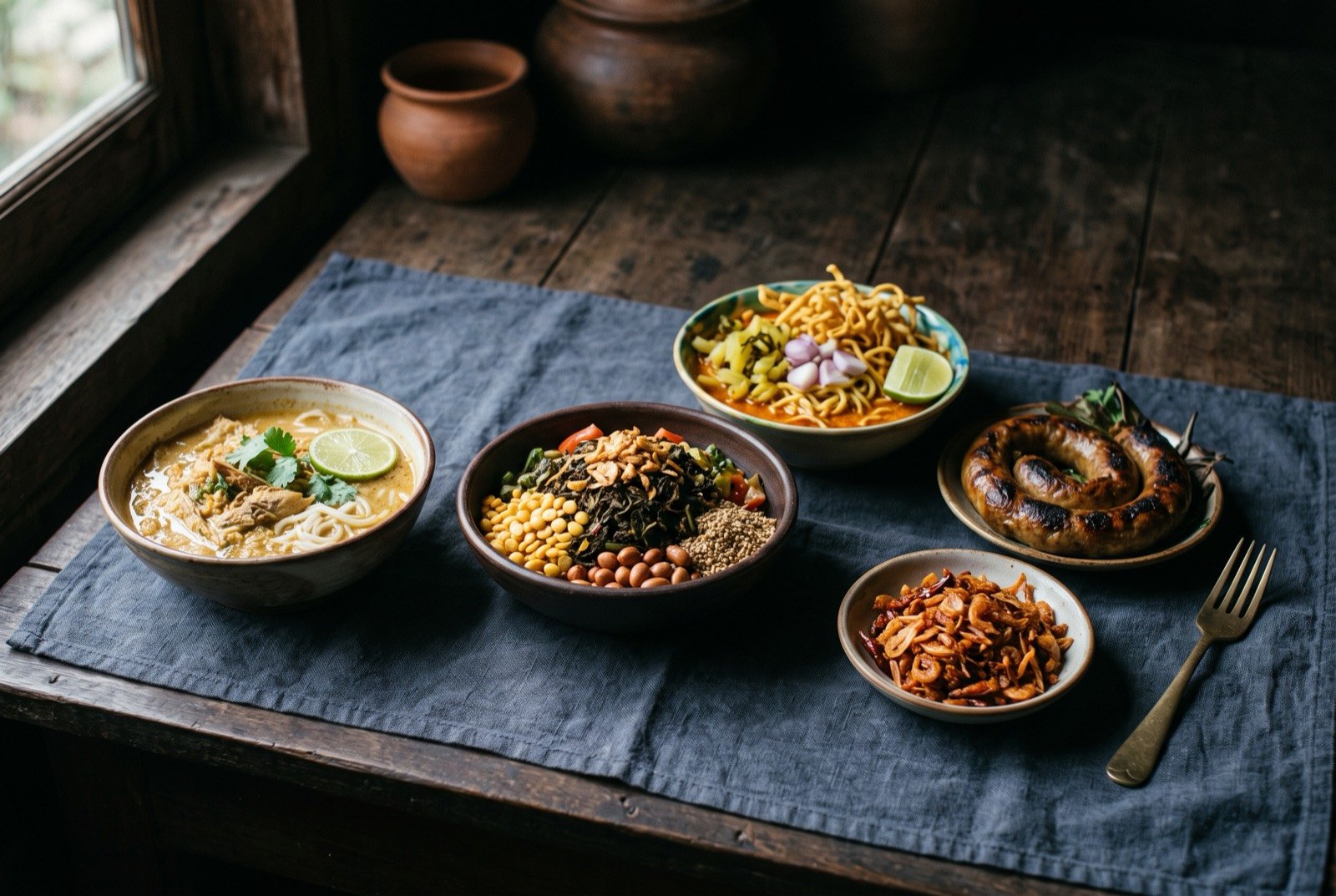
Two food worlds treated honestly as two, not flattened into one: the Irrawaddy dry zone, Myanmar's Bamar heartland, where peanut oil, fermented fish and the British colonial Indian layer built Yangon's table, and the upland Shan hills and northern Thailand's Lanna region together, a Tai and Yunnanese meeting ground of tea, fermented soybean and curried noodle soup, sharing a caravan road neither side owns alone. Every dish as tradition built it, then what a modern chef would change.
Sources and review · What this chapter does not assert · How we research · Spotted something wrong?
A Sense of Place
Two food worlds sit inside this volume, and this chapter keeps them apart rather than blurring them into a single "Burmese and Thai borderlands" idea, because the ecology, the history and the flavour logic genuinely differ. The Irrawaddy dry zone, what Burmese calls အညာ (Anyar), "the upper country," covers most of Sagaing, Mandalay and Magway Regions, a rain-shadow basin blocked from monsoon moisture by the Arakan Mountains, the Pegu Range and the Shan Hills to its east. Rainfall runs 500 to 900mm a year, concentrated into a four to six month window, the rest of the year genuinely arid. The defining crops are sesame, groundnut, pigeon pea, chickpea, green gram and sorghum in the uplands, rice only in lowland pockets near the river itself. The fat here is peanut oil and sesame oil, not the coconut milk of the delta further south or the mustard and soy oils of the Shan hills to the east, and that single fact is the clearest marker separating dry-zone Bamar cooking from both its neighbours.
Chickpea matters more here than a reader might expect. Myanmar is the world's third-largest pulse producer after Canada and India, and chickpea is grown almost entirely within this same dry zone, Sagaing accounting for over half the national crop, Magway and Mandalay most of the rest. The chickpea flour that thickens mohinga is not an Indian import grafted onto a Burmese dish, it is dry-zone produce doing dry-zone work. Toddy palm is the region's other defining plant, tapped for sugar, oil and alcohol, a traditional livelihood now genuinely under threat: a Myanmar Now photo essay on tappers in Chauk township quotes a man with twenty five years' experience worrying the trade "will disappear" within a decade as rural youth leave it. This chapter does not romanticise dry-zone cooking as a purely resourceful peasant idyll either. Chronic child undernourishment in the dry zone stood at 27% even before the 2021 coup's compounding instability, a fact worth holding alongside the ingenuity of a fermented, oil-preserved pantry.
To the east, the Shan Plateau in Myanmar and the historic territory of the Lanna kingdom in northern Thailand, Chiang Mai, Chiang Rai, Mae Hong Son, share one ecological and culinary logic distinct from both the Bamar dry zone and the rice-only lowlands south of Bangkok: highland terrain unsuited to flood-irrigated monoculture rice, tea grown as both drink and food, and fermented soybean rather than fish or shrimp paste as the savoury backbone. A Thai food writer puts the last point plainly: central Thai cooking relies on shrimp paste just as northern cooking depends on fermented soybean. Three peoples hold this world together. The Tai Yai, known in English as Shan, are Myanmar's second-largest ethnic group, historically settled in river-valley flatlands practising wet rice farming. The Lanna Thai, the Kham Mueang-speaking population of the old Lanna kingdom, hold the lowland core around Chiang Mai. And the Yunnanese Chinese Muslims, Hui by ethnicity and religion, known locally as Chin Haw in Thai and Panthay in Burmese usage, arrived from the late nineteenth century as long-distance mule-caravan traders and settled in pockets across both sides of the border, most visibly at Doi Mae Salong. Turmeric shows up far more insistently in this upland world than in central Thai cooking, a marker one Thai food writer names directly describing Mae Hong Son's Tai Yai cooking as mildly salted, built on local vegetables, tomato and turmeric.
A table of peoples, logic and dishes
| World | Defining logic | The dishes that carry it |
|---|---|---|
| Bamar dry zone (Sagaing, Mandalay, Magway) | peanut and sesame oil, chickpea and pulses, heavily salted freshwater ngapi | mohinga, balachaung |
| Yangon's colonial Indian and Bengali layer | dum-style rice cookery, wheat breads, samosa pastry, tea-shop hybrid food | danbauk, samusa thoke |
| Rakhine coast (noted, not fully treated here) | marine ngapi, little or no added salt, sour-and-salty fish-rice cookery | mont di |
| Shan Plateau, Tai Yai | fermented soybean, turmeric, tomato, chickpea-starch tofu | Shan noodles, tohu nway/thote |
| Lanna Thai | fresh-herb curry pastes, charcoal grilling | sai oua, nam prik ong |
| Yunnanese Chin Haw/Panthay caravan world | dry-roasted whole spice, wheat noodle, tea trade | khao soi's Chinese-Muslim ancestor, kaeng hang le |
The History in Layers
The indigenous core, and how little of it reaches the palace record
Mohinga's earliest textual trace is Konbaung-period, the eighteenth and nineteenth centuries: the poet U Pu references mont hin, the poet U Min uses mont ti. Burmese Wikipedia, citing the researcher Dr Khin Maung Nyunt, notes something genuinely telling: mohinga's method does not appear in royal palace cookery records at all. It was common people's food, not court cuisine, and its history is correspondingly harder to pin down than a dish the palace bothered to write about. Ngapi itself has firmer early evidence: a Mon stone inscription dated to the first century CE, and ngapi-makers listed by name in Burmese inscriptions from the twelfth to fifteenth centuries, traded for rubies, benzoin and musk. This chapter treats the deeper archaeological inference, that rice-noodle and fermented-fish cooking may run back to the Pyu era, as a plausible but unproven extension of that record, not as settled fact.
The Indian Ocean spice trade and the colonial rice economy
Rangoon's rise as a rice-export port dates from the British takeover of Lower Burma in 1852 and the 1869 completion of the Suez Canal, which put Burmese rice directly on world shipping lanes to Europe. What followed was one of the more consequential and least remembered migrations in the region's history. Tamil Nadu moneylenders, the Chettiars, arrived from 1826 financing the reclamation of the Irrawaddy Delta for rice cultivation, and by 1930 accounted for roughly 80% of lending in Lower Burma. When the 1930s global depression collapsed paddy prices, mass defaults transferred an estimated 1.9 million acres from Burmese cultivators to Chettiar hands, precipitating their eventual expulsion. This chapter names the scale of that transfer honestly, while flagging that its sourcing is entirely English-language academic history: repeated Burmese-language searches for a Burmese-side account of the Chettiar era returned nothing usable, a real gap rather than a settled Burmese perspective this chapter can claim to represent.
The wider migration dwarfs even that story in scale. Per the Burmese historian Thant Myint-U, migration into Rangoon ran at roughly 250,000 people a year at the turn of the twentieth century, peaking at 480,000 in 1927, briefly making Rangoon the world's busiest immigration port, ahead of New York. By 1933 half of Rangoon's 400,000 residents were Indian, against roughly a third Burmese. Tamils dominated dock and rice-mill labour; Bengalis arrived both as administrators and as labourers, with established Bengali Hindu communities in Rangoon, Mandalay, Mawlamyine, Bassein and Sittwe by the 1920s. That world ended abruptly: the 1962 Ne Win coup nationalised Indian, Chinese and Pakistani-owned enterprises, expelled roughly 400,000 Indians, and halted external trade, a policy that within a few years turned Burma from rice exporter into rice importer.
What that migration actually left in Yangon's food, and what it did not
Danbauk, Burmese biryani, descends from Persian dum pukht by way of Indian biryani, and is solidly of Indian Muslim origin. It became a specifically Yangon dish, served at Muslim weddings and festivals, milder and less oily than an Indian biryani, and traditionally made with domestic rather than imported basmati rice, a real divergence worth naming rather than smoothing over, since most diaspora-published recipes today use basmati as the default. Samusa thoke, breaking a fried samosa into a composed salad with cabbage, onion, mint, a chickpea-curry dressing and lime rather than eating the pastry whole, is the specifically Burmese contribution layered onto an imported form. Naan and palata entered Yangon's breakfast tables the same way and are now, in the households that eat them, simply Burmese food rather than a foreign import felt as such.
Not every dish with an apparent Indian connection actually has one, and this chapter is careful about which is which. Ohn no khao swè's leading origin story places it in Shwedaung township near Pyay, entirely within the Bamar zone, not as an Indian import at all, while separately noting that the Memon community of Gujarati Muslim traders carried a related dish onward from Burma to Pakistan, where it became khausa. If anything, the causal arrow may run the opposite direction to the one a reader would guess, and this chapter states that as genuinely unresolved rather than picking the tidier story. Behind all of this sits the Zerbadi community, Bamar Muslims descended from Indian Muslim men and Burmese women present since precolonial royal times, distinct from the colonial-era migrant community proper, and the largest Muslim group in Myanmar today. It is one reason Indian-Muslim-descended food reads in many Yangon households as simply Burmese rather than as an import at all.
Pre-colonial Shan states, the Lanna kingdom, and the caravan road between them
Both the Shan states and the Lanna kingdom were their own polities before Burmese and Siamese central control tightened around them. The Shan states were ruled through a system of chao fa, "sky lords," across dozens of small principalities, which the British reorganised into the Federated Shan States in the 1920s under indirect rule. From at least the late Qing dynasty, Yunnanese Muslim mule-caravan traders ran routes from Yunnan, via Simao and Xishuangbanna, through Shan State and into northern Thailand and beyond, carrying silk, tea and brasswork south, raw cotton and salt north. Named historic Yunnanese Muslim trading houses running this route include Xingshunhe, Yuanxinchang and Yongyichang. This community, ethnically Hui and Muslim, settled most visibly at Mae Salong in Chiang Rai, a settlement the traders and the later Kuomintang-remnant soldiers who followed the same route after 1949 called by their own name for the mountain. Intermarriage with local Muslim women, including South Asian Muslim communities in Chiang Mai, produced a distinct urban Muslim identity, linguistically and culturally assimilated but religiously apart. Present-day Doi Mae Salong markets itself, not inaccurately, as "Little Yunnan," its oolong tea economy a direct continuation of the trading identity rather than a modern invention laid over an unrelated place.
Khao soi's contested origin, laid out rather than settled
This dish's history is genuinely disputed, and this chapter states the dispute honestly rather than choosing a winner. The standard Thai popular account, repeated near-verbatim across many recipe sites in a pattern that itself suggests one source copied rather than several independently confirmed, holds that Yunnanese Chinese Muslim migrants brought the dish via Burma into northern Thailand, Laos and beyond, the Burmese predecessor a coconut-free noodle soup. A more specific, single-sourced Thai broadsheet account names a particular figure, a northern Thai cook known as Uncle Pan, working at a Shan-run khao soi shop, who around 1941, during wartime displacement, added fresh coconut milk, something northern Thai cooking traditionally avoided, and that this recipe standardised and spread through Chiang Mai after 1950 as Shan Muslim traders returned. This chapter could not cross-verify the Uncle Pan story against a second source, and presents it as one well-sourced Thai account rather than settled fact.
The most careful account available comes from Austin Bush, a Thai-fluent food writer who has spent years researching the region directly rather than passing through it: khao soi is "probably an amalgam of Burmese/Shan and Chinese-Muslim cooking styles," the name likely from the Burmese khauk-hswe, meaning noodles generally rather than naming this dish specifically, with a Burmese and Shan precursor called ohn no khauk-hswe still eaten in Shan State today, carried south by Chinese Muslim traders who, in his phrase, "added the spices they were so fond of." Bush hedges carefully throughout, and explicitly dismisses at least one restaurant's own origin myth as unlikely. Lao khao soi, a related but genuinely distinct tomato-meat-sauce dish over hand-cut rice noodles, and the Burmese ohn no khauk-hswe itself are best understood as siblings in this lineage, not as derivatives of the Chiang Mai dish. Thailand, Laos and Myanmar's Shan State each have a real claim here, and this chapter treats none of them as the origin.
Kaeng hang le's Burmese ancestry is named directly by Thai sources, not disguised: the dish's own name is Burmese, hin meaning curry, le meaning meat, originally a Tai Yai and Shan curry that became a prestige dish on the Lanna banquet table. A "Burmese-style" and a distinct "Shan and Lanna-style" preparation exist side by side today, the Burmese-associated version leaning more sour and salty with pickled garlic, ginger and tamarind, a real enough distinction that this chapter's recipe below names which version it follows.
Rakhine cuisine, named honestly as a separate world, and a live tension flagged rather than resolved
Per this atlas's own crossover convention, Rakhine State's coastal cuisine is understood to sit closer to Chittagong and the Bay of Bengal than to the Bamar dry zone this chapter otherwise covers, and its full treatment belongs to a future volume on the Indian subcontinent's own eastern edge. This chapter names one genuine tension rather than resolving it: that working assumption implies strong South Asian culinary influence, but Austin Bush's own fieldwork in Rakhine State, where he expected exactly that influence given the Bangladesh border, instead found the cooking "distinctly, well, Rakhine," sharper and more assertively sour and salty in a way he compares to Thai and Lao cooking rather than to Bengali food. Structurally, Rakhine ngapi does differ sharply from the dry zone's version: marine fish with little or no added salt, against the dry zone's heavily salted freshwater product, two different preservation strategies for two different ecologies rather than one regional variant of the same thing. Rakhine food's current visibility inside Yangon is worth naming as what it actually is: in 2026, Rakhine restaurateurs including Yee Yee Kyaw, who evacuated two Sittwe restaurants to Yangon in 2024 and now serves roughly two hundred bowls of mont di a day from a small site, are rebuilding under displacement, serving homesick Rakhine migrants rather than curious Bamar diners, and deliberately not adapting their recipes to Yangon tastes. This is a refugee-community food scene, not yet a fine-dining one, and this chapter names that plainly rather than romanticising it as cross-cultural exchange.
The Flavour Arsenal
Ngapi, the load-bearing ingredient of the dry zone
Fish species named specifically for dry-zone ngapi production run to a dozen freshwater types. The process itself is a genuine two-stage salt cure: fish cleaned and scaled, mixed with salt at roughly 10% of weight, weighted in clay pots or plastic containers for a day to a day and a half; sun-dried a further one to two days; then a second, heavier salting to bring the ratio to 15 to 20%, pounded, some producers adding a little ground rice or rice bran, sealed and stored a minimum of four to six months, the finished yield roughly 65 to 75% of the input weight. Five named categories exist: seinza ngapi, fresh shrimp paste dried three to four days then pounded with salt and aged months; hmyin ngapi, from small shrimp; yay kyo ngapi, freshwater fish, sometimes a named three-species blend; htamin ngapi, sun-dried small fish; and ngapi kaung, whole fish salted and aged individually, the longest fermentation of the five.
The dry-zone-versus-coastal distinction matters more than a reader might assume from the shared English name: dry-zone and delta ngapi is freshwater fish, heavily salted; Rakhine ngapi is marine fish with little or no added salt, a genuinely different product doing a different job, not a regional variant of one thing. Myeik's version, further south again, is noted as unusually salty even by inland standards.
Balachaung, si htamin and the dry-zone pantry
Balachaung is built by frying shallot and garlic separately in oil until golden and removing them, then grinding dried shrimp coarse and frying it in the same oil with turmeric and chilli powder, then dissolving ngapi in vinegar and stirring it through, cooking the whole mass roughly five to seven minutes with continuous stirring until visibly dry and crisp. That final drying stage is not merely a texture choice, it is what makes an ambient-stable condiment that keeps for months in a sealed jar without refrigeration, in a region where refrigeration has never been a given. Si htamin, turmeric rice, is glutinous rice cooked with turmeric, salt and onion, finished with roasted sesame and fried onion, a breakfast or snack food rather than a main dish.
Thua nao, the fermented soybean disc that plays the Shan hills' equivalent role
Where the dry zone runs on ngapi, the Shan hills and Lanna run on thua nao. The Thai word itself is instructive: nao does not mean "rotten," it names the fermentation process directly. Yellow soybeans are soaked overnight, then steamed or boiled soft, then fermented two to four days depending on ambient warmth, transformed by naturally occurring Bacillus bacteria, the same genus behind Japanese natto, into something intensely savoury via the breakdown of soy protein into free amino acids. The primary ferment, called thua nao sa, is wrapped in banana leaf and left roughly three nights until visible white mould and mucilage develop. From there three finished products branch off: a soft, wet paste ground with salt, chilli and garlic and steamed or grilled as a direct relish; a pressed, sun-dried disc for long storage, which needs a light toast over flame before use, a step Thai sources are specific reduces the fermented aroma before grinding; and a dip made from the ground ferment with roasted dried chilli, dried ginger and minimal salt. One piece of local lore, worth repeating as lore rather than as settled history, holds that the ruler of Lamphun once sent thua nao as tribute to the ruler of Chiang Mai.
The curry-paste correction
This chapter's own scoping notes suggested Shan and northern Thai curry pastes lean generally toward dried spice over fresh herb. The research behind this chapter both confirms and complicates that. Khao soi's paste genuinely is dried-spice-heavy, closer to an Indian-inflected masala than to a lowland Thai curry paste, coriander seed, cumin seed and black pepper all dry-roasted before pounding alongside the fresh aromatics, and that dried-spice weight traces directly to the dish's Yunnanese Muslim ancestry. But sai oua's paste is fresh-herb-forward, lemongrass, galangal, coriander root and kaffir lime zest outweighing any dried spice, and the nam prik family leans on roasted fresh chilli rather than dried whole spice at all. The "dried spice" characterisation holds specifically for the khao soi and Yunnanese-inflected curry line, and this chapter does not generalise it across every Lanna and Shan paste, since the research does not support that generalisation. Nam prik ong, built from dried chilli and fresh tomato, and nam prik noom, built from a named mild green chilli cultivar called phrik noom, not simply an unripe chilli as the name might suggest to an outsider, sit either side of that distinction: ong dried-chilli-forward, noom entirely fresh and roasted.
Tea, drunk and eaten
Tea sits at the centre of the Shan and Lanna world in a way it does not in the Bamar dry zone. The Ta'ang people of northern Shan State, historically centred on Namhsan, are described in academic literature as Myanmar's first tea cultivators, and Namhsan still produces all three of Myanmar's traditional tea types: pickled, green and black. On the Lanna side, miang, both the fresh leaf and the fermented, wrapped snack miang kham, draws on the same tea stock via hill villages such as Ban Pa Miang near Chiang Mai, a crop and an eating tradition shared culturally with Laos and Shan State rather than a purely Thai invention. Present-day Doi Mae Salong's oolong economy continues this same identity in a different register, tea as trade good rather than as ferment.
Part Two
The Technique Ladder
The argument, from inside
Two figures anchor this chapter's technique ladder, one from each side of the volume, and both make the same underlying point in different words: elevation here means doing the traditional mechanism properly, not importing an outside method. Htet Myet Oo of Rangoon Tea House, Yangon, makes a distinction worth building this whole chapter's diagnosis around, that "Burmese food" is not one register but at least three, tea-shop food, regional cooking, and home cooking, each with different techniques, and most food written about Myanmar from outside collapses all three into one undifferentiated idea. Win Srinavakool, who took khao soi from a Chiang Mai stall to a London restaurant, is unusually honest about the deliberate adaptations he makes for a non-Thai palate, removing the traditional chilli-oil slick, thickening the broth, choosing a rougher noodle. Neither man is defending a static dish. Both are doing the mechanism properly for their own audience, which is exactly this atlas's argument applied to two different cuisines at once.
Rung 1. Hsibyan, cook the curry base until the oil visibly returns
The base of virtually every Bamar curry runs through two named stages: hsi that, "killing the oil," frying onion, garlic, ginger, chilli and turmeric until the raw, sharp edge cooks out and the paste darkens and turns glossy; then hsibyan, "the oil returns," simmering in a water-and-oil mixture until the water has fully boiled off and a clean layer of oil visibly rises and separates on top. This is the Bamar cook's own doneness signal, not a Western reduction technique borrowed and relabelled. Chemically it is Maillard browning on the aromatics followed by a straightforward phase separation: once the water-soluble raw flavours have cooked out, the fat can no longer stay emulsified with a liquid that is no longer there, and it rises clean. What a cook does with this rung. Do not stop the base at "smells cooked." Watch for the oil itself visibly separating and pooling at the edges of the pan before adding protein or ngapi; a curry started before that point tastes of raw onion no matter how long it simmers afterward.
Rung 2. Dry-roast the whole spice before it goes anywhere near a wet paste
Khao soi's curry paste is genuinely dried-spice-heavy in a way most lowland Thai curry pastes are not, and the reason traces directly to its Yunnanese Muslim ancestry: coriander seed, cumin seed and black pepper, toasted whole in a dry pan until fragrant, then ground, then worked into a paste with the fresh aromatics, galangal, lemongrass, shallot, garlic, dried chilli. The paste is then fried in a little coconut cream until it visibly breaks, the fat separating out a second time, the same phase-separation chemistry as Rung 1 applied to a different base, before stock goes in. Skipping the dry-toast step, or adding a pre-made paste straight to warm coconut milk without frying it out first, is the single biggest reason a bought khao soi paste tastes flat: the Maillard transformation on the whole spice never happens, and neither does the second oil-break that concentrates the paste's flavour before it meets the broth. What a cook does with this rung. Toast the whole spices separately and completely before grinding, using the reader's own dedicated spice grinder, then fry the finished paste hard in the coconut cream's fat until it visibly breaks before loosening with stock, never the other way round.
Rung 3. Ferment lahpet for months, not days, and use the kit that can actually hold the temperature
Fresh tea leaves, ideally picked before ten in the morning, are steamed five to ten minutes to wilt them and drive off the sharpest tannins, the excess water pressed out, then packed tightly into pots or bamboo vats, weighted, and fermented two to four months at minimum, some producers extending to six, the containers sometimes buried. Peer-reviewed food science confirms this is a genuine lactic and acetic fermentation, Lactobacillus and Acetobacter alongside Candida and Pichia yeasts, not a marinade wearing the word "pickled," and that the process both softens bitterness and measurably increases retained polyphenol and antioxidant activity. Zaw Mahesh at Lahpet, London, does exactly this in-house rather than buying pre-fermented leaf, precisely because so much commercially exported lahpet has been found cut with MSG and dye, a documented quality problem, not folklore. What a cook does with this rung. A full months-long ferment is the real thing and this chapter does not pretend a shortcut replicates it. But a genuine, sourced quick-ferment exists for a reader who wants to try the mechanism at home: good loose-leaf green tea, briefly steeped and pressed dry, packed into a sterilised jar under a coffee filter, held at 28 to 32°C for seven to ten days, precisely the band a home dehydrator's low or proving setting can hold steady. It will not be Shan State lahpet. It is a real ferment on the same principle, not an invented substitute.
Rung 4. Toast rice to a deep gold before grinding it, and grind it coarse
Raw glutinous rice, dry-toasted in a bare pan for ten to twenty five minutes until deep golden and smelling of popcorn, then ground coarse rather than to a flour, appears across this whole food world as both a broth thickener and a finishing garnish. The aroma is generated entirely by the toasting itself, a straightforward Maillard reaction on the rice's own starch and sugars, and no commercial substitute, however finely ground, can produce it after the fact. What a cook does with this rung. Toast further than feels necessary, until the grains are genuinely dark gold rather than pale, and stop the grinder while the texture is still coarse and gritty rather than fine; a rice powder ground to flour loses the crunch that makes it worth adding at all.
Rung 5. Bank coconut husk into the coals for sai oua
Traditional sai oua is grilled over charcoal with coconut husk added directly to the fire, a fuel that burns drier and sweeter than most hardwoods, a genuinely different smoke character from the oak or fruitwood this atlas has recommended elsewhere. What a cook does with this rung. Add dried coconut husk, or coconut-shell charcoal where husk itself cannot be sourced, to a base of good lump charcoal on the Big Green Egg, rather than relying on lump charcoal alone; the difference is a real, testable one, not a marketing flourish.
Rung 6. Set Shan tofu with starch and heat alone, no coagulant at all
Shan tofu is not soy tofu wearing a different name. Chickpea flour, water, salt and turmeric are cooked over direct heat with continuous stirring until the starch gelatinises and the mixture thickens into a pourable batter, then poured into a shallow tray to cool and set into a firm, sliceable, pale gold jelly. There is no coagulant anywhere in this process, no calcium sulfate, no nigari, no acid: the set comes purely from starch gelatinisation and cooling, the same mechanism as a cornflour-set pudding, entirely different from the protein coagulation that sets true soy tofu. This is precisely why it can be eaten warm and soft straight from the pot, or cooled fully into firm blocks for slicing and frying, a genuinely different set of possibilities from soy tofu's single fixed texture. What a cook does with this rung. Stir continuously and do not stop once the mixture starts to thicken, since an unstirred pot sets unevenly at the base before the top has gelatinised at all; and understand the two serving states, warm and firm, as two different, equally traditional endpoints of the same batter, not a soft failure and a proper success.
Part Three
The Ferment and Preserve Bench
1. Ngapi
Freshwater dry-zone ngapi: a two-stage salt cure, roughly 10% salt then a second salting to 15 to 20%, sun-dried between stages, stored a minimum of four to six months. Rakhine's marine ngapi uses little or no added salt, a genuinely different product for a different ecology, not a milder regional variant.
2. Lahpet
Fresh tea leaf steamed to wilt and reduce tannins, packed tightly to exclude air, fermented two to four months minimum via Lactobacillus and Acetobacter bacteria alongside Candida and Pichia yeasts, a genuine lactic and acetic ferment. Finished pickling ratios: 5 to 10% minced garlic and ground chilli, 1 to 2% salt, 1 to 2% fresh lime juice, 20 to 30% peanut oil, all by weight of the fermented leaf.
3. Thua nao
Yellow soybean, soaked, cooked, fermented two to four days by naturally occurring Bacillus bacteria, then either used soft and wet as a relish, pressed and sun-dried into discs for long storage, or ground into a chilli dip. This chapter's dishes above do not require it directly, but no account of the Shan hills' flavour arsenal is complete without naming it as the region's structural equivalent to ngapi.
4. Balachaung
Covered in full as dish three above: dried shrimp, ngapi and vinegar, fried with aromatics until visibly dry, an oil-preserved condiment built to keep for months without refrigeration.
Sourcing in Britain
Verified September 2026. Where a supplier could not be fully confirmed, that is said rather than smoothed over.
The ranked list: what decides great from grim
- Real ngapi, not a bland substitute. The single highest-leverage decision across this whole chapter's spine of dishes. Genuine UK sourcing exists and is better than most readers would assume: NST Foods UK, a Myanmar specialist online grocer, stocks a confirmed live pounded grilled shrimp paste; Easy Bites, an Edinburgh-based, family-run Burmese café and mini-mart, carries several genuine ngapi products with bilingual labelling and UK-wide delivery; Mum's House, 29 Harington Terrace, London N18 1JX, is a physical Burmese supermarket with a dedicated shrimp and fish paste category; Motherland Myanmar is a verified online-only alternative. Where none of these work, Thai kapi, specifically Pantai or Nang Fah brand shrimp paste, is a workable stand-in for background umami in a cooked dish, saltier and more aggressively fishy than most Burmese ngapi and not a substitute where ngapi's specific character is the point.
- Real fermented lahpet, not plain Burmese black tea. The second-highest-leverage decision, since plain tea leaves are simply a different dish, not a lesser version of this one. Muyar Condiments is a genuine UK-based ferment maker, tea sourced from Myanmar's Shan State and finished in the UK, though stock genuinely fluctuates; NST Foods UK stocks several confirmed lines. Where genuine lahpet cannot be sourced, the dehydrator quick-ferment described under Rung 3 above is a real, sourced method, not an invented workaround, and this chapter treats it as a recipe in its own right rather than a footnote.
- Thua nao, honestly the weakest sourcing point in the whole chapter. No UK retailer could be confirmed. Doenjang, used sparingly, is a reasonable stand-in for its funky, savoury note, genuinely closer than Chinese fermented black bean, which reads as a different, saltier flavour entirely.
- Catfish for mohinga. Bradley's Fish sells frozen Pangasius catfish with next-day delivery; Eurocross, 13 Lamson Road, Rainham RM13 9YY, sells whole gutted catfish. Pangasius is a mild, fairly neutral fish, workable but not flavour-identical to the Ayeyarwady basin species mohinga traditionally uses.
- Banana stem, not banana blossom, for mohinga. These are different plant parts sold as different products: Lakshmi Stores UK and Alli Bhavan both list fresh banana stem specifically. Banana blossom, much more widely available through mainstream Southeast Asian grocers, is a different vegetable and should not be assumed interchangeable.
- A khao soi curry paste built from parts, not a single bottle. No dedicated bottled Maesri khao soi paste was confirmed for UK delivery, though Sous Chef stocks the full Maesri range otherwise. Build the paste from Maesri red curry paste plus fresh whole-spice roasting and pounding as this chapter's Rung 2 describes, rather than relying on one bottle to do the whole job.
- Fine rice vermicelli, not standard pad Thai noodles. Mohinga and khao soi both want a more delicate noodle than the default; Southeast Asian specialists such as Longdan and NST Foods carry the finer grade.
- Dried spices and fresh galangal and turmeric for khao soi and sai oua's pastes. Genuinely well stocked across Sous Chef, Longdan, and general South and Southeast Asian grocers; no sourcing difficulty here.
Physical shops
Mum's House, 29 Harington Terrace, Great Cambridge Road, London N18 1JX, is the best-verified physical Burmese grocer found for this chapter. Easy Bites, 173 Gorgie Road, Edinburgh, is a genuinely Burmese-run café and mini-mart, and the only Burmese grocer in this brief with a confirmed street address outside London. A genuine gap worth stating plainly: outside London and Edinburgh, physical Burmese grocery shopping in the UK is effectively unconfirmed by this research, despite a real Burmese-UK population presence in Manchester, Birmingham and Glasgow. For northern Thai and Shan-adjacent ingredients rather than specifically Burmese ones, London's established pan-Asian and Thai grocers, Talad Thai Supermarket, Loon Fung, See Woo, Wing Yip, and Khun Ya in Bermondsey, specifically named for hard-to-find Thai items, are the practical route.
Kit substitution, honestly
A Big Green Egg run low and steady with a diffuser plate genuinely replicates a clay pot's even, retained heat for mohinga's long simmer or a Shan-style braise, a legitimate outdoor use of kit the reader already owns. A bamboo sticky-rice steamer is cheap, widely available and the correct choice outright, no substitute needed. A dehydrator's low or proving setting is the genuine, sourced way to attempt lahpet's fermentation at home, see Rung 3. A heavy stone mortar and pestle, not the reader's high-power blender, is the closer traditional match for khao soi and sai oua's pastes, giving a different, better texture than a blender's smooth puree; this chapter recommends the mortar specifically rather than defaulting to the more powerful machine.
Voices and Sources
From inside the tradition
- Htet Myet Oo and Isabella Sway Tin, Rangoon Tea House, Yangon and Bangkok. The chapter's clearest voice on why "Burmese food" is not one register but at least three, tea-shop, regional and home cooking, and on the elevation of tea-shop food specifically to a fine-dining register.
- Chef Orng (Orng Joitamoi), Orng Kitchen and ECHO Dining, Yangon. Built his restaurants around direct relationships with farmers and foragers, frustrated that Yangon diners once had to fly abroad for serious cooking.
- Sai Htun Myo Thant, Shan Yoe Yar, Yangon. Ethnic Shan chef building Yangon's first dedicated Shan fine-dining restaurant around the full range of Shan-state cooking, not only the noodles and tofu that travel outside the state.
- Desmond Tan, Burma Superstar, San Francisco and Oakland. Discovered and corrected widespread adulteration in commercially exported lahpet by sourcing directly from small Shan-hill farmers; codified the oil-break as a teachable technique in his cookbook with Kate Leahy.
- Dan Anton and Zaw Mahesh, Lahpet, London. Zaw ferments the restaurant's own tea leaves in-house rather than buying pre-fermented lahpet, precisely because of the adulteration problem Tan documented.
- Win Srinavakool, Khao-Sō-I, Chiang Mai and London. Unusually transparent about the specific, deliberate adaptations he makes to khao soi for a non-Thai palate, a rare direct account of how and why a dish changes on export.
- John Chantarasak, AngloThai, London. British-Thai chef arguing that Thai flavour architecture can be rebuilt faithfully with UK produce without imported "exotic" ingredients.
- Austin Bush, author of The Food of Northern Thailand. The most careful, hedged, seriously researched English-language voice on khao soi's contested origin and on Rakhine cuisine's real character, consistently distinguishing what he found from what he expected to find.
The UK diaspora
- Lahpet, Shoreditch, West End and Bermondsey Larder, London. The clearest UK attempt to do for Burmese food what Kiln and Som Saa did for Thai.
- Amy and Emily Chung, "The Rangoon Sisters," authors of The Rangoon Sisters: Recipes from Our Burmese Family Kitchen, whose published mohinga was voted number one in Observer Food Monthly's 2018 "Best 50 Things in Food."
- MiMi Aye, British-Burmese author of Mandalay: Recipes and Tales from a Burmese Kitchen.
The gaps, named
No Rakhine-origin cookbook author, chef or food writer publishing in English or reachable by search was located for this chapter. The Rakhine material above rests on one Western food journalist's fieldwork and general encyclopaedic summary, a real gap this chapter names rather than papers over. No dedicated Shan-language food writing was found online. The Shan Herald Agency for News exists and publishes in Shan script, but its content is current-affairs journalism, not food writing; this chapter's Shan material rests substantially on Thai-language academic and journalistic writing about Tai Yai communities, and on English-language fieldwork by Austin Bush and Naomi Duguid, both seriously embedded but neither a member of the tradition. No restaurant combining Yunnanese Muslim, Hui, cooking with an elevated fine-dining register was found in either Thailand or Myanmar, a genuine gap in coverage or possibly in the phenomenon itself, stated as a finding rather than filled with speculation.
Things this chapter has deliberately not asserted
- A single origin for khao soi. Three genuinely competing accounts exist, the standard Thai popular version, a single-sourced Thai broadsheet story naming "Uncle Pan" and 1941, and Austin Bush's more hedged Chinese Muslim and Burmese and Shan synthesis. This chapter presents all three, attributed, and picks none.
- A settled transmission path for kaeng hang le beyond its named Burmese ancestry and its adoption as a Lanna banquet dish; the exact mechanism and date of that adoption were not found.
- A settled etymology for nam ngiao. Whether the name derives from the kapok flower (ดอกงิ้ว) used in the broth or from an older, now somewhat pejorative Thai term for Shan people is genuinely unresolved in the sources this chapter's research found, and both are named without a preference.
- That htamin jin, khao som and jin som are the same dish. They belong to the same sour-rice-and-fermented-meat family and may share ancestry, but no source confirmed they are identical, and this chapter does not silently equate them.
- Any specific, named effect of the Chettiar lending system or the wider colonial finance layer on Burmese food culture itself, beyond the English-language academic scholarship's own claims. No Burmese-language source on this specific strand could be found despite repeated targeted searching, and this chapter states that gap rather than inventing a Burmese-side narrative to fill it.
- That diaspora Burmese restaurants systematically under-season with ngapi to avoid offending non-Burmese customers. This is a plausible inference from ngapi's known culinary function, not a claim any named chef in this chapter's research actually made, and it is not presented as sourced fact.
- Any direct culinary exchange between Rakhine State and Bengali or Chittagonian cooking technique specifically, beyond geographic proximity across the Bay of Bengal. The one piece of serious first-hand food journalism available, Austin Bush's fieldwork, found the opposite of what this project's own crossover framing predicted, and this chapter names that tension rather than resolving it in either direction.
- That any UK retailer beyond those named above currently stocks thua nao. None could be confirmed, and doenjang is offered as an honest, explained compromise rather than implying a genuine alternative exists.
- That "Burma Girl" or any other unverified restaurant origin story repeated in passing English-language coverage is factual; where a restaurant's own founding myth could not be corroborated, it is omitted rather than repeated uncritically.
The first volume of mainland Southeast Asia, Not Just Stew. Research briefs: AS-42-tradition.md and AS-42-modernist-sourcing.md. Sourcing verified September 2026.
Hsibyan, cook the curry base until the oil visibly returns
The base of virtually every Bamar curry runs through two named stages: hsi that, "killing the oil," frying onion, garlic, ginger, chilli and turmeric until the...
Dry-roast the whole spice before it goes anywhere near a wet paste
Khao soi's curry paste is genuinely dried-spice-heavy in a way most lowland Thai curry pastes are not, and the reason traces directly to its Yunnanese Muslim...
Ferment lahpet for months, not days, and use the kit that can actually hold the temperature
Fresh tea leaves, ideally picked before ten in the morning, are steamed five to ten minutes to wilt them and drive off the sharpest tannins, the excess water...
Toast rice to a deep gold before grinding it, and grind it coarse
Raw glutinous rice, dry-toasted in a bare pan for ten to twenty five minutes until deep golden and smelling of popcorn, then ground coarse rather than to a...
Bank coconut husk into the coals for sai oua
Traditional sai oua is grilled over charcoal with coconut husk added directly to the fire, a fuel that burns drier and sweeter than most hardwoods, a genuinely...
Set Shan tofu with starch and heat alone, no coagulant at all
Shan tofu is not soy tofu wearing a different name.
The dishes
- Mohinga Bamar dry zone and delta
- Lahpet Thoke Fermented tea leaf salad, grown in the Shan hills, eaten across the whole of Myanmar
- Balachaung Bamar dry zone
- Danbauk Yangon's Indian Muslim layer
- Khao Soi Lanna and the Yunnanese caravan world, Chiang Mai
- Shan Noodles The Shan hills
- Sai Oua Lanna, Chiang Mai
- Kaeng Hang Le Named directly for its Burmese ancestry, adopted as a prestige dish on the Lanna banquet table
- Tohu Nway and Tohu Thote The Shan hills
Sources and review
- Researched
- 12 sources cited
- Reviewed
- Not yet reviewed from inside the tradition
- Cooked
- Not yet cooked and reported
Where this volume comes from
3 research briefs on file for this volume, researched to the rules on How we research. Published 3 September 2026. Last changed 8 September 2026.
The brief's own account of its sources
Split, roughly. For the Bamar strand: an estimated 35 to 40% genuinely local or in-tradition (Burmese Wikipedia with named academic citations, Burmese government agricultural and consumer sites, Myanmar Now journalism, in-tradition Burmese and diaspora cookbook authors and chefs with direct Yangon lineage), and 60 to 65% Western-language secondary (much of it itself citing serious academic sources such as Ruddle and Ishige and Steinkraus, a meaningfully different category from an SEO farm; academic history on Chettiars and Indian migration; diaspora cookbook authors, a genuine middle ground