Mainland Southeast Asia · Volume 39, Broken Rice, Fermented Fish and a City Built on Borrowed Ground
Hủ tiếu Nam Vang
Sài Gòn, via Phnom Penh and Chợ Lớn
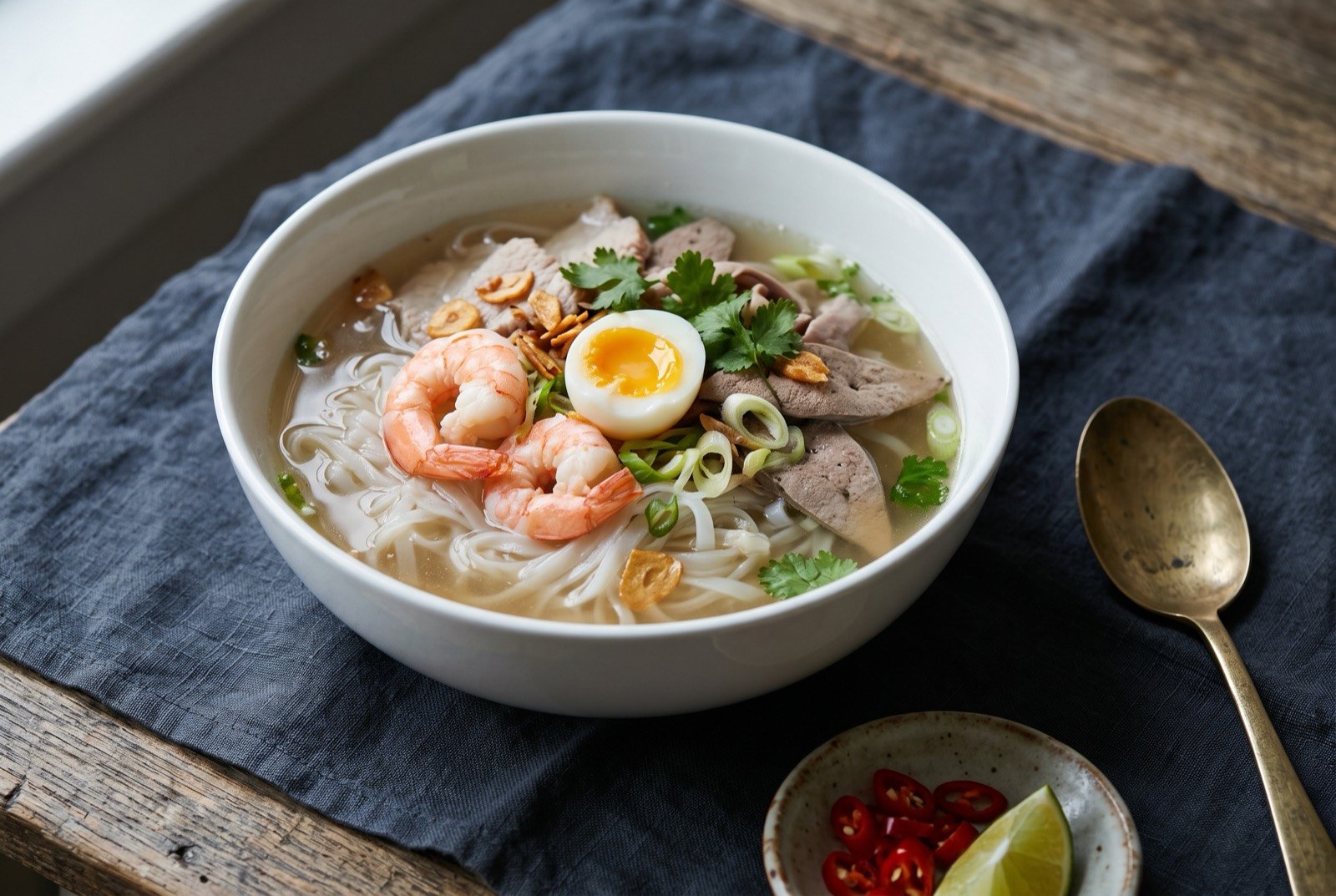
Illustration
- Time
- 3 hours
- Researched
- 11 sources cited
Khmer-prepared, Teochew-descended, Vietnamised on arrival: this dish is the whole volume's argument in one bowl.
As tradition built it
Serves 4 to 6. Several hours for the broth, then a fifteen minute assembly.
Ingredients
- 1 kg pork bones
- 200 g dried squid, whole
- 50 g dried shrimp
- 1 white radish, peeled and chunked
- as available garlic cloves, whole and peeled
- for garnish golden-fried shallot, to finish
- 500 g rice noodles (hủ tiếu, or thin flat rice noodles)
- 300 g lean pork, thinly sliced
- 300 g minced pork, formed into small balls
- as available shrimp, to enrich (Sài Gòn style)
- as available squid, to enrich (Sài Gòn style)
- as available pork liver, to enrich (Sài Gòn style)
- to serve lettuce
- to serve bean sprouts
- for garnish fried garlic
- for garnish coriander
- for garnish lime
- for garnish chilli
Method
- Bring the bones, dried squid, dried shrimp, radish and garlic to the boil in plenty of water.
- Reduce immediately to roughly 70 to 80 percent heat and skim continuously. Drop to 60 percent if it threatens to boil hard again, but keep enough movement that foam still rises where it can be skimmed.
- Once the foam runs clear rather than dark, cover and hold at minimal heat for the long finish. No source consulted gave a precise bone-to-water ratio or total simmer time; treat the above as a protocol, not a tested figure, and simmer until the broth tastes rounded rather than thin, several hours in practice.
- Poach the sliced pork and pork balls in a little of the broth, then shock in cold water to stop the cooking and prevent surface darkening.
- Blanch the noodles, build the bowl: noodles, sliced pork, pork balls, and, for the Sài Gòn version, shrimp, squid and liver. Ladle over the hot broth, finish with fried garlic, golden-fried shallot, coriander, lime and chilli.
- For the original Cambodian dish, serve with lean pork and pork balls only, lettuce and bean sprouts the sole vegetables, nothing else added.
What a modern chef changes
The dish's own migration, plated as commentary
Rung 2
Method
- Apply the heat-and-skim protocol with real discipline: a controlled 70 to 80 percent simmer, continuous skimming, foam judged by clarity rather than time, then a chinois pass at the very end for a broth that is genuinely, not just visually, clear.
- Sous vide the pork and liver separately, low and precise, so each component's texture is a deliberate choice rather than a side effect of a shared pot.
- Serve the two versions side by side: a small bowl built to the original Cambodian simplicity, lean pork, pork balls, lettuce, bean sprouts, next to the full Sài Gòn-enriched bowl, letting the diner taste the 1970s journey rather than reading about it.