The Sinosphere · Volume 33, The Mala Basin
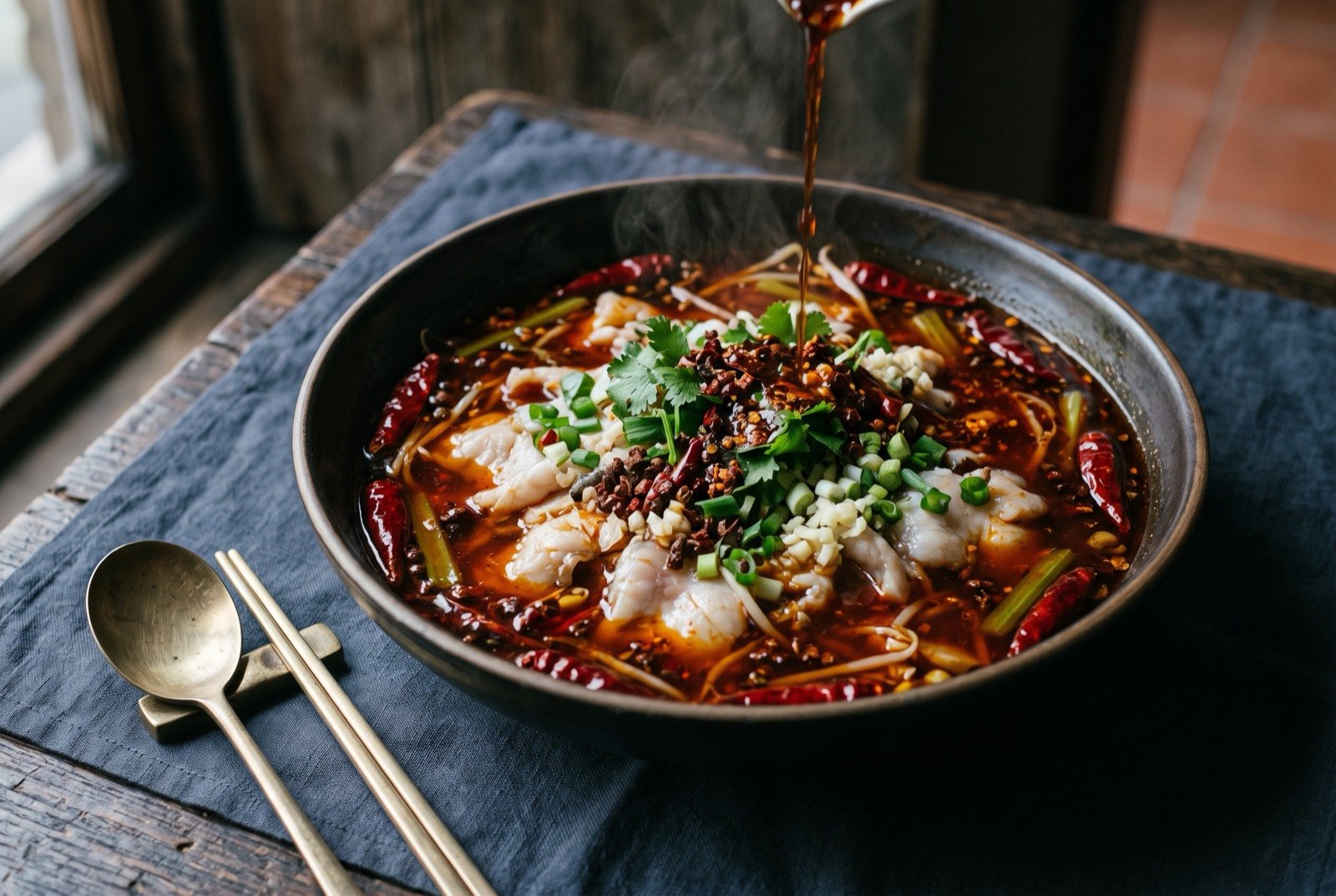
Water-boiled fish / Shuizhuyu (水煮鱼)
Jiangbei, Chongqing
Illustration
- Time
- 30 minutes
- Researched
- Researched from 96 sources in the brief
A documented Chongqing adaptation, from the 1970s and 1980s, of an earlier Zigong technique, water-boiled beef, itself traced to Zigong's Northern Song-era salt-well economy, where aged draft oxen no longer able to power the brine winches were slaughtered and given cheaply to salt workers, cooked simply in water, salt and chilli. Restaurateurs in Jiangbei county's Cuiyun township adapted that technique to freshwater fish, and by the mid-1980s a strip of restaurants near Chongqing's Jiangbei airport, known nationally as "water-boiled fish street", had carried the dish across the whole country through the 1990s.
As tradition built it
Serves 4. About 30 minutes.
Ingredients
- 1 grass carp fillet, thinly sliced
- 1 egg white, 1 tbsp cornflour, a splash of wine egg white, cornflour and Shaoxing wine, for marinating
- 3 tbsp Pixian doubanjiang
- a little ginger, garlic and spring onion; 20g Sichuan pepper; 50g dried chillies ginger, garlic, spring onion, whole Sichuan pepper and dried chillies
- 1 large bowl stock
- to finish chilli oil, freshly bloomed, to finish
Method
- Marinate the fish slices with the egg white, cornflour and Shaoxing wine.
- Fry the doubanjiang in roughly three times the oil of an ordinary stir-fry, with the ginger, garlic, spring onion, whole Sichuan pepper and dried chillies, then add the stock and bring to a simmer.
- Slip the fish slices in and cook just three to five minutes, no longer, until barely opaque.
- Finish at the table with a separate pour of chilli oil, the chillies and Sichuan pepper freshly bloomed in a fresh batch of oil until just fragrant and colouring, never scorched, poured directly over the dish so the aroma arrives at the last possible moment rather than being cooked into the poaching liquid, exactly the two-stage logic of Rung 5.
What a modern chef changes
A precise water bath and a blended aromatic stock
Rungs 1 and 5
Method
- Poach the fish slices at a controlled 62°C water bath rather than in the simmering stock directly, which removes any risk of overcooking a fish this thin, then transfer briefly into the hot stock only long enough to warm through before plating, a genuine refinement of the traditional method's margin for error rather than a stylistic addition.
- Build the finishing chilli oil as the full staged three-pour method (Rung 1) instead of a single hot pour, layering colour, raw heat and top-note aroma separately rather than in one pass.
- Blend a small amount of the poaching stock's aromatics in a high-power blender before straining, extracting more from the ginger, garlic and Sichuan pepper than a simple simmer alone would release, for a rounder, more concentrated base beneath the fish.