Asia · Volume 33
Sichuan and Chongqing
The Mala Basin
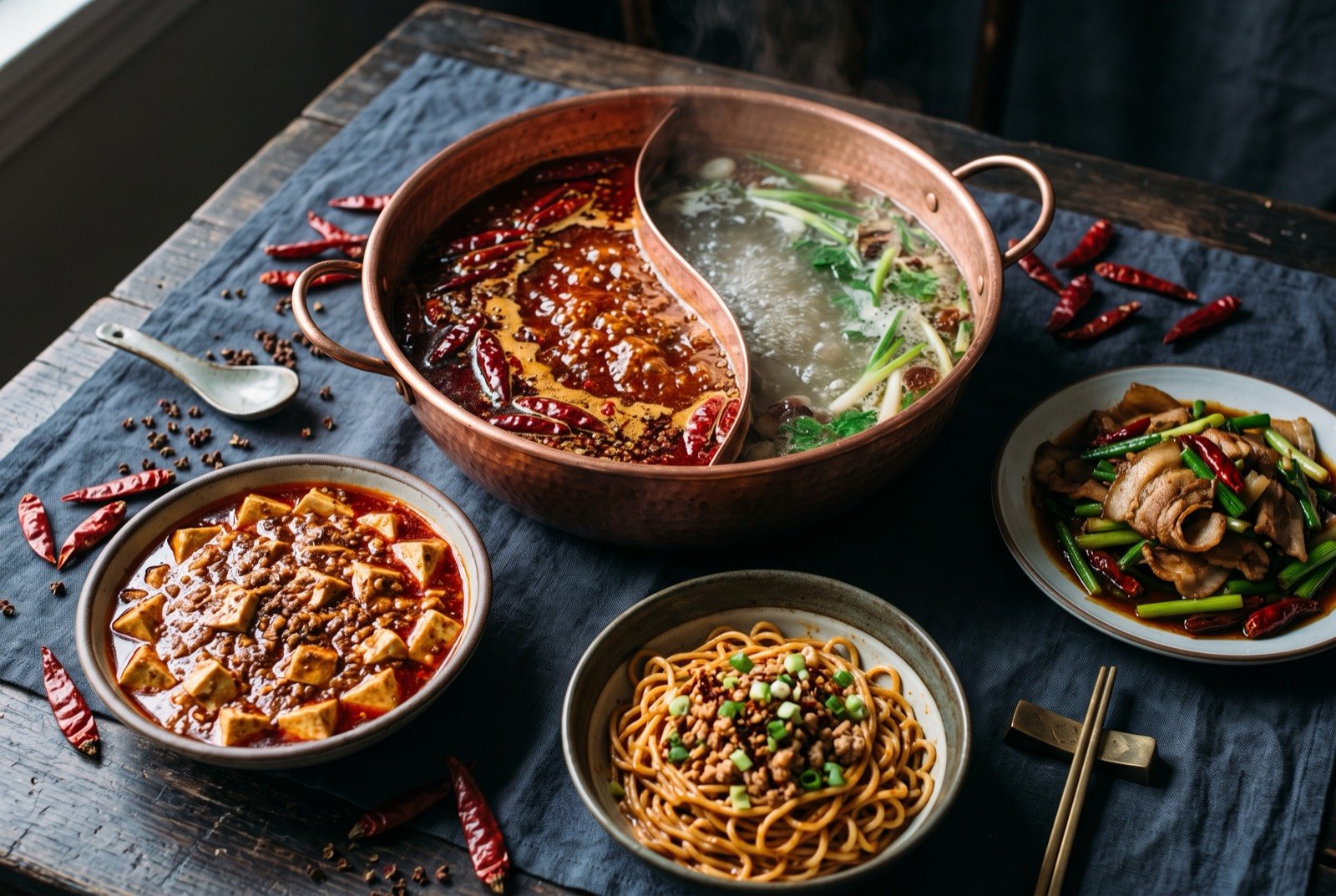
Sichuan and Chongqing, taken seriously: a fog-bound basin whose real achievement is mala itself, chilli's capsaicin and Sichuan pepper's numbing sanshool worked as two separate flavour channels and built out, in a codifying twenty-four-flavour-type system, into a genuine grammar rather than a single note of heat. Two cities inside one enclosed bowl grew two different tempers, Chengdu's fermentation-deep teahouse patience and Chongqing's dockside offal and tallow improvisation, and every dish as tradition built it, then what a modern chef would change.
Sources and review · What this chapter does not assert · How we research · Spotted something wrong?
A Sense of Place
Sichuan is a bowl. Mountains close it on every side, the Tibetan Plateau rearing up to the west, and inside that ring sits a basin of roughly 160,000 square kilometres, humid, fogbound and mild, where winters are warm, springs are dry, summers are hot and autumns drown in rain. Chinese geographers describe it as "almost completely enclosed", and Mount Emei and Jinfo Mountain register among the highest fog-day counts anywhere in China. Sixty to seventy percent of that rain falls at night, a phenomenon old enough to have its own name in classical poetry, 巴山夜雨, the night rain of the Ba mountains. English food writing likes to explain the region's love of chilli and Sichuan pepper as a folk-medical response to all that damp, warming the body, driving out moisture. It is a tidy story. No Sichuanese source in this research said it, and this book will not repeat it as fact.
What the enclosure actually did was slower and stranger: it let a food culture develop nearly in isolation, then refilled the bowl twice with outsiders. Ba and Shu, the two ancient kingdoms that gave the region its old shorthand, farmed the five grains and kept six kinds of livestock, and classical texts already record brine, rock salt, Sichuan pepper and ginger as seasonings here more than a thousand years before chilli existed anywhere in Asia. But the basin was also depopulated twice by catastrophe, most devastatingly by the warlord Zhang Xianzhong's massacres at the end of the Ming, and refilled both times by state-sponsored resettlement from elsewhere in China. The decisive wave, known as Huguang tian Sichuan, "Huguang fills Sichuan", ran from the Shunzhi to the Qianlong reigns of the Qing and brought an estimated six million migrants into the province, about half of them from Hubei and Hunan. Sichuan's population went from 2.68 million in 1757 to nearly 35 million by 1830. Roughly seven in ten Sichuanese today are thought to descend from these migrants, and Chinese cultural writing credits this churn, arriving into an enclosed bowl and then staying, with giving Sichuanese culture its characteristic mixing and its openness. It is also, as the History in Layers section below sets out, the likeliest route by which chilli itself entered the province.
Modern Sichuan is around 94 percent Han, with Yi, Tibetan and Qiang minorities concentrated at its mountainous edges: it is China's largest Yi settlement area, its second-largest Tibetan settlement area and its only Qiang settlement area, in Liangshan, Ganzi, Aba and the Beichuan hills. Ethnic-minority cooking sits mostly outside this chapter's scope, which follows the basin cuisine, but it is worth naming that the province's food map does not stop at the Han-majority plain.
Chengdu is the basin's old capital and its teahouse city. Tea-drinking in the Ba-Shu region is described as pre-Qin in origin, and Chengdu built a whole civic culture around it: low tables, bamboo chairs and the three-piece gaiwan, bowl, lid and saucer, a service style distinctive enough that Chinese writing calls it its own "covered-bowl tea culture". By 1909 the city had 454 recorded teahouses; by 1929, 641. They were never just for drinking. Merchants closed deals there, itinerant labourers waited for work there, and Sichuan opera and the storytelling arts of qingyin and pingshu matured inside them. "Chengdu is one big teahouse, and the teahouse is a small society" is a line that recurs across Chinese writing on the city, and it is the right lens for how Chengdu eats: unhurried, social, structured around small dishes and long afternoons rather than a single defining feast.
Chongqing is a different animal, and the difference matters more than geography alone explains. It sits where the Jialing River meets the Yangtze at Chaotianmen, one river visibly clearer, one more turbid, running side by side before they merge, a confluence so distinctive that Chinese sources describe it as looking like a giant mandarin duck hotpot, one side red, one side clear, before anyone had built one. The city is built up the hillsides in tiers, "backed by the Ba mountains, facing two rivers", and Chinese writers credit that steep, staircase geography with shaping a harder, more improvisational urban culture than Chengdu's. Chongqing was administered as part of Sichuan from 1954 until 14 March 1997, when it became China's fourth municipality directly under central government, alongside Beijing, Shanghai and Tianjin, a move driven by Three Gorges Dam resettlement logistics and by Beijing's wish to give the upper Yangtze its own economic anchor, not by any pre-existing food rift. But an older, separate rivalry, over who really invented hotpot, predates 1997 and runs alongside it rather than because of it, and this chapter keeps those two threads apart rather than blurring them into one story of political grievance.
| Who | Where | Defining logic | Carries it |
|---|---|---|---|
| Han Sichuanese, Huguang-descended | The Chengdu plain and basin interior | Fermentation depth and the twenty-four flavour types; a slow, teahouse tempo | Doubanjiang, mapo tofu, dan dan noodles, twice-cooked pork |
| Han Chongqingers | The Jialing-Yangtze confluence and the river terraces above it | Tallow, offal, dockside improvisation; heat as confidence, not caution | Hotpot, laziji, water-boiled fish, xiaomian |
| Zigong salt-well communities | Zigong, inland from both cities | An older, harder-working technique lineage built on cheap draft-ox meat | Water-boiled beef, the parent of Chongqing's water-boiled dishes |
| Yi, Tibetan and Qiang communities | Liangshan, Ganzi, Aba, the Qiang counties of Mianyang | A separate highland foodway, largely outside this chapter's scope | Named here rather than folded silently into "Sichuanese" |
The History in Layers
Start with the sentence that should anchor everything else in this chapter: modern Sichuanese cuisine is young. Chinese food history is blunt about it. Counted from the Qianlong reign, the cuisine's history runs to only around two hundred years, and the systematic formation of today's flavour types, dishes and cooking methods can only really be traced to the Republican era, the early twentieth century. Whatever this chapter's dishes feel like, none of them is ancient in the way rice or millet farming is ancient. Sichuan's mala identity is closer in age to the modern nation state than to the kingdoms of Ba and Shu.
Chilli's arrival is the clearest proof of that youth, and it is a genuinely contested story rather than a tidy one. Chinese academic writing describes chilli entering China in two separate phases: an earlier late-Ming-to-early-Qing phase, arriving by sea via the Korean peninsula, and a later phase from the Kangxi reign onward, carried mainly by Portuguese and Dutch maritime traders and their Southeast Asian colonies, or via Luzon through Fujian's Yuegang port, where it was first known as "foreign ginger". No source in this research names Macau specifically as the entry point, a claim that circulates in English food writing and is not repeated here. Ming-era texts record chilli as "foreign pepper", used to warm the stomach and treat frostbite, medicine rather than food.
Chilli's arrival in Sichuan itself is later still, and unusually precisely dated by provincial gazetteers rather than legend. The earliest recorded mention anywhere in a Sichuan gazetteer is 1749, in Dayi county, later than Hunan's own earliest record. Sichuan's major culinary text of the same century, the Xingyuanlu, does not mention chilli at all. References become more frequent through the Jiaqing reign, 1796 to 1820, and it is only from the Daoguang, Xianfeng and Tongzhi reigns, the 1820s through the 1870s, that chilli is described as planted everywhere in the countryside. Chinese scholarship holds that the most likely route was overseas to Zhejiang, then to Hunan, then into Sichuan, carried substantially by the same Huguang migrants who repopulated the basin after Zhang Xianzhong's massacres. Before chilli, the heat in old Sichuanese cooking came from Sichuan pepper and from a now nearly vanished native pungent fruit called zhuyu, Sichuan dogwood.
There is a genuine wrinkle here worth naming rather than smoothing over. The popular origin legend for Pixian doubanjiang, the fermented broad bean paste that underwrites most of this chapter, dates its earliest form to 1688, decades before Sichuan's first gazetteer record of chilli existing in the province at all. This book has not tried to reconcile the two dates. Either the doubanjiang legend has telescoped a later event onto an earlier, more resonant one, or chilli reached one Pixian household as an isolated curiosity well before it reached the official record. Both are plausible. Neither is provable from what survives.
The cuisine as it exists today was built by named people, and that is unusual for a regional Chinese cuisine and worth taking seriously. Lan Guangjian, a Chengdu native, founded the restaurant Rongleyuan with a partner in 1912, integrating folk technique with elements of Western cooking, and is honoured in Chinese food writing as the father of modern Sichuan cuisine. Huang Jinglin, a former county magistrate rather than a trained cook, opened a private-kitchen-style restaurant called Guguyu in 1930, so exclusive it reportedly turned away Chiang Kai-shek, and gave Sichuan camphor tea duck, pot-braised meat and spiced beef tendon among its signature dishes. These are not folk-memory figures. They are documented restaurateurs whose kitchens are directly traceable to dishes still cooked today.
And the codification is still happening. On 21 October 2025, at the Chengdu Museum, a formal group standard titled Sichuan Cuisine Composite Flavour Types, Twenty-Four Flavour Types was released, drafted by the standards committee of Sichuan Tourism University, the present-day institutional heir to the Sichuan Higher Institute of Cuisine where Fuchsia Dunlop trained in the mid-1990s. Chinese coverage frames it explicitly as moving Sichuan cuisine from oral, apprenticeship-based transmission into what it calls a standardised era, intended to support industrialisation and the cuisine's expansion abroad. This chapter is being written less than a year after that standard existed. Sichuanese cuisine is still, quite literally, being written down for the first time.
Chongqing's own history layers differently, and its central dish carries a genuinely disputed origin. Chinese sources converge on a broad shape for hotpot's beginnings: in the late Ming or early Qing, or per other tellings the Jiaqing reign, dock workers and boat-trackers on the Jialing wharves at Chaotianmen salvaged offal, cattle innards discarded by slaughterhouses or left over from beef vendors, cleaned it and simmered it streamside in a pot balanced on stones, seasoned with chilli, Sichuan pepper, ginger, garlic and riverbank salt. Every version of this story is told by the sources themselves as 相传, "it is said", not as an archivally documented fact, and no primary Qing-dynasty record has been found behind any of them. A firmer, later staging point exists: by the 1920s, vendors around the Jiangbei docks were selling cheap, pre-sliced offal simmered in a shared spicy broth, sold piece by piece at fixed prices, known locally as "water, eight pieces", and by around 1934 this had moved from street stalls into fixed premises using copper pots. That is the first identifiable pre-restaurant commercial form of what became Chongqing hotpot, and it is genuinely documented rather than legendary.
The origin dispute itself is real and unresolved. Alongside Chongqing's Jiangbei claim, Chinese sources describe a Luzhou theory, centred on Yangtze boatmen wintering at Xiaomitan, and a Zigong theory, arguing that Zigong's salt-well workers had earlier and better access to the key ingredients, beef, chilli and salt, than Chongqing's dock workers did. Some Sichuan-side voices have argued Chongqing hotpot should sit under the broader umbrella term "Sichuan hotpot", a claim Chongqing sources and trade bodies resist, and one source suggests the post-1997 administrative split sharpened this rivalry rather than starting it. This book attributes each claim to its proponents and adjudicates none of them. What is not in dispute is that in March 2007 the China Cuisine Association formally granted Chongqing the title "China's Hotpot Capital", and that the popular written case for Chongqing's claim traces to the 1940s and the Sichuan-born writer Li Jieren.
One thread deserves honesty rather than romance: the history of "old oil". Traditional Chongqing hotpot bases were, and in illegal pockets of the trade still are, built partly on reused oil, filtered and re-rendered fat skimmed from customers' spent broth, sometimes bluntly called "swill oil", the same term used for illegally reclaimed catering waste oil generally. This practice is banned under China's Food Safety Law and has been, in the words of Chinese press, "banned for years yet never eradicated". On 26 July 2011, a CCTV consumer programme exposed a named Chongqing restaurant reselling reclaimed base oil as tradition; more than three hundred member restaurants of the city's hotpot trade association subsequently pledged to switch to single-use base. It has not gone away entirely: in January 2024, a restaurant in Chongqing's Jiangjin district was formally penalised for exactly this practice, regulators seizing three drums of reclaimed fat. In legitimate use today, "old oil" style means something different and honest: a freshly made tallow base, simmered for hours with a full spice charge, used once and discarded, prized for depth rather than for having been recycled. This chapter treats the two meanings as distinct, because conflating them either romanticises a food-safety violation or unfairly tars the compliant majority of the trade.
The Flavour Arsenal
Ferments and pastes
| Ingredient | What it is | What it does |
|---|---|---|
| Pixian doubanjiang (郫县豆瓣酱) | Fermented broad beans, erjingtiao chilli, wheat flour and salt, aged from six months to three years or more in open ceramic crocks, turned by hand | The base note of the whole cuisine: savoury, deeply fermented, red-oiled once fried. A geographically protected product since 2005, its craft on China's national intangible cultural heritage register |
| Zhacai (榨菜) | Pickled swollen mustard-stem tuber from Fuling, cured by a repeated three-clean, three-wash, three-cure, three-press process, first commercialised in 1898 | Salty, savoury crunch, used as a seasoning ingredient and a garnish as much as a side dish |
| Douchi (豆豉) | Fermented black soybeans | A deep, almost meaty umami note, folded into mapo tofu and twice-cooked pork alongside doubanjiang |
| Pao cai brine (泡菜/老盐水) | A living, unglazed clay-jar brine of boiled water, salt, sugar and baijiu, seeded with old brine where possible and never touched by oil or tap water | Sichuan's household lacto-ferment, maintained for years, sometimes handed between families to start a new jar faster |
| Fermented glutinous rice (醪糟) | Sweet rice wine mash | A rounding, faintly sweet ferment note stirred into hotpot bases and some sauces |
Chillies and Sichuan pepper
| Ingredient | What it is | What it does |
|---|---|---|
| Erjingtiao (二荆条) | Sichuan's most widely used chilli, deep red, fragrant, moderate heat, capsaicin content over 27 percent | The chilli of Pixian doubanjiang itself, and the default choice for frying red oil where fragrance matters more than raw heat |
| Zidantou / chaotianjiao (子弹头/朝天椒) | "Facing heaven" chillies, growing upright, smaller and hotter, less fragrant | Blended with erjingtiao where a dish needs more raw heat than aroma |
| Hong huajiao (红花椒, red Sichuan pepper) | Dried red Sichuan pepper husks, principally Hanyuan and Da Hong Pao grades | Woodsy, citrus-edged numbing agent, the workhorse pepper for braises and doubanjiang-based dishes |
| Qing huajiao (青花椒, green Sichuan pepper) | Fresher, greener pepper, principally Jinyang and Jiuyeqing | Sharper, more intensely numbing and more vegetal, traditional in fish dishes and Chongqing noodles |
Oils, fats and aromatics
| Ingredient | What it is | What it does |
|---|---|---|
| Caiziyou (菜籽油) | Roasted, expeller-pressed rapeseed oil, distinctly toasty and nutty, smoke point around 210°C | The base cooking fat of Sichuan cuisine, heated deliberately to its smoke point before use to tame its raw sharpness |
| Niuyou (牛油, beef tallow) | Rendered beef fat, historically a by-product of Chongqing's dockside cattle trade | The defining fat of an authentic Chongqing hotpot base, as against Chengdu's lighter vegetable-oil bases |
| Hongyou (红油, chilli oil) | Oil infused with toasted, ground chilli in a graduated, staged pour | The cuisine's most portable technique, covered in full on the ladder below |
| Yacai (芽菜) | Preserved mustard-stem shreds from Yibin | The savoury backbone of dan dan noodles and dry-fried green beans |
The Technique Ladder
Rung 1. The staged chilli oil pour
Dried chillies are dry-toasted to about half-crisp, given a little oil, and toasted further until deep and brittle, then pounded coarse. Separately, oil is heated with aromatics until golden, strained clean, then cooled to roughly sixty to seventy percent of full heat before it ever meets the chilli. The pour itself happens in three stages, cooling further between each: a first pour at sixty to seventy percent heat, a second at around forty-five percent, a third at twenty to thirty percent. Each temperature band extracts and preserves a different set of compounds: the hottest pour blooms colour and raw heat fastest but risks scorching aroma, the coolest pour protects the most volatile fragrance notes that would simply cook off at higher heat. Doing it in three passes rather than one is how a kitchen gets colour, aroma and texture separately controlled rather than fighting each other in a single pour.
Rung 2. Mala balancing, two separate nerve pathways at once
Chilli's capsaicin and Sichuan pepper's sanshool compounds do not act on the same receptors. Capsaicin triggers the same heat-sensing pathway as literal burning; sanshool triggers a distinct tactile pathway that reads as vibration and numbness rather than heat. Mala cooking layers both deliberately, and the professionally taught twenty-four flavour types build outward from this pairing, combining it with sour, sweet, savoury and aromatic registers to produce named composite flavours such as guaiwei, strange flavour, which holds salty, sweet, numbing, spicy, sour and fragrant in balance at once, or the hula lizhi scorched-chilli-lychee flavour behind kung pao chicken, where a charred, smoky heat sits over a sour-first, sweet-finish sauce. This is the cuisine's real technical achievement, working two separate sensory channels at the same time rather than simply turning up the heat.
Rung 3. Doubanjiang ageing and blending
A young, red-oil doubanjiang, aged three to six months, is bright, sharp and immediate. A one-year paste is duller in colour, mellower, rounder. A three-year paste is dark, dry and deeply funky. Professional kitchens keep more than one age on hand and blend them dish by dish, since a young paste alone can taste raw and a fully aged paste alone can taste flat; blending recovers both brightness and depth in the same spoonful. No source in this research gave a fixed numeric blending ratio for a named dish, so treat any specific ratio offered elsewhere with suspicion; what is well attested is the principle itself.
Rung 4. Ganbian, dry-frying off the surface moisture
Before a dry-fried dish takes its sauce, the main ingredient is fried hard enough, and long enough, to drive off surface moisture entirely: green beans fried at roughly eighty percent oil heat for about two and a half minutes until the skin blisters into what Chinese cooks call tiger-skin texture. The point is not doneness, it is dehydration at the surface, so the seasoning that follows clings and concentrates rather than steaming off in its own released liquid. Skipping this step is the single most common reason a home version of a dry-fried Sichuan dish comes out wet and flat rather than dry, fragrant and a little chewy at the edge.
Rung 5. Shuizhu, the water-boiled method
Thin-sliced protein is poached briefly in a seasoned, doubanjiang-forward stock, just long enough to cook through and no longer, three to five minutes for fish. It is then finished not by further cooking but by a separate pour of freshly made hot chilli oil straight over the top at the table, the chillies and Sichuan pepper bloomed in a fresh batch of oil until just fragrant and colouring, never scorched. The two stages do different jobs: gentle poaching keeps the protein tender, and the hot-oil finish delivers aroma and heat that would be lost if it were cooked into the poaching liquid itself.
Rung 6. Building a hotpot base honestly
A proper base starts with beef tallow rendered slowly, the longer the better, then built up in careful stages: doubanjiang and aromatics fried in the hot fat, dried chillies added once the paste has reduced and dried a little, a whole spice sachet, cardamom, tsaoko, star anise, cassia, clove and more, added last and simmered rather than fried, so its more delicate aromatics survive. It is made once per service and discarded, never filtered and reused. This is the honest version of "old oil", flavour built from patience and a long ingredient list, not from what a previous table left behind.
The Ferment and Preserve Bench
1. Doubanjiang, kept and blended by age
Buy or make at least two ages if possible, a younger red-oil paste for brightness and an older, darker paste for depth, and blend them dish by dish rather than relying on a single jar. If making from scratch is out of reach for the UK kitchen, this is the one ingredient worth buying the best available version of; see Sourcing in Britain below.
2. A pao cai mother jar
Dissolve 60g salt in 2kg boiled, cooled water, not tap water, stir in 30g sugar and 30g white liquor, and, if any exists, a spoonful of an established brine to seed the culture faster. The jar must be unglazed clay with a water-sealed rim if at all possible, and must never touch oil, at any stage, or the culture fails outright. First ferments take a day or two for cabbage, up to a week or two for firmer vegetables like carrot or mooli; once established, the brine can be fed and topped up indefinitely, and older brine is genuinely prized, traditionally passed between households to start new jars faster. This is a real, ongoing project rather than a one-off recipe, and it rewards exactly the kind of patient, low-effort attention a serious home cook already gives a sourdough starter.
3. Zhacai and douchi
Bought rather than made at home, these are worth having permanently in the fridge: zhacai for its salty crunch stirred through congee or dan dan noodles, douchi for the deep umami it adds alongside doubanjiang in mapo tofu and twice-cooked pork.
Sourcing in Britain
Pixian doubanjiang. The benchmark, genuinely available UK brand is Juan Cheng (鹃城), a state-owned Pixian producer whose process carries China's intangible cultural heritage designation, sold via Amazon UK and by Starry Mart. Read the label rather than trusting the front-of-pack English name: a genuine Pixian paste lists broad beans, chilli, wheat flour and salt, roughly in that order; watch for sugar, soybean oil or fermented soybean paste displacing broad beans as the dominant ingredient. Sous Chef UK's own-brand paste and The Asian Cookshop's unbranded version are reasonable substitutes with short, honest ingredient lists. Lee Kum Kee's widely available Chilli Bean Sauce, sold in Tesco, is a real and respected Hong Kong brand but a genuinely different product, sweetened and soybean-forward rather than fermented broad bean paste; treat it as a last resort for mapo tofu or twice-cooked pork, not a first choice.
Sichuan pepper. Buy whole, never pre-ground, and grind fresh in the spice grinder immediately before use; ground pepper loses its numbing lift within months. Red Hanyuan-grade pepper is the workhorse for braises; green pepper, sharper and more citrus-forward, suits fish and Chongqing-style noodles. There is no UK or EU equivalent of the old US citrus-canker import ban, and Sichuan pepper is sold openly by mainstream retailers here; buy from Sous Chef or a dedicated spice seller over a slow-turnover supermarket shelf, where stock is more likely to be stale.
Dried chillies. Sous Chef UK sells named erjingtiao-adjacent long dried chilli and facing-heaven chilli specifically, the most reliable UK source for the actual cultivars this cuisine uses rather than generic dried chilli, which behaves and tastes differently in chilli oil.
Zhacai and douchi. Sous Chef UK stocks both. The market-leading Chinese zhacai brand, Wujiang, is sold by UK Regency.
Rapeseed oil, not a compromise. Sichuan's own caiziyou is a roasted, expeller-pressed rapeseed oil, and cold-pressed, unrefined British rapeseed oil, widely available, shares real character with it, nuttier and more assertive than refined vegetable oil. Warming it gently before use, rather than using it cold, closes some of the gap to the roasted Sichuanese original.
Shops. SeeWoo and Loon Fung, both on or near Lisle Street and Gerrard Street in London's Chinatown, and New Loon Moon on Gerrard Street, are the most reliable central London stops. Wing Yip, the UK's largest Oriental grocer chain, has stores in Birmingham, Manchester, Croydon and Cricklewood. Wai Yee Hong in Bristol ships nationally and is a strong option outside London.
Kit. Sous vide genuinely earns its place in this cuisine, particularly for twice-cooked pork and tea-smoked duck, where a controlled long poach solves a real problem the traditional stovetop method has to work around rather than adding luxury for its own sake. The high-power blender and dedicated spice grinder are for fresh-toasting and grinding chilli and Sichuan pepper in small batches, the single change most likely to improve any dish in this chapter over sourcing an expensive rare brand. The dehydrator earns its keep drying dan dan noodles' yacai, refreshing stale bought chillies, and driving the extra surface moisture off green beans and laziji's chicken before frying. The Big Green Egg's best use here is tea-smoked duck, where its sustained, even low heat does something a stovetop wok-smoking setup genuinely cannot.
Voices and Sources
Eating it first. Bar Shu, on Frith Street in Soho, opened in 2006 with Fuchsia Dunlop consulting on the food, and remains the reference restaurant for Sichuanese cooking in Britain. Sichuan Folk in Spitalfields, founded by a former Bar Shu chef, and Ma La Sichuan in Westminster, run by Zhang Xiaozhong, formerly head chef at both Bar Shu and The Shard's Hutong, are both current and strongly regarded. Er Mei, on Lisle Street, was the first dedicated Sichuan restaurant to open directly inside London's Chinatown, Sichuanese-owned with a culinary director based in Chongqing. Outside London, Red Chilli in Manchester serves Sichuan alongside Beijing and Cantonese cooking and is confirmed still trading. Baiwei, once part of Bar Shu's own restaurant group and a fixture of older "best Sichuan London" lists, has closed; do not go looking for it.
Books and writers. Fuchsia Dunlop trained as a chef at what was then the Sichuan Higher Institute of Cuisine in Chengdu, from 1994 to 1996, the first Westerner to do so, and her book, published as Sichuan Cookery in the UK and Land of Plenty in the US, documented what she called the twenty-three flavours of Sichuan, close to the professionally taught twenty-four-type system this chapter draws on, and remains the definitive English-language account of the cuisine. Her most recent book, The Five Tastes, covers Chinese gastronomy's five tastes generally, a broader, later work, not a simplification of her earlier Sichuan-specific scholarship, and the two should not be confused. In Chengdu and Chongqing themselves, Lan Guijun of Yu Zhi Lan, the world's only two-Michelin-star Sichuanese restaurant, Yu Bo of the private, table-a-night Yu's Family Kitchen, and Chen Tianfu of Chai Men Hui, a recognised inheritor of Sichuan cuisine's intangible cultural heritage, are the living reference points for where the cuisine is being taken next.
Things this chapter has deliberately not asserted
- That chilli reached China via Macau or direct Portuguese maritime trade specifically. Chinese academic sourcing describes a more contested, multi-route picture, an earlier Korean-peninsula phase and a later Portuguese, Dutch or Luzon phase, and no source names Macau.
- That the 1688 origin date for Pixian doubanjiang is consistent with the documented gazetteer timeline for chilli's arrival in Sichuan, which begins only in 1749. The two dates sit awkwardly together and this book has not reconciled them.
- That Sichuanese cuisine's heat level is a folk-medical response to the basin's humidity. This is a common claim in English food writing that no Sichuanese source in this research substantiated.
- A settled verdict on hotpot's true city of origin, contested honestly between Chongqing, Zigong and Luzhou, or on the disputed origins of laziji, dan dan noodles, huiguorou or gongbao jiding, all reported here as genuinely unresolved in the Chinese-language sources themselves.
- That fuqi feipian or chuan chuan xiang are Chongqing dishes. Both are documented Chengdu inventions widely eaten in Chongqing, and this chapter has not repeated the common misattribution.
- That Chongqing-style spicy crayfish is a Chongqing invention. Its documented origin is Nanjing and Jiangsu; Chongqing's version is a national mala-format adaptation.
- Any documented account of a named Chengdu or Chongqing fine-dining kitchen using sous vide, or of a kitchen deliberately pacing numbing-heat intensity across a tasting menu. Both are plausible and neither was found sourced.
- A single UK government citation confirming that no plant-health import restriction applies to Sichuan pepper. The conclusion is well supported by the fact of open UK retail sale and the absence of any reported ban, but no primary DEFRA, APHA or FSA source was found stating it directly.
- That MáLà Project or a restaurant called simply "Chuan" operate in the UK. Both were named as candidates in early research and neither could be verified as a UK operation.
The staged chilli oil pour
Dried chillies are dry-toasted to about half-crisp, given a little oil, and toasted further until deep and brittle, then pounded coarse.
Mala balancing, two separate nerve pathways at once
Chilli's capsaicin and Sichuan pepper's sanshool compounds do not act on the same receptors.
Doubanjiang ageing and blending
A young, red-oil doubanjiang, aged three to six months, is bright, sharp and immediate.
Ganbian, dry-frying off the surface moisture
Before a dry-fried dish takes its sauce, the main ingredient is fried hard enough, and long enough, to drive off surface moisture entirely: green beans fried...
Shuizhu, the water-boiled method
Thin-sliced protein is poached briefly in a seasoned, doubanjiang-forward stock, just long enough to cook through and no longer, three to five minutes for fish.
Building a hotpot base honestly
A proper base starts with beef tallow rendered slowly, the longer the better, then built up in careful stages: doubanjiang and aromatics fried in the hot fat...
The dishes
- Mapo tofu (麻婆豆腐) Chengdu, Sichuan
- Kung pao chicken / Gongbao jiding (宫保鸡丁) Sichuan (Shandong-Sichuan origin disputed)
- Dan dan noodles (担担面) Zigong, Sichuan
- Twice-cooked pork / Huiguorou (回锅肉) Chengdu, Sichuan
- Fish-fragrant aubergine / Yuxiang qiezi (鱼香茄子) Sichuan
- Dry-fried green beans / Ganbian sijidou (干煸四季豆) Sichuan
- Tea-smoked duck / Zhangcha ya (樟茶鸭) Chengdu, Sichuan
- Chongqing hotpot (重庆火锅) Chaotianmen, Chongqing
- Laziji (辣子鸡), Chongqing "chicken amid chillies" Gele Mountain, Chongqing
- Water-boiled fish / Shuizhuyu (水煮鱼) Jiangbei, Chongqing
Sources and review
- Reviewed
- Not yet reviewed from inside the tradition
- Cooked
- Not yet cooked and reported
Where this volume comes from
3 research briefs on file for this volume, researched to the rules on How we research. Published 5 September 2026. Last changed 8 September 2026.
The brief's own account of its sources
Approximately 27 WebSearch queries were run, all in Chinese, plus 5 WebFetch calls against Chinese-language pages: a Chongqing district government heritage page, the Chongqing Local Gazetteer Office, a People's Daily-affiliated culture page, and two Chongqing Morning Post newspaper articles.