Asia · Volume 26
Beijing, Tianjin, Hebei, Henan and Shandong
The Hung Oven, the Clear Stock and a Banquet That Never Quite Existed
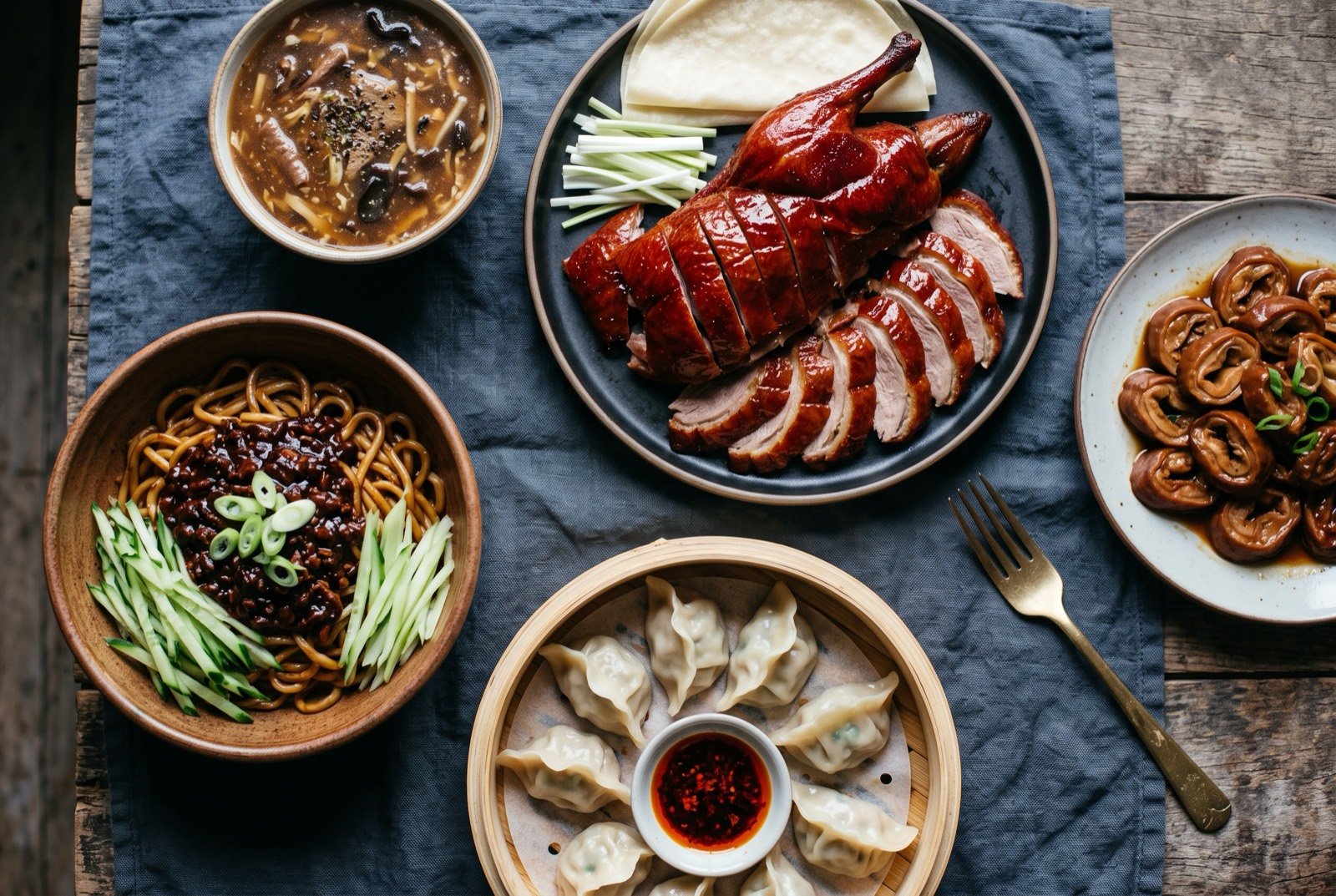
Beijing, Tianjin, Hebei, Henan and Shandong, taken seriously. The North China Plain that fed the imperial capital on wheat, not rice, and on stock, not sauce, where a hung-oven duck technique was lifted wholesale from palace suckling-pig roasting within a decade of a shop's founding, and where the hundred-and-eight-dish Manchu-Han Imperial Feast most people have heard of turns out to be a twentieth-century commercial reconstruction rather than a recovered court menu. Every dish as tradition built it, then what a modern chef would change.
Sources and review · What this chapter does not assert · How we research · Spotted something wrong?
A Sense of Place
Five provinces sit on this chapter's table and none of them grow rice as a staple. That single ecological fact, wheat instead of rice, is the whole reason the North China Plain reads as one food world rather than five separate ones: Beijing and Tianjin at the plain's northern edge where it meets the steppe, Hebei ringing the capital, Henan straddling the Yellow River's middle reaches, and Shandong pushing east into the Bohai and Yellow Seas on its own peninsula. Where southern China eats rice with everything, this plain eats wheat with everything: jiaozi, mantou, baozi and noodles are not one dish among many here, they are the daily starch itself, older and more load-bearing than any named dish this chapter will give twice.
The plain's other defining fact is that it fed the capital, twice over, by two entirely different mechanisms. The first mechanism was proximity and conquest: when the Ming dynasty moved its capital from Nanjing to Beijing in 1421, and when the Qing inherited that same capital and its court apparatus two centuries later, Shandong's simple nearness to the new seat of power meant a disproportionate number of the palace's own chefs were recruited from Shandong. Multiple independent Chinese sources converge on this specific mechanism, not as an isolated coincidence but as a structural pipeline that persisted across two dynasties, and it is the reason Beijing's own historic high-dining district still carries a named Qing-era Shandong-cuisine restaurant, Tongheju, among its old "eight great mansions". This should not be overstated into a single tidy story, and the record itself pushes back against a too-simple version of it: individual emperors kept their own tastes regardless of which region supplied the kitchen staff, and Qianlong's own well-documented personal preference for Jiangnan, Suzhou and Hangzhou, cooking is the clearest counter-example, the point at which "the Qing court ate Shandong food" stops being a safe thing to assert without qualification. The second mechanism arrived after the first one ended: when the 1911 revolution abolished the court itself, its named chefs did not vanish, they opened restaurants. Fangshan, on Beihai Park's north shore, was founded in 1925 by four named former imperial kitchen cooks, explicitly styled to recreate court dishes, and it still holds national Intangible Cultural Heritage status for exactly that transmission. Closed court technique became open commercial technique within a single generation, twice, at two different centuries.
Shandong itself is not one cuisine but three, and the distinction matters more here than in most chapters this atlas has written, because all three fed the same court. Jinan cuisine is defined above all by its stock work, the deliberate, hours-long divide between a clear soup and a milky one, painstaking and slow by design. Jiaodong cuisine, the coastal branch centred on the Yantai peninsula, is seafood-forward, built around a fishing and trading economy the interior plain never had; Fushan, near Yantai, is renowned enough in its own right to be called simply "the hometown of cooking". Confucius Mansion cuisine, the aristocratic branch out of Qufu, is a genuinely distinct, nationally listed sub-tradition rather than a marketing label, built by an unbroken line of enfeoffed nobility across dynasties who absorbed court cooking and the cuisine of every visiting official who passed through. A looser fourth, Boshan cuisine, is named less consistently across sources and is not treated here as a fully separate branch.
Henan is the plain's own centre, in the oldest sense of the word, and it makes exactly the historical claim you would expect a region straddling the Yellow River's middle reaches to make. Kaifeng was the Northern Song capital; Luoyang, further west, has been a capital city under more than one dynasty; and Henan's food writers make their own bid for the title "mother cuisine" of Chinese cooking, resting it on Yi Yin, the semi-legendary Shang-dynasty figure credited as China's founding chef. This chapter treats that claim exactly as it treats Shandong's identical claim for Lu cuisine: as a live rhetorical position taken by an interested party, not a settled historical fact, and returns to the contest properly in the next section.
A table of provinces, defining logic and dishes
| Province or city | Defining logic | Carried by |
|---|---|---|
| Beijing | Capital city, wheat staple, court cuisine filtering into commercial restaurants after 1911 | Peking duck, jiaozi, zhajiangmian, copper-pot lamb hotpot, baodu, douzhir |
| Tianjin | Port city on the Hai River and the Grand Canal, later nine foreign concessions | Goubuli baozi, jianbing guozi, Kiessling's Western restaurant lineage |
| Hebei | The plain ringing the capital, wheat and donkey-meat country | Lu rou huo shao |
| Shandong | Three internal schools, Jinan's stock work, Jiaodong's coastal seafood, Confucius Mansion's court-adjacent formality | Scallion-braised sea cucumber, sweet and sour Yellow River carp, nine-turn intestines, Dezhou braised chicken |
| Henan | The Yellow River's middle reaches, Kaifeng's Song-dynasty capital legacy, wheat-noodle culture | Hu la tang, huimian, Luoyang water banquet, carp with dragon-whisker noodles |
The History in Layers
Before Beijing was a capital at all, roast duck was already elite food, and its documented lineage runs south, not north. The earliest reasonably firm textual anchor for roast duck as court cooking is not Beijing at all: it is the Yuan-dynasty court physician Hu Sihui's 1330 dietary manual Yinshan Zhengyao, which records a method for "烧鸭子," roast duck, at the Mongol court. Chinese food historians trace the lineage onward through the Ming court kitchens, which were based in Nanjing before the Yongle Emperor moved the capital north to Beijing in 1421, carrying court cooks and the roast-duck tradition with them, by way of what became Nanjing's own "金陵片皮鸭," sliced-skin duck. One Chinese food-history outlet has separately argued that duck-roasting itself is ultimately a "胡食," a non-Han import from the plain's northern and steppe neighbours; this specific claim comes from a single credible source and could not be corroborated academically within this chapter's research, so it is offered here as a single-source claim, not a settled one.
The technology that made Beijing's duck famous did not develop on its own. It was a named, dateable transfer of palace roasting technique from one animal to another, inside one shop, within one decade. Quanjude was founded in 1864 by Yang Quanren, a Hebei dry-goods trader who bought a failing shop on Qianmen Street and renamed it. He hired a cook remembered as "Chef Sun," who had worked in the Qing court's own meat-roasting bureau, the 包哈局, and who is credited with adapting the palace's method for roasting whole suckling pig on an open hung spit to duck instead. This is the plainest possible demonstration of this atlas's own animating idea inside a single Beijing shop: a restaurant technique with a genuine indigenous ancestor, elevated by doing an existing court method more deliberately on a different animal, not by importing anything foreign. Bianyifang's rival closed-oven method is older still, tracing its name to 1416, and the two techniques, hung-oven guaergou and closed-oven menlu, are administered as two genuinely separate crafts by China's own Intangible Cultural Heritage authority, not treated as cosmetic variation on one dish. This chapter returns to both methods in real technical depth below.
The Manchu-Han Imperial Feast, as most people have heard it described, a single codified banquet of a hundred and eight palace dishes served over one to three days, is not well documented as a real Qing court institution under that name, and this chapter will not repeat it as history. What is genuinely documented is more interesting than the myth. The earliest textual use of the term "满汉席" is in Li Dou's Yangzhou Huafang Lu, an eighteenth-century notebook recording a Yangzhou merchant banquet served during one of the Qianlong Emperor's southern tours, not a Beijing palace document. A specially-appointed professor at Hubei University, Pan Honggang, has argued in a 2024 book that the palace not having a fixed banquet under this name does not mean the banquet form itself, Han hosts serving Manchu food to Manchu guests and the reverse, did not exist and spread through official and folk dining independently of any single court kitchen. The genuinely documented enormous Qing court banquets are the 千叟宴, the Thousand Elders Banquets, held only four times in the whole dynasty under Kangxi and Qianlong, mixing several thousand Manchu and Han guests across three days on roughly eight hundred tables of food; Chinese food writers themselves describe this as the prototype of the later Manchu-Han idea, not the thing itself under that name. The modern hundred-and-eight-dish banquet sold by restaurants today is a twentieth-century commercial reconstruction built on top of these genuine fragments, not a recovered historical menu, and this chapter deliberately does not assert a specific dish count as the real historical Manchu-Han Feast.
Lu cuisine's own claim to be the "mother cuisine" of Chinese cooking is contested from a direction most Western food writing never mentions: Henan makes the identical claim, on different grounds, for exactly the same title. Shandong's food writers argue Lu cuisine is the only genuinely "self-originated" tradition among China's great cuisines, formed on its own out of local agriculture and Confucian court culture rather than shaped by trade or migration the way Cantonese or Huaiyang cooking were, and from that self-originated status, the argument runs, it spread outward and fed directly into the imperial kitchen. Several of the same Chinese-language pieces making this argument immediately undercut it by noting that Lu cuisine has the lowest public visibility of any of the so-called "eight great cuisines" today, and by acknowledging that the whole eight-great-cuisines framework is itself a promotional and pedagogical device from the 1970s to the 1990s, not a rigorous historical classification. Henan's culinary establishment makes essentially the same rhetorical move for 豫菜, resting its claim to be the wellspring of all the great Chinese traditions on Yi Yin, the semi-legendary Shang-dynasty founding chef, whose own birthplace is contested across four separate traditions with no firm textual resolution. A mainstream Chinese news outlet has explicitly called the entire "mother cuisine" contest between the two provinces unproductive, and this chapter agrees: both claims are attributed to their source below, and neither is adjudicated.
Confucianism itself gets pressed into service for both regions, and one of its most quoted food lines turns out to argue the opposite of what it is usually made to say. "食不厌精,脍不厌细," commonly translated as an endorsement of refined, elaborate cooking and quoted constantly in Confucius Mansion cuisine's own promotional material, comes from the Analects, Xiang Dang 10.8. A Chinese-language Confucian-studies site has argued that read in full context, alongside the same passage's eight repeated food refusals for spoiled, discoloured, badly cut or badly sauced food, and its explicit caution against eating too much even of good meat, the line's actual argument is closer to moderation than to gourmet extravagance. This chapter treats the phrase as genuinely Confucius's own, and its popular use as a slogan for lavish cuisine as a stretch that Chinese-language scholarship has itself pushed back on.
Tianjin's own history runs on a separate track from Beijing's entirely, and the chapter treats it that way rather than as Beijing's little sibling. Tianjin's identity is dated by local sources to the Sui-dynasty opening of the Grand Canal, and its position at the Hai River's mouth on the Bohai coast gave it two simultaneous food economies at once, a genuine seafood and river economy alongside a land-trade-hub economy linking the capital region to the Northeast and to Shandong and Jiangsu. Following the treaty settlements after the Second Opium War, Tianjin held concessions for nine foreign powers, more than any other Chinese treaty port, and unlike Beijing's or Shanghai's smaller Western contact this generated a resident foreign population with real, still-traceable culinary infrastructure: Kiessling, founded 1907 by the German Albert Kiessling in the German concession, is named alongside Shanghai's Chez Rouge and Beijing's Maxim's as one of "China's four great Western restaurants," a genuinely distinct lineage with no Beijing equivalent. Locals have their own name for their relationship to good food: 卫嘴子, "the mouth of the Garrison," meaning both glib-tongued and, as a point of local pride, genuinely knowing how to eat well regardless of a shop's outward appearance.
The most recent layer sits inside a single restaurant in today's Beijing, and it is the clearest living proof that this plain's court technique is still an active inheritance rather than a museum piece. Da Dong, the trade name of Dong Zhenxiang, patented his "酥不腻" (crispy, not greasy) reinvention of Peking duck in 2001 after a five-year development process, changing duck age, oven shape and roasting time to break with the assumption that the dish must be fatty. Chinese trade press names him directly as a disciple of Wang Yijun, a National Treasure-level Lu cuisine master who spent seventy years at Fengzeyuan, one of old Beijing's historic "eight great restaurants," and who is credited as the source of that house's own clear and milky stock and its classic Lu dishes. Da Dong's celebrated modern duck sits directly on top of a documented Lu cuisine lineage, not apart from it, exactly this atlas's argument that every elevated restaurant technique in these cuisines has an indigenous ancestor.
The Flavour Arsenal
Wheat, the plain's true staple
Wheat flour is the base of everything this chapter treats as daily food: jiaozi, mantou, baozi and every noodle dish below. Millet and sorghum were the older staples of the plain before wheat's dominance, and both remain present in regional dishes and in liquor production, but wheat is what a reader should reach for first.
The two stocks Shandong built a whole cuisine on
清汤, clear stock, is built from fat hen, fat duck and pork knuckle, brought to a fast boil to release scum, skimmed, then dropped to a bare simmer, described in Chinese sources as "菊花泡," "chrysanthemum-bubble," small intermittent bubbles and never a rolling boil, held there for hours. The final polish for a genuinely transparent soup uses minced chicken breast and thigh meat stirred into the hot stock as a "raft," coagulating and trapping remaining particulate before a final strain through cloth, a technique functionally identical to French consommé clarification, arrived at independently under a different name. Confucius Mansion cuisine pushes the same principle further with 三套汤, "three-fold stock," where a stock already made by the clear method becomes the liquid for a second batch of raw ingredients, and that second stock in turn simmers a third, three full extraction cycles, repeatedly named as the standout technical feat of Kong-family kitchens.
奶汤, milky stock, is the deliberate inverse. The same fattier cuts are brought to a full rolling boil and kept there, never skimmed, for a few hours, then strained. The rolling boil is the entire point: it mechanically shears fat into microscopic droplets while soluble proteins released by the long cook act as emulsifiers, holding that fat suspended in the liquid rather than letting it pool on the surface. A China Association for Science and Technology explainer confirms the mechanism directly: a white soup needs enough fat, an emulsifier and enough mechanical agitation to combine them, and the milkier a soup looks, the more fat it contains, not more nutrition.
Zhangqiu scallions, the King of Scallions
章丘大葱, Zhangqiu scallion, is a real, long-documented, protected Shandong ingredient, not a marketing invention. Its ancestral introduction to the Qi-Lu region is traced to around 681 BCE, and the Zhangqiu County Gazetteer records it becoming an imperial tribute item in the Ming Jiajing reign, personally titled "King of Scallions" by the Jiajing Emperor in 1552. Chinese sources give it four defining traits, "高、长、脆、甜," tall, long, crisp and sweet: an unusually vigorous plant, a white shank typically 50 to 60cm and up to around 80cm at its longest, notable crispness, and a genuinely sweet white part with very little of ordinary scallion's sharp bite. It carries current national geographic-indication protection and has twice set Guinness World Records for the longest scallion. It is eaten two ways worth knowing: raw, cut into batons and dipped in sweet bean paste wrapped in a flatbread, a genuinely everyday habit, and as the specific accompaniment Quanjude insists on for its own roast duck, on the stated grounds that any other scallion makes the flavour impure.
Sea cucumber and abalone, the banquet-grade shellfish
Both are nearly flavourless once rehydrated and both are genuine luxury goods, in China and in Britain alike. Sea cucumber's whole culinary logic in this cuisine is "以浓攻浓," attacking richness with richness, layering concentrated savouriness onto a blank canvas via scallion oil and reduced stock rather than seasoning the sea cucumber directly. No oil or salt may touch the rehydration water at any point, either will break the rehydrated flesh down entirely.
The Yellow River's own carp
黄河鲤鱼, Yellow River carp, has a genuine documented delicacy status: the Jinan Fu Zhi prefectural gazetteer records "黄河之鲤,南阳之蟹,且入食谱," Yellow River carp and Nanyang crab both entering the recipe books, real gazetteer-level evidence of the fish's standing, though not proof of any specific recipe's antiquity. Sources specify the Jinan-area fish particularly, for its golden scales, red tail, tender flesh and few bones against carp generally.
Hu la tang's spice bench
Sichuan peppercorn and white pepper together are the genuine core of Henan's hu la tang, alongside chilli oil and five-spice powder, a real exception worth flagging plainly, since this is not Sichuan food and Sichuan peppercorn belongs nowhere else in this chapter. Fenugreek and a wheat-gluten wash (面筋, the solid protein washed out of salted dough, and the starchy wash water it leaves behind) are the soup's other structural ingredients, the wash water stirred into the boiling stock as a genuine starch-slurry thickener, not a flour roux.
Sesame paste, sweet bean sauce and the condiments that carry the plain's flavour
芝麻酱, sesame paste, made from roasted rather than raw sesame and genuinely distinct from tahini, is essential to Beijing's hotpot dip and to hu la tang alike. 甜面酱, sweet bean sauce, sweeter and thinner than hoisin, with more sugar and less vinegar, is the historically correct pancake condiment for Peking duck, though restaurants in English-speaking markets routinely mislabel it "hoisin" for a Western audience, a confusion this chapter does not repeat. 黄酱, yellow soybean paste, is zhajiangmian's own base, traditionally sourced from Liubiju, a Kangxi-era Beijing house still trading today. 豆瓣酱, doubanjiang, appears in this chapter in a form most UK cooks will not expect: a plain, non-spicy fermented soybean and broad-bean paste, not the fiery Pixian chilli paste Sichuan cooking made famous.
The Technique Ladder
Five rungs, each doing real, explicable work.
Rung 1. Separate the duck's skin from its fat before any heat touches it
A tube or nozzle inserted through the neck incision pumps air by hand or pump between the skin and the underlying subcutaneous fat, inflating the skin to roughly 80% taut, "充到八成满." Chinese sources describe this as the single most important step for crisp skin, because it physically creates an air gap for rendered fat to drain into during roasting, rather than pooling directly beneath the skin and keeping it wet. Duck fat begins rendering at a comparatively low internal temperature, well before the skin's own structural collagen and keratin set and harden, which is the physical reason the fat can drain out before the skin has finished cooking, provided the gap already exists for it to drain into.
Rung 2. Glaze with maltose, dry with real air, and understand what each is doing
Boiling water poured over the raw skin first causes immediate, localised collagen shrinkage, tightening the surface before any sugar or heat is applied. A maltose syrup, roughly 50g maltose to 450g water, is then ladled over the whole bird, usually twice, and does two jobs: the sugar itself Maillard-browns at roasting temperature for the dish's characteristic jujube-red lacquer, and the syrup layer seals moisture and fat beneath the skin through the drying stage that follows. That drying stage, several hours in a cool, shaded, well-ventilated place, never direct sun, which weeps fat out, is a genuine dehydration step, not a cosmetic one: it bonds the skin more tightly to the connective tissue beneath it, thickening the effective skin layer so it crisps under dry heat rather than blistering thinly or simply steaming in its own moisture.
Rung 3. Choose your oven logic deliberately, open flame or sealed residual heat
Quanjude's hung-oven method, guaergou, burns fruit wood as an open flame throughout the roast at 230 to 250°C, the duck hanging on a pole and constantly rotated by hand for even exposure, no door to close, cooking by direct radiant and convective heat with a comparatively dry internal cavity. Bianyifang's closed-oven method, menlu, is the deliberate inverse: fuel is burned inside the oven first and then extinguished entirely, and the duck cooks purely on the chamber's residual, stored heat with no flame contact at any point, its cavity filled with hot stock rather than plain water before it goes in, so the bird effectively poaches from the inside while it roasts from the outside, "外烤内煮." The two methods hold separate national Intangible Cultural Heritage listings precisely because Chinese heritage authorities treat them as genuinely different crafts, not cosmetic variants of one dish, and a home cook choosing between an open, actively fired kamado-style cook and a closed, lid-down, dying-ember cook is making the same real choice.
Rung 4. Build a clear stock by trapping particulate, not by filtering it away
A minced-meat raft, lean meat and sometimes egg white, is added to a warm stock and brought back to a boil while stirring, then left to simmer undisturbed. As the proteins denature and coagulate they form a mat that physically traps suspended fat and particulate as it rises through the liquid, clarifying what is beneath, the same coagulation-and-filtration principle as a French consommé's raft, arrived at independently. A milky stock is built by refusing every part of this discipline on purpose: boiled hard rather than gently, never skimmed, so fat and connective-tissue protein emulsify into the liquid instead of being trapped and removed.
Rung 5. Pound, don't chop, when the dish wants a velvet texture
芙蓉鸡片's chicken velvet is built by pounding chicken breast with the back of the cleaver, traditionally struck around 300 times in one direction, not with the blade's edge, mechanically extracting and aligning the muscle's own myofibrillar protein into a smooth, workable paste, the same underlying principle as a Western quenelle or mousseline forcemeat, done by hand rather than by machine shear. Mixed with egg white roughly 1:3 and poached gently in oil held at roughly 90°C, a temperature chosen specifically because higher heat causes the setting protein network to boil internally and honeycomb, ruining the intended silky, cloud-soft texture.
The Ferment and Preserve Bench
Douzhir
Douzhir, the fermented run-off from mung bean starch noodle production. Mung beans are soaked, hulled, wet-ground into a slurry, and the slurry left to ferment in a vat; the starch settles for noodles, and the soured liquid on top is raw douzhir, drunk cold or cooked and served with fried 焦圈 and pickled vegetables. Qianlong himself is recorded as having ordered this humble street ferment brought into the palace in 1754, a real instance of folk food travelling upward, the opposite direction to Peking duck's palace-to-street journey.
六必居's pickle bench
Founded in the Kangxi era, Liubiju is historically known for pickles alongside its yellow soybean paste, a genuine Beijing house worth knowing beyond zhajiangmian's sauce.
Master stock (卤水), for the donkey-meat substitution below
A five-spice, soy and rock-sugar braising liquid, built once and kept, that a home cook can use to braise beef shin or brisket as an honest substitute for Hebei's unobtainable lu rou huo shao, discussed fully under Sourcing.
Sourcing in Britain
Verified September 2026. This is, by the established pattern of this atlas, a genuinely well-served volume for UK sourcing, given Britain's long-established Chinese grocery trade. Where a supplier could not be fully confirmed, that is said rather than smoothed over.
The ranked list: what decides great from grim
- Buy a Silver Hill duck, not a Gressingham, for Peking duck. This is the single highest-leverage decision in the whole chapter. Gressingham is explicitly bred for less fat and more breast meat, the opposite of what this dish needs. Silver Hill, from Emyvale, County Monaghan, is the actual trade standard behind an estimated 98% of London Chinatown's roast ducks, and it is retail-buyable direct from Alternative Meats for £24.95.
- Use real tianmianjiang, sweet bean sauce, not hoisin, for the pancake dip, and know that the two are genuinely different products despite restaurants routinely calling sweet bean sauce "hoisin" for English-speaking customers. WASO's CBL brand is a verified UK stockist.
- Do not reach for Pixian doubanjiang, and do not assume Sichuan peppercorn belongs everywhere in this book. This region is not Sichuan food. Sichuan peppercorn's one genuine home here is Henan's hu la tang, and nowhere else in this chapter.
- Accept there is no real Zhangqiu scallion substitute, and say so rather than reaching for ordinary spring onions and calling it equivalent. A thick-shafted UK leek, a Giant Musselburgh-type variety, is the closest match for bulk and sweetness in cooked dishes; nothing UK-available reproduces the specific variety's character.
- Budget seriously, or substitute honestly, for dried sea cucumber and abalone. Real banquet-grade stock runs into three figures for a single dish's ingredients, £125 to £150 for a good sea cucumber at UK Dried Seafood Ltd. Canned abalone from a shop like Pasar Mart UK is a legitimate, much cheaper entry point that should be offered rather than hidden.
- Use plain flour, not bread flour, for jiaozi wrappers. UK bread flour's higher protein fights the rolling and produces an overly chewy result. Sous Chef's dedicated Chinese Dumpling Flour is a genuine named product worth reaching for.
- Name the donkey meat gap honestly. There is no UK route to real lu rou huo shao with donkey. Braising beef shin or brisket in the master stock above is a legitimate technique substitution, not a disguised original.
- Use the chinois for what it is actually for here: Shandong's clear and milky banquet stocks, not a generic nice-to-have already sitting in a cupboard.
Named shops and delis
See Woo, Lisle Street, London Chinatown, trading since 1975, over 8,000 imported ingredients; a dedicated seafood section worth checking in person for dried sea cucumber and abalone. New Loon Moon Supermarket, Gerrard Street, over 40 years trading, three storeys, a wholesale supplier to major UK supermarkets as well as a retail shop. Loon Fung Supermarket, Chinatown, trading since 1965. Wing Yip, superstores at Purley Way, Croydon, and Cricklewood, the widest single-chain range of frozen mandarin pancakes, sauces and dried goods in the country. Sous Chef and Oriental Mart curate smaller, well-chosen ranges with reliable UK delivery and are the right starting point for this chapter's named sauces.
Outside London
Manchester: Wing Yip, Oldham Road, over 4,500 products with a strong seafood section and a butchery prepped for Chinese cooking; Hang Won Hong, George Street, a dedicated dried seafood counter worth checking directly for sea cucumber and abalone. Birmingham: Wing Yip Birmingham Superstore, the chain's original store and UK headquarters, the single largest Chinese-grocery footprint in the country. Liverpool: Chung Wah Supermarket and WH Lung. Glasgow: SeeWoo Glasgow, described as Scotland's biggest Asian superstore. Newcastle: Sun Fung Supermarket, Stowell Street, opened 2024, and HiYou Oriental Food Emporium, with online delivery.
Honest gaps
Donkey meat has no UK commercial supply chain at all; a hard gap, not a soft one. Fresh Zhangqiu-variety scallion is not available, and no UK allium genuinely reproduces its scale of sweetness. A dedicated "duck pump" or "duck hook" product does not exist as a named UK retail item; both are honest DIY substitutions, a bicycle track pump and generic butcher's S-hooks. Reliable, checkable stock of dried sea cucumber and abalone at specific grades is confirmed for only one dedicated specialist site, with items already selling out; Chinatown counters almost certainly carry more, but their physical stock could not be verified beyond general claims. Small independent Chinese groceries close, relocate and rebrand without much notice, and every shop named above should be phone-checked or visited before being treated as a live recommendation, especially before relying on one for the expensive dried seafood above.
Voices and Sources
From inside the tradition
- Wang Yijun (王义均), National Treasure-level Lu cuisine master, seventy years at Fengzeyuan, one of old Beijing's historic "eight great restaurants," credited as the source of that house's own clear and milky stock and its classic Lu dishes, and, through his own disciple Da Dong, this chapter's clearest single documented example of a modern reinvention built on top of a real house tradition.
- Dong Zhenxiang ("Da Dong"), whose "crispy, not greasy" Peking duck, patented in 2001 after a five-year development process, is named directly in Chinese trade press as trained under Wang Yijun's tutelage, and whose own stated philosophy, always Chinese food at the centre, drawing on other places and peoples for technique, is this chapter's clearest primary account of deliberate elevation from inside a real lineage.
- Wang Haoquan (王浩全), chef-founder of Lu Shang Lu, Beijing, two Michelin stars, whose own stated operating principle, real ingredients, craftsmanship, real flavour, cleanliness, and whose explicit naming of Lu cuisine's three historic branches, Confucian-mansion, southwestern Shandong and Jiaodong coastal, as his own source material, is this chapter's strongest documented case of a working restaurant treating tradition as a deliberate starting point rather than a marketing word.
- Chen Zongming (陈宗明), Jinan-based chef with roughly 50 years in the trade, trained under Lu cuisine master Yan Jingxiang, who has built a public following teaching traditional Lu technique before opening his own restaurant in Jinan in 2024, a genuine living transmission of technique still active outside the capital.
- Bai Yongming, twentieth-generation national-heritage-listed inheritor of Bianyifang's closed-oven duck technique, and the documented seventh-generation line of transmission at Quanjude from the original ex-palace cook remembered only as "Chef Sun," both real, named, unbroken lines of craft transmission this chapter draws its technical detail from directly.
The gap, named rather than papered over
No documented London or wider UK restaurant meets this chapter's bar for genuine, years-long, named technique lineage back to this region's cuisine. Andrew Wong's own formal training is documented for Sichuan cuisine, at the Sichuan Higher Institute of Cuisine, and while multiple reputable English-language profiles state he "learned the secret of perfect Peking duck in Beijing," none names the restaurant, the master chef, or the duration of that stage; this chapter does not present his Beijing duck technique as documented lineage on the strength of that alone. Hutong, at the Shard, markets its own food as "based on the Lu school cuisine of Shandong Province," but its own reported past head chefs, Fei Wang and Bing Luo, are both documented as trained at Sichuan cuisine institutions with career paths through Sichuan-style restaurants; this is a genuine, sourced discrepancy between a restaurant's own marketing and its documented staffing, named directly here rather than left to stand unchallenged.
Things this chapter has deliberately not asserted
- That the Manchu-Han Imperial Feast was a real, fixed, hundred-and-eight-dish Qing court banquet, eaten by emperors as routine. The 108-dish figure traces to a Yangzhou merchant banquet recorded by Li Dou, not to any Beijing palace document; the genuinely documented enormous court banquets are the four Thousand Elders Banquets, which Chinese food writers themselves describe as the idea's prototype, not the thing itself under that name.
- That either Shandong or Henan is settled fact as the "mother cuisine" of Chinese cooking. Both provinces' own food writing makes this claim, on different grounds, and a mainstream Chinese news outlet has explicitly called the contest between them unproductive. This chapter attributes both claims to their source and adjudicates neither.
- That Peking duck's roasting tradition is definitively a "胡食," a non-Han northern import. This specific claim rests on one credible but single Chinese source and could not be corroborated academically.
- That the Beijing duck breed descends with certainty from either imperial hunting stock or Grand-Canal-transported southern lake duck. Both accounts circulate in Chinese sources with no clear scholarly resolution.
- A single, fixed roasting time for either hung-oven or closed-oven duck. Sources give figures ranging from 40 to 70 minutes depending on the source and likely on bird size and era of practice; this chapter reports the range rather than a false precision.
- A single, settled founding date for Goubuli baozi. The popular date of 1858 and the national heritage body's own documented timeline of 1869 to 1882 disagree, and this chapter reports both rather than resolving the discrepancy.
- That baodu's origin lies in a specific Guangxu-era Qing court archival record. This claim rests on one lower-tier source and could not be independently corroborated; the safer claim is simply that baodu is old Beijing market food of uncertain precise origin.
- That zhajiangmian or jianbing guozi have a documented founding date or originator. Both are honestly reported as old, regional dishes of uncertain precise origin, rather than assigned an invented founding story for narrative convenience.
- That hu la tang's Song-dynasty or Ming-dynasty origin story is historical fact. Chinese-language sources on the dish itself call its origin unverifiable folk legend, and this chapter reports it as exactly that.
- That the Luoyang water banquet's Wu Zetian origin story is historical fact. A named Luoyang cultural scholar has directly disputed the popular account, and this chapter follows his more sceptical, continuity-and-decline reading over the legend.
- That the Yellow River's ecology can be traced through documented food history to either Lu cuisine's or Henan cuisine's specific development. Research for this chapter found only contemporary hydrology and agriculture policy material connecting the two, not food-history scholarship, and this chapter does not draw a causal line the sources do not support.
- That any restaurant technique attributed to Fengzeyuan, Quanjude, Bianyifang, Donglaishun or Goubuli in this chapter's Elevation sections is a documented practice at that specific house, except where a named chef or restaurant is stated directly, Da Dong's own reported oven and timing changes and Lu Shang Lu's own reported donkey-hide gelatin elevation among them. Everywhere else, the modernist techniques offered are this chapter's own extrapolation of the technique ladder's logic onto this reader's own kit, named as exactly that.
Separate the duck's skin from its fat before any heat touches it
A tube or nozzle inserted through the neck incision pumps air by hand or pump between the skin and the underlying subcutaneous fat, inflating the skin to...
Glaze with maltose, dry with real air, and understand what each is doing
Boiling water poured over the raw skin first causes immediate, localised collagen shrinkage, tightening the surface before any sugar or heat is applied.
Choose your oven logic deliberately, open flame or sealed residual heat
Quanjude's hung-oven method, guaergou, burns fruit wood as an open flame throughout the roast at 230 to 250°C, the duck hanging on a pole and constantly...
Build a clear stock by trapping particulate, not by filtering it away
A minced-meat raft, lean meat and sometimes egg white, is added to a warm stock and brought back to a boil while stirring, then left to simmer undisturbed.
Pound, don't chop, when the dish wants a velvet texture
芙蓉鸡片's chicken velvet is built by pounding chicken breast with the back of the cleaver, traditionally struck around 300 times in one direction, not with the...
The dishes
- Peking Duck Beijing
- Jiaozi The North China Plain
- Zhajiangmian Beijing
- Beijing Copper-Pot Lamb Hotpot Beijing
- Goubuli Baozi Tianjin
- Scallion-Braised Sea Cucumber Shandong (Jiaodong coast)
- Sweet and Sour Yellow River Carp Shandong (Jinan)
- Nine-Turn Braised Intestines Shandong (Jinan)
- Hu La Tang Henan (Xiao Yao Town)
- Peony Swallow-Nest Henan (Luoyang)
Sources and review
- Reviewed
- Not yet reviewed from inside the tradition
- Cooked
- Not yet cooked and reported
Where this volume comes from
3 research briefs on file for this volume, researched to the rules on How we research. Published 4 September 2026. Last changed 8 September 2026.
The brief's own account of its sources
This brief rests overwhelmingly on Chinese-language, in-tradition sourcing, run through real Mandarin-language search, not English queries with a Chinese term inserted. Bloc A (Beijing/Tianjin): approximately 55 to 60 distinct Chinese-language URLs used as the basis of fact, including five separate national Intangible Cultural Heritage project pages (ihchina.