The Sinosphere · Volume 26, The Hung Oven, the Clear Stock and a Banquet That Never Quite Existed
Peony Swallow-Nest
Henan (Luoyang)
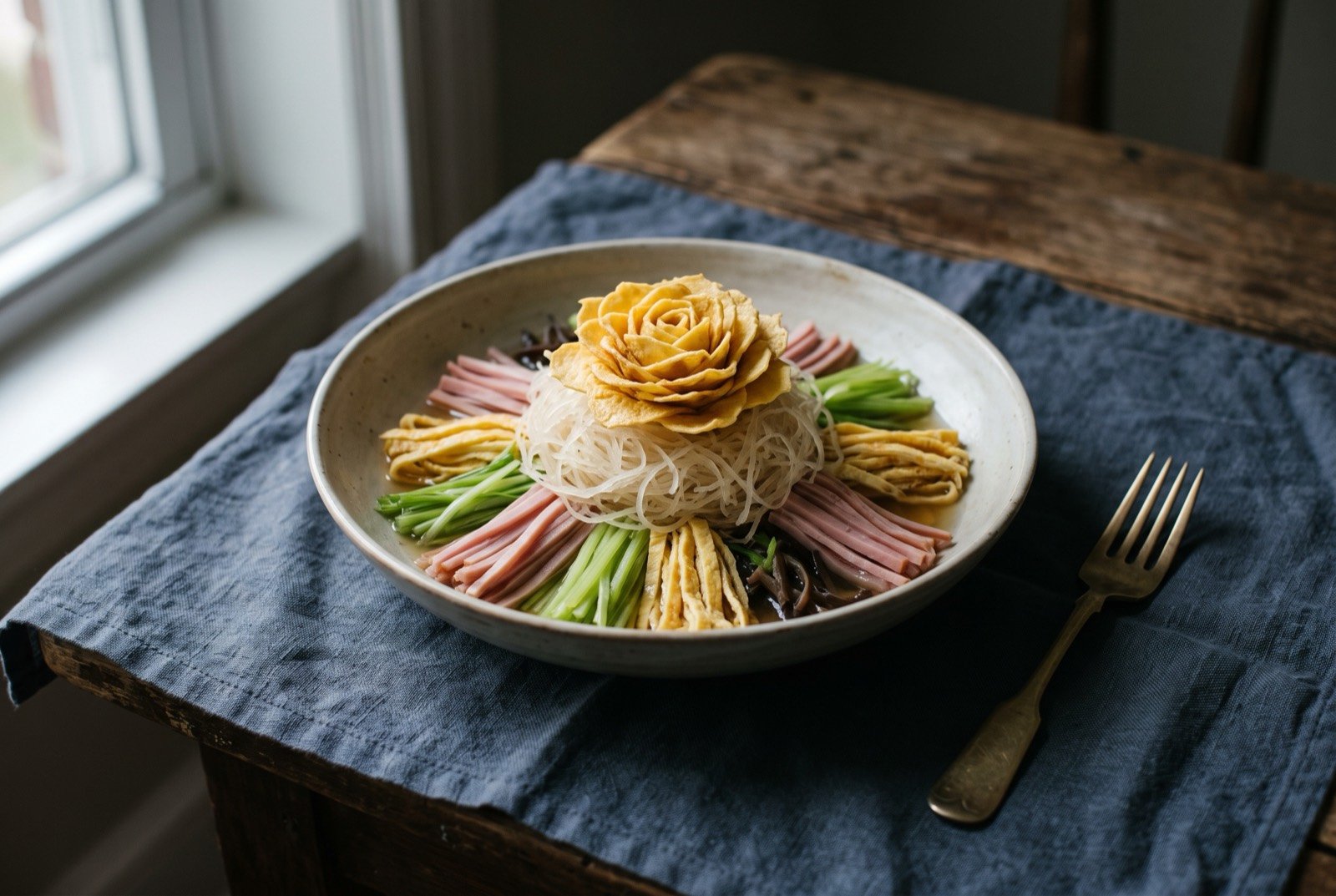
An illustration of the dish, not a photograph of it cooked.
- Time
- 30 minutes
- Reviewed
- Not yet reviewed from inside the tradition
- Cooked
- Not yet cooked and reported
The opening dish of the Luoyang water banquet, a 24-dish set (8 cold, 4 large hot, 8 medium hot, 4 anchoring dishes) in which every single course carries broth or sauce, "件件有水,样样带汤," the entire reason for the banquet's name. Popular legend credits Empress Wu Zetian with the dish's invention, at least three separate, mutually inconsistent versions of the story; a named Luoyang cultural scholar, Zhang Yuanchun, has pushed back directly on the whole popular account, arguing the prestigious version declined along with Luoyang's own fortunes after the Song capital moved south, and what survives is a folk simplification of something that changed substantially over a thousand years, not an unbroken re-enactment of a single Tang-dynasty banquet. This chapter presents the Wu Zetian stories as legend and Zhang's continuity-and-decline account as the better-grounded reading.
As tradition built it
Serves 4 as a banquet opener. About 30 minutes active time, plus 3 days of drying and freezing (a genuinely long process; a shortened version follows in the modernist notes).
Ingredients
- 1 large white radish (daikon), shredded fine
- 25g ham, shredded
- a small handful egg sheet, shredded
- a small handful imitation crab-stick, shredded
- a small handful day-lily buds
- as needed stock, hot, to finish
Method
- Steam and sun-dry the shredded radish repeatedly, traditionally nine times each, then freeze at around minus 18°C for up to 90 days, dehydrating and toughening the strands toward a texture resembling bird's nest.
- Mound the dehydrated radish "nest" on a serving plate.
- Surround it with eight matched bundles alternating ham, egg-sheet, crab-stick and day-lily-bud shreds.
- Steam the assembled dish for half an hour.
- Finish with a golden egg-sheet garnish arranged in the shape of a peony flower.
- Pour hot stock over the dish at the table.
What a modern chef changes
A dehydrator standing in for weeks of sun-drying, and a clear stock finish. Rungs 2 and 4, combined.
Rungs 2 and 4
Method
- Use a dehydrator to compress the traditional nine-times steam-and-dry cycle into a single, controlled overnight process, applying rung 2's dehydration logic (removing surface moisture deliberately, not incidentally) to a vegetable rather than a duck's skin, a genuine, honest shortcut that changes the traditional timeline without changing the finished texture's underlying principle.
- Finish with a proper raft-clarified clear stock (rung 4) rather than a generic hot stock, since this is, after all, a Henan dish opening a banquet whose whole grammar is built on soup, and a genuinely clear finishing stock honours that grammar more than an opaque one would.
- Freeze the shredded radish in a single thin layer rather than a block, for faster, more even dehydration in a domestic freezer than the traditional 90-day method assumes access to industrial cold storage.