The Sinosphere · Volume 26, The Hung Oven, the Clear Stock and a Banquet That Never Quite Existed
Scallion-Braised Sea Cucumber
Shandong (Jiaodong coast)
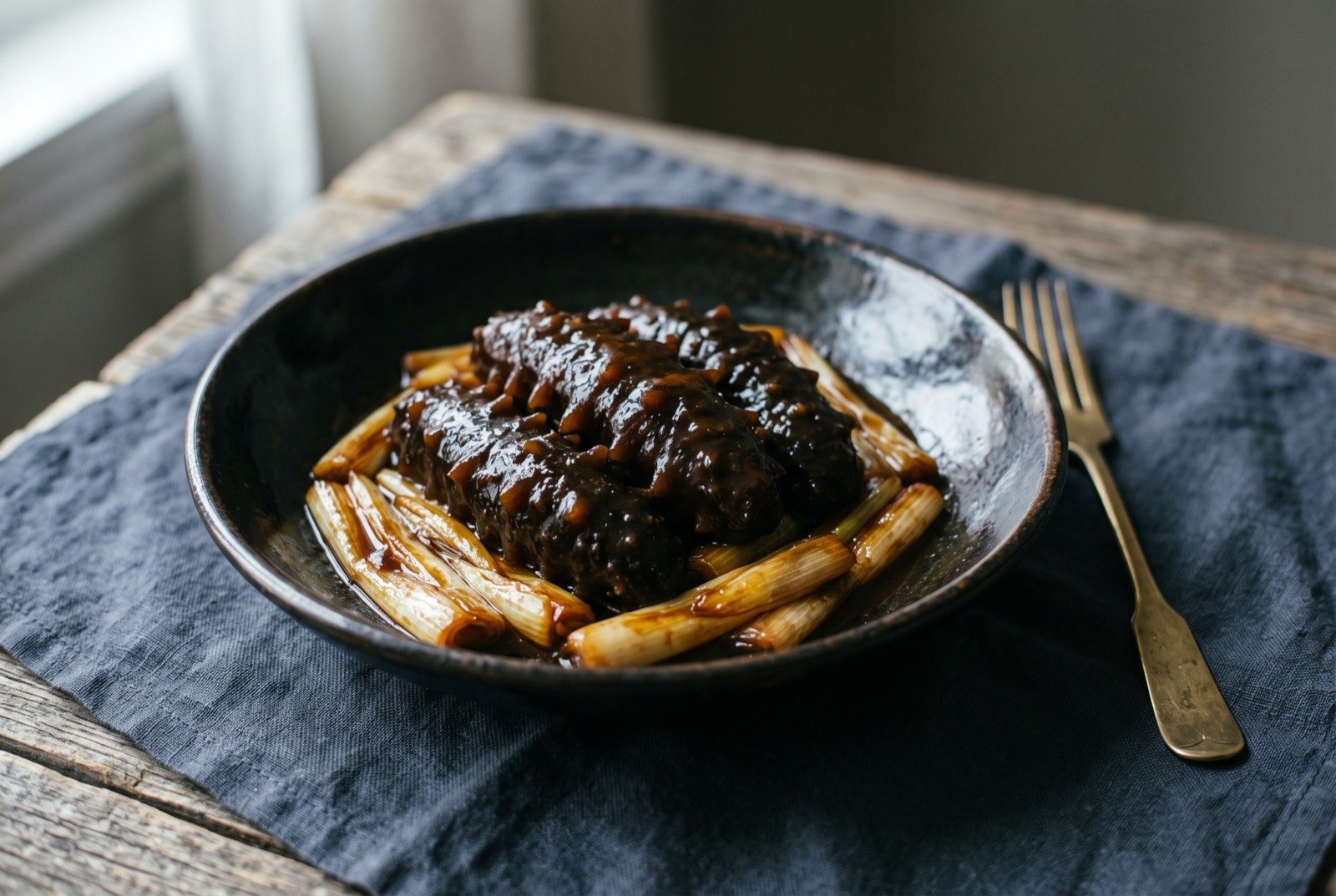
An illustration of the dish, not a photograph of it cooked.
- Time
- 1 hour
- Reviewed
- Not yet reviewed from inside the tradition
- Cooked
- Not yet cooked and reported
A classic dish of the Jiaodong branch of Lu cuisine, originating in Fushan near Yantai, named among Shandong's ten classic dishes in 2018. Sea-cucumber cookery generally is traced to Qing-dynasty recipe texts, evidence of the ingredient's Qing-era status rather than proof of this specific recipe's age.
As tradition built it
Serves 4 as part of a banquet. About 1 hour, plus rehydration time (allow 2 to 3 days ahead).
Ingredients
- 400g rehydrated sea cucumber, cut into oblique slices roughly 1.6cm by 5 to 6.6cm
- 2, or 1 thick leek Zhangqiu scallion or a thick UK leek substitute, split lengthwise, cut into 5 to 6.6cm sections
- 125g lard or oil
- as needed ginger, a few slices
- to taste Shaoxing wine, salt
- as needed stock, for poaching
- 1 tbsp; 1 tsp; 1 tbsp, mixed with 2 tbsp water soy sauce, sugar, cornflour, for the braise
Method
- Blanch the rehydrated sea cucumber once in boiling water, remove.
- Separately simmer stock with a piece of scallion and ginger, salt and Shaoxing wine, then poach the sea cucumber gently in this and drain.
- Heat the lard until very hot, roughly 80% of smoking point, and fry the scallion and ginger with a little soy sauce until the scallion turns deep golden, then remove and reserve as scallion oil.
- Return a portion of that oil to the wok, add the fried scallion back with the sea cucumber, stock, soy sauce, sugar, salt and wine, and simmer through.
- Thicken with a cornflour slurry, then finish by pouring the reserved scallion oil over the dish just before plating.
What a modern chef changes
A sous vide rehydration and a controlled reduction, after Lu Shang Lu's own documented Beijing reinterpretation. Rung 4's reduction discipline.
Rung 4
Method
- Rehydrate the sea cucumber under sous vide at a low, held temperature rather than an open soak, for more even, controllable rehydration without any risk of oil or salt contamination breaking the flesh down.
- Follow Lu Shang Lu's own documented practice and work donkey-hide gelatin (阿胶, a genuine Shandong speciality) into the braise, a real, named contemporary elevation of this exact dish rather than an invented flourish, offered here exactly as that.
- Reduce the braising sauce to the point the traditional method names, "食后盘无余汁," no sauce left on the plate after eating, using a wide pan and patience rather than a thickener alone to get there.