The Sinosphere · Volume 26, The Hung Oven, the Clear Stock and a Banquet That Never Quite Existed
Zhajiangmian
Beijing
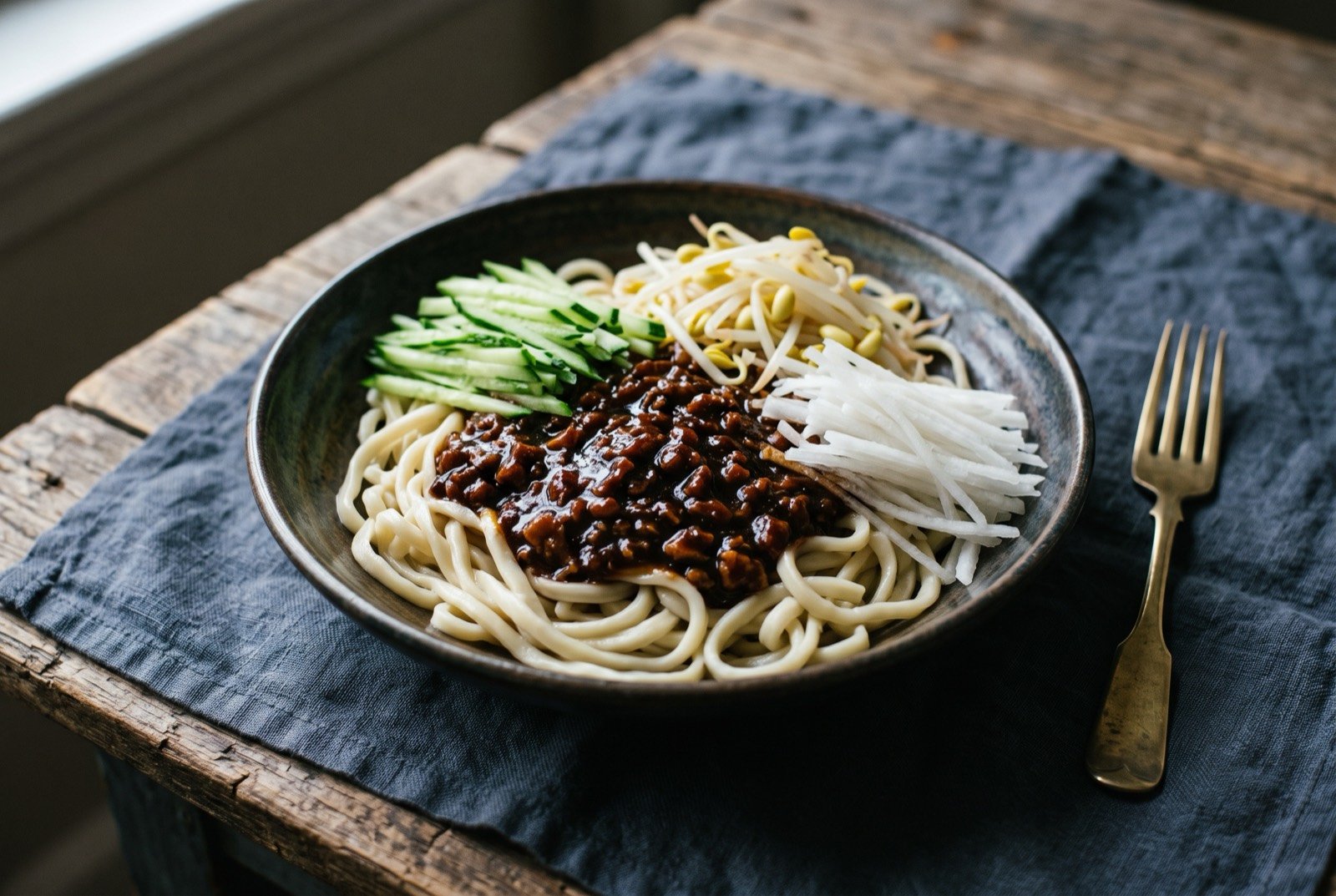
An illustration of the dish, not a photograph of it cooked.
- Time
- 45 minutes
- Reviewed
- Not yet reviewed from inside the tradition
- Cooked
- Not yet cooked and reported
No single well-corroborated founding date or origin story survives beyond "several hundred years old, Beijing, Hebei and Tianjin region," an honest gap this chapter does not paper over. One well-documented transnational fact is worth naming: the Korean jjajangmyeon now standard in Korea descends from this dish, carried to Incheon and adapted by Shandong-origin Chinese migrants in the early twentieth century and reshaped further, sweeter and blacker, through the 1950s, a Korean adaptation of the Beijing original, not the reverse.
As tradition built it
Serves 4. About 45 minutes.
Ingredients
- 400g wheat noodles, fresh if possible
- 300g pork belly or shoulder, diced small
- 3 tbsp yellow soybean paste (黄酱)
- 1.5 tbsp sweet bean paste (甜面酱)
- as needed scallion and ginger, chopped
- as needed vegetable oil
- as available cucumber, bean sprouts, radish, toon sprouts or edamame, to garnish (菜码)
Method
- Fry the diced pork in oil with scallion and ginger until fragrant and lightly browned.
- Mix the yellow and sweet bean pastes roughly 2:1 and add to the pork.
- Slow-fry the sauce down, "小碗干炸," until the oil visibly separates and rises to the surface, the traditional mark of a properly fried sauce.
- Cook the noodles, drain well.
- Top the noodles with the sauce and a generous scattering of raw or lightly blanched vegetables, tossed together at the table.
What a modern chef changes
A slower, better-controlled sauce reduction and a dehydrator for the garnish. Rung 4's reduction discipline, applied to a bean paste rather than a stock.
Rung 4
Method
- Reduce the sauce at a lower, more controlled heat over a longer time, watching for the same visible fat separation the traditional method targets, but achieving it more evenly with a heavy pan and a probe thermometer than by eye on a domestic hob.
- Dehydrate a portion of the toon sprouts or radish for a concentrated, crisp garnish alongside the fresh raw vegetables, adding a genuinely different texture to the traditional 菜码 array without changing its principle.
- Hand-cut the noodles from a rested, high-protein dough rather than using shop-bought noodles, giving a chewier bite closer to the dish's street-stall origins.