The Sinosphere · Volume 26, The Hung Oven, the Clear Stock and a Banquet That Never Quite Existed
Jiaozi
The North China Plain
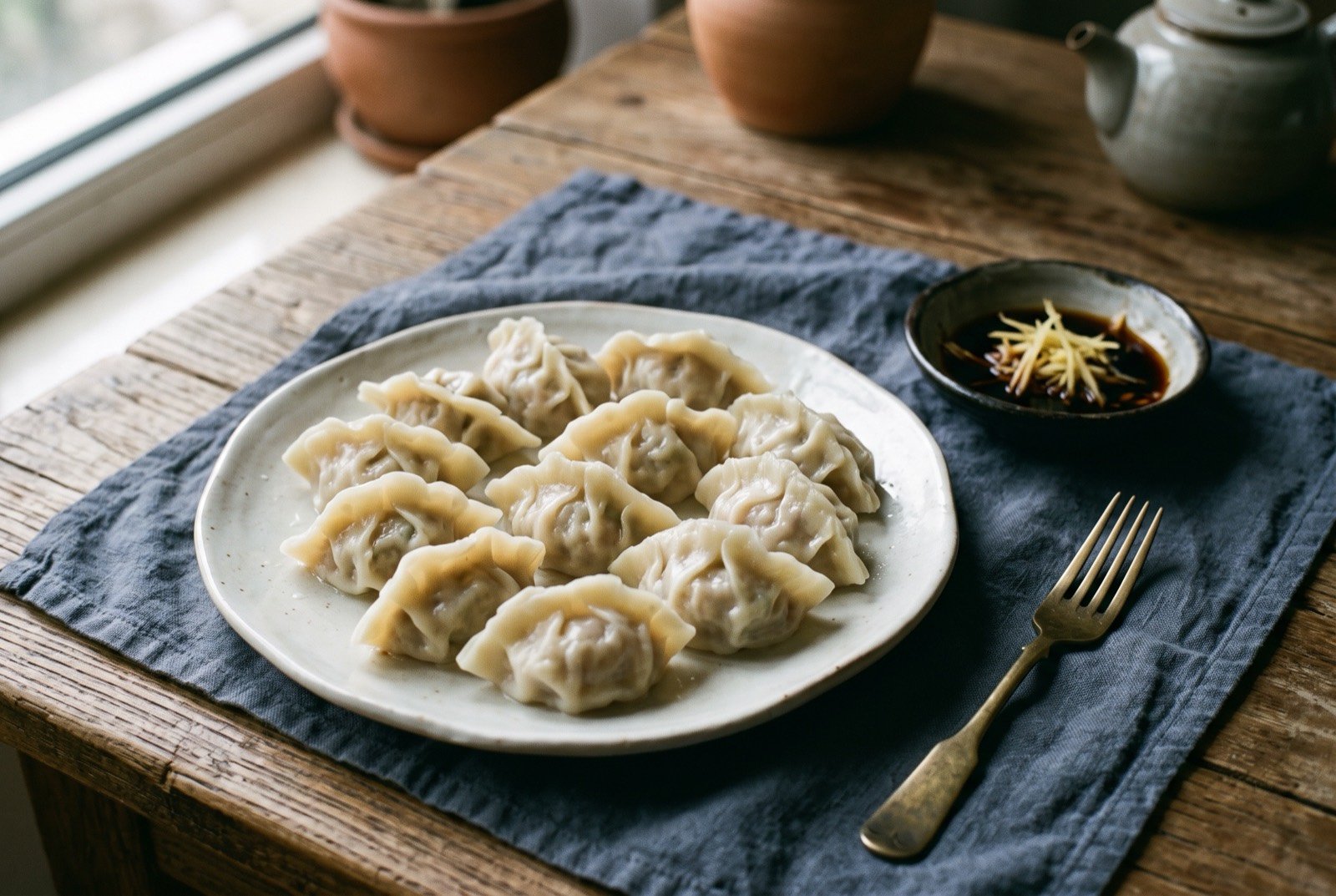
An illustration of the dish, not a photograph of it cooked.
- Time
- 1 hour 30
- Reviewed
- Not yet reviewed from inside the tradition
- Cooked
- Not yet cooked and reported
The near-universal Chinese origin story credits Zhang Zhongjing, the Eastern Han physician later revered as a sage of medicine, with devising a warming mutton and herb soup wrapped in ear-shaped dough to treat frostbitten ears among the poor, the origin of the dumpling's older name "娇耳," tender ears. Chinese sources themselves present this as legend, 相传, not documented history, and this chapter reports it as exactly that: a genuinely old and widely believed story, not a verified event.
As tradition built it
Pork and cabbage filling.
Makes about 40 dumplings, serves 4 to 6. About 1.5 hours.
Ingredients
- 500g plain flour, roughly 10% protein
- 250ml water
- 500g Chinese cabbage, finely chopped
- 1 tsp salt, for the cabbage
- 400g minced pork, 20 to 30% fat
- 30ml scallion-ginger water (scallion and ginger steeped in water, strained)
- 1 tbsp light soy sauce
- 1 tsp sesame oil
- to taste white pepper, to taste
Method
- Mix the flour and water into a firm dough, knead until smooth, rest covered for 30 minutes.
- Salt the chopped cabbage, leave 10 minutes, then squeeze out as much liquid as possible.
- Beat the pork with the scallion-ginger water in several additions, working it in one direction until the mixture turns sticky and tacky, "起胶" (the same protein-binding mechanism as rung 5).
- Fold in the cabbage, soy sauce, sesame oil and white pepper.
- Divide the dough into small balls, roll each into a disc roughly 1.5mm thick at the centre and 1mm at the rim, 8 to 10cm across.
- Place a spoonful of filling in the centre of each wrapper, fold and pinch the edges shut.
- Boil in plenty of water until the dumplings float and the wrapper is translucent, about 5 minutes, or steam for a softer skin.
What a modern chef changes
A high-power blender for the filling, sous vide for the cabbage. Rung 5's binding logic, applied to a vegetable rather than a protein.
Rung 5
Method
- Pulse the pork briefly in a high-power blender rather than hand-mincing, which extracts and aligns the same myofibrillar protein rung 5 describes for chicken velvet, giving a more even, better-bound filling with less manual beating required.
- Vacuum-seal the salted cabbage and compress it under a sous vide bath's own light pressure for 10 minutes rather than squeezing by hand, drawing out water more evenly and leaving a denser, less watery vegetable component.
- Rest the finished dough for a full hour, not 30 minutes, under cling film, for a more relaxed gluten structure that rolls thinner without tearing, a genuine improvement a home cook with time to spare can make over the traditional shop-floor pace.