Aotearoa and Australia · Volume 02, The Ration, the Milk Bar and the Bush Table
Dim sim
Melbourne
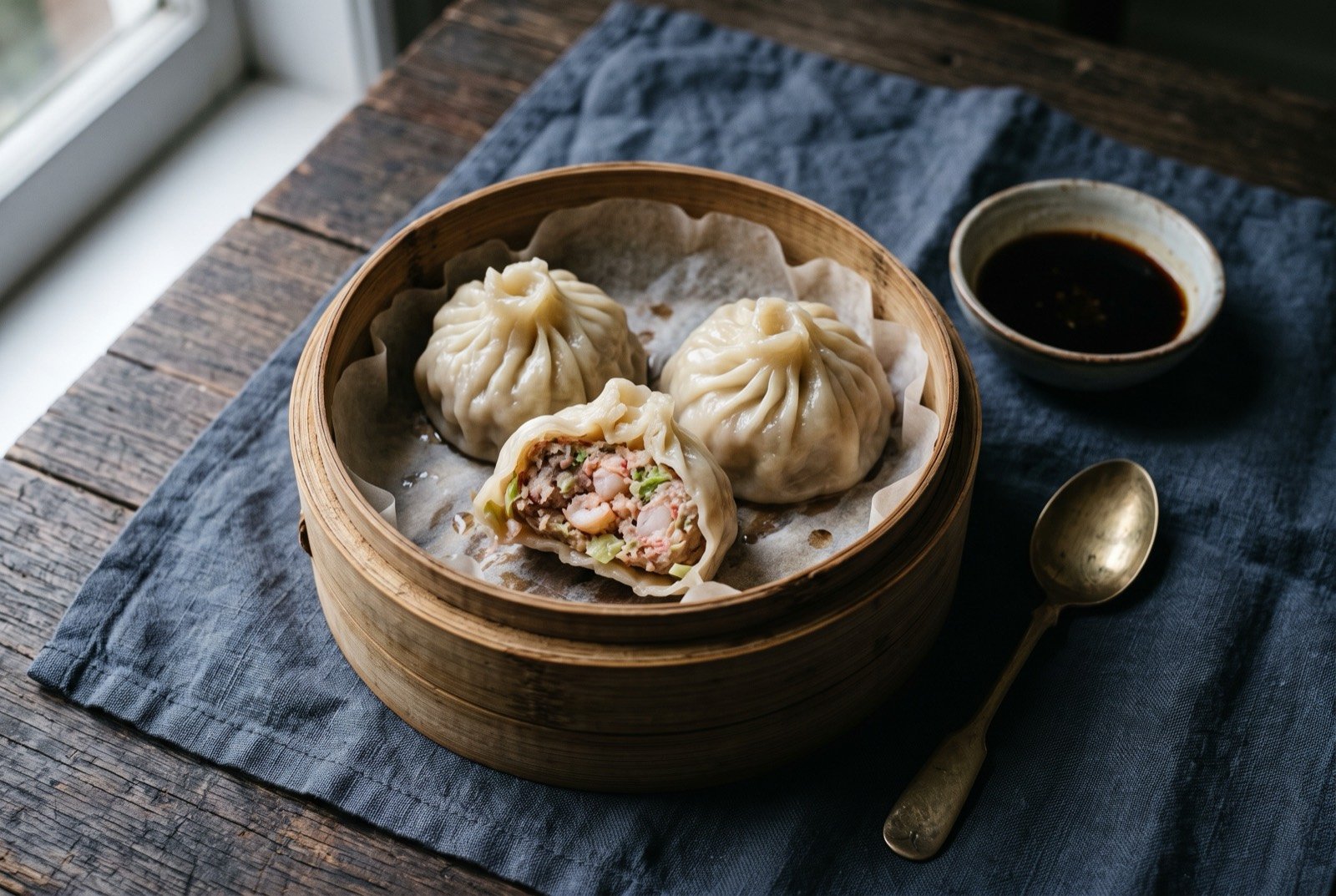
An illustration of the dish, not a photograph of it cooked.
- Time
- Hands on 30 minutes · Waiting 30 minutes
- Reviewed
- Not yet reviewed from inside the tradition
- Cooked
- Not yet cooked and reported
William Chen Wing Young invented the modern Australian dim sim in Melbourne's Chinatown in 1945, adapting Cantonese siu mai for mass factory production and Anglo-Australian taste. His daughter Elizabeth Chong, a professional Chinese-Australian chef and broadcaster, is the direct, named, in-tradition source for both the recipe's origin and its name: "They called it a dim sim because in my dialect we don't say dim sum, we say dim sim." The larger "South Melbourne dim sim," the format most Australians actually recognise, carries a second, independent 1949 lineage through Ken Cheng, who began selling them from a trolley at Caulfield Racecourse before relocating to South Melbourne Market.
As tradition built it
Elizabeth Chong's own sieu mai, published via SBS's The Cook Up with Adam Liaw. Yields 30 pieces. About 30 minutes, plus 30 minutes chilling.
Ingredients
- 30 wonton wrappers, 7.5 cm square
- 125 g fresh green prawns, peeled, deveined, finely chopped
- 155 g fatty pork mince
- ½ cup water chestnuts, diced
- ½ cup canned bamboo shoots, drained and diced
- ½ cup spring onion, diced, mainly white part
- ½ cup celery, diced
- 2 tsp table salt
- ¼ tsp white pepper
- 1 tsp fresh ginger, grated
Method
- Combine the prawn and pork with the water chestnuts, bamboo shoots, spring onion and celery.
- Add the table salt, white pepper and fresh ginger and pound the mixture until smooth; chill 30 minutes.
- Round off the wrapper corners; fill each with a tablespoon of the mixture, gather the sides and pleat the top; pack the filling firm with a butter knife so it stands proud of the wrapper, and flatten the base so the dumpling stands upright.
- Steam over boiling water for 15 to 20 minutes.
Notes
Dipping sauce: soy sauce to sesame oil, roughly two parts to one.
Commercial dim sim as sold in Australia today typically scales this into a larger, denser, more cabbage-forward parcel than Chong's own delicate original.
What a modern chef changes
This chapter's own technique work; no fine-dining precedent for dim sim was found in this research.
Rung 5
Method
- Hand-chop the prawn rather than processing it, exactly as Chong's own recipe specifies, for a genuinely different, less pastelike texture than a food processor gives.
- Steam over a controlled, thermometer-checked heat rather than a rolling boil, for a more even set through the filling.
- Finish the dipping sauce with a native touch, a drop of finger lime vesicles through the soy and sesame, a small, honest addition rather than a claim that any restaurant does this.