Oceania and the Pacific · Volume 02
Settler and Modern Australia
The Ration, the Milk Bar and the Bush Table
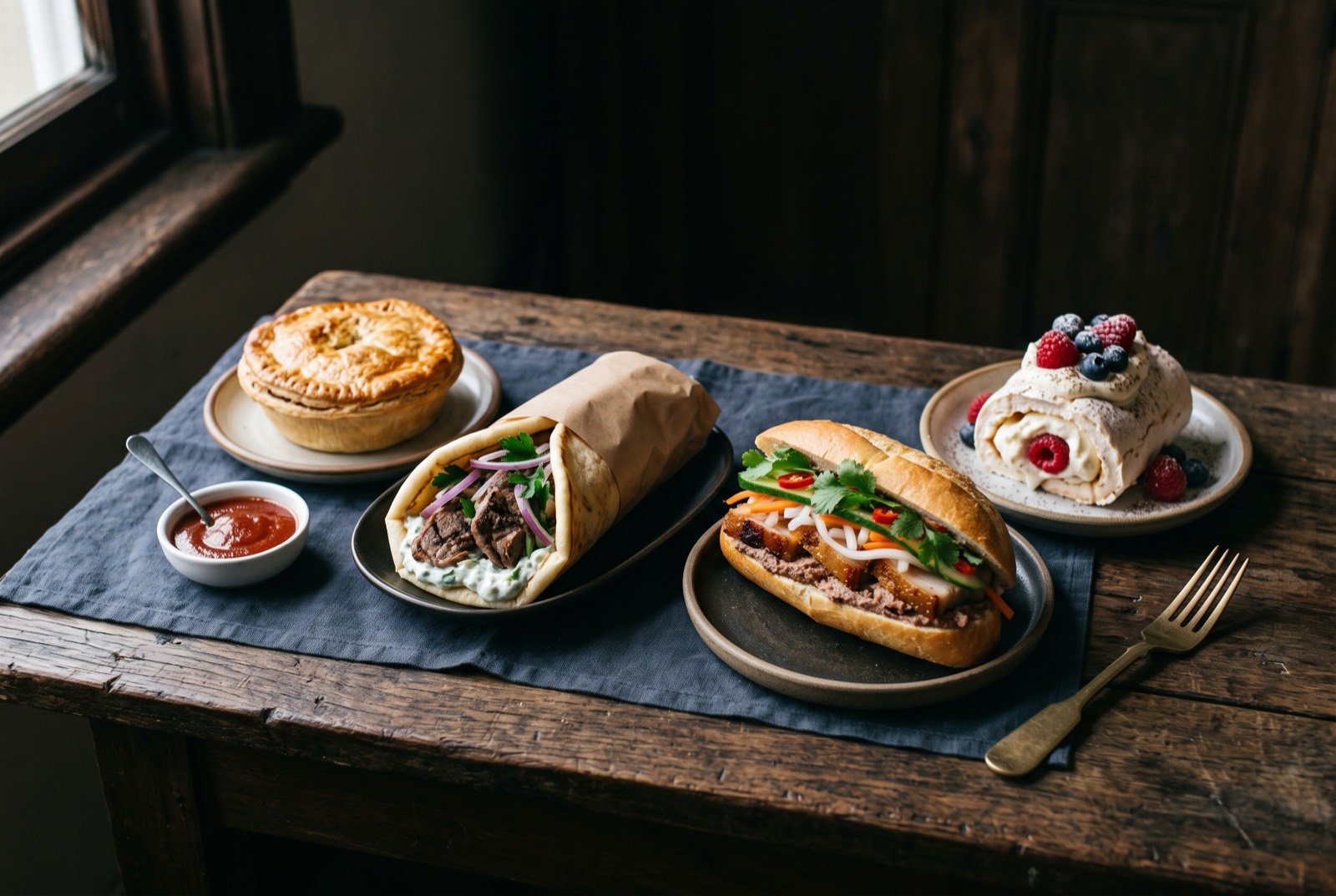
The meat pie and the Sunday roast, Vegemite on toast and chicken parmigiana, Vietnamese pho and banh mi in Cabramatta and Footscray, and a contemporary native-ingredient fine-dining movement folding the continent's own foodways back in.
Sources and review · What this chapter does not assert · How we research · Spotted something wrong?
A Sense of Place
Australia's settler and migrant food has no single ecological logic the way most of this atlas's volumes do, because it isn't one cuisine responding to one landscape. It is four distinct historical processes laid over the same continent: a penal colony's rations hardening into a national pub diet; a pastoral economy built on wool and, later, refrigerated meat exports; a sequence of immigration waves each one initially unwanted and each one now claimed as part of "Australian food"; and a still-unfinished reckoning with the fact that the ingredients this country is proudest of internationally, wattleseed, quandong, Kakadu plum, finger lime, saltbush, mountain pepper, macadamia, belonged to somebody first, and that somebody is very rarely who ends up plating them.
| Thread | What fills the structural role | What actually organises the food |
|---|---|---|
| The British ration, hardened into pub food | Salt beef, flour, golden syrup, tomato sauce, lamb | Scarcity first (First Fleet rationing), then pastoral wealth (wool, refrigerated meat export), then working-class institutionalisation (the pub, the servo, the fundraising sausage sizzle) |
| The migrant wave, absorbed and reclaimed | Olive oil and lamb (Greek); tomato, garlic and espresso (Italian); soy, ginger and pork (Chinese); pita, lamb and pickled vegetable (Lebanese); nuoc mam, rice paper and fresh herb (Vietnamese) | Chain migration into a handful of named suburbs, Oakleigh, Carlton, Leichhardt, Cabramatta, Footscray, Lakemba, where each community's own food economy, milk bar, espresso bar, market, bakery, grew strong enough to be discovered by everyone else |
| The native-ingredient movement | Wattleseed, quandong, macadamia, saltbush, lemon myrtle, mountain pepper, finger lime, green ant, paperbark | Aboriginal and Torres Strait Islander knowledge, developed and held over millennia (the full account of which is OC-01's, not this chapter's), now supplying a settler-led fine-dining industry that is, on its own published figures, somewhere between 1 and 2 per cent Indigenous owned |
None of these three threads is this chapter's invention as a grouping. It is the atlas's own scope decision, made in the volume map that preceded this chapter: OC-02 covers "Settler and Modern Australia," the 250 years since 1788, while the tens of thousands of years before it, and the knowledge systems that never actually stopped, belong to OC-01. Reading this chapter without that companion volume in mind risks the exact error the "not asserted" section at the close of this chapter names directly: mistaking a settler restaurant's rediscovery of a native ingredient for that ingredient's invention.
A word on searching. This chapter's research ran in English throughout, and says so rather than pretending otherwise. Two of its three threads, the British-colonial throughline and the fine-dining movement, are English-language subjects by their nature. The third, the postwar migration layer, is not, and a genuine attempt was made to search in-language: Greek and Vietnamese searches both returned real, usable results, including a Vietnamese-language broadcast on Cabramatta's fiftieth-anniversary festival, read and used directly below; Italian, Arabic and Turkish searches were not attempted with the same depth, a real limitation named honestly rather than smoothed over.
The History in Layers
The First Fleet's ration, and what actually survived it
The convict transports that reached Sydney Cove in January 1788 carried food chosen for a voyage, not a colony: 135 tierces of beef, 165 of pork, 448 barrels of flour, 116 casks of pease, 8 barrels of rice, later topped up from HMS Sirius with sago, spices and vinegar. Surgeon George Worgan recorded the standard weekly ration for an adult male convict as 7 lb salt beef or 4 lb pork, 3 pints dried peas, 7 lb flour, 6 oz butter and half a pound of rice, women receiving two thirds of that and children less again; within two months of landing it was already clear the colony's own two-year supply target would not stretch, and rations were cut. The meat that made the crossing survived it by the barrel method: rubbed with salt and saltpetre, packed in alternating layers of meat and salt, the cask finally sealed with brine. The slang for the result, "salt junk," is not a colonial coinage; it is inherited Royal Navy and merchant-marine English, older than the settlement itself, and this chapter treats it as such rather than crediting Australia with a word it only borrowed.
Damper is the ration's one genuine survivor as a named, still-cooked dish, and its own origin story does not survive close checking as cleanly as its folklore suggests. Two sources disagree on its first print appearance, one dating it to 1825 in Barron Field's Memoirs, the other to a Colonial Magazine reference from 1840 in Van Diemen's Land; neither claim is reconciled here, and this chapter states the discrepancy rather than picking a side. What is better supported is narrower than the popular story: damper became closely associated with stockmen, drovers and swagmen from the mid-nineteenth century because flour, salt and water needed only a campfire, but the bread itself is documented as general colonial fare from at least the 1820s to 1840s, predating any single occupational-invention story. And damper is not, this chapter says plainly, a descendant of Aboriginal bush bread, the ground-seed, ash-baked loaves Aboriginal Australians had made for millennia before European contact from native grass and acacia seed. The two share a cooking method, coals and ash, and nothing else; any claim that colonial ash-baking technique was learned from Aboriginal practice remains, per the sources checked here, unproven rather than established, and the deeper, actual history of Aboriginal bush bread belongs to OC-01.
Wool, then meat: the pastoral economy behind the Sunday table
Australia's wool industry is dated from 1797, when John Macarthur and the Reverend Samuel Marsden imported Spanish merino sheep, the first Australian wool sale reaching London's Garraway's Coffee House in 1821. Squatters and pastoralists grew rich on wool through the century, and the specific hinge that turned Australia from a wool economy with meat as a byproduct into a meat-exporting nation as well was the arrival of refrigerated shipping in the 1880s, which let lamb and mutton travel to Britain at scale for the first time. The British Sunday roast, transplanted onto this abundance, became a weekly Australian ritual, though this chapter is honest that the specific social history of when and how that transplant took hold is thinly documented next to the wool trade's own well-recorded economics: what can be stated is the pastoral fact, not a dated social one.
Vegemite, and the local answer to a British shortage
Vegemite began as a wartime supply problem, not an act of national invention from nothing. Fred Walker & Co.'s food technologist Cyril Percy Callister, whose biography is anchored in the Australian Dictionary of Biography rather than the brand's own marketing copy, was set the task in the early 1920s of making a spread from Carlton & United's brewers' waste yeast after the First World War disrupted British Marmite imports; sources differ narrowly between 1922 and 1924 for the exact development date, and this chapter carries that uncertainty rather than inventing false precision. The name came from a national naming competition with a £50 prize, chosen in the end by Fred Walker's own daughter from among the entries, the actual winning entrant never recorded. Vegemite's early sales were slow against its established local rival, Sanitarium's Marmite, and it took a decade of promoting the spread's Vitamin B content, then the 1950s "Happy Little Vegemites" jingle, to make it a household staple rather than a curiosity. It spent over ninety years under foreign ownership, Kraft from 1935, until Bega Cheese bought it back for AUD 460 million in January 2017, a genuinely tidy fact for a spread whose whole cultural identity is "unmistakably Australian": for most of the twentieth century, it wasn't Australian-owned at all.
White Australia's slow, two-stage end, and the migration it actually let in
The postwar immigration story is usually told as one date, 1973, and it wasn't one date. The Chifley government's Assisted Passage Migration Scheme, from 1945, brought roughly two million migrants by 1965 under the "populate or perish" policy, with formal assisted-passage agreements for Italy and informal ones with Greece; by the 1950s, Italian and Greek arrivals already outnumbered British ones. The Holt government's 1966 review, not the 1973 Whitlam reforms, was the real first crack in the White Australia policy, removing race-based discrimination against citizenship applicants, though it stopped well short of ending racial selection in immigration outright. It was Whitlam, in 1973, who formally renounced race as a selection criterion, followed by the 1975 Racial Discrimination Act. What this means for the food history below is worth stating plainly rather than letting it imply a tidier story than the facts support: the Greek and Italian migration that filled Melbourne's milk bars and Sydney's espresso bars happened in the 1950s and 1960s, squarely inside the White Australia period, under arrangements that still formally privileged European arrivals, while the Vietnamese and Lebanese Muslim migration covered later in this chapter arrived only after 1975, once race had actually been dropped as a selection test.
The milk bar, and Greek Melbourne
Greek migration to Australia predates the postwar boom by seven decades, a small gold-rush-era presence from the 1850s to 1890s working oyster saloons, soda parlours and cafes, but the community "exploded" after 1952, when assisted passage extended properly to Greek migrants. The institution that made that migration visible before souvlaki ever did was the milk bar. Mick Adams, born Joachim Tavlaridis, opened the Black and White Milk Bar on Sydney's Martin Place in November 1932; it drew 5,000 visitors on its opening day and over 27,000 in its first week, and by 1937 there were roughly 4,000 milk bars across Australia, most run by Greek migrants. A peer-reviewed history of Australian retailing independently credits the concept's "transformative transnational origins" to Adams specifically, corroborating the popular account from an academic angle rather than a journalistic one.
Melbourne carries the largest Greek population of any city outside Greece and Cyprus, a defensible claim this chapter uses in preference to the popular but unverifiable "third-largest Greek city in the world," which one comparison actually ranks seventh globally once Cypriot cities are counted. Oakleigh, Melbourne's present-day Greek food precinct, was "just a village," "very Anglocentric" as late as the 1950s; Cypriot migrant Chris Apeitos and his wife Antigone bought one of the area's first Greek-owned properties on Carlisle Street in 1954, Oakleigh Cannons FC was founded in 1972, and the suburb now holds 35,000 Greek residents, 14 per cent of them speaking Greek at home, with Eaton Mall as its commercial heart since 2000. Souvlaki itself likely arrived unremarked with the earliest 1890s Greek migrants, per Barbara Santich, Professor Emeritus at the University of Adelaide and a genuinely credentialled Australian food historian, but became mass Melbourne takeaway food specifically through outlets like The Twins on Lygon Street, Carlton, operating by the mid-1970s and namechecked directly in Helen Garner's 1977 novel Monkey Grip, a real, checkable literary marker for when the dish entered the mainstream Melbourne imagination.
Lygon Street, Leichhardt, and the espresso machine that came to the CBD
Italian settlement in Melbourne's Carlton began in the 1920s, an earlier, smaller Viggiano community of street musicians having settled Little Lonsdale Street from the 1890s, but the real numbers arrived from 1949 onward as part of Australia's mass postwar programme, overwhelmingly through chain migration, relatives and paesani already established sponsoring the next arrival rather than migrants travelling on formal schemes. Lygon Street became Australia's best-known "Little Italy." Sydney's Leichhardt tells a parallel story: Italians first settled from the late 1800s, 259 Italian-run shops and businesses were established there between 1858 and 1933, and the major postwar wave of the 1940s and 1950s worked disproportionately in construction, 1966 census data showing Italians dominating plastering, concreting, bricklaying and terrazzo work specifically. In 2020 the NSW Geographical Names Board formally renamed central Leichhardt "Little Italy," to reception the community itself describes as genuinely mixed rather than uncomplicated celebration.
Victoria's Italian-born population rose from 8,305 to 91,075 between 1947 and 1961, an elevenfold increase in fourteen years, and the single clearest pivot point for how Italian espresso became mainstream Australian culture rather than an ethnic-enclave curiosity is Pellegrini's Espresso Bar, opened on Bourke Street in 1954 by brothers Leo and Vildo Pellegrini. Unlike most Italian cafes of the era, which served within their own community, the Pellegrini brothers chose the CBD theatre district, putting an authentic Italian espresso machine in the middle of mainstream Melbourne life; Legend Café followed nearby in 1956, and Pellegrini's was heritage-listed by the National Trust of Australia in 2014.
Cabramatta, Footscray, and the food of the boat
Before 1975 there were around 500 Vietnamese people in Australia, mostly Colombo Plan students. The fall of Saigon that April is the symbolic founding date of the Vietnamese-Australian community; mass refugee arrivals followed from 1978 (5,400 that year), peaked at 12,915 in 1980, ran at 8,500 or more annually through the mid-1990s, then collapsed after 1996 as the Howard government cut family-reunion intake, down to 3,135 settler arrivals by 2006 to 2007. Cabramatta was already a migrant "transition zone," having housed successive British, German, Greek, Italian and Yugoslav waves before Vietnamese refugees were channelled through the same Cabramatta Migrant Hostel infrastructure. By the 2021 census, 37.8 per cent of Cabramatta's residents claimed Vietnamese ancestry, the suburb's largest single ancestry group.
SBS journalist Lin Taylor, whose own family fled Vietnam by fishing boat from My Tho in 1979, wrote directly of Cabramatta's harder history: through the 1980s and 1990s it was known as "the heroin capital of Australia" before its rehabilitation into a food destination "frequented by young hipster-types and food bloggers." Her account is unusually strong sourcing for this brief, a named journalist writing her own family's history rather than reported at a distance: her uncle's boat of 157 refugees was attacked by Thai pirates off Singapore, his father killed in the attack, survivors rescued after eleven days at sea by the British ship Entalina and passed through the Kuching and Air Raya refugee camps before reaching Australia. A fiftieth-anniversary festival for the Vietnamese community, held 24 to 25 October 2025 at Cabravale Memorial Park, was covered directly in Vietnamese by SBS's own Vietnamese-language service, read and used here rather than only in English translation: organiser Nguyễn Từ Hiếu Trung framed the weekend around commemoration of the boat people, gratitude to Australia, and traditional pastry-making demonstrations by artisan Bùi Thơm, alongside refugee-artefact exhibitions and boat replicas. In Melbourne, Vietnamese refugees settled Footscray from the late 1970s onward, building bakeries and grocers along Hopkins Street; this chapter's sourcing for Footscray specifically is honestly thinner than Cabramatta's, leaning on general local reporting rather than the kind of academic or community-authored source available for Sydney.
Banh mi's own Australian arrival has no confirmed first sale: the Australian Food Timeline states plainly that "the exact date of the first bánh mì sale in Australia remains unknown," naming Hong Ha Bakery in Mascot (1986), a Dinh family shop in Bankstown (1988) and Richmond's Phuoc Than (trading since 1999) as the earliest documented businesses rather than a founding moment. A banh mi that cost roughly $5.50 a decade ago now runs to $11, with some specialty shops charging up to $17, a live community argument about fair pricing for genuinely skilled labour that this chapter names rather than smooths over.
Lakemba, and a market that grew from one man's grill
Lebanese migration to Australia runs in two distinct waves that this chapter keeps apart rather than blending into one story. The first, from the 1880s, was largely Christian, fleeing Ottoman-era economic disruption after the 1869 opening of the Suez Canal broke traditional Middle Eastern trade routes; by 1892, Lebanese Sydneysiders already formed "a rather large colony" in Redfern, and the community grew slowly, from under 5,000 in 1947 to around 25,000 by 1971. The second wave, far larger and majority Muslim, followed the Lebanese Civil War from 1975; the Lebanese-Australian population doubled to 50,000 by 1981, helped by the Fraser government's bespoke "Lebanon Concession" refugee mechanism. Lakemba, today home to the highest Muslim population of any Australian suburb and the country's largest mosque, hosts the Ramadan night markets that are this chapter's clearest single example of a migrant food culture crossing fully into mainstream Sydney life: they began in 2007 when one vendor, Abdul Obeid, grilled camel meat on the footpath of Haldon Street for worshippers leaving Taraweeh prayers, and now draw over a million visitors a year, the food on offer having broadened well past Lebanese dishes into Syrian, Indian and Burmese street food. This chapter does not crown a single inventor of the Australian kebab: the commonly repeated claim that Tony Khater brought the first kebab to Sydney in 1965 comes only from that business's own account of its history, and the Australian Food Timeline itself calls the whole subject "complicated." Better documented are chain milestones: Ali Baba, founded by brothers Mick and Karl Marjan, opened outside Canberra's Woden Plaza in 1979; El Jannah, now a major national chain, opened its first Granville store in 1998.
The dim sim, and the man they called the chicken roll king
Chinese migration to Australia's goldfields began with the 1851 gold discovery, most arrivals from Guangdong province; many who didn't strike gold became market gardeners or ran cookshops feeding diggers of every background, one of the earliest documented Chinese restaurants opened by John Alloo at Ballarat in 1854. This chapter keeps that gold-rush layer firmly separate from the dish most associated with Chinese-Australian food today, because dim sim is not gold-rush food: it was invented in Melbourne's Chinatown in 1945, a full ninety years later, by William Chen Wing Young, a Chinese-Australian entrepreneur born in Wahgunyah, Victoria, in 1896, whose family originated in Guangdong. His daughter, the well-known Chinese-Australian chef and broadcaster Elizabeth Chong, is the named, in-tradition source for the story: her father "noticed Australians were especially fond of the Cantonese siu mai," adapted the recipe for mass factory production, and named the result plainly, in her own words, "because in my dialect we don't say dim sum, we say dim sim." Chen Wing Young was also known as the "chicken roll king" for a separate line of business, the direct ancestor of the (chicken-free) Chiko Roll that Frank McEncroe would later build into its own icon, one Chinese-Australian entrepreneur's innovation rippling into two unrelated national snack foods. The larger "South Melbourne dim sim" carries a second, independent lineage: Ken Cheng began selling steamed dim sims from a trolley at Caulfield Racecourse in 1949 before relocating to South Melbourne Market, where the style still bears the market's name.
The bushfood movement, credited honestly
Modern Australian cuisine as a named critical category dates precisely to the Sydney Morning Herald Good Food Guide's 1993 edition, applying "Modern Australian" to 34 restaurants and cemented under editor Leo Schofield the following year. It grew out of two things happening at once: the trade and produce culture built by postwar Mediterranean migration, then the technique and flavour supplied by Southeast and South Asian migration from the 1970s and 1980s, with young Australian chefs returning from European stages applying French technique to both. Cheong Liew, a Malaysian-born, Adelaide-based chef who arrived in 1969, opened Neddy's on Hutt Street with Barry Ross in 1975, serving dishes that fused Cantonese and French technique; in 1999 he became the first Australian chef awarded an OAM specifically for shaping the style of contemporary Australian cuisine, and he is widely, and accurately, credited as the father of Australian fusion. But Liew's fusion was not native-ingredient led, and the two threads run separately before converging.
The native-ingredient thread's clearest starting point is Jean-Paul Bruneteau, a French-Australian chef who opened Rowntrees, The Australian Restaurant, in Hornsby, Sydney, in 1984 with Jennifer Dowling, described as the first fully native-concept Australian restaurant, serving barbecued witchetty grubs in peanut sauce alongside riberry, Dorrigo pepper, warrigal greens, lemon myrtle, wattleseed and Illawarra plum sourced from small regional bushfood suppliers. Bruneteau successfully lobbied the New South Wales government to permit kangaroo meat in restaurants, and won a gold medal for "Most Original Cuisine" at Tokyo's Second International Cooking Festival in 1988 for a rolled wattleseed pavlova, a specific composed dish this chapter returns to below. Andrew Fielke opened Red Ochre in Adelaide in 1992, expanding to Cairns and Alice Springs before leaving restaurants in 2001 to found Creative Native Foods, still a wholesale bushfood supplier today. A third name belongs in this history for a less comfortable reason: Vic Cherikoff, a non-Indigenous researcher who began bushfood research in 1982 and built a wholesale business that helped commercialise roughly thirty five native plant foods now in the marketplace, is one of the industry's actual founding figures, and his centrality as a non-Indigenous man is itself part of the equity problem this chapter names directly below rather than glossing over.
That equity problem is not a fringe claim; it is published and multiply corroborated. Only 1 to 2 per cent of Australia's bush food and botanicals sector is Indigenous owned and led. First Nations businesses represent under 1 per cent of the growers, farm managers and exporters across the native botanicals supply chain, generating around 1 per cent of the industry's produce and dollar value, a gap the reporting traces in part to Aboriginal Australians having been excluded from most forms of commercial business rights until the 1970s, leaving generations without the accumulated capital the settler side of this industry could draw on. The famous settler-chef restaurants named in the dishes below are, on the ingredient side, downstream customers of a small number of genuinely Indigenous-owned suppliers: Something Wild, based at Adelaide Central Market and described as Australia's largest Indigenous-owned food and beverage company, supplies game meat, native greens and saltbush dukkah to Attica, Vue de Monde and Brae among others; Warndu, founded in 2016 by Damien Coulthard, an Adnyamathanha and Dieri man, with Rebecca Sullivan and Siobhan O'Toole, is a majority Indigenous-owned, Supply Nation-registered producer of wattleseed, saltbush, native thyme, river mint, lemon myrtle, strawberry gum and Davidson plum. Chefs Nornie Bero, Mindy Woods, Clayton Donovan and Mark Olive, all named in the dishes and voices sections below, are the direct counter-evidence that Indigenous-led fine dining exists and is excellent, not absent, and this chapter names them accordingly rather than letting the settler restaurants stand in as the whole story. What this chapter does not do, and should not be read as doing, is attempt OC-01's job: the deep, dated, region-specific history of how each of these ingredients was known, gathered and prepared before any restaurant existed belongs there, researched and told by that volume, not summarised secondhand here.
One further, useful marker rather than a founding moment: René Redzepi's Noma ran a ten-week pop-up at Sydney's Barangaroo in early 2016, building a menu around abalone, lantana flowers, green ants, crocodile fat and Kakadu plum after time spent, per his own account, with Indigenous communities in Arnhem Land, which he called "something of a tribute." Australian trade press treats this correctly as an accelerant for international attention on native ingredients, not as part of the Australian movement's own lineage, and this chapter gives it the same light touch.
The Flavour Arsenal
The colonial pantry
Salt beef and salt junk. Barrel-cured meat, the First Fleet's own preservation method: rubbed with salt and saltpetre, packed in layers, sealed in brine. Its slang name is inherited maritime English, not an Australian coinage.
Golden syrup. A British product, not an Australian one: invented around 1883 by the Eastick brothers turning a sugar-refining waste byproduct into something palatable, and still dominated by the same brand, Lyle's, that invented it. Australians nicknamed it "cocky's joy" for its place in a small farmer's cheap, portable pantry, a genuinely local twist on an imported staple.
Vegemite. Roasted brewers' yeast extract, developed by Cyril Callister in the early 1920s as a local answer to disrupted British Marmite supply. Sharper, saltier and less sweet than Marmite, and worth using thinly: it is a stronger, more concentrated spread than its British cousin, not an equivalent one.
Tomato sauce. The meat pie's non-negotiable companion, thick, sweet and vinegar-sharp; the colloquialisms attached to it, "dog's eye" for the pie and "dead horse" for the sauce, are attested slang without a dated academic etymology, and this chapter reports them as living usage rather than documented history.
The migrant pantry
Greek. Lamb (cheaper and more available in Australia than in Greece itself, where pork historically dominated), lemon, oregano, olive oil, garlic. Australian souvlaki's lettuce filling is a specifically local addition, absent from the Greek original.
Italian. Tomato, garlic, basil, parmesan, and above all proper espresso, the ingredient that did more than any dish to carry Italian-Australian food into the national mainstream.
Vietnamese. Nuoc mam (fish sauce), fresh herb (coriander, mint, Thai basil), rice paper, pickled carrot and daikon, pâté as a specifically banh mi-Australianised French colonial holdover.
Lebanese. Lamb, pita, garlic, tahini, sumac, pickled turnip; camel meat as Lakemba's own founding street-food ingredient, now a genuine curiosity rather than an everyday one.
Chinese. Soy sauce, ginger, spring onion, water chestnut, bamboo shoot; pork and prawn together, the base of the siu mai that became dim sim.
The native larder
Every ingredient in this section is Aboriginal and Torres Strait Islander food knowledge first, developed and used for purposes this section states plainly but does not claim to fully document, since that fuller, dated, region-specific account is OC-01's task, not this chapter's. What follows describes how the settler-led fine-dining sector uses them today, not their deeper history.
Wattleseed. Roasted, ground acacia seed, chocolate, coffee and nutty in character; the ingredient behind Bruneteau's 1988 wattleseed pavlova and Firedoor's wattleseed flatbread.
Macadamia. Native to the forest belt running from Brisbane through northern New South Wales to south-east Queensland, known and used by Aboriginal groups including the Budjilla for food, oil-based liniment and body paint under names including kindal-kindal and boombera, long before Hawaiian planter W.H. Purvis took cuttings there in 1881 and built the crop's first commercial industry, thirty years before Australia commercialised its own native nut seriously. Australia now grows more macadamias than Hawaii does, but the "Hawaiian nut" branding persists worldwide, a tidy, single-ingredient case study in exactly the kind of erasure this chapter is alert to elsewhere.
Quandong. A native peach, peachy, sour and faintly aniseed, traditionally stewed into jam or pie filling, reduced into a glaze for roast meat, or made into a chilli dipping sauce.
Muntries. Spicy-apple-flavoured native berries, traditionally pounded into a paste and dried for storage and trade, a direct dehydrator application for a home cook today.
Saltbush, lemon myrtle, mountain pepper (Tasmanian pepperberry), finger lime, Kakadu plum. The core seasoning register of today's native-ingredient fine dining, named throughout the dishes below.
Green ant. A traditional Aboriginal food, historically steeped in water and left to ferment into a lemon-flavoured drink, its sharp taste coming from formic acid, between 44 and 94 per cent of the insect's organic acid content by one cited analysis. Used today as a pickling agent, a gin infusion and a bright top note on goat's cheese; entirely unobtainable in Britain, and this chapter does not pretend otherwise.
The Technique Ladder
Five rungs, chosen for what a British kitchen with a Big Green Egg, a sous vide, a dehydrator, a high-power blender, a chinois and a spice grinder can actually reproduce.
Rung 1. Ash and ember, and the honest limit of the comparison
Damper was baked directly in the campfire's coals; the native-ingredient movement chars a fibrous or woody ingredient to carbon and grinds it fine as a savoury, faintly bitter seasoning, coconut husk ash under Attica's famous potato, burnt leek ash under Vue de Monde's John Dory. Both use fire and ash, and this chapter keeps them as two separate techniques serving two separate purposes rather than one continuous tradition, exactly as it keeps damper and Aboriginal bush bread separate above. What a cook does with this rung. A Big Green Egg run hot and direct chars a husk, a leek top or an onion skin to true carbon in minutes; cooled and ground fine in a spice grinder, it becomes a genuine seasoning dust rather than a garnish, usable on the roast lamb and the wattleseed dessert below alike.
Rung 2. The barrel and the brine, properly rebuilt
Colonial preservation was blunt: salt, saltpetre, time. What a cook does with this rung. A proper wet brine cure, controlled overnight in the fridge rather than for months in a barrel, then a slow, low sous vide cook, gives a UK kitchen a genuinely superior version of the same preserved-meat logic behind the meat pie's filling, without needing the barrel's own timescale or salt load.
Rung 3. Charcoal and the skewer
Greek souvlaki's whole discipline is thin, even cuts of meat over direct, hot charcoal, cooked in minutes rather than hours. What a cook does with this rung. A Big Green Egg run direct and hot, coals close to the grate, reproduces this far better than a domestic grill pan; cut the meat by hand to a genuinely even thickness rather than trusting a supermarket's pre-cut kebab pack, and resist the urge to marinate longer than the citrus and oil actually need.
Rung 4. Wood-fire-only discipline
Firedoor in Sydney cooks entirely over wood, no gas or electricity anywhere in the kitchen, choosing different timbers, fruitwood, chestnut, reclaimed wine-barrel oak, deliberately for the flavour each one gives rather than only for heat. What a cook does with this rung. A Big Green Egg owner can run the same discipline as an exercise: build a whole course using only the Egg, treating the fuel wood itself as a named ingredient rather than an invisible heat source, exactly the logic Hastie applies at professional scale.
Rung 5. Native oils, purées and standing fermentation
Vue de Monde purées macadamia with kelp oil and passes it through a chinois for a genuinely smooth, native-to-native pairing, since macadamia is itself Australian rather than a French technique borrowed for a native ingredient; Brae ferments roots as a matter of course rather than a garnish. What a cook does with this rung. A high-power blender and a chinois turn roasted macadamia into a purée as smooth as any French one; a dehydrator holds a starter or a native fruit paste at a steady, controlled temperature no open fire ever could, letting a home kitchen treat fermentation and reduction as everyday technique rather than special-occasion effort.
The Ferment and Preserve Bench
1. Salt beef and salt junk
Covered in full above, this chapter's clearest colonial-era preserved protein, barrel-cured for a voyage and a colony that could not yet grow its own food reliably.
2. Đồ chua
The pickled carrot and daikon inside every proper banh mi: julienned, covered in a vinegar, water, sugar and salt brine, left anywhere from an hour for a fresh, sharp crunch to a full day for a mellower, more traditional depth.
3. Green ant fermentation
An Aboriginal technique, historically steeping the ants in water and letting the mixture ferment into a sharp, lemon-flavoured drink. This chapter names it here because it belongs on any honest ferment bench for this volume, and defers its full, sourced history to OC-01, cross-referencing back to it in the Flavour Arsenal above rather than repeating the claim twice.
4. Standing fermentation as house practice
Not garnish: Brae ferments roots routinely; Vue de Monde runs fermented koji and a fermented chilli butter through several dishes. A dehydrator makes this genuinely reproducible at home, holding a starter at a steady low temperature no domestic kitchen otherwise offers.
Sourcing in Britain
The honest headline: this chapter's three threads source very differently in Britain. The British-colonial pantry needs almost nothing imported at all, most of it already sits in a British kitchen. The migrant-diaspora ingredients are, with one real exception, easy: any major UK city's Asian, Mediterranean or Middle Eastern grocers carry what banh mi, souvlaki and dim sim actually need. The native larder is where this chapter has to be honest that a British cook is mostly locked out.
What is genuinely easy
Vegemite is stocked at Tesco and Ocado, around £1.85 for 220 g at Tesco; it is not a Marmite substitute, and a cook expecting Marmite's flavour should adjust the quantity down, not up. Tim Tam has been available via Waitrose and Ocado since March 2024, and is now also stocked at Tesco, Sainsbury's and Morrisons per Arnott's own UK page. Golden syrup needs no importing at all: it is a British product, Lyle's, invented in Plaistow in 1885, that Australian baking simply adopted. Macadamia nuts are sold everywhere, but a cook wanting them for their Australian identity should know that South Africa and Kenya now lead world production; no UK-available Australian-branded line was confirmed in this research, so treat any macadamia bought here as generically sourced rather than authentically Australian. Vietnamese, Greek and Chinese ingredients for banh mi, souvlaki and dim sim, fish sauce, rice paper, pickling vegetables, oregano, filo, wonton wrappers, water chestnuts, are all readily available through any decent UK Asian or Mediterranean grocer; a reader in a major city should not expect real difficulty here.
What is patchy
Australian wine is genuinely well served for a specific, careful buyer: Majestic stocks real Barossa Valley wine, and two dedicated specialists, Auswinesonline.co.uk and The Vinorium, carry named Hunter Valley Semillon from Tyrrell's, Brokenwood and Keith Tulloch. Note that the once-cited "Australian Wine Centre" no longer trades; Companies House records it dissolved in 2013, and it should not be named as a current source. Tasmanian mountain pepper is well stocked through specialist spice merchants, Steenbergs and Spice Mountain both carry it. Lemon myrtle (Sous Chef) and finger lime (Exotic Fruits, Riverford) are genuinely available. Wattleseed and Kakadu plum have real UK listings but were both out of stock at the time this research was checked, worth confirming before relying on either for a specific occasion.
What is honestly unobtainable
Quandong, saltbush and muntries have no UK retailer at all, confirmed after real search effort rather than assumed. King Island cheese has no UK stockist; Cornish Blue or Colston Bassett is the honest substitute for its blue style, a good French or British triple-cream brie for its softer one. Yabby is barred by UK law itself, which permits only ornamental redclaw crayfish; signal crayfish, eaten in Britain partly as a conservation practice against an invasive species, or langoustine, are the sensible substitutes. Barramundi is sold in UK shops but is farmed in Vietnam or Sri Lanka, not Australia; a reader wanting the genuine Australian fish will not find it here. Four'N Twenty pies are not UK-distributed, though Fountain Tomato Sauce, the specific Australian brand, is sourceable through The Australian Food Shop, a verified UK-delivering specialist. Green ant, paperbark and witchetty grub are entirely unobtainable, for reasons that need no further explanation; where this chapter's technique work above leans on ant-sourness or paperbark smoking, it names the transferable technique, citric acid substitution, an alternative aromatic wood or leaf wrap, rather than pretending the ingredient itself can be found.
Voices and Sources
From inside the tradition
- Barbara Santich, Professor Emeritus, University of Adelaide, author of Bold Palates: Australia's Gastronomic Heritage, shortlisted for the 2013 Prime Minister's Literary Awards, this chapter's clearest credentialled source on Greek-Australian food's early history.
- Elizabeth Chong, Chinese-Australian chef, cookbook author and broadcaster, daughter of dim sim's inventor William Chen Wing Young, and the direct named source for both the dish's origin and her own published sieu mai recipe.
- Jan O'Connell, food historian, author and founder of the Australian Food Timeline, whose honesty about her own project's gaps (the unknown first date of banh mi's Australian sale, the unresolved 1953 parmigiana reference) is itself a model this chapter has tried to follow.
- Nornie Bero, a Komet woman of the Meriam people of Mer Island, Torres Strait, chef behind Mabu Mabu and Big Esso, whose menus draw directly on Torres Strait dishes and whose business's status, per the most recent reporting found, was in negotiation to reopen at the time of this research, unresolved and worth checking again before this chapter is treated as current.
- Mindy Woods, Bundjalung woman, AGFG's first Indigenous female chef-hat winner, chef behind Karkalla on Country in Byron Bay, and winner of the World's 50 Best Restaurants "Champions of Change" award in 2025, this chapter's strongest, most currently active Indigenous fine-dining voice.
- Clayton Donovan, who grew up on Gumbaynggirr and Bundjalung land and ran the hatted Jaaning Tree in Nambucca Heads for four consecutive years before moving into education and advocacy.
- Mark Olive, a Bundjalung man widely called the godfather of Aboriginal cuisine in Australia, whose broadcast career runs from Message Stick through to co-hosting On Country Kitchen.
- Jean-Paul Bruneteau, whose 1984 Rowntrees is named here as the first fully native-concept Australian restaurant, and whose 1988 wattleseed pavlova this chapter treats as a specific, dated dish rather than an ancient one.
The researchers and institutions
- Ashley Carruthers, School of Archaeology and Anthropology, Australian National University, writing the Dictionary of Sydney's Vietnamese entry, this chapter's strongest single academic source for Cabramatta's resettlement history.
- Lin Taylor, SBS News, whose own family's 1979 boat journey from Vietnam anchors this chapter's account of Cabramatta's harder history in genuine first-person testimony rather than reported distance.
- The State Library of Queensland, whose own investigation into the lamington treats its origin as a live historiographical question rather than a settled fact, a model of honest institutional research this chapter has tried to match.
- The State Library of NSW's "Food of the Colony" learning resource, drawing on First Fleet ships' logs and officers' and surgeons' journals directly.
The gap, named plainly
No named Lebanese-Australian food historian or writer was located in this research, in contrast to Santich for Greek-Australian food or Chong for Chinese-Australian food; the Lebanese section above leans on journalism and a government heritage report rather than an in-tradition food voice, and this chapter states that gap rather than papering over it. Michael Symons's One Continuous Picnic, the standard scholarly history of Australian food, could not be accessed as full text in this research and should be sought directly by any future edition of this chapter rather than relied on secondhand. Emeritus Professor Maurice French's The Lamington Enigma, the definitive academic treatment of that dispute, was likewise not accessed directly.
Things this chapter has deliberately not asserted
- That any native Australian ingredient or technique used in today's fine dining originated with the settler chefs and restaurants who now use it. Every one of them is Aboriginal and Torres Strait Islander food knowledge first, and this chapter defers the full, dated, region-specific account of that knowledge to OC-01 rather than attempting it here at second hand.
- A precise year for how many millennia any specific native ingredient or technique has been in Aboriginal or Torres Strait Islander use. This chapter uses general "millennia" framing only, leaving ingredient-specific dating to OC-01.
- That damper descends from, or is a version of, Aboriginal bush bread. They are separate traditions sharing a cooking method, ash and coal, and any deeper influence remains, per the sources checked, unproven rather than established.
- That damper was simply "invented by" drovers and stockmen. It became strongly associated with bush work from the mid-nineteenth century, but the bread itself is documented as general colonial fare from at least the 1820s, predating that occupational story.
- A single settled first-print date for damper. Two sources give 1825 and 1840 respectively and this chapter carries the discrepancy rather than resolving it.
- The FSANZ "270 million pies a year, 12 pies a person" figure as verified national data. FSANZ's own page does not cite an underlying study, and this chapter uses the figure with that caveat attached.
- Any single settled origin story for the lamington. The State Library of Queensland's own position, after direct investigation, is that this remains genuinely unresolved between at least four competing theories.
- That Lord Lamington actually said "poofy woolly biscuits." The quote traces only to a 2007 newspaper article, not to any contemporary source.
- A single clean two-town dispute for the Chiko roll. Three towns, Bendigo, Wagga Wagga and Bathurst, are in live, politically contested dispute over three different claims, invention, first sale, and longest manufacture, not one shared claim.
- That Tony Khater brought the first kebab to Sydney in 1965. This comes only from that business's own account of its history and is explicitly called "complicated" by the Australian Food Timeline itself.
- That Melbourne is precisely "the third-largest Greek city in the world." This popular framing does not survive close checking as a demographic ranking; the defensible claim is narrower, the largest Greek population of any city outside Greece and Cyprus.
- A single reconciled figure for Cabramatta's Vietnamese population. Two measures exist in the sources found, 37.8 per cent ancestry per the 2021 census and a separately reported 33 per cent population figure from 2025, not strictly the same measure, and not reconciled here.
- That Nornie Bero's Big Esso has, or has not, reopened after its 2025 liquidation. The most recent reporting found described negotiations in progress with no confirmed outcome, and this chapter states that status as unresolved rather than guessing.
- That Jock Zonfrillo's Orana Foundation ever completed and publicly delivered the Aboriginal food-plant database it promised. The trail on this goes cold in the sources found after 2020, and this chapter does not present the foundation as an uncomplicated legacy.
- That the specific wattleseed pavlova elevation offered in this chapter's tenth dish has been plated by any named chef. It is this chapter's own extension of a documented 1988 dish and a documented contemporary technique, stated as such throughout rather than attributed reportage.
- A dated, academically sourced etymology for "dog's eye" and "dead horse" as meat-pie slang, or for the Victoria-versus-Queensland "parma" and "parmi" split. Both are attested colloquial usage without an academic source found in this research.
- A food-specific distinction between Macedonian-Australian and Greek-Australian cuisine in the diaspora context. The migration histories are genuinely and importantly distinct; no source found in this research supports a parallel culinary distinction, and asserting one would be invention rather than research.
Volume OC-02 of Aotearoa and Australia, Not Just Stew. Research briefs: OC-02-tradition.md and OC-02-modernist-sourcing.md. Sourcing verified September 2026.
Ash and ember, and the honest limit of the comparison
Damper was baked directly in the campfire's coals; the native-ingredient movement chars a fibrous or woody ingredient to carbon and grinds it fine as a...
The barrel and the brine, properly rebuilt
Colonial preservation was blunt: salt, saltpetre, time.
Charcoal and the skewer
Greek souvlaki's whole discipline is thin, even cuts of meat over direct, hot charcoal, cooked in minutes rather than hours.
Wood-fire-only discipline
Firedoor in Sydney cooks entirely over wood, no gas or electricity anywhere in the kitchen, choosing different timbers, fruitwood, chestnut, reclaimed...
Native oils, purées and standing fermentation
Vue de Monde purées macadamia with kelp oil and passes it through a chinois for a genuinely smooth, native-to-native pairing, since macadamia is itself...
The dishes
- The meat pie, and the pie floater Australia-wide (the pie floater: Adelaide)
- Sunday roast lamb Pastoral Australia
- Vegemite on toast Melbourne
- The lamington Queensland
- The Chiko roll Regional Victoria and NSW, contested
- Chicken parmigiana, "the parma" Melbourne (Kew)
- Dim sim Melbourne
- Souvlaki Melbourne
- Banh mi Cabramatta and Footscray
- Wattleseed pavlova Hornsby, Sydney
Sources and review
- Reviewed
- Not yet reviewed from inside the tradition
- Cooked
- Not yet cooked and reported
Where this volume comes from
3 research briefs on file for this volume, researched to the rules on How we research. Published 3 September 2026. Last changed 12 September 2026.
The brief's own account of its sources
Rough count and mix. Across this research pass, sources cluster into three tiers: 1. Strong, Australian, institutional or primary-adjacent sources (roughly a third of citations used): State Library of NSW's "Food of the Colony" learning resource (drawing on First Fleet ships' logs and officers'/surgeons' journals); State Library of Queensland's dedicated lamington investigation blog post; the Australian Dictionary of Biography entry for Cyril Callister; Food Standards Australia New Zealand's own consumer page; the National Trust of South Australia's 2003 Heritage Icon listing for the pie