Oceania and the Pacific · Volume 04
Pākehā and General New Zealand Food
The Roast, the Dairy and the Corner Shop
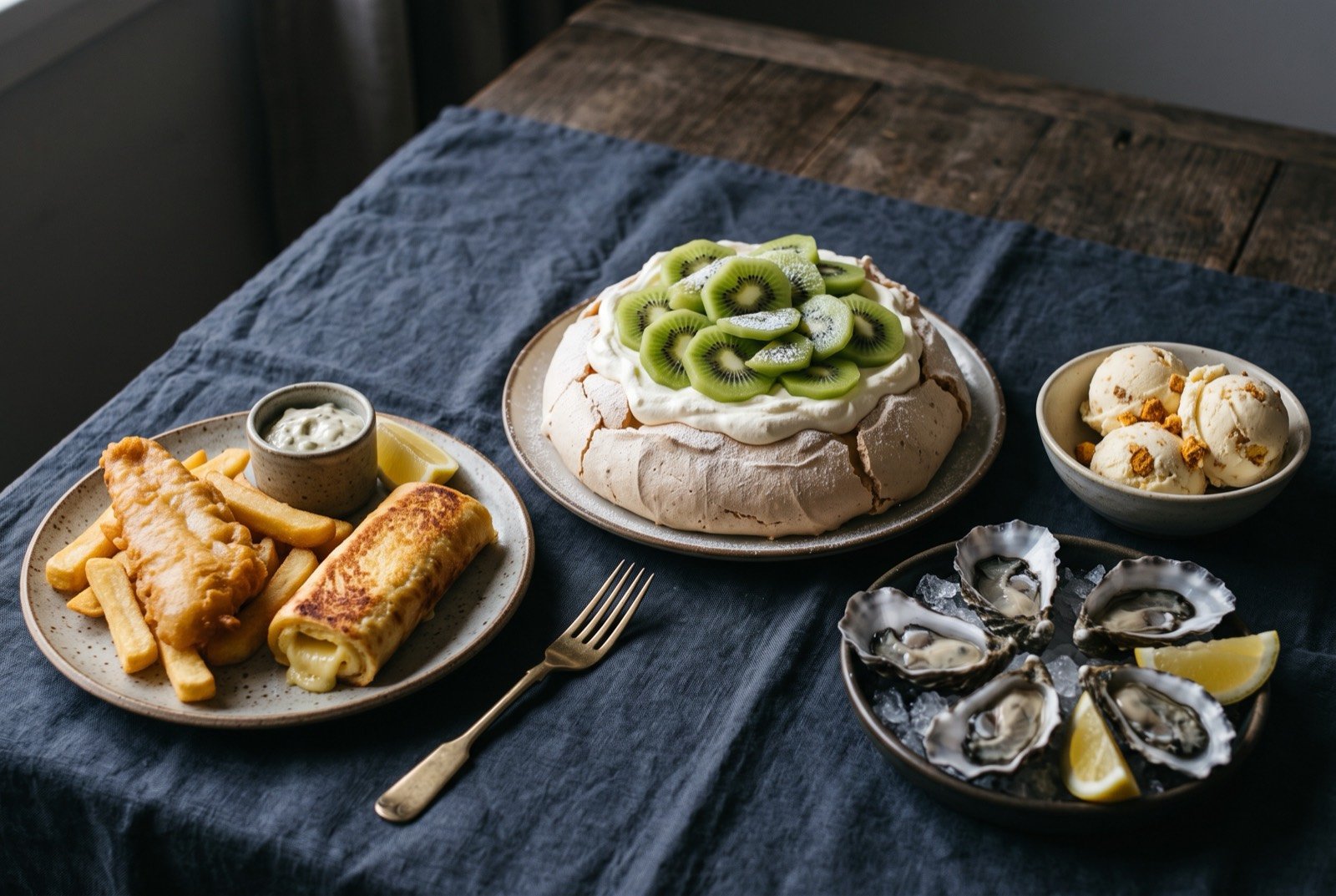
This is the food of British-descended New Zealand: the world built by settlers who arrived to farm a country already fed, for a thousand years, by a completely different tradition. It is not the food this atlas gives fullest weight to in this culinary region. That honour belongs to Te Ao Māori, the earth oven, the kūmara and the eel weir, a food world with its own volume elsewhere in this atlas and its own much longer claim on this land. What follows is the Pākehā layer laid on top of it: a pastoral economy built to feed Britain from the far side of the world, a corner shop culture that fed New Zealand itself, and a slow, real reckoning with the fact that the country's most famous dessert, its most argued-over coffee, and its most contested biscuit are all shared claims rather than settled ones. Every dish as tradition built it, then what a modern chef would change.
Sources and review · What this chapter does not assert · How we research · Know this better? Tell us
A Sense of Place
Say the honest thing about scope first. Two volumes in this atlas's Aotearoa and Australia group are named directly in this chapter but do not yet exist: OC-02, Settler and Modern Australia, and OC-03, Māori Food. Both are named here as the atlas's own crossover policy requires, cross-linked rather than silently ignored, and both are written honestly as not yet available rather than pretended into existence. Where this chapter shares a dish with one of them, pavlova and the Anzac biscuit with Australia, whitebait fritters with Māori food, it says so plainly and treats the dispute on its own merits, because an honest gap beats a silent omission.
What is Pākehā food, structurally? It is a British emigrant diet reorganised around a completely different set of constraints: a pastoral economy built almost entirely to feed a market fourteen thousand miles away, successive immigrant labour forces who fed themselves first and the wider country afterwards, and, eventually, a produce culture confident enough to stop imitating Europe and start naming its own ingredients on the menu. The word "Pākehā" itself is a Māori-language term for non-Māori New Zealanders, mostly of European and especially British descent, and this chapter uses it in exactly that sense, as the settler culture's own accepted name rather than an imposed label.
| Force | What it did to the food |
|---|---|
| British emigration and land settlement, from the 1840s | Brought the Sunday roast, the meat-and-three-veg template, and a domestic cooking culture organised around the Edmonds Cookery Book rather than any restaurant tradition |
| The 1882 refrigerated shipping breakthrough | Turned New Zealand into what a Te Ara collection titles plainly "Britain's farm," an economy built to export the best cuts of lamb and the best butter, leaving home cooking to run on what did not leave the country |
| Chinese goldfields migration, from 1866 | Left the goldfields for market gardening as the gold ran out, feeding the country vegetables for over a century before its own restaurant and takeaway repertoire became a genuinely New Zealand-specific cuisine in its own right |
| Dalmatian (Croatian) gumdigging and viticulture, from the 1890s | Pushed out of the Northland gumfields by prejudice and legislation, into grape growing that became, generations later, the foundation of the modern Marlborough and Central Otago wine industry |
| Postwar Pacific Islander migration into Auckland | Built a Sāmoan, Tongan, Cook Islands and Niuean food world inside Auckland itself, most visibly at Ōtara Market, fully treated elsewhere in this atlas's Polynesia volumes and named here only lightly |
| The rise of a produce-and-wine-led fine dining scene, from the 1990s | Turned Bluff oysters, Marlborough Sauvignon Blanc, Central Otago Pinot Noir and native ingredients into deliberate points of national culinary identity rather than colonial exports with no domestic voice |
A word on sourcing, stated honestly. This chapter is not African-language research, and CLAUDE.md's local-language search table does not extend to New Zealand; the discipline that does transfer is local-source-first. Every claim below is checked, wherever possible, against a genuinely New Zealand source, Te Ara Encyclopedia of New Zealand, NZ History, RNZ, Stuff, NZ Herald and its Viva section, The Spinoff, Metro and Cuisine magazines, the Otago Daily Times, named New Zealand food writers and food historians, rather than the generic Western food media this atlas's house style asks to be excluded as a factual basis. Where only a generic source existed for a claim, that is said plainly rather than smoothed over, most visibly for the chemistry behind hokey pokey's honeycomb toffee, which no New Zealand source was found to document in method even though the flavour is entirely New Zealand's own.
The History in Layers
The pastoral economy, and what it left for the home table
Sheep farming in New Zealand dates to missionary Samuel Marsden's imports from New South Wales to the Bay of Islands in 1814, and large-scale pastoralism, fine wool sheep run on cheaply leased Crown land, took off from the 1840s. From 1856 to 1987 sheep farming was New Zealand's single most important industry.
The pivot from wool to meat is dated precisely. On 15 February 1882 the ship Dunedin left Port Chalmers for London carrying 4,331 mutton carcasses, 598 lamb carcasses, 250 kegs of butter and assorted poultry and game, refrigerated by a coal-fired Bell-Coleman compression plant. The voyage nearly failed twice, a broken compressor crankshaft cost 643 carcasses early on, and Captain John Whitson later crawled into the hold to saw extra air holes when circulation failed in the tropics, but the cargo sold in London within a fortnight for more than double what it would have fetched at home. Te Ara's own ephemera collection names the resulting relationship without softening it: "New Zealand as Britain's farm." By the early twentieth century the industry was, in Te Ara's own words, "geared up to produce meat for the British market and wool for the worsted trade centred around Bradford, England," and the two decades after the Second World War, when Britain took all the meat and wool New Zealand could produce, are remembered as the golden years, sheep numbers rising 40 per cent between 1951 and 1961. Sheep numbers peaked at 70.3 million in 1982 and had fallen to 25.3 million by 2021, dairy returns overtaking sheep returns from 1992 onward, a trajectory this chapter reads as the domestic consequence of Britain's own reorientation toward Europe rather than any failure of the New Zealand industry itself.
This is the material fact behind the ordinary Pākehā Sunday roast. For over a century the country produced far more lamb than it could eat, with the finest cuts contracted away to Smithfield, so the home table ran for generations on the cuts and whole carcasses that did not leave the country, cooked plainly and often, not on any inherited French method. This chapter offers that connection as its own reasoned inference from the export structure described above, not as a claim any single named source makes explicitly.
Immigration built the corner shop as much as it built the farm
New Zealand's dairy, the small grocery and takeaway shop, not the milk industry, though the two names collided into one word, has a specific, dateable history. From the early 1900s, "dairy produce sellers" held a legal monopoly on selling milk, cream, cheese, butter and eggs and could open on Sundays; the term only generalised to small grocery shops from the late 1930s, and a 1945 law effectively banning other grocers from Saturday trading cemented dairies as the after-hours and weekend default that fish and chip and, later, Chinese takeaway trade grew up alongside. A 1994 study found 227 of 269 suburban Auckland dairies were Indian-owned, a fact this chapter states plainly rather than glossing, since the dairy's own ownership history is itself a small immigration history.
Chinese immigration reached New Zealand as goldfields labour: twelve labourers were brought to the Otago fields in 1866, and by 1869 over 2,000 had arrived, nearly all from Guangdong province, for what they called the "New Gold Mountain." As the Otago fields exhausted between roughly 1880 and 1913, sons and young relatives of the original prospectors moved into market gardening, leasing land, often from Māori, and working in kinship groups; by 1899 about 1,390 hectares nationally were under market garden cultivation, spreading to Pukekohe and Levin as roads and railways developed. A genuine split then opened between home and restaurant cooking: Chinese households kept more authentic Cantonese technique at home, while restaurant kitchens, some of which reportedly served fish and chips and steak alongside or instead of Chinese dishes simply to survive, progressively adapted to Pākehā taste, producing the specifically New Zealand-Chinese takeaway repertoire this chapter documents below.
A parallel, less-food-visible immigration built the modern wine industry from an entirely different starting point. From the 1890s, Dalmatian immigrants, from what is now Croatia, worked the kauri gumfields of Northland's far north; prejudice and eventually restrictive legislation pushed them out of gumdigging through the early twentieth century, and many turned to grape growing, concentrated around West Auckland and Hawke's Bay. By 1906 fourteen Dalmatian-run vineyards were producing wine commercially; by the 1950s Dalmatian families owned around 90 per cent of West Auckland's roughly 80 small vineyards. Andrew Fistonich, founder of Villa Maria, became a licensed winemaker in 1949; Ivan Yukich produced the first vintage in 1944 for what became Montana Wines, now Brancott Estate. It is this same Yukich family, one generation on, whose 1973 planting at Brancott Valley put Marlborough Sauvignon Blanc on the world's table, covered fully below. That continuity, from gumfield exile to the country's signature modern wine export in two generations, is one of this chapter's clearest single arguments for treating immigration as a structural force in Pākehā food rather than a footnote to it.
Indian settlement is a genuine, honestly stated gap in this chapter's research. Organised community settlement began in the 1890s with Gujarati and Punjabi arrivals, Sikh migrants working flax milling, drain digging and road building, urban Gujarati and Punjabi settlers often working as door-to-door fruit and vegetable hawkers, a proto food-retail history in its own right; a later, distinct wave followed the 1987 Fijian coups, and a meaningful share of Auckland's Indian food scene today may be specifically Fijian-Indian rather than directly subcontinental. But this chapter found no credible New Zealand academic or press source connecting this history to specific named historic dishes or restaurants, unlike the well-documented Chinese-New Zealand case, and says so rather than inventing a parallel dish history that the research does not support.
The corner of Auckland this chapter treats lightly, on purpose
Postwar Pacific Islander migration built a genuine food world inside Auckland, most visibly at Ōtara Market, running since 1978, a Saturday morning institution selling hāngī-style earth oven food, taro, fish dishes and Cook Islands doughnuts to a strongly Polynesian and Pasifika clientele. Long-running family businesses like Evelina's Polynesian Food in Clendon Park and Ōtara, trading for around 25 years, and the annual Pasifika Festival, the largest festival of its kind in the world by attendance, drawing over 200,000 visitors and featuring live umu, hāngī and lovo demonstrations side by side, are real and current. This chapter names that scene here, honestly, and stops, because its full treatment, palusami, ʻota ʻika, lū pulu, sapasui, already exists with real depth in this atlas's OC-12 volume, Samoa, Tonga and Niue. Re-treating it here would repeat rather than add, exactly the outcome this atlas's crossover policy exists to prevent.
Two disputes this chapter attributes rather than settles
Pavlova. New Zealand's strongest documented claim rests on Dr Helen Leach, a culinary anthropologist at the University of Otago, whose 2008 book The Pavlova Story searched community fundraising cookbooks, church, school and Mothers' Union compilations, rather than commercial cookbooks alone, on the reasoning that these captured home cooks' own contributions years earlier. She traced a recipe genuinely named "pavlova" to a 1926 or 1927 Davis Gelatine Company booklet, though that dish is a layered jelly, not a meringue; a meringue recipe from Dunedin in 1928; and, decisively, a single-layer, soft-centred meringue cake using egg white, sugar and cornflour in the Rangiora Mothers' Union Cookery Book of 1933, submitted by a local woman, Laurina Stevens, which the Otago Daily Times describes as carrying the correct name, ingredients and method. By 1940 Leach had found at least 21 New Zealand pavlova recipes, the same year commercial Australian cookbooks first carried the dish at all. Australia's standing counter-claim centres on Herbert "Bert" Sachse, a chef at Perth's Esplanade Hotel, said to have created a matching meringue cake in 1935, though no Australian cookbook carries a matching recipe until the 1940s, and a Sachse family relative has separately suggested he may simply have misdated his own notes. The Oxford English Dictionary's own 2010 ruling, tracing the name itself to the 1927 New Zealand booklet, declined to award a winner and listed the dish's origin as "Austral. and N.Z." This chapter treats that as the honest, neutral verdict: New Zealand's documentary record runs earlier and deeper, Australia's claim is real and seriously argued by its own historians, and the dish itself, per Leach's own thesis, evolved and diffused rather than being invented once by anyone. Pavlova's full recipe treatment lives here, in OC-04, as this atlas's crossover policy requires of a dish's one home volume; OC-02, the still-unwritten Australia volume, should name it lightly and link back rather than re-treat it once it exists.
Flat white. New Zealand's claim centres on Fraser McInnes, a barista at Bar Bodega on Wellington's Willis Street, said to have produced one in 1989 as an accidental "failed cappuccino," milk that would not foam, served anyway. A separate Auckland claim, from Derek Townsend and Darrell Ahlers of Cafe DKD, half-concedes an Australian naming origin even while claiming New Zealand development, since they say they learned the name itself from a friend who had worked in Sydney cafés. Australia's claim runs earlier in print: a Sydney café, Miller's Treat, was reviewed using the phrase "flat white coffee" in May 1983, and Alan Preston, who opened Moors Espresso Bar in Sydney in 1985, says he brought the drink from far north Queensland cane country, where, per coffee historian Dr Garritt Van Dyk, Italian plantation owners had been drinking a "white coffee: flat" style drink since the 1960s. The Oxford English Dictionary traces the bare term to Britain by 1971, earlier still, though unconnected to the specific espresso drink either country actually claims. A genuine piece of New Zealand journalism on this, rather than a repeated pub-quiz anecdote, is Stuff's feature crediting a Wellington barista's Melbourne-trained friend with bringing the name back to New Zealand in the first place, which complicates rather than settles the Wellington-invented-it story even as it tells it. This chapter attributes both claims and states plainly that no source found, New Zealand or Australian, resolves the dispute on the documentary evidence alone.
The Anzac biscuit, named and cross-linked, not re-treated. New Zealand's claim here is genuinely the stronger, print-dated one: the correct name and a matching recipe appear together in Dunedin's St Andrew's Cookery Book, in either 1919 or 1921 depending on which named historian is cited, years before Australia's first matching recipe in 1923. Food historians on both sides of the Tasman, including Allison Reynolds, who researched the dish in Australia, New Zealand and England, agree the popular story, women baking today's exact recipe and posting it to Gallipoli in 1915, cannot be literally true, since coconut, an ingredient in the modern recipe, would likely have spoiled on the months-long voyage, and the now-standard recipe did not stabilise until 1927. This chapter names the New Zealand claim honestly and stops there, because the atlas's own crossover policy places this dish's full treatment in OC-02, Settler and Modern Australia, a volume not yet written; no recipe is given here, and a future OC-02 should link back to this paragraph rather than either chapter re-arguing the case from nothing.
The Flavour Arsenal
The pastoral base
Lamb. The defining protein of this whole chapter, and the reason the country's most ordinary Sunday meal is also its most historically loaded one, given the export history above. Butter and cheddar-style cheese. New Zealand's dairy co-operative movement dates to 1871 in Otago; Fonterra, formed in 2001 from a merger approved by an 84 per cent farmer vote, now handles a large share of world dairy trade, and named domestic cheese brands, Kāpiti (1984, later Fonterra-owned), Whitestone (1987, Oamaru, founded in direct response to a 1980s rural downturn) and Mainland (1954, its 1993 "Good Things Take Time" campaign among the country's best-remembered), carry real cultural weight even as, in a fact this chapter states rather than glosses, Fonterra agreed in September 2025 to sell Anchor, Mainland and Kāpiti to the French dairy group Lactalis.
Starches
Kumara, the Māori-derived name for New Zealand's own sweet potato, and pumpkin, the two starches that mark a New Zealand Sunday roast out from its British original, standing in for potato and parsnip.
The confectionery pantry
Golden syrup, sweetened condensed milk, desiccated coconut and malt biscuits, the household staples behind hokey pokey and lolly cake, both mid-twentieth-century, and both genuinely undocumented in precise origin, a gap this chapter states plainly rather than papering over.
Coastal and reef
Bluff oysters (Ostrea chilensis, sometimes Tiostrea chilensis in older literature), the Foveaux Strait flat oyster, one of the last wild dredge oyster fisheries left in the world, harvested March to August and repeatedly cut short in recent seasons, 2023, 2024 and 2025, by the endemic parasite Bonamia exitiosa, a fact worth stating plainly in a chapter that treats the oyster as prestige food rather than an infinite resource. Hoki, tarakihi, blue cod (rāwaru) and snapper, the fish behind fish and chips, the species shifting by region and by decade as stocks have changed.
Fruit
Feijoa, a backyard tree fruit ripening mid-March to May whose brief season and heavy yield genuinely does drive a social ritual of surplus, bags left on neighbours' doorsteps, buckets by the gate, more than any single recipe. Kiwifruit, first grown commercially from seeds brought from China in 1904 by Whanganui headmistress Isabel Fraser, renamed from "Chinese gooseberry" in 1959 for the frankly commercial reason that the old name was politically toxic for Cold War-era exports to the United States.
Wine and coffee
Marlborough Sauvignon Blanc, planted commercially from 1973 and internationally reset by Cloudy Bay's 1985 vintage, now around 86 to 89 per cent of New Zealand's wine export volume. Central Otago Pinot Noir, pioneered from the late 1970s by Alan Brady, Rolfe and Lois Mills at Rippon, and Ann Pinckney, with Felton Road, founded 1991, now among the region's most internationally cited producers. The flat white, treated in the Technique Ladder below as much as an aromatic as a technique.
Asian immigrant pantry
Soy sauce, glass noodles and Cantonese stir-fry aromatics, ginger and garlic, carried into New Zealand kitchens by Chinese market gardeners and restaurant cooks and adapted into a genuinely New Zealand-specific repertoire, chop suey, chow mein, egg foo young, kau yuk, lemon chicken, sweet and sour pork, wonton, distinct from the Cantonese cooking those same families kept at home.
The Technique Ladder
Five rungs, each a real, sourced mechanism specific to this chapter's own kitchens.
Rung 1. Roasting by fat content, not by a single number
New Zealand Spring Lamb's own published guidance splits method by cut rather than giving one blanket time: a lean leg is recommended hot, 230°C for the first 15 minutes then dropped to 175°C, roughly 25 minutes per 450g to medium-rare, while a fattier cut is roasted continuously at a lower 160°C for longer, letting the fat render and self-baste the meat as it goes; internal temperature targets are given precisely, 42°C rare, 58°C medium-rare, 68°C medium-well, with a 15-minute rest before carving.
What a cook does with this rung. A Big Green Egg run indirect at 120 to 130°C holds a leg or rack to just under target temperature, pulled and rested, then finished a couple of minutes a side over direct heat for a genuine crust, which decouples even cooking from surface browning far more cleanly than a single-temperature domestic oven ever can.
Rung 2. Double frying is the whole discipline fish and chips usually skips
New Zealand's fish and chip fish has shifted by region and by decade, hoki, tarakihi and lemon fish in the north as snapper stocks declined, gurnard and blue cod predominating in the south, blue cod's lean, tight muscle fibre suiting deep frying particularly well. A proper chip shop already fries twice, blanching at a lower temperature to cook the potato through, then finishing hot for colour and crunch; most home versions skip the first stage entirely.
What a cook does with this rung. Blanch chips at 130 to 140°C until tender but pale, rest, then finish at 180°C for genuine shatter, and dry the fish fillet's surface in a dehydrator for 15 to 20 minutes before battering, since a drier surface takes batter far more evenly than one straight from the fishmonger's ice.
Rung 3. Egg white stabilised by acid and starch, then finished by ambient heat, not direct heat
The Edmonds Cookery Book's current pavlova method beats six egg whites to stiff peaks, adds sugar gradually over a full five minutes of continuous beating until fully dissolved, then folds in vinegar, vanilla and a small quantity of cornflour, and bakes at a moderate 150°C before leaving the whole meringue to cool inside the switched-off oven overnight. The acid and starch stabilise the whipped protein foam against collapse, and the overnight residual-heat cooldown, rather than a fast cool on a wire rack, is what gives a proper pavlova its soft, marshmallow-like centre under a crisp shell rather than a dry, uniformly crunchy meringue.
What a cook does with this rung. A kitchen thermometer confirming a genuinely stable, slow-declining oven temperature, and the discipline of leaving the door shut overnight rather than checking on it, matters more to this dish than any single ingredient ratio.
Rung 4. Hard-crack sugar work, aerated by an alkali, not by whipping
Hokey pokey's honeycomb toffee piece is built by heating sugar and golden syrup to the hard-crack stage, roughly 150°C, then stirring in bicarbonate of soda off the heat, which reacts to release carbon dioxide and aerate the set toffee into its familiar honeycomb structure. No New Zealand source was found describing this exact method for any named commercial producer, this is standard confectionery chemistry rather than an attributed in-tradition technique, and this chapter states that plainly rather than dressing generic method up as local knowledge.
What a cook does with this rung. A sugar thermometer taken to a true hard crack, and bicarbonate stirred in fast and briefly before the mixture is poured to set, gives a home cook the same aerated structure a factory line achieves by scale, and the same chemistry, run at a lower final temperature and finished with a feijoa purée fold rather than a straight pour, gives a genuinely New Zealand-flavoured variant of an otherwise generic technique.
Rung 5. Wine-led, provenance-first composition
Amisfield, a Central Otago winery whose kitchen states its menu is "shaped entirely by what is local, seasonal, wild, and endemic to New Zealand," builds dishes to its own Pinot Noir and aromatic wines rather than pairing wine to a finished plate; Josh Emett's Rātā in Queenstown works the same way with its own Otago growers.
What a cook does with this rung. Choosing the bottle, a Marlborough Sauvignon Blanc's acid, a Central Otago Pinot Noir's silky tannin, before designing the dish's fat, acid and char, reframes wine pairing as a design constraint rather than an afterthought, and is exactly the discipline behind treating a fragile, short-season ingredient like a Bluff oyster with restraint rather than heavy manipulation: served closer to raw, sharpened rather than reworked.
The Ferment and Preserve Bench
This is honestly the thinnest bench in this atlas's Oceania volumes so far, and this chapter says so rather than inventing ferments that do not exist here. Wine and beer are this chapter's only genuine, well-documented fermentation traditions, covered above and in the sourcing section below. New Zealand's confectionery and dairy traditions, hokey pokey, lolly cake, the Southland cheese roll, are built on preserved and shelf-stable pantry ingredients, sweetened condensed milk, golden syrup, dried onion soup mix, rather than on any fermentation step, a genuinely different preservation logic from the fermented staples this atlas has documented across its Pacific volumes. Feijoa chutney, given in full below, is this chapter's one real preserve, a vinegar-set relish rather than a ferment, in the long British tradition of turning a glut into something shelf-stable.
Sourcing in Britain
Verified September 2026. Where a supplier could not be fully confirmed, that is said rather than smoothed over.
What is genuinely available
Marlborough Sauvignon Blanc and Central Otago Pinot Noir are widely and reliably available. Majestic Wine stocks Villa Maria and Craggy Range; Waitrose, which states it was the first UK supermarket to bring New Zealand wine to Britain in the 1980s, sells an own-label Blueprint New Zealand Sauvignon Blanc and a wider range through Waitrose Cellar, including Marlborough's The Ned. For the serious Central Otago end, Felton Road is stocked by specialist merchants Wine Republic and VINVM, and Rippon by London's Lea & Sandeman.
New Zealand lamb is a real, current, named UK supermarket category, not a historical curiosity. Sainsbury's runs 100 per cent British lamb in season, switching to New Zealand sourcing outside the British season, alongside a dedicated New Zealand producer group of around 120 farmers; Tesco follows a similar British-first, New Zealand-backup model with clear origin labelling.
Sanza (sanza.co.uk) is the one genuine, currently-trading UK-resident Kiwi shop found in this research, an online expat grocer stocking over 25 Whittaker's chocolate lines alongside Pascall, Watties, L&P and Sanitarium NZ-Mite, New Zealand Marmite relabelled to avoid a UK trademark clash. Kiwi Corner Dairy and NZ Made are New Zealand-based exporters, not UK shops, a genuinely different, slower and pricier proposition worth distinguishing from Sanza rather than treating the same.
The false friend, worth naming directly
Vogel's bread is stocked by Sainsbury's and Waitrose and is a genuinely different product from New Zealand's Vogel's, however identical the branding looks. Both trace their name to Swiss naturopath Alfred Vogel's 1950s mixed-grain recipe, but New Zealand's Vogel's has been made since 1967 by Goodman Fielder, while British Vogel's has separately been produced by British bakers since 1972, now Nicholas & Harris. A reader buying "Vogel's" in a British supermarket is not eating the New Zealand loaf.
What genuinely cannot be got, stated plainly
Bluff oysters have no realistic fresh UK supply chain; even the short-haul trade to Australia is a specialist, same-day operation, and nothing in current trade reporting shows a comparable route to Britain. The honest substitute is a British native oyster, Ostrea edulis, not a farmed rock oyster: Colchester and Mersea natives, which carry Slow Food Ark of Taste status, or Whitstable natives, share the flat-shelled, cold-water, mineral character a rock oyster does not have, even though neither is Bluff's own species or its own Southland merroir.
Feijoa in the UK is a rare, imported-from-elsewhere, unripe-when-you-get-it curiosity rather than a plannable ingredient. Feijoas.UK, self-described as the UK's only feijoa farm, states plainly that imported fruit, from Colombia or Georgia, not New Zealand, turns up occasionally and unpredictably at Tesco, Sainsbury's or Harrods, picked before it is ripe, and that its own UK-grown crop essentially never reaches shops beyond direct sales. No UK source was found for New Zealand-origin frozen feijoa pulp, chutney or spirits.
Whitestone, Kāpiti and Mainland cheese have no confirmed UK stockist by any route found in this research, specialist cheesemonger, supermarket or mail order. A reader wanting a similar style, Whitestone's washed-rind and blue cheeses in particular, should look to a British artisan equivalent by style rather than expect any actual New Zealand supply chain.
Fish for fish and chips. No UK import channel exists for hoki, tarakihi or the other New Zealand species, and none is needed: cod, haddock and, increasingly, pollock are the practical British stand-ins, pollock's mild, flaky character being the closest match to hoki specifically. Sainsbury's briefly rebranded pollock as "Colin" in 2009 to make it acceptable as a cod alternative, a useful precedent for the same substitution logic applied here.
Ranked, ingredients that decide great from grim
- The lamb's fat content and cooking discipline, more than its origin, since British lamb is excellent and NZ lamb is a real but secondary supermarket category here.
- A genuine British native oyster in place of a farmed rock oyster, for anything standing in for Bluff.
- A real specialist wine merchant for Central Otago Pinot Noir specifically, since supermarket ranges rarely go past entry-level Marlborough Sauvignon Blanc.
- Sanza, not a generic "British" Vogel's loaf, for any reader determined to taste the actual New Zealand pantry rather than a same-named substitute.
Voices and Sources
From inside the tradition
- Dr Helen Leach, culinary anthropologist, University of Otago, whose 2008 book The Pavlova Story remains this chapter's single most important named source, and whose method, searching community fundraising cookbooks rather than commercial ones, is itself worth naming as good historical practice.
- Allyson Gofton, New Zealand food writer of nearly 30 years standing, Food in a Minute, more than 20 cookbooks, whose own site carries both a roast kumara recipe used above and a clear-eyed account of the Anzac biscuit dispute citing Helen Leach directly.
- Annabel Langbein, New Zealand cookbook author and television presenter, whose feijoa chutney recipe is used above.
- Ben Bayly, chef-owner of Ahi, Auckland, whose charred-meringue pavlova is this chapter's clearest documented example of a New Zealand fine-dining kitchen treating a Kiwiana dish with real technical seriousness rather than nostalgia alone.
- Peter Gordon, the New Zealand chef most responsible for introducing a version of this country's produce and fusion sensibility to a British audience, at the Sugar Club in 1990s London, and who has since returned to cook in New Zealand again.
- Josh Emett (Rātā, Queenstown) and the Amisfield kitchen, Central Otago, both treated in the Technique Ladder above as the clearest examples of wine-led menu design as a deliberate New Zealand fine-dining discipline.
The researchers and institutions
- Te Ara, the Encyclopedia of New Zealand, this chapter's single most load-bearing source, covering the sheep industry's economic history, the dairy shop's legal history, Chinese market gardening, kiwifruit's naming, Dalmatian winemaking, and Indian and Fijian settlement.
- The Spinoff's Kai section, whose detailed, historian-sourced pieces on the Southland cheese roll and on Invercargill's fish-and-chip history are the strongest single-outlet contribution to this chapter's honest, unresolved-origin dishes.
- RNZ, for its reporting on the Anzac biscuit dispute and on Kiwi English's own vowel shift behind the "fush and chups" joke, sourced to named Victoria University of Wellington linguist Emeritus Professor Janet Holmes.
Things this chapter has deliberately not asserted
- That pavlova was invented by a single named person in either country. Dr Helen Leach's own research frames it as evolved and diffused; this chapter reports the documentary record on both sides rather than declaring a winner.
- That the Rangiora Mothers' Union Cookery Book's 1933 pavlova recipe definitely did or did not use vinegar. Two credible secondary sources disagree, and the primary 1933 text was not accessible to resolve it.
- That the flat white was definitely invented in Wellington. New Zealand's own strongest press account of the story, Stuff's feature, itself credits a Melbourne connection for the drink's name, complicating rather than confirming a clean New Zealand-invention story.
- A full recipe or origin account for the Anzac biscuit. Its home volume in this atlas is OC-02, Settler and Modern Australia, not yet written; this chapter names New Zealand's genuinely strong, print-dated claim and stops there.
- That any specific ratio, timing or method in this chapter's roast lamb recipe comes from the Edmonds Cookery Book. The book's actual roast lamb recipe was not accessible in this research; the timings given here come from Beef + Lamb New Zealand and New Zealand Spring Lamb instead, and are named as such.
- That kumara and pumpkin became fixed New Zealand Sunday roast sides at any specific, dateable point. No source found dates this; it is reported as received convention.
- A named-chef source for hokey pokey's honeycomb toffee method. The chemistry is standard confectionery technique, sourced to generic Western baking references rather than any New Zealand voice, and this chapter says so rather than dressing it up as in-tradition knowledge.
- An origin story for lolly cake. None survives checking; Wikipedia itself states the origin is unknown, and this chapter repeats that rather than inventing a folk tale.
- That the Jaffas cinema-aisle-rolling tradition is specifically linked to Wellington's Embassy Theatre. This could not be verified; the well-documented civic tradition used instead is Dunedin's Baldwin Street Jaffa Race.
- That any named New Zealand fine-dining restaurant has put a specific, sourced "elevated" version of the whole lamb roast, the cheese roll, lolly cake, hokey pokey, the flat white, or NZ-Chinese chow mein on a menu. No such example survived verification for these six dishes; every modernist recipe given for them above is this chapter's own extension of documented technique and ingredients, stated as that throughout rather than presented as attributed reportage.
- That Auckland's Indian food scene is predominantly Fijian-Indian in origin. This is suggested only by casual restaurant-guide asides, not by any credible New Zealand demographic or press source, and is not asserted as established fact.
- A formal legal or biosecurity prohibition on importing fresh Bluff oysters to the United Kingdom. This chapter found the trade commercially and logistically unrealistic, not a documented ban, and states the finding that way rather than asserting a rule that was not confirmed.
- That Sanitarium NZ-Mite, sold in the UK as "NZ-Mite," is a different product from New Zealand Marmite. It is the same Sanitarium product, relabelled only to avoid a UK trademark clash with Unilever's British Marmite.
Roasting by fat content, not by a single number
New Zealand Spring Lamb's own published guidance splits method by cut rather than giving one blanket time: a lean leg is recommended hot, 230°C for the first...
Double frying is the whole discipline fish and chips usually skips
New Zealand's fish and chip fish has shifted by region and by decade, hoki, tarakihi and lemon fish in the north as snapper stocks declined, gurnard and blue...
Egg white stabilised by acid and starch, then finished by ambient heat, not direct heat
The Edmonds Cookery Book's current pavlova method beats six egg whites to stiff peaks, adds sugar gradually over a full five minutes of continuous beating...
Hard-crack sugar work, aerated by an alkali, not by whipping
Hokey pokey's honeycomb toffee piece is built by heating sugar and golden syrup to the hard-crack stage, roughly 150°C, then stirring in bicarbonate of soda...
Wine-led, provenance-first composition
Amisfield, a Central Otago winery whose kitchen states its menu is "shaped entirely by what is local, seasonal, wild, and endemic to New Zealand," builds...
The dishes
- Pavlova New Zealand, contested with Australia
- Fish and chips New Zealand
- Southland cheese roll New Zealand, specifically Southland
- Lamb Sunday roast, with kumara and pumpkin New Zealand
- Hokey pokey ice cream New Zealand
- Lolly cake New Zealand
- Bluff oysters New Zealand
- Feijoa chutney New Zealand
- Flat white New Zealand, contested with Australia
- NZ-Chinese-style chow mein New Zealand
Sources and review
- Researched
- 8 sources cited
Where this volume comes from
4 research briefs on file for this volume, researched to the rules on How we research. Published 3 September 2026. Last changed 20 September 2026.
The brief's own account of its sources
Of roughly 60 distinct sources consulted across both tradition passes, the clear majority are New Zealand or in tradition: Te Ara Encyclopedia of New Zealand (multiple pages across sheep farming, seafood, food shops, market gardening, kiwifruit, wine, Dalmatians, Indians, Fijians, and the "Britain's farm" ephemera entry), NZ History (govt.nz), RNZ (citing named academic Janet Holmes), The Spinoff (citing named food historian Helen Leach on both pavlova and the cheese roll), the Otago Daily Times (Whitestone Cheese, and Helen Leach's own obituary and profile), rova.nz, dish.co.