Oceania and the Pacific · Volume 03
Māori Food
The Waka, the Hāngī and the Tide
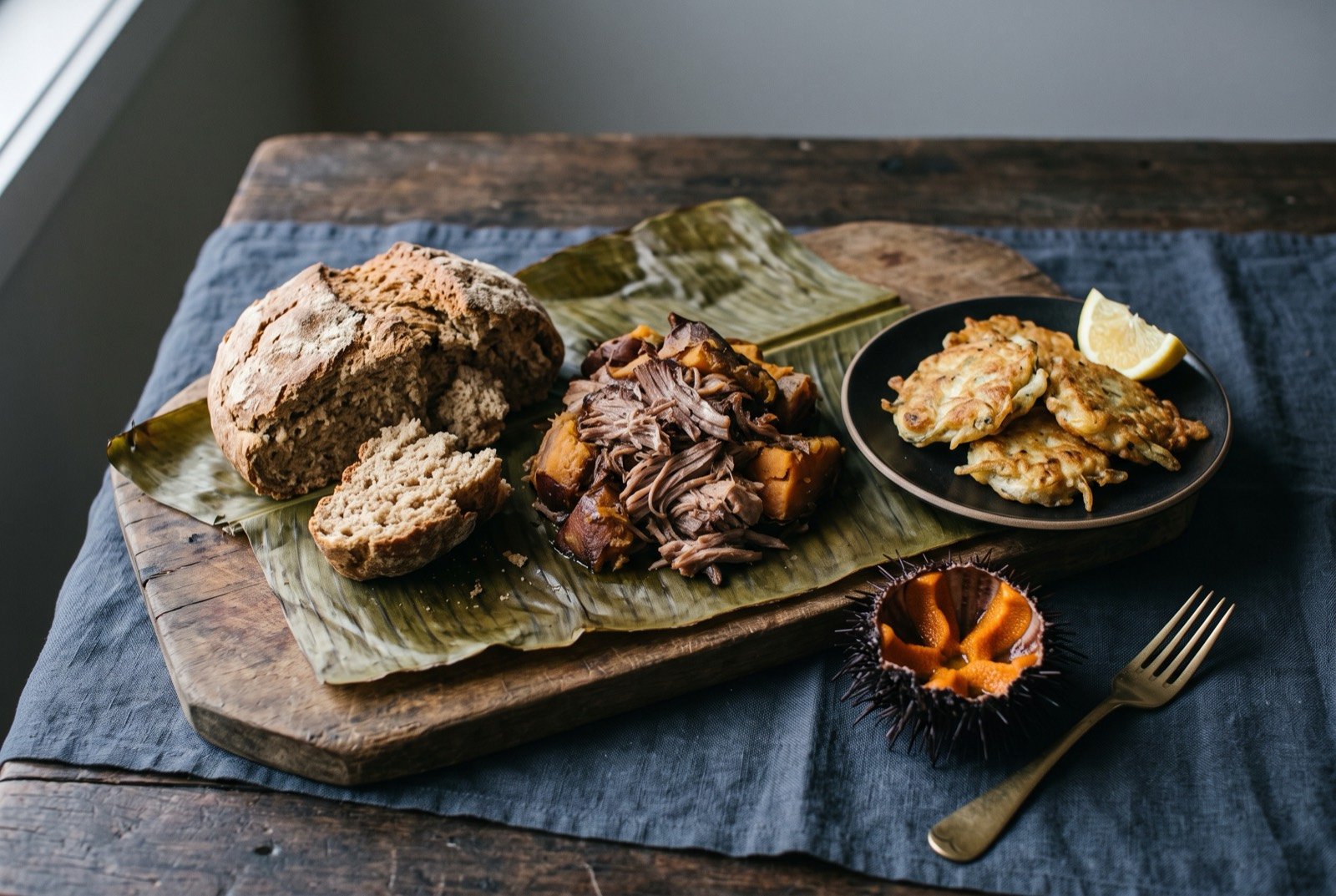
Māori food taken seriously as a Polynesian voyaging cuisine pushed to the coldest edge it could survive, not a garnish on general New Zealand food. The last wave of Eastern Polynesian voyagers reached Aotearoa around 1250 to 1300 CE carrying kūmara, taro and the rest of the canoe crop package into a climate that killed breadfruit, coconut, banana and pig outright, leaving a re-bred staple economy, an engineered eel weir, and an earth oven to be built from what survived, and every dish as tradition built it, then what a modern chef would change.
Sources and review · What this chapter does not assert · How we research · Spotted something wrong?
A Sense of Place
Te Māra: the cultivated staple economy, re-learned at the edge of its own climate
Māori gardening in Aotearoa had to solve a problem no other Polynesian society growing kūmara ever faced: a genuine winter. In tropical Polynesia kūmara grows year-round and is propagated from a cut shoot; in Aotearoa winter is too cold for growth anywhere in the country, and even summer growth failed in some regions. Māori had to re-learn propagation from the tuber itself and build an entire storage architecture to bridge the cold months, something the crop's origin islands never demanded of anyone. Kūmara gardens, māra kūmara, used puke, raised mounds, laid out in rows or a quincunx "five on a dice" pattern on sloping, north-facing, sun-catching ground. Light sandy soil was preferred; where soil ran heavier, Māori physically carried gravel, sand, shell and charcoal over real distances to improve drainage and bank daytime heat into the ground overnight, extensive stone-row garden remains still survive from this work. James Cook, observing Māori gardens at the Bay of Injuries in 1769, recorded exactly this crop list growing in cultivated plots, corroborating the tradition independently as an outsider eyewitness.
Storage did the rest of the work summer growing alone could not. Rua kūmara, semi-subterranean storage pits, held tubers at the humidity a New Zealand winter would otherwise destroy, some small and dug straight into the ground, others large, roofed, and pitched like a small building. Pits were sterilised with fire before use, sealed against vermin with a wooden door, and their contents were rotated and checked, because a kūmara left too long could spoil, though even that had a use: tubers that began to rot were deliberately fermented rather than discarded, into a preserved product called kōtero, prized for a flavour described as shrivelled but rich and sweet. A tuber that failed one purpose was simply redirected to another, the same nose-to-tail thinking this atlas keeps finding wherever people had to make a difficult harvest go all the way round.
Te Moana me Ngā Awa: the coastal and freshwater economy, worked by season and by tide
The second structural pillar of this cuisine belongs to the sea and the river, not the garden, and this chapter treats it as a fully separate economy because Māori practice already did. Shellfish gathering, pāua, pipi, tuatua, toheroa, was traditionally women's work, organised hapū by hapū and even whānau by whānau around specific named gathering beds, with outsiders expected to ask permission from the kaitiaki, the guardian, of that ground before taking anything. Fishing and eeling sat on a different, largely male axis, built around reading a calendar the sea itself set: kina roe at its best when kōwhai and pōhutukawa flower, tuna heke, the great downstream migration of mature eels bound for the deep Pacific to spawn, arriving on rainy autumn nights under a dark moon, triggering the one short window a year when a pā tuna, a river weir, was worth building and tending. This is not a gathering economy in the passive sense the word can imply. Reading a tide, a flowering tree or a flood correctly, and having built the weir or learned the reef in advance of that exact week, is itself the technology.
The structural logic, at a glance
| Te Māra (the cultivated staple economy) | Te Moana me Ngā Awa (the coastal and freshwater economy) | |
|---|---|---|
| Starch | Kūmara, re-bred and stored to survive a climate no other Polynesian society growing it ever faced | Not applicable; this economy supplies protein, not starch |
| Fat | Effectively none in the European sense before contact; shark liver oil (hinu mango) and bird fat the closest equivalents | Fish and shellfish oil; muttonbird preserved in its own rendered fat, the clearest fat-preservation tradition in the whole cuisine |
| Backbone before kūmara, and alongside it | Aruhe, fern root, laboriously pounded but always present, "the food portion that never fails" | Eel (tuna), taken in real volume at the autumn migration and dried or smoked for months of storage |
| The defining technology | Rua kūmara, the storage pit that turns a single autumn harvest into a year-round supply | Pā tuna, the river weir engineered to intercept one week's migration a year |
| Gender and social organisation | Gardening organised around whānau and hapū land holdings | Shellfish gathering largely women's work by named bed; fishing and eeling largely men's work |
| What changed first, and fastest, after contact | Potato, easier to grow than kūmara, displaced fern root within decades | The Quota Management System and, later, iwi-led rāhui, replaced open customary access with formal regulation on both sides |
The History in Layers
Hawaiki, and a settlement dated a full four centuries later than earlier estimates believed
The archaeological consensus on when Aotearoa was first settled has moved substantially in the past generation. Older, pre-2000 estimates put settlement around 800 CE; the current consensus, built from a convergence of radiocarbon dating, pollen and volcanic-ash analysis, DNA evidence and genealogical dating, places it around 1250 to 1300 CE, independently corroborated by oral-tradition dating using roughly twenty five years per generation, which converges on a broadly consistent 1325 to 1400 CE. Manuka Henare, the Māori economic historian whose Te Ara account anchors much of this chapter, calls Aotearoa "the largest landmass settled by Polynesians," the final and most demanding stop of a migration that had already crossed most of the Pacific. Tribal tradition names the voyaging canoes, Aotea, Te Arawa, Kurahaupō, Mātaatua, Tainui, Tākitimu, Tokomaru among them, and different iwi hold genuinely different traditions of who specifically carried the kūmara itself: Horouta descendants credit the ancestor Hinehākirirangi, who is said to have safeguarded it and planted it at Manutūkē; Te Arawa and Tainui tradition instead credit Whakaotirangi. This chapter records both without adjudicating between them, in keeping with the atlas's rule on plural, unresolved tribal claims.
Breeding a tropical crop onto the coldest edge it was ever asked to survive
Peter Adds, of Te Āti Awa and Taranaki, records the plain fact of what happened to the tropical crop package once it reached this climate: kūmara, taro, hue, uwhi and tī pore survived, but were marginal even in the best growing country, and Adds is honest that kūmara's own deeper origin sits further back again, in South America, carried into Polynesia by voyagers long before it ever reached Aotearoa specifically. A 2021 peer-reviewed study, led by archaeologist Ian Barber of the University of Otago with Oxford radiocarbon dating support, and carried out under the explicit authority of Kāti Huirapa Rūnaka ki Puketeraki and the Pūrākaunui Block Incorporation, pushed the confirmed archaeological limit of pre-European kūmara cultivation some 250 kilometres further south than any prior record, to storage pits at Pūrākaunui in eastern Otago, dated by Bayesian radiocarbon modelling to a tight window of 1430 to 1460 CE. The excavated pits themselves carry real engineering detail: vertical sides, over half a metre deep, two to five metres long, with rocks and evidence of fires found at their base, read by the researchers as active thermal management, keeping the pit above roughly ten degrees to prevent live tubers rotting this far south. Suzanne Ellison, manager of Kāti Huirapa Rūnaka ki Puketeraki, called the carbon-dated confirmation "very affirming about traditions and mātauraka relating to Huriawa Peninsula"; Pūrākaunui Block Incorporation chairperson Nicola Taylor said the findings "confirm for us at Pūrākaunui the importance of our very long history and connection with the land."
The paper's second strand is just as important and reads southern Ngāi Tahu oral tradition on its own terms rather than as folklore to be explained away: traditions of the kūmara-associated deity Rongo, and specifically traditions of loss, among them the tradition that the canoe Ārai Te Uru lost its kūmara cargo overboard in a storm off Moeraki, read by the researchers not as a literal shipwreck account but as encoded cultural memory of the crop's eventual failure at this southern edge. The paper proposes, without adjudicating between them, two live historical explanations: either rua kūmara technology was deliberately carried south around 1430 to offset the loss of moa and other large game, or the crop economy collapsed outright under Little Ice Age cooling after 1450, which is why it had already dropped out of living memory by the time of sustained European contact two centuries later. This chapter records both possibilities and does not choose between them either.
Aruhe, and the food that was always there because nothing threatened it
Fern root filled the gap horticulture on its own could not close, and Manuka Henare's account of a specific illustrative tradition makes the ecological logic vivid rather than abstract: a high-born woman is said to have refused a kūmara gardener as a husband, since his crop could be raided in wartime, refused an eeler too, since he was only useful when rivers flooded, and a fisherman, useful only in calm seas, and married instead a man who could dig fern root, "so there would always be food." The proverb behind this, te tūtanga tē unuhia, "the food portion that is always present," names exactly what aruhe was worth: not a delicacy, a guarantee. Digging it was genuinely brutal labour, the best roots lay up to a metre underground, and the pounding that followed, breaking cooked root down with a dedicated wooden beater called a patu aruhe to separate starchy flesh from fibre, left a paste still carrying three or four times its own weight in indigestible strands, in Joseph Banks's own description from Cook's 1769 voyage. It survived as a staple for centuries, and it was still, by the mid nineteenth century, being abandoned fast: potato, introduced by visiting sailors in the 1780s, grew more easily than kūmara and helped provision war parties so directly that some historians have argued the so-called musket wars of the 1810s to 1830s deserve to be remembered partly as potato wars instead. A Māori-language newspaper editorial from 1861 mourns the shift already well under way in its own words, that fern root and pohue had been left off in favour of what it calls, bluntly, putrid corn, "great indeed is the badness of that exceedingly bad food," a period source lamenting a nutritional decline in real time rather than a historian reconstructing it after the fact. This chapter did not find any evidence of aruhe surviving today as a living, regularly eaten dish, unlike rēwena, boil-up, takakau and even kānga pīrau, all of which still have practising cooks; that absence is stated here plainly rather than implied away.
Land, fisheries and a dispossession that ran on two separate tracks
Colonisation hit this cuisine's two structural economies through two largely separate legal and administrative mechanisms, and this chapter names both rather than collapsing them into one vague story of loss. On land, the New Zealand Wars of the 1860s and the raupatu, confiscation, that followed them stripped huge tracts of the most productive growing country from Māori ownership; on the water, Māori were formally excluded from commercial kaimoana harvest by the late nineteenth century, and the twentieth century's Quota Management System, however necessary for conservation, was imposed on customary fishing grounds without Māori consent or, in its early form, any real accommodation for customary practice at all. Both tracks were addressed, imperfectly and only after sustained legal and political pressure, within living memory. The Treaty of Waitangi Fisheries Settlement, the Sealord Deal, was signed on 23 September 1992: the Crown paid 150 million dollars toward Māori acquisition of a 50 per cent stake in Sealord, New Zealand's largest fishing company, plus an ongoing 20 per cent allocation of quota in any new species subsequently brought into the Quota Management System, together worth roughly a third of the country's total commercial fishing quota, administered since 2004 through Te Ohu Kaimoana, the Māori Fisheries Trust. Running alongside that commercial settlement, a separate regulatory track, the Fisheries (Kaimoana Customary Fishing) Regulations 1998 and their South Island equivalent a year later, let iwi and hapū define their own rohe moana, sea territory, and appoint tangata kaitiaki empowered to authorise, restrict or entirely prohibit customary take within it. This second track is not archival. It is what let Ngāti Manuhiri file a Fisheries Act application in 2026 for a two-year rāhui protecting the Whangaparāoa coastline after visitors were found stripping rock pools bare, chief executive Nicola Rata-MacDonald pointing out plainly that filling a bucket with periwinkles the size of a fingernail is not a sustainable catch, and framing the whole restoration effort as, in her words, "what we as Māori offer to our country." It is what let Ngāi Tūāhuriri, in August 2026, place a rāhui on their own five-year-old customary whitebait season after reports that some fishers felt unsafe, stating that "customary fishing rights must remain firmly connected to the responsibilities that come with those rights." Recent Māori-authored commentary, in Ngāi Tahu's own Te Karaka magazine and in The Spinoff's Māori-affairs section, argues the commercial side of the 1992 settlement has itself been under-delivered by the Crown in the decades since, a live argument this chapter records rather than resolves.
Kina barrens, and a crisis Māori communities are managing rather than only suffering
A genuinely current ecological story belongs here rather than in a footnote. Kina populations, unchecked by the large snapper, blue cod and crayfish that once cracked them open before decades of overfishing thinned those predators out, have stripped kelp forest entirely from stretches of reef, leaving bare rock and dense kina known as kina barrens, now covering a reported 36 per cent of rocky coastline across northeastern New Zealand. The response is not simply regulatory. Ngāti Manuhiri partnered with Ngāi Tai ki Tāmaki on active kina removal from barrens between Ōtata and Hauturu-o-Toi in the summer of 2020 and 2021, monitoring kelp recovery, kina density and fish and crayfish numbers for three years against untouched control barrens, and the same Ngāti Manuhiri Settlement Trust separately ran a mussel reef restoration project aimed at restoring the actual predators that hold kina in check, rather than treating removal alone as a fix. Mātauranga Māori is cited explicitly alongside Western marine science in the wider Hauraki Gulf research this work sits inside, and the framing offered by the communities running it is consistently kaitiakitanga, guardianship, not victimhood: this is a resource under real pressure, being actively managed by the people whose resource it is.
Hiakai, and a movement that changed its own mind about what mattered most
Monique Fiso, of Te Whakatōhea, Ngāti Awa and Ngāti Porou descent and also Samoan, trained in Michelin-starred kitchens in New York before returning to Aotearoa at the end of 2015, driven, in her own account, by a road trip through the South Island where she saw every international cuisine represented on a menu somewhere and almost no Māori food anywhere, which made her ask, in her own words, "what am I doing with my craft?" Hiakai began as a pop-up dining series in 2016 and became a bricks-and-mortar restaurant in Wellington, named to TIME's 100 Greatest Places in 2019 and Lonely Planet's Best in Travel 2021, and drew coverage from the Wall Street Journal, the New York Times and National Geographic among others. Fiso built the restaurant around a pātaka, a dedicated pantry of indigenous ingredients including harakeke blossom, matipo leaf syrup and karamū berry vinegar, so that, in the words of one profile, "nothing is there by accident," and her signature dish, ika and kūmara, deliberately recast fish and chips, in her own description, as "a story of Māori culture and Kiwiana that captures the essence of Aotearoa," taking a dish that reads as generically national and re-rooting it in specifically Māori material culture. She insisted on a printed glossary at the back of the menu rather than quietly translating unfamiliar ingredients away, because, in her words, "I want people to understand why things are done in a certain way." Her book, Hiakai: Modern Māori Cuisine (2020), won the Booksellers Aotearoa New Zealand Award for Illustrated Non-Fiction at the 2021 Ockham New Zealand Book Awards, and was conceived, she has said, as a foundation rather than a closed statement: "for people to get a greater understanding of our ingredients, use the tools in the book and then do their own thing."
Hiakai closed in March 2024, and this chapter states that plainly rather than skating past it, because what happened next matters more to this movement's real shape than the restaurant's own run did. General small-business pressure, a landlord's decision to sell the building, and a deliberate choice by Fiso and co-owner Katie Monteith to redirect toward food security work all featured in her own account of the closure, framed by both of them as evolution rather than an ending. Since 2024 Fiso has been, in her own words, out of the kitchen and into the case against industrial agriculture, describing having reached "the top of the maunga," the mountain, as a chef and feeling her energy for kai would now do more work outside a restaurant than inside one. Her practical version of kai motuhake, food sovereignty, today is deliberately domestic rather than restaurant-grade: shopping at local markets, buying meat from a local butcher, growing herbs in pots, foraging onion weed, tarata, kawakawa and sea lettuce, work she frames as good for reclaiming food sovereignty and, in the same breath, good for physical and mental health. This chapter treats Fiso's own arc, plating technique first, food systems second, as the clearest available argument that the two halves of this movement, fine dining and food sovereignty, are not two separate stories running in parallel. They are one continuous argument that changed its own mind about where the real leverage was.
Charles Royal, and an honest complication no simple story of revival should paper over
Charles Royal, of Te Whanau-a-Apanui, Ngāti Raukawa ki te Tonga and Ngāti Maru, trained as an army chef before turning to a career built on mātauranga Māori, indigenous knowledge, later convening a masters programme in the subject at Te Wānanga-o-Raukawa. In 1996 he opened a Cajun-Creole restaurant in Rotorua and watched hotels around him run hāngī shows for tourists as pure spectacle while their actual dining menus served shrimp cocktail and other unrelated international fare, Māori food present as theatre and absent as cooking. His own restaurant shifted toward what he called contemporary Māori fusion, built on pikopiko fern fronds, horopito bush pepper and kawakawa, and when demand from other chefs outstripped what he could supply from his own kitchen, he pivoted in 2004 into wild harvesting and supply outright, founding Kinaki with his wife Tania and working with Crop and Food Research to validate the safety of the plants he sells, careful to state the danger margin honestly: "Of 312 different varieties of fern in New Zealand, only seven are edible." His own framing of the stakes, in his words, is blunt: "If a culture loses its food identity, it is near impossible to get back." He is equally honest, and this chapter records it rather than smoothing it into a simpler story, that commercialising taonga foods drew real suspicion from inside his own community, remembering being mocked, "who does he think he is, selling our leaves?" Even a practitioner working entirely from inside the tradition faced that question, which means the real line the reader should draw is not a blanket rule about who is allowed to cook what, but relationship, reciprocity and accountability to the community the food comes from, a harder and more honest test than a simple authenticity checklist.
The Flavour Arsenal
Kūmara: bred at the edge, and now down to three commercial lines
Kūmara is the staple this whole cuisine was built to keep alive through a winter no East Polynesian variety was bred to survive, harvested in autumn, ngahuru, around March. Small tubers were sun-dried into kao, a portable, long-life sweet snack eaten raw or soaked and mashed; larger ones went into the hāngī, or were boiled, baked in ash, or grated raw into roroi, a deliberately different, coarser texture from anything cooked whole. Cultivation was heavily ritualised, tied to Rongomātāne, a god of both cultivated food and peace, with a first, ceremonial planting set aside for him ahead of the main crop, and a hākari feast, the pure, marking harvest once the growing season's tapu was formally lifted. Almost none of the pre-European named varieties survive commercially: the now-dominant Ōwairaka Red descends from Rarotongan sweet potatoes noticed by a carpenter aboard a whaling ship moored at Ōpōtiki in the 1850s, and Māori replaced their older stock with these higher-yielding types within a generation. A 1969 collection of hundreds of varieties sent to Japan for safekeeping was partly repatriated in 1988, backed by British botanist David Bellamy; three of the nine returned cultivars, taputini, rekamaroa and hutihuti, may pre-date European contact, though DNA confirmation of their provenance remains ongoing. Today's whole commercial crop rests on just three modern lines, Ōwairaka Red, Toka Toka Gold and Beauregard, a genuine and stated loss of diversity this chapter does not try to talk around.
Aruhe: the staple that survives now only as memory
Fern root, the rhizome of bracken, rārahu, has no living culinary practice behind it any more, and this chapter names that honestly rather than implying a continuity that has not survived. It belongs here as the structural staple that filled the gap horticulture could not close for centuries, not as an ingredient a reader could ever cook with today.
Taro, hue and uwhi: the rest of the voyaging package, permanently marginal
Taro, hue the bottle gourd and uwhi the yam all survived the voyage south and all remained genuinely marginal even in the best growing country, unlike their status as true staples further north in the Pacific. Hue served a second purpose beyond food, as a container, drilled and dried into a vessel used in the māra itself.
Pūhā: a bitter green Māori adopted after contact, and made their own
The bitter green at the centre of boil-up, pūhā, is overwhelmingly Sonchus oleraceus, common sow thistle, and it is not in fact native to Aotearoa: it arrived, most likely by accident, with European contact, and Māori adopted it as a substitute for a true native sow thistle, Sonchus kirkii, which has become far scarcer since colonisation-era land clearance. This is worth stating plainly precisely because it complicates any simple story of an unbroken, purely pre-contact tradition: pūhā is a genuinely adopted ingredient, absorbed completely into the cuisine within a couple of generations, in exactly the way this atlas's house rule on colonial-era or contact-era ingredients already allows.
Horopito and kawakawa: the closest thing this cuisine has to a spice cupboard
Horopito, a hot, peppery native shrub in the Winteraceae family carrying the compound polygodial, and kawakawa, a true pepper-family relative with a milder, basil-and-lemongrass character, are the two aromatics Charles Royal built his entire supply business on, and remain the closest thing Māori cooking has to a defined spice register. Both carry real traditional medicinal use alongside their culinary one, horopito for fungal skin complaints and digestive pain, kawakawa as a blood thinner requiring genuinely careful handling rather than casual use.
Mānuka and kānuka: the hāngī's own aromatic signature
Where Hawaii's imu runs on kiawe, Aotearoa's hāngī runs, consistently, on mānuka or kānuka, native scrub timber that gives the pit's slow-burned stones their own specific aromatic signature, a genuinely different fuel from anywhere else in this atlas's earth-oven family, not an interchangeable stand-in for one.
Kaimoana: taonga under real, current pressure
Pāua, kina, pipi, tuatua and toheroa are, this chapter states without qualification, taonga under active management rather than a casually gathered larder. Pāua is quota-managed to a 125 millimetre minimum and a daily limit cut to five per species across the central and lower North Island from September 2023, free-diving only, no breathing apparatus permitted, specifically to leave a depth refuge where stock can recover. Toheroa, once canned commercially at 77 tonnes in a single year before the trade was banned in 1969, has not recovered in over four decades of near-total closure, a single 1993 gathering event at Oreti Beach removing roughly 100,000 in one day and effectively finishing what little stock remained there. Te Rarawa kaumātua Haami Piripi's own words on what that loss actually cost: "We lost our larder, we lost our nohoanga, we lost our cultural association with the place."
Kānga pīrau: fermented corn, genuinely thin on paper, genuinely alive in practice
Fermented maize, soaked whole in a woven kete in slow-running stream water for up to six weeks until the inner flesh breaks down, applies a preservation technique Māori had already used on crayfish and fish to a crop that only arrived after contact. It carries real, current Māori press coverage of practising makers and is treated in this chapter's ferment bench below rather than as a full recipe, because no source reached for this chapter gave quantities precise enough to publish responsibly.
Muttonbird: a taonga this chapter names in full and does not turn into a recipe
Tītī, the sooty shearwater chick, is harvested each April and May under a right held exclusively by Rakiura Māori, families connected to Stewart Island, guaranteed by the 1864 Deed of Cession, predating and sitting entirely outside the general Treaty settlement machinery covered above. Chicks are traditionally preserved inside pōhā, bags made from a whole inflated bull-kelp frond, wrapped in tōtara bark and packed into a woven flax kete, birds layered in with their own rendered fat rather than salt, a genuine fat-preservation tradition distinct from anything else in this chapter. Sixty seven years and 6,744 individual hunts of muttonbirders' own harvest diaries now feed directly into population science tracking the bird, a striking case of mātauranga-based record-keeping doing real conservation work. This chapter names tītī with the weight it deserves and does not attempt a recipe for it, both because it is genuinely unobtainable outside that specific customary right, and because turning a closely held customary harvest into a home-kitchen instruction would misrepresent what it actually is.
The Technique Ladder
The argument, from inside
Every rung below answers the same question this atlas keeps asking of every cuisine it treats seriously: a kitchen reaching for a controlled ferment, a precision smoke or a held sous vide bath is not importing anything onto Māori ingredients. It is doing, with better equipment, exactly what a rua kūmara, a pā tuna and a rēwena bug already did.
Rung 1. Build radiant heat first, then trap steam under leaf and earth
The hāngī runs on the same mechanism as every earth oven this atlas has documented, radiant and conductive heat from stones fired for hours, steam generated once the pit is sealed, and a real smoke note from the fuel itself. Construction specifics: a pit 50 to 100 centimetres deep, sized to hold the stones and two stacked baskets; volcanic stone specifically, andesite or basalt, since ordinary stone cracks dangerously under this heat; mānuka or kānuka logs burned down over three to four hours until the stones reach 600 to 700 degrees Celsius; food loaded in wire baskets, meat closest to the stones, vegetables above it, seafood above that if included; the whole pit sealed under wet sacking, then backfilled earth, and cooked, unattended but watched for escaping steam, for two to four hours depending on load. In Rotorua specifically, hāngī have for centuries been cooked using geothermal steam directly rather than a wood fire and heated stone at all, a real, documented regional variant rather than a modern novelty.
Rung 2. Ferment a potato starter, and read its sourness by nose rather than a clock
Rēwena's bug, boiled and mashed potato worked with flour, sugar and water into a wild-fermented starter, behaves exactly like any sourdough mother once established, fed and maintained indefinitely rather than made fresh each time. Tania Gilchrist, director of the Court Theatre's 2023 production Rēwena, on why she keeps her own bug alive rather than buying bread from a shop: "It's part of the duality of being Māori, right? It would be nice to go down the shop and get a loaf of rēwena, but it's nice to not only have those skills but to be able to pass on those skills. When it comes to food sovereignty, it's not just access to the food, it's how do we process our food?" She names her own starters, Rangi, Wai, Rongo, and describes the relationship without irony: "You become invested in your bugs. They become like your children."
Rung 3. Tenderise, then sear hard and fast rather than cooking through
Pāua needs real mechanical work before it is edible, shucked meat beaten on a board under a cloth to break down its dense muscle, then sliced thin, roughly five millimetres, before frying, mincing for a creamed preparation, or, occasionally, eating raw. The technique this rung isolates is the discipline of stopping the moment tenderness is achieved rather than cooking through out of habit, exactly the same logic a modernist kitchen applies to a scallop or a piece of squid.
Rung 4. Smoke and dry over embers to hold a catch that will not last
Tuna pāwhara, split and smoke-dried eel, answers the same problem a hāngī pit or a rua kūmara solves in a different register: a single, brief, unrepeatable seasonal glut, the autumn eel migration, that has to be turned into months of stored food or wasted entirely. Whole or split fish were cleaned, gutted, laid over a grating of green rods above a fire, and either partially cooked there or hung to dry fully, sometimes stored afterward in kelp or bark with whale oil poured over to exclude air.
Rung 5. Build a broth from bones and greens, then finish with a steamed dumpling
Boil-up's structure, pork bones simmered for structure, root vegetables added partway through, bitter greens folded in at the very end so they keep some bite, and flour-and-water doughboys steamed on top under a lid that is never lifted mid-cook, is a genuinely transferable piece of technique: build the base low and slow, then finish with a second, entirely different cooking event, steam rather than simmer, for the dumpling's specific texture.
Ferment or Preserve Bench
Kānga pīrau, this chapter's real bench entry
Whole corn cobs, soaked in a woven kete in slow-running stream water for up to six weeks, until the kernels settle and the inner flesh breaks down, is a genuine, still-practised fermentation, applying a technique Māori had already used on crayfish and fish to a crop that only arrived after contact. The result is mashed and most often served with cream and sugar; a baked variant beats it with egg, butter, sugar and cinnamon. This chapter does not give it a full Tradition and Elevation treatment above because no source reached here carries quantities precise enough to publish responsibly, but it belongs on this bench as evidence of a genuine, ongoing Māori fermentation tradition, not an isolated curiosity.
Kōtero, the fermented kūmara that turns a spoiling tuber into a second product
Kūmara that began to rot in storage was not simply discarded. Deliberately fermented instead, it became kōtero, described in the sources behind this chapter as shrivelled but carrying a rich, sweet flavour, exactly the same nose-to-tail thinking this atlas keeps finding wherever a difficult harvest had to be made to go all the way round.
Sourcing in Britain
Verified September 2026. The honest headline for this volume, blunter than most others in this atlas: most of Māori food's defining ingredients are either genuinely unobtainable in Britain, or available only as a real, clearly flagged compromise. Where something works, this chapter says so plainly; where it does not, it says that plainly too.
Kūmara: not available fresh, and a genuinely useful substitution nuance
There was a real UK supply route once: a Dargaville-based grower cooperative built shipments into roughly 200 Sainsbury's stores through the 2000s, sold as a premium item. Nothing found in researching this chapter suggests that trade still exists in 2026; treat fresh kūmara as unobtainable, not as a matter of searching harder. There is a genuinely useful nuance behind the honest substitute, though: New Zealand's own "orange kūmara" is, by name, the Beauregard cultivar, and Beauregard is also the dominant variety grown for British supermarkets, meaning an ordinary UK orange sweet potato is not merely a loose approximation, in a meaningful number of cases it is the same cultivar New Zealand itself sells. What does not survive the substitution: the red-skinned, white-fleshed Ōwairaka Red, the everyday variety most associated with New Zealand kūmara, has no UK equivalent at all, and freight-and-storage time means a UK sweet potato will never carry the just-dug freshness of one bought within days of harvest at home. Buy the best, freshest orange sweet potato available and treat it as genuinely closer than expected, not as the real thing.
Kaimoana: pāua, kina, pipi, tuatua, true whitebait, all essentially unobtainable
Genuine New Zealand pāua, Haliotis iris, is not sold in Britain in any form; almost all commercial export runs east to Asia as a prestige canned product, not west to Europe. What Britain does have is abalone from other oceans, Australian blacklip and greenlip species through Fine Food Specialist and Seafood Australia, wild-caught abalone with UK next-day delivery through The Fish Society, a real, legitimate relative worked with the same tenderise-and-sear technique but genuinely not the same animal. Kina, Evechinus chloroticus, has no UK route either, and New Zealand has never even managed to build a reliable export trade to Japan, its nearest large market, let alone Britain; UK sea urchin roe (The Fish Society, Fine Food Specialist, Cornwall's own Buy the Sea) is a different genus entirely but occupies the same broad flavour register. Pipi and tuatua have no UK sourcing route found at all; the nearest honest substitute for texture and cooking method is a small UK clam such as palourde, a substitution of technique, not of species. Whitebait is the sharpest trap in this entire chapter: New Zealand's īnanga is a native galaxiid fish, found as the same species in New Zealand, Chile, Argentina and Tasmania; British "whitebait" is juvenile herring and sprat, a wholly unrelated northern-hemisphere fish sharing nothing beyond both being tiny and silver. Use UK whitebait for the format and method only, and never let the shared English name imply it is the same animal. Muttonbird has no export trade of any kind and should not be presented as a sourcing gap waiting to be closed; it is a customarily restricted harvest tied to one specific iwi's rights, not a retail failure.
Taro: genuinely and reliably available
Correct-species taro, Colocasia esculenta, is widely sold in Britain as eddoe or dasheen through Afro-Caribbean and South Asian grocers and pan-Asian chains including Wing Yip, Loon Fung and Longdan. As with every other Pacific volume in this atlas, the trap is Xanthosoma sagittifolium, sold nearby as "cocoyam," a different plant with a different starch structure; buy by the correct name or check the Latin on the label.
Watercress, easy; pūhā, a genuine and useful surprise
Watercress needs no comment at all, grown commercially in Britain since the 1800s and stocked everywhere. Pūhā is the more interesting case: the exact species Māori cooking now uses, Sonchus oleraceus, common sow thistle, is itself a naturalised European plant, meaning it already grows wild across England, Wales, Ireland and southern Scotland on disturbed ground and verges. No UK grocer sells it as a crop, so the honest instruction is to forage it correctly, away from roadsides and sprayed ground, distinguishing it from dandelion by its multiple flowers per stalk and milky cut sap, rather than to shop for it. Where foraging is not practical, young dandelion greens or a mild spring cabbage are the honest fallback, a different plant with a different specific bitterness, not an equivalent.
Horopito and kawakawa: a genuine gap, stated as such
Both are commercially sold within New Zealand, confirming they are real processed products, not only a home-foraged ingredient, but no UK retailer, spice specialist or cross-border reseller stocking either was found in researching this chapter. State this plainly: fresh or dried horopito and kawakawa are not currently reachable in Britain, and this chapter does not nominate a single honest substitute for horopito's specific heat, closer to a mild chilli-and-black-pepper combination than to any one spice.
Freshwater eel: real, but never to be treated casually
New Zealand tuna has no UK import route. The honest substitute, European eel, is Critically Endangered on the IUCN Red List and CITES Appendix II listed, with the EU banning all cross-border trade in it since 2010. Legal UK trade still exists, built on sustainable domestic fisheries, most notably Lough Neagh in Northern Ireland; Bradley's Fish, Steve Hatt Fishmongers and Jarvis The Fishmonger all sell smoked eel from named sustainable sources, and this chapter names them deliberately rather than staying silent, but a reader reaching for eel here is buying a critically endangered species even when the specific product is legally and sustainably sourced, and should decide with that fully in view.
Specialist New Zealand grocers: genuinely thin
SANZA, the main UK Kiwi shop, stocks confectionery, biscuits and drinks for homesick expats, no fresh produce and nothing from this chapter's ingredient list at all. No dedicated Māori or Aotearoa-Pacific fresh-produce grocer, physical or online, was found operating in Britain, a real gap relative to the Fijian, Filipino and other Pacific grocery scenes already documented elsewhere in this atlas.
Ingredients that decide great from grim, ranked
- Correct-species taro (eddoe or dasheen). Genuinely available and correctly identified, and the single biggest "get it right" ingredient on this list.
- The freshest possible orange sweet potato as the kūmara stand-in. The underlying compromise cannot be engineered away, but a good greengrocer confirming Beauregard-type stock, and simple freshness, do real work here.
- Correctly foraged pūhā. A genuine, free, correct-species ingredient hiding on British waste ground, the only cost is doing the identification properly.
- Sustainably sourced smoked eel from a named UK supplier. Real and buyable, but never a casual substitute given European eel's conservation status.
- Abalone and sea urchin from other oceans, clearly labelled as such. Worth cooking with real technique, but only ever presented as a relative of pāua or kina, never as the thing itself.
- UK watercress. Trivial, full strength, no compromise required.
Voices and Sources
Books
- Monique Fiso, Hiakai: Modern Māori Cuisine (Godwit/Penguin, 2020), winner of the Booksellers Aotearoa New Zealand Award for Illustrated Non-Fiction at the 2021 Ockham New Zealand Book Awards.
- Christall Lowe, Kai: Food Stories and Recipes from my Family Table (2022), winner of the Judith Binney Prize for Illustrated Non-Fiction, and Kai Feast.
- Charles Royal, Cooking with Charles Royal (Huia, 2010).
Chefs and practitioners
- Monique Fiso, now working on a second book on wild botanical kai and kai motuhake with Katie Monteith, having closed Hiakai in 2024 to focus on food sovereignty advocacy.
- Charles Royal, of Kinaki, still harvesting and supplying pikopiko, kawakawa and horopito from family land near Taumarunui.
- Rewi Spraggon, "NZ's Hāngi Master," who fed food banks and the homeless through Covid lockdowns and assembled eleven of the country's top Māori chefs for Aotearoa's first official Matariki public holiday.
- Kārena and Kasey Bird, Te Arawa twin sisters and the first duo to win MasterChef New Zealand, whose Creation Dinner series brings Māori cosmology to a fine-dining degustation format.
Institutions and scholarship
- Te Ara, the Encyclopedia of New Zealand, whose entries by Peter Adds (Te Āti Awa), Manuka Henare (Ngāti Kahungunu, Ngāti Hauā), Basil Keane and Charles Royal himself with Jenny Kaka-Scott anchor much of this chapter.
- Ian Barber (University of Otago) and Thomas Higham (Oxford), whose 2021 kūmara-storage archaeology was conducted under the explicit authority of Kāti Huirapa Rūnaka ki Puketeraki and the Pūrākaunui Block Incorporation.
- Te Ohu Kaimoana, the Māori Fisheries Trust.
- Te Rūnanga o Ngāi Tahu's Te Karaka magazine.
Things this chapter has deliberately not asserted
- That takakau has a directly confirmed technical continuity with fern-root cake preparation; this is asserted by general secondary sources but was not independently confirmed against a Māori-authored primary source in the research behind this chapter.
- That rēwena bread is traditionally used to lift the tapu of a cemetery visit by crumbling it over the hands; this rests on a single Western academic encyclopedia and was not corroborated against a Māori source.
- A precise count of named pre-European kūmara cultivars, for comparison with Hawaii's roughly 240 named ʻuala varieties; no citable number was found, and this chapter does not invent one by analogy.
- The exact content of Monique Fiso's own published method for fermentation or pit-steaming technique, or Charles Royal's own recipes, since neither book was directly accessible during research; quotes used are drawn from interviews and press coverage of both, not from the books themselves.
- A specific, named, on-the-record quote from any Māori chef criticising a named non-Māori or touristic Māori-food venture as inauthentic or extractive; the "honest diagnosis" of shallow Māori-inspired food in this chapter is built from structural evidence, Charles Royal's own account of tourist hāngī shows served alongside shrimp cocktail, rather than from a direct condemnation quote, because no such quote was found.
- A full modern quantities-and-timings recipe for kānga pīrau or for tuna pāwhara as historically made; both are named and described honestly in this chapter, but neither is given the full Tradition and Elevation treatment given to the eight dishes above, because the sourcing behind this chapter did not reach a precise enough recipe to publish responsibly.
- That any UK retailer currently stocks fresh kūmara, horopito or kawakawa in any form; extensive searching found no evidence any of the three is currently reachable in Britain.
- The precise wording of a cited 1861 Māori-language newspaper editorial on the decline of fern root, which this chapter's research reached only at one remove, via a secondary citation, and was not independently verified against the primary scanned archive.
Build radiant heat first, then trap steam under leaf and earth
The hāngī runs on the same mechanism as every earth oven this atlas has documented, radiant and conductive heat from stones fired for hours, steam generated...
Ferment a potato starter, and read its sourness by nose rather than a clock
Rēwena's bug, boiled and mashed potato worked with flour, sugar and water into a wild-fermented starter, behaves exactly like any sourdough mother once...
Tenderise, then sear hard and fast rather than cooking through
Pāua needs real mechanical work before it is edible, shucked meat beaten on a board under a cloth to break down its dense muscle, then sliced thin, roughly...
Smoke and dry over embers to hold a catch that will not last
Tuna pāwhara, split and smoke-dried eel, answers the same problem a hāngī pit or a rua kūmara solves in a different register: a single, brief, unrepeatable...
Build a broth from bones and greens, then finish with a steamed dumpling
Boil-up's structure, pork bones simmered for structure, root vegetables added partway through, bitter greens folded in at the very end so they keep some bite...
The dishes
- Hāngī: Pork and Kūmara Māori, Aotearoa
- Rēwena Bread (Parāoa Rēwena) Māori, Aotearoa
- Takakau Māori, Aotearoa
- Boil-Up Māori, Aotearoa
- Whitebait Fritters Māori, Aotearoa
- Pāua, Tenderised and Pan-Seared Māori, Aotearoa
- Kina, Raw From the Shell Māori, Aotearoa
- Tuna Pāwhara: Smoke-Dried Eel Māori, Aotearoa
Sources and review
- Reviewed
- Not yet reviewed from inside the tradition
- Cooked
- Not yet cooked and reported
Where this volume comes from
4 research briefs on file for this volume, researched to the rules on How we research. Published 3 September 2026. Last changed 8 September 2026.
The brief's own account of its sources
Balance of sourcing. Of roughly 45 distinct sources consulted for this brief: Māori-authored or Māori-institution sources (a clear majority of the load-bearing cultural and contemporary-issue claims): Te Ara entries authored or co-authored by Basil Keane (Māori scholar, MCH Director of Māori Digital Projects) covering eeling and, by strong inference from his broader Te Ara authorship pattern, likely other Māori-topic entries used here; the Te Ara tītī entry co-authored with the Rakiura Tītī Islands Administering Body (the iwi governance body itself); Te Rūnanga o Ngāi Tahu's Te Karaka