Aotearoa and Australia · Volume 03, The Waka, the Hāngī and the Tide
Pāua, Tenderised and Pan-Seared
Māori, Aotearoa
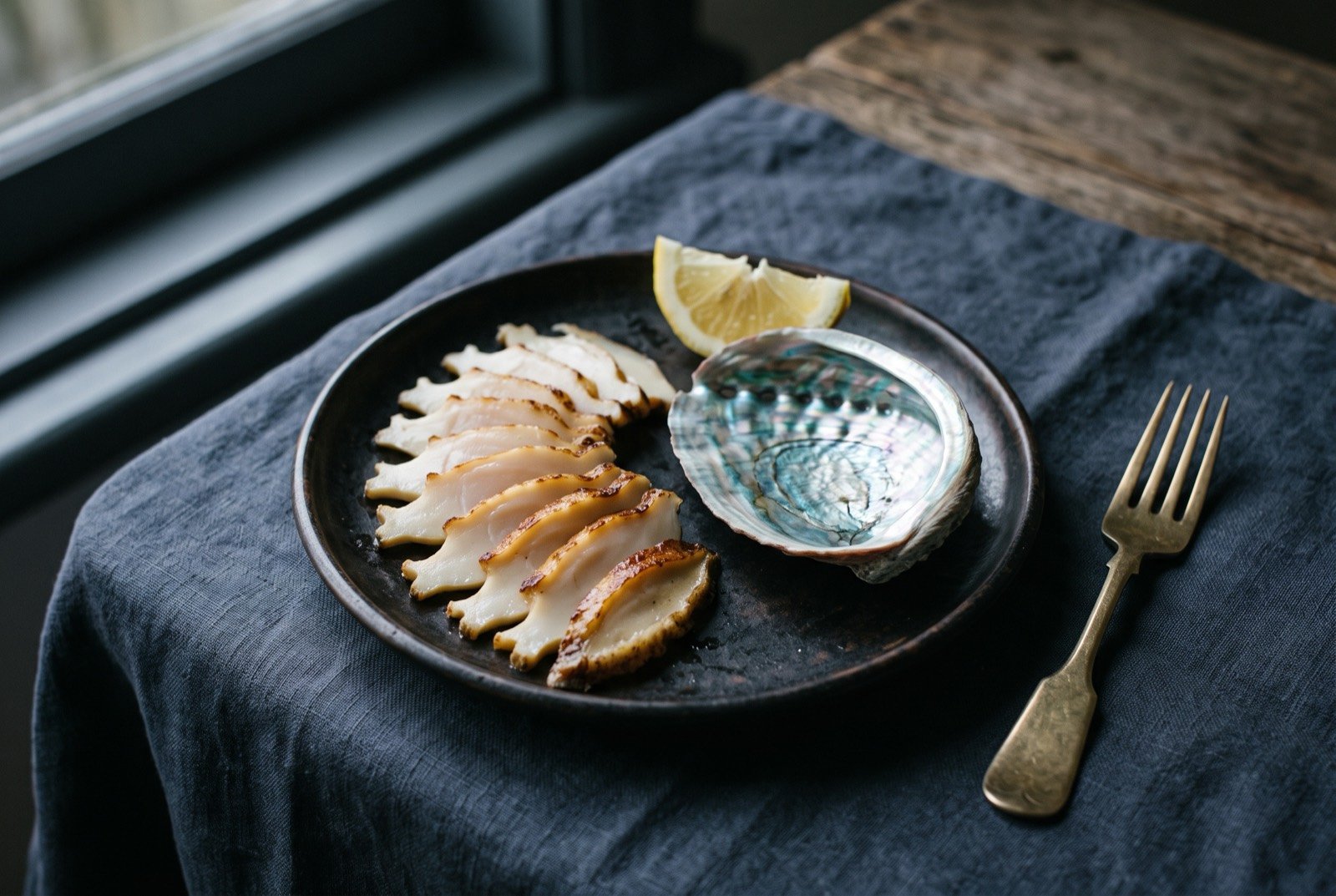
An illustration of the dish, not a photograph of it cooked.
- Time
- 20 minutes
- Reviewed
- Not yet reviewed from inside the tradition
- Cooked
- Not yet cooked and reported
Pāua is gathered from shallow rocky reef by free divers only, no breathing apparatus permitted, to leave a depth refuge where stock can recover, under a strict, tightening quota. Preparation demands real mechanical work before it is edible: the shucked meat is beaten on a board under a cloth to break down its dense muscle, then sliced thin before cooking.
As tradition built it
Serves 4 as a starter. 20 minutes.
Ingredients
- 4 pāua, shucked (or, honestly, abalone from another ocean, see Sourcing in Britain)
- to taste sea salt
- a knob butter or neutral oil
- to serve lemon, to serve
Method
- Place the shucked pāua on a board, cover with a cloth, and beat firmly on both sides and at the tough edges until visibly softened.
- Slice thinly, roughly 5 mm.
- Season with salt.
- Heat a pan until very hot, add butter or oil, and sear the slices 10 to 15 seconds a side, no longer.
- Serve immediately with lemon.
What a modern chef changes
The tenderising and the sear treated as two entirely separate, precisely controlled stages.
Rung 3.
Method
- Tenderise with a dedicated meat mallet on a marked board rather than a general kitchen surface, working systematically edge to centre for even texture rather than a few heavy, uneven blows.
- Sear on a carbon steel pan heated past smoking point for exactly the time it takes to colour, not cook through, pulling the slices the moment they show colour at the edge.
- State the substitution honestly: genuine New Zealand pāua, Haliotis iris, is not available in Britain; abalone from Australian or other waters (see Sourcing in Britain) is a real, legitimate relative worked with the same technique, but a different species with a different texture, and this chapter does not call it pāua.