The Sinosphere · Volume 30, The Red-Lees Jar, the Ten-Second Slice and a Coast Two Tongues Call Home
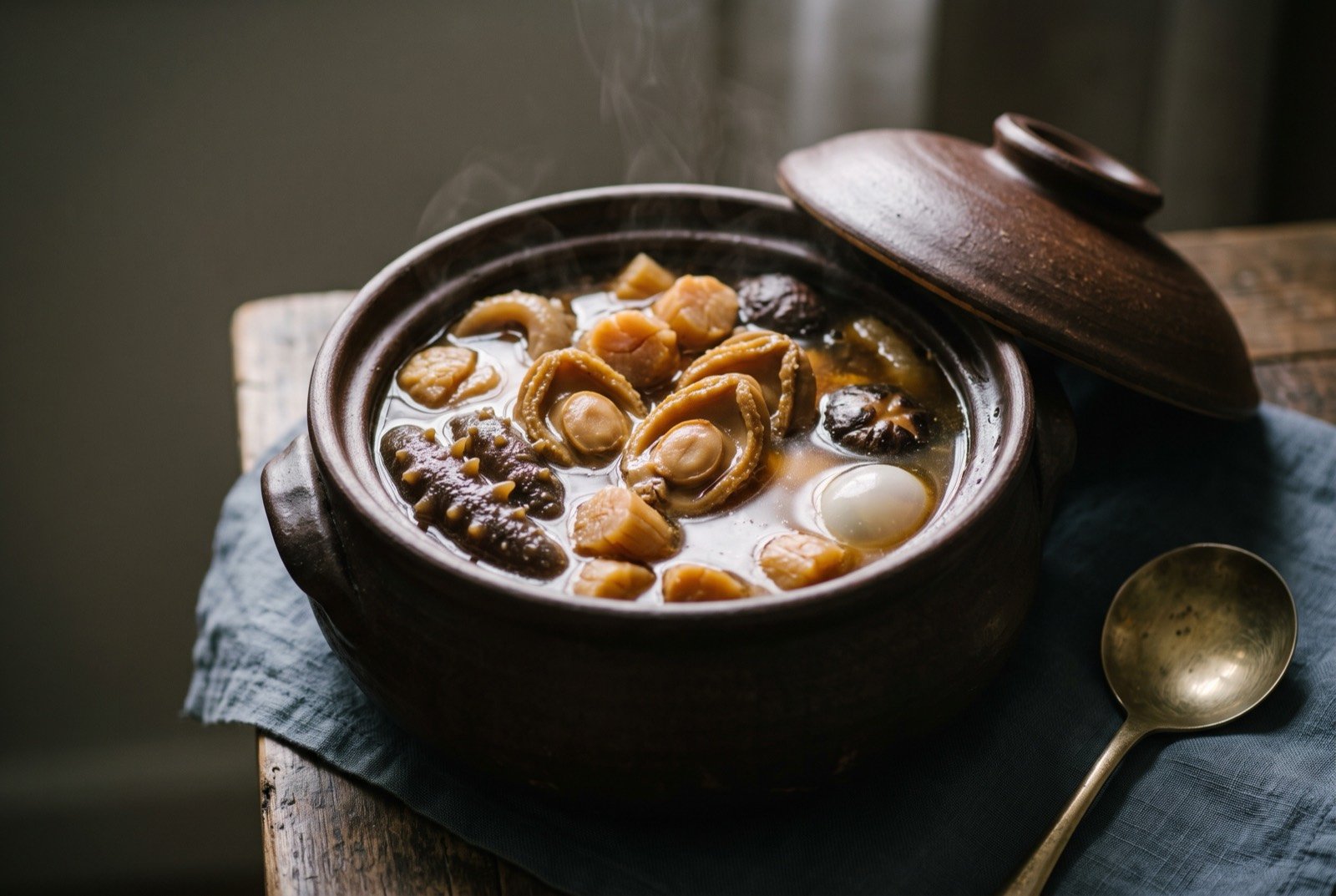
Fotiaoqiang (佛跳墙), Buddha Jumps Over the Wall
Fuzhou, Fujian
Illustration
- Time
- 18 hours
- Researched
- Researched from 80 sources in the brief
Credited to Zheng Chunfa (郑春发, 1856 to 1930), a Fuzhou chef working for the Qing official Zhou Lian, who in 1876 was so struck by a banquet dish of whole poultry with shark fin, sea cucumber and abalone that he had his own chef reproduce and refine it. Zheng shifted the balance toward seafood and perfected the sealed-jar method, later opening his own restaurant, Ju Chun Yuan, where the dish reportedly earned its name from a scholar's couplet on smelling it: even the Buddha would abandon his meditation and jump the wall to come. The technique was listed as national intangible cultural heritage in June 2008, with a documented four-generation master-apprentice lineage from Zheng Chunfa onward.
As tradition built it
A banquet dish. Stock simmers a minimum of 18 hours; the sealed jar itself simmers several hours more.
Ingredients
The method as the tradition gives it, with the ingredients named. Quantities follow as we verify them, lead dishes first.
For the stock
- about 25% of the stock's total weight free-range chicken
- about 20% of the stock's total weight pork loin bone
- about 5% of the stock's total weight dried porcini
- about 1.5% of the stock's total weight Jinhua ham, or jamón serrano cured nine to twelve months as an honest British substitute, since raw Chinese pork products cannot legally be imported
Solid components
- whole hen and duck pieces
- pig trotter
- pork spare rib
- 250g sea cucumber, soaked and rehydrated
- abalone, soaked and rehydrated
- 125g dried scallop, soaked and rehydrated
- fish maw, soaked and rehydrated
- 200g shiitake
- 500g winter bamboo shoot
- 1 whole pigeon egg
To assemble
- 10g cassia bark
- star anise
- 75g old ginger
- 2.5 litres a good Shaoxing hua diao wine
- as available a sheet of lotus leaf, to seal the jar
Method
- Build the stock first, as its own project: simmer the chicken, pork loin bone, dried porcini and Jinhua ham (or jamón serrano) a minimum of 18 hours until deeply savoury.
- Separately, soak and rehydrate each of the banquet-grade dried seafood components, the sea cucumber, abalone, dried scallop and fish maw, according to its own kind.
- Layer everything, the stock, the solid components (hen and duck pieces, pig trotter, pork spare rib, shiitake, winter bamboo shoot and pigeon egg) and the aromatics (cassia bark, star anise and old ginger), into an earthenware jar with the Shaoxing hua diao wine.
- Seal the jar's mouth with a sheet of lotus leaf, and simmer over the gentlest possible heat, traditionally charcoal, for several hours until the jar itself, opened at the table, releases the aroma the dish is named for.
Notes
The traditional Fujian 竹叶青 rice wine is essentially unobtainable outside China and should not be confused with the unrelated Shanxi herbal spirit sold under the same name.
What a modern chef changes
Sous vide precision for the stock and each protein, the sealed jar kept exactly as it is
Rung 1
Method
- Build the 18-hour stock in a pressure-clarified reduction, using a chinois to strain it glass-clear before it ever meets the jar.
- Vacuum-seal each protein separately with a portion of that clarified stock and hold it at a species-appropriate low temperature, since pork trotter needs far longer and hotter than a delicate piece of fish maw ever should.
- Keep the earthenware jar and the lotus-leaf seal exactly as they are. This dish's whole point is the sealed, undisturbed final simmer, and the elevation lies entirely in the precision of what goes into the jar, not in replacing the jar itself.